.png)
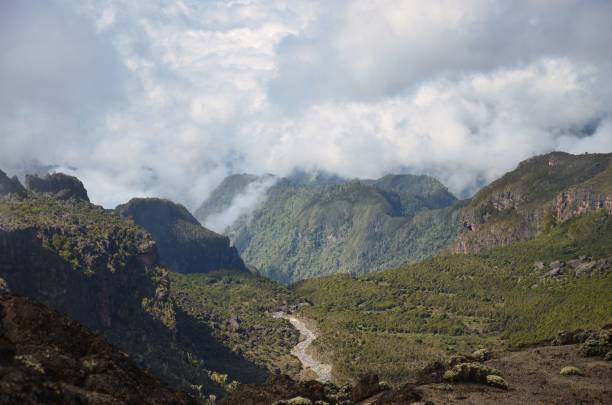
Machame Route vs Marangu Route
Coca-Cola comfort or Whiskey wild? Discover which Kilimanjaro trail tells your summit story.
When Edmund Hillary looked at Kilimanjaro, he later joked he preferred the "Coca-Cola route" because it sounded refreshing. But the nicknames aren't just playful - they reflect the soul of two very different treks. Machame, the "Whiskey Route," is a visual blockbuster: steep ravines, the infamous Barranco Wall, and campsites alive with chatter under star-lit skies. Marangu, the "Coca-Cola Route," is a gentle giant's path, famous for its comfortable sleeping huts and a lineage stretching back to the earliest colonial climbs. Choosing between them isn't just about comfort - it's about how you want to feel when you reach Gilman's Point at 5,681 meters. One route is a test of resilience, the other a test of patience. One wraps you in canvas and the other surrounds you with wood. This guide is not merely a comparison - it is a forensic examination. We map out every kilometer, every altitude shift, every dollar, and every historical whisper so that by the time you finish reading, you will know exactly which path calls your name.
I. Historical Tracks: Two Trails, Two Identities
The Marangu trail is Africa's oldest established route on Kilimanjaro. In the early 1900s, German and British colonial officers, based near the town of Moshi, commissioned local Chagga guides to cut a path through the thick southeastern rainforest. The Chagga people, who have inhabited the fertile volcanic slopes of Kilimanjaro for centuries, knew these forest corridors intimately - they had used them for generations to access hunting grounds and trade routes. By the 1930s, the colonial administration had erected the first wooden huts along the trail, making Marangu the only "civilised" climb on the mountain. These simple structures evolved into the dormitory-style accommodation that trekkers use today, each hut a living artifact of East Africa's nascent mountain tourism industry.
The "Coca-Cola" moniker that Marangu carries emerged from the 1970s and 1980s when trekking culture took on a more commercial character. Bottled Coca-Cola was sold at the mountain huts, and climbers began to associate the route with a softer, more accessible experience - one you could enjoy with a cold drink in hand, almost as if you weren't climbing a 5,895-meter volcano at all. In reality, of course, there is nothing soft about a Kilimanjaro climb, regardless of the path. The name stuck, though, and it has become one of the most recognizable route brands in global mountain tourism. For trekkers who preferred something rougher, grittier, and more adventurous, there was Machame - the "Whiskey Route," so named because it was tougher, stronger, and not for the faint of heart. The polarity of these two nicknames - a soft drink versus a hard liquor - captures the marketing genius and the cultural truth that these two routes have come to represent.
It is worth noting that the very first successful summit of Kilimanjaro in 1889 by German geographer Hans Meyer and Austrian mountaineer Ludwig Purtscheller used a path that closely mirrors what we now call the Marangu route. Their Chagga guide, Kinyala Johannes Lauwo of Ashira Marangu, is believed by local historians to have been instrumental in navigating the mountain's upper reaches. Lauwo allegedly lived to the remarkable age of 125, passing away in 1996, and his legacy runs deep through every Marangu ascent made today. The huts that trekkers sleep in along the Marangu route are not merely infrastructure - they are the direct descendants of the expedition culture that began with Meyer's party.
Machame, by contrast, began as a series of local Chagga footpaths that connected villages on the mountain's southern flank. In the 1970s and 1980s, as the park authority sought to relieve pressure on the increasingly congested Marangu, the Machame trail was formally developed into a trekking route. Adventurous porters were already using it informally as a descent line from the Shira Plateau, and the established outfitters of the time recognized its potential for spectacular scenery and a more gradual acclimatization profile. By the 1990s, Western trekking agencies had branded it the "Whiskey Route," and its ascent as one of the world's most sought-after treks had begun in earnest.
II. The Daily Rhythm: A Day-by-Day Dissection
A route is defined by its rhythm. Here we place the classic 6-day Machame against the 6-day Marangu, because the extra day on each makes all the difference. When trekkers ask about the 5-day Marangu or the 6-day Machame, they are often comparing a rushed schedule against a properly paced one - and the mountain punishes rushing.
Day 1 - Gate to Camp: The First Footfall
Machame (Machame Gate 1,800m ? Machame Camp 2,835m): Your adventure begins at Machame Gate on the mountain's southern side. The moment you step out of the vehicle, you are greeted by the unmistakable energy of the southern trailhead - dozens of porters organizing loads, guides briefing their teams, and the distant sight of the rainforest canopy disappearing into mist. The 11-km trek packs a brutal 1,035-meter elevation gain as you grind upward through dense, muddy forest. Tree roots become natural staircases, and the air is thick with the sound of colobus monkeys crashing through the canopy overhead. This is a punishing "hello" that immediately separates true trekkers from casual tourists. You will arrive at Machame Camp, perched at 2,835 meters, with your thighs burning and your heart already beginning to adapt to the altitude. The camp is a bustling city of brightly-colored tents perched on a forest ridge, and the first night under canvas is often cold and damp.
Marangu (Marangu Gate 1,860m ? Mandara Hut 2,700m): Departing from the southeastern Marangu Gate, you follow an 8-km path through some of the richest rainforest on Kilimanjaro. The gradient is gentle, gaining only 840 meters over 4 to 5 hours of steady walking. The path is wide, well-maintained, and lined with giant ferns and moss-covered trees. Blue monkeys and black-and-white colobus monkeys are frequently spotted here - the Marangu rainforest is considered one of the best wildlife-viewing zones on the entire mountain. You arrive at Mandara Hut, a cluster of comfortable A-frame wooden cabins nestled in the forest, with bunk beds that have actual mattresses, communal washrooms, and a mess hall where hot meals are served. It feels almost like a mountain lodge, and there is a genuine sense of comfort as you settle into your first night.
Day 2 - Into the Moorland
Machame (Machame Camp 2,835m ? Shira Camp 3,850m): A shorter 5-km day, but don't be deceived - the climb is relentlessly steep as the forest gives way to giant heather and moorland. You break through the treeline and the world suddenly opens, revealing the vast, windswept Shira Plateau - a collapsed volcanic caldera that is among the most geologically significant features on Kilimanjaro. The glaciers of Kibo glitter in the distance, and at 3,850 meters, the altitude begins to make its presence felt as a mild pressure behind the eyes.
Marangu (Mandara Hut 2,700m ? Horombo Hut 3,720m): A longer 12-km day, but the gradient is soothing as you traverse open moorlands dotted with giant lobelias and senecios - prehistoric-looking plants that seem to belong to another planet entirely. You arrive at Horombo Hut, the busiest camp on the Marangu route, a sprawling village of cabins with 120 bunk beds and a festive, social atmosphere. Horombo is where trekkers on the longer itinerary spend a crucial extra acclimatization night, and it is often the most memorable social experience of the climb - stories are swapped, card games are played, and the shared experience of the mountain binds strangers into a temporary family.
Day 3 - Acclimatisation: The Dividing Line
Machame (Shira 3,850m ? Lava Tower 4,630m ? Barranco Camp 3,976m): This is where the Machame route deploys its secret weapon. The day is deliberately designed around the principle of "climb high, sleep low." You ascend 10 km through an increasingly barren alpine desert to the base of Lava Tower, a 300-foot volcanic plug that rises abruptly from the scree at a staggering 4,630 meters. Here, the altitude hits hard - mild headaches are common, and your body is forced to produce additional red blood cells in a frantic physiological adaptation. But instead of sleeping at this punishing elevation, you descend 680 meters into the Barranco Valley, where giant groundsels stand like alien guardians. You sleep at a lower, safer altitude, and your body silently thanks you. This single day accounts for a significant portion of the Machame route's superior summit success rate.
Marangu (Horombo Hut 3,720m ? Zebra Rock excursion or rest ? Horombo Hut): On the wiser 6-day Marangu itinerary, this is a treasured acclimatization day. You take a short morning hike to Zebra Rock (4,100m), a distinctive striped formation, and then return to Horombo for a second night. This extra day significantly boosts summit chances, allowing your body the time it desperately needs to adjust. On the more common 5-day Marangu, however, this rest day is omitted entirely. Trekkers march directly from Horombo Hut to Kibo Hut (4,700m) on Day 3 and then attempt the summit that very same night - a rushed ascent profile that is the single biggest reason for Marangu's historically lower success rate.
Day 4 - The Barranco Wall & The Alpine Desert
Machame (Barranco Camp ? Karanga Camp 4,035m ? Barafu Camp 4,673m): The day begins with the legendary Barranco Wall - a 257-meter scramble that is not technical but is hands-on-rock fun. You wedge your boots into crevices, pull on solid volcanic rock, and after a heart-pumping 90 minutes, are rewarded with a stunning view of the southern icefields. The route then undulates across the Karanga Valley, a terrain of giant senecios and lobelias, before a steady climb to Barafu Camp - a barren, windswept moraine at the literal foot of the summit cone.
Marangu (Horombo Hut 3,720m ? Kibo Hut 4,700m): A long, 10-km slog across the alpine desert. The landscape becomes sparse, lunar, and profoundly silent. Kibo Hut is a stark stone building - less comfortable than the lower huts, but offering basic shelter. You go to bed at 6 PM because the summit push begins at midnight.
The Summit Night: The Same White-Knuckle Challenge
Both routes converge on the same final, unforgiving ascent from Kibo Hut or Barafu Camp. You'll leave at midnight, stumbling up loose scree under a canopy of stars so brilliant they feel almost hallucinatory at this altitude. The gradient is relentless, the air thin, and the cold bone-deep - temperatures can plummet to -20?C. The difference is that Machame trekkers arrive at the summit push with the benefit of the "climb high, sleep low" day at Lava Tower, their bodies subtly better prepared for the oxygen-starved final kilometre.
III. Huts versus Tents: The Daily Reality
The question of "Where will I sleep?" is often the deciding factor between these two routes. Marangu is the only Kilimanjaro path that offers permanent mountain huts, a feature that polarizes trekkers sharply. Inside each hut, you will find wooden bunk beds with thin but functional mattresses, communal dining halls alive with the chatter of climbers sharing stories, and basic flush toilets. Mandara Hut has 60 bunk beds, Horombo Hut a sprawling 120, and Kibo Hut a more austere 60. The huts are genuinely warmer than tents and provide real, solid shelter from rain and driving wind. For someone who hates the idea of camping in freezing conditions, Marangu's huts are a powerful psychological draw.
However, the huts also come with significant social trade-offs. They can be noisy at night - snoring, people moving around, early-morning summit preparation starting at 11 PM before the midnight ascent. During peak season, dormitories can be full, forcing you to share a small room with up to three strangers. Privacy is minimal, and if you are a light sleeper, the hut experience may leave you more exhausted than a tent ever would.
Machame, by contrast, means tent-life. A good outfitter - and African Majestic Adventure prides itself on this - will provide a spacious, high-quality tent with a thick foam mattress and a warm, four-season sleeping bag. Your tent becomes your private sanctuary on the mountain. You will wake to the sound of giant groundsels rustling in the wind and the warmth of a magnificent sunrise breaking across the Shira Plateau. The trade-off is elemental exposure: nights at Barranco can be bitingly cold, and a sudden rainstorm will quickly turn the campsite into a sea of slick mud. But for many climbers, the solitude and star-gazing from a tent make this the far more authentic, soulful Kilimanjaro experience.
IV. The Economics: Why Marangu is Cheaper
A 5-day Marangu trek typically costs between $1,500 and $2,200 per person, while a 6-day Machame runs from $1,900 to $3,000. The price gap isn't simply about the tents or huts - it is driven by fundamental logistical differences. Shorter Marangu itineraries mean lower park conservation fees, fewer total days of guide and porter wages, and the absence of tent-rental equipment. All of these factors make Marangu the most budget-friendly route on Kilimanjaro. However, paying less upfront can be deeply deceptive. The rushed 5-day Marangu has a documented summit success rate as low as 30%, meaning a significant number of trekkers end up paying twice - or investing even more to return another year. Machame's extra day and superior acclimatization profile represent an investment in summit success that often translates to genuine long-term savings.
- 5-Day Marangu: ~$1,500-$2,200 (lowest cost, highest risk of failure)
- 6-Day Marangu: ~$1,800-$2,500 (added acclimatization, much better success)
- 6-Day Machame: ~$1,900-$2,800 (strong value for high success)
- 7-Day Machame: ~$2,200-$3,200 (the gold standard for summit confidence)
V. Scenery & Wildlife: The Visual Verdict
Machame is widely regarded as a visual masterpiece. Over the course of 6 to 7 days, you traverse four distinct climatic zones - from steamy equatorial rainforest to desolate arctic desert. The highlights include the soaring Shira Plateau, the volcanic drama of Lava Tower, and the unforgettable scramble up the Barranco Wall. The descent follows the completely separate Mweka route, meaning every single day offers fresh, new landscapes - you never walk the same ground twice. Wildlife encounters on Machame include black-and-white colobus monkeys, blue monkeys, and a rich diversity of birdlife in the rainforest sections. On the Shira Plateau, zebras and hyenas have been sporadically observed, and smaller creatures like bushbucks, dik-diks, and mongooses are more common.
Marangu, by contrast, is a greener, softer visual experience. The lower rainforest sections are genuinely beautiful, teeming with birdlife like the silvery-cheeked hornbill and Hartlaub's turaco. However, the out-and-back nature of the route means that the descent follows the exact same path as the ascent, which can feel repetitive - you see the same views twice. Marangu lacks the volcanic intensity of Lava Tower and the Barranco Wall. What it offers instead is a gentle, steady immersion into the mountain's quieter rhythms.
What Climbers Often Ask
Are Marangu huts comfortable?
They have bunks, mattresses, and communal dining. But expect shared rooms, sometimes noisy conditions, and basic washing facilities - still the cosiest option on Kili.
Which has the higher success rate?
Machame 6-day achieves 85-90% summit success. Marangu 5-day sits around 50-60% due to poor acclimatisation. Extending Marangu to 6 days improves chances to 75-90%.
Is Marangu less scenic?
Yes, it lacks the Barranco Wall and Lava Tower drama. However, the rainforest on Marangu is richer in birdlife, and the moorland has a unique, gentle beauty.
How crowded are they?
Marangu is the busiest route and receives almost half of all trekkers. Machame's camps are spread out, but you'll still share the trail with up to 150 climbers daily in peak season.
VII. Our Verdict: The African Majestic Prescription
Choose Marangu if: you hate camping, want a lower cost, or you're a first-time hiker who prefers the psychological reassurance of four solid walls. The Coca-Cola route is not a soft climb - no path to 5,895 meters is soft - but it is the most socially comfortable, and its history is etched into every plank of its mountain huts. If you do choose Marangu, we strongly urge you to book the 6-day version; the extra acclimatization day at Horombo is not a luxury - it is a statistical necessity.
Choose Machame if: you love raw nature, crave spectacular and varied scenery, and you're willing to rough it in a tent for a significantly better chance of standing tall on Uhuru Peak. The Whiskey Route's "climb high, sleep low" acclimatization profile is smarter, safer, and more effective mountaineering. The memories of sunrise over the Shira Plateau and the sisterhood of the Barranco Wall will stay with you for a lifetime.