.png)
Marangu Route vs Lemosho Route
Coca-Cola comfort or wild western privacy? Discover which path writes a safer, more spectacular summit story.
Kilimanjaro is not one mountain with one face - it is a world of climates, histories, and human dramas. The Marangu route, rising from the south-east, is the mountain's oldest and most storied trail, famed for its comfortable huts and its Coca-Cola branding. The Lemosho route, carved out of the remote western rainforest, is the conservationist's choice: low-impact, high-success, and breathtakingly scenic. One offers the warmth of wood-lined dormitories; the other, the solitude of a tent under a canopy of stars. Choosing between them is not simply a matter of cost or comfort - it is a decision about what kind of journey you want the mountain to give you. In this guide we will dissect every day, every dollar, every altitude shift, and every enduring story so that you can step onto Kilimanjaro with absolute clarity.
I. Historical Roots: Oldest vs. Wildest
The Marangu trail is essentially Kilimanjaro's mountaineering birthplace. When German geographer Hans Meyer and Austrian mountaineer Ludwig Purtscheller made the first recorded summit of Kibo in 1889, they ascended via a route that closely approximates today's Marangu path. Their legendary Chagga guide, Kinyala Johannes Lauwo of Ashira Marangu, is believed to have been instrumental in plotting the course through the rainforest and up to the crater. Lauwo later estimated his age to be over 120, and his legacy is woven into every step of the Marangu route. By the 1930s, the colonial administration had built the first huts - simple wooden structures that gave this route its reputation as the "civilised" climb. Through the 1970s and 1980s, bottled Coca-Cola was sold at these huts, and the nickname "Coca-Cola route" was born - an ironic name for a gruelling high-altitude march.
The Lemosho route, in stark contrast, belongs to a much older and wilder story. For centuries, the western slopes of Kilimanjaro were traversed by the Maasai and Wakwavi people, who tracked elephant and buffalo through dense montane forests that European explorers rarely penetrated. This was a game trail, a hunting corridor, not a path for climbers. In the 1990s and early 2000s, as the Kilimanjaro National Park authority sought to relieve pressure on the crowded southern gates, conservation-minded operators began to formally develop the Lemosho approach. The goal was explicit: create a low-impact, high-acclimatisation route that protected the fragile western ecosystem while delivering far superior summit success. The Lemosho route we walk today is thus a deliberate fusion of ancient animal corridors, Maasai hunting paths, and modern mountaineering science.
II. The Daily Rhythm: 8-Day Lemosho vs. 6-Day Marangu
A route is defined by its rhythm. The standard 8-day Lemosho itinerary is purpose-built for maximum acclimatisation, while the 6-day Marangu (the wise version, not the risky 5-day) is the sweet spot for comfort climbers. Below we place them head-to-head so you can feel the difference in your bones.
Day 1 - Gate to Camp: The First Footfall
Marangu (Marangu Gate 1,860m ? Mandara Hut 2,700m): Departing from the bustling southeastern gate, you walk 8 km through a rich equatorial rainforest alive with the calls of turaco birds and colobus monkeys. The gradient is forgiving, gaining only 840 metres over 4-5 hours. You arrive at Mandara Hut - a cluster of A-frame wooden cabins with bunk beds and a cosy mess hall. It feels almost like a mountain hotel, and the first night is surprisingly comfortable.
Lemosho (Londorossi Gate 2,360m ? Mti Mkubwa Camp 2,895m): A 4x4 drive brings you to the remote Londorossi Gate on Kilimanjaro's far west. The trail from here is a pristine 6-km footpath through untouched montane forest, gaining only 535 metres over 3-4 hours. The forest floor is often marked by fresh elephant tracks, and the air is thick with the scent of wild jasmine. Only a handful of permits are issued per day, so you will likely share this trail with no one but your team.
Day 2 - Deeper into the Mountain
Marangu (Mandara Hut 2,700m ? Horombo Hut 3,720m): A longer 12-km day through the moorland zone, where giant lobelias rise like prehistoric sentinels. You arrive at Horombo Hut - a sprawling village of cabins with 120 beds, a true social hub on the mountain. For 6-day climbers, this is a precious acclimatisation stop.
Lemosho (Mti Mkubwa 2,895m ? Shira 1 Camp 3,610m): An 8-km day hiking along a ridge as the forest gives way to the vast Shira Plateau. The views open dramatically, and you spend the first night on the plateau at 3,610 metres, the altitude still gentle on the body.
Day 3 - Acclimatisation: The Fundamental Difference
Marangu (Horombo Hut 3,720m ? rest day at Horombo): On the 6-day itinerary, this day is dedicated to a short morning hike to Zebra Rock (4,100m), then returning to Horombo for a second night. This extra night significantly boosts summit chances, but it's still a gentle climb compared to Lemosho's active "climb high, sleep low" approach.
Lemosho (Shira 1 3,610m ? Shira 2 Camp 3,850m): Another full day traversing the plateau, reaching 3,850 metres. You are now well into the acclimatisation zone, and your body is silently producing more red blood cells. The lunar landscape of the Shira caldera, with Kibo's glaciers gleaming in the distance, is sublime.
Day 4 - Lemosho's Acclimatisation Edge
Marangu (Horombo 3,720m ? Kibo Hut 4,700m): A long, 10-km slog through the alpine desert to a stark stone hut at the literal foot of the summit cone. The altitude is oppressive, and you'll go to bed early for a midnight summit push.
Lemosho (Shira 2 3,850m ? Lava Tower 4,630m ? Barranco Camp 3,976m): This is Lemosho's masterpiece. You ascend to Lava Tower at an extreme 4,630 metres, forcing a powerful physiological response. Then you descend 650 metres to sleep in the sheltered Barranco Valley, surrounded by giant groundsels. This single "climb high, sleep low" day is one of the key reasons Lemosho's summit success rate exceeds 90%.
Day 5 onwards - The Summit Push
Marangu: You wake at midnight at Kibo Hut and begin the gruelling 6-hour trudge to Gilman's Point on the crater rim. The ascent is direct and relentlessly steep, often on loose scree, and temperatures can drop to -20?C. Many climbers turn back before reaching the summit.
Lemosho: From Barranco you scramble the iconic Barranco Wall (a thrilling, non-technical rock climb), then continue to Barafu Camp (4,673m) before your own midnight summit push. By now your body has been given the gift of time - you are far better acclimatised than any Marangu climber.
III. Huts versus Tents: Where You Lay Your Head
This is the single sharpest differentiator. Marangu is the only route on Kilimanjaro that offers permanent mountain huts. Each dormitory has bunk beds with mattresses, communal dining halls, and - most prized - basic flush toilets. The huts are warmer than tents and provide genuine shelter from rain and wind. But they also come with trade-offs: snoring dorm-mates, early-morning summit-prep noise from 11 PM, and limited privacy.
Lemosho is exclusively camping. A good outfit provides a spacious tent, a thick foam mattress, and a warm four-season sleeping bag. Your tent is your private refuge. You will fall asleep to the sound of wind in the giant heathers and wake to a sunrise staining the Shira Plateau gold. The trade-off is you are exposed to the elements, and a sudden storm makes camp life muddy and challenging. But for those who seek a raw, immersive mountain experience, tent-life is the soul of Kilimanjaro.
IV. Scenery & Wildlife: The Visual Verdict
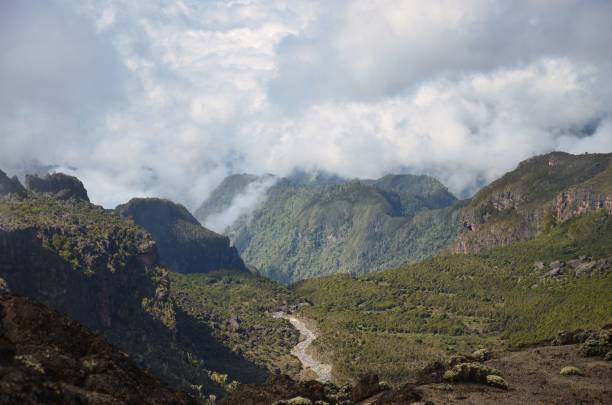
Lemosho is universally hailed as the most scenic route on Kilimanjaro. It crosses four climatic zones and includes the spectacular Shira Plateau, the volcanic drama of Lava Tower, and the thrilling Barranco Wall scramble. Because the descent follows a different path, you never walk the same ground twice. Wildlife sightings are the richest on Kilimanjaro: elephants, buffalo, colobus monkeys, and even the elusive leopard have been spotted in its remote western forest.
Marangu is a gentler, greener visual journey. The lower rainforest is particularly rich in birdlife, with silvery-cheeked hornbills and Hartlaub's turacos lighting up the canopy. However, Marangu is an out-and-back route; you descend the same path, which can feel repetitive. It also lacks the volcanic grandeur of Lava Tower and the Barranco Wall. What Marangu offers instead is a steady, historical immersion - you are walking the very path of the first pioneers.
V. The Economics: A Significant Price Gap
A 6-day Marangu trek costs roughly $1,800-$2,500; an 8-day Lemosho runs $2,800-$3,800 or more. The difference is driven by the longer itinerary, higher park conservation fees, remote 4x4 transport to Londorossi Gate, and the logistics of a full camping setup. Lemosho's price tag is higher, but it buys you a vastly superior summit success rate and the solitude of the western wilderness. Marangu's lower cost is attractive, but the 5-day version has a documented failure rate of 40-50% - meaning many trekkers end up paying twice.
- 6-Day Marangu: ~$1,800-$2,500 (huts, decent success with extra day)
- 5-Day Marangu: ~$1,500-$2,200 (risky, 50-60% success)
- 7-Day Lemosho: ~$2,500-$3,200 (good, but 8-day is better)
- 8-Day Lemosho: ~$2,800-$3,800 (the gold standard for success)
What Climbers Often Ask
Are Marangu huts shared?
Yes, dormitories sleep up to 8 people. Earplugs are recommended. The huts have bunk beds, mattresses, and communal dining rooms.
Is Lemosho too hard for beginners?
No, the 8-day Lemosho is gentler than Marangu's rapid ascent. The extra days make it ideal for first-time high-altitude trekkers.
Why is Lemosho's success so high?
The 8-day itinerary gives your body time to produce more red blood cells. The "climb high, sleep low" at Lava Tower is a proven acclimatisation strategy.
Which route is less crowded?
Lemosho is dramatically quieter - only a few groups start each day. Marangu is the busiest route, especially the huts at Horombo.
VII. Our Verdict: The African Majestic Prescription
Choose Marangu 6-Day if: you hate camping, want a lower cost, or you're a first-time high-altitude trekker who prefers the social warmth of mountain huts. Marangu's historical soul is undeniable - you are following in the footsteps of Meyer, Purtscheller, and Lauwo. But you must book the 6-day version; the 5-day is a gamble.
Choose Lemosho 8-Day if: you want the highest possible summit success, the most spectacular scenery, and the deepest wilderness immersion. Lemosho is the science-backed, ecologically sensitive choice - it is, quite simply, the best route on Kilimanjaro for those who want to stand tall on Uhuru Peak.