

.png)
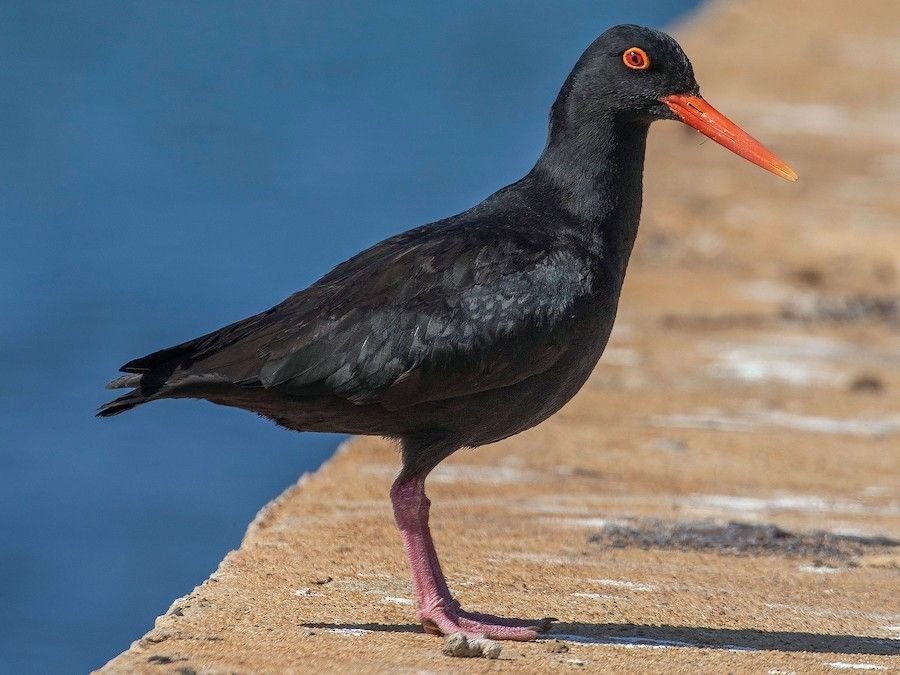
African Oystercatcher
Haematopus moquiniA powerful black coastal wader with a bright red bill and legs, perfectly adapted to rocky shores and tidal feeding grounds.
The African Oystercatcher (Haematopus moquini) is a large, sedentary shorebird of southern Africa in the family Haematopodidae. Its all-black adult plumage, strong orange-red bill and pink-red legs make it unmistakable on rocky shores, beaches, estuaries and offshore islands.
African Oystercatcher Quick Facts
What Is the African Oystercatcher?
The African Oystercatcher (Haematopus moquini) is a large coastal wader and the only oystercatcher species endemic to southern Africa. Adults are almost entirely black, with a long wedge-shaped bill in vivid red-orange and strong red legs.
The species was described in the nineteenth century and is taxonomically distinct within the genus Haematopus. Its morphology reflects a highly specialised life along the intertidal zone, where it opens or dislodges marine prey from rocks and shorelines.
Its breeding range is centred on Namibia and South Africa, while non-breeding dispersal can extend north to Angola and east into Mozambique. It is not a regular resident of Tanzania, so Tanzanian birding pages should not promise routine sightings of this species.
How to Identify an African Oystercatcher
The African Oystercatcher is one of southern Africa’s most distinctive shoreline birds. Look for the combination of an all-black adult body, a heavy red-orange bill, pink-red legs, a red eye-ring and a strong upright stance.
- Plumage: Adults are glossy to deep black over the body, neck and head.
- Bill: Long, thick and vivid red-orange, built for prying and levering marine prey from hard surfaces.
- Legs: Strong pink-red to red legs provide stability on rocks and wet sand.
- Eye: A noticeable red eye-ring surrounds the dark eye.
- Juveniles: Young birds are duller, with grey-brown plumage and less intensely coloured bills and legs.
- Structure: A large, powerful wader with a broad body, long wings and a stout, straight-backed profile.
Distinguishing from Other Oystercatchers
In the African range, the species is especially distinguished by its entirely dark adult plumage. The Eurasian Oystercatcher is black-and-white and is the more familiar comparison, while the African Oystercatcher has a more restricted southern African coastal range.
Behavior & Social Life
African Oystercatchers are strongly tied to the shoreline. Pairs defend breeding territories, while non-breeding birds may gather in suitable feeding or roosting areas. They walk deliberately across intertidal rocks and beaches, often returning to productive feeding spots.
Daily Activity
- Foraging: Searches exposed intertidal surfaces for mussels, limpets and other marine invertebrates.
- Feeding technique: Uses the powerful bill to prise, hammer or pull prey from rocks and substrate.
- Roosting: Rests above the tide line on beaches, rocks, islands and sheltered coastal points.
Movement
Adults are largely sedentary within their coastal range. Juveniles are more mobile after independence and can disperse along the coast, with documented movements extending well beyond natal areas.
Habitat & Distribution
The species is a shoreline specialist found where rocky and sandy intertidal habitat provides exposed marine invertebrate prey:
- Rocky shorelines and wave-cut platforms.
- Sandy beaches, bays and estuaries with suitable feeding surfaces.
- Offshore islands and coastal rocks that provide nesting and roosting sites.
- Sheltered lagoons and coastal inlets, especially where prey is concentrated.
Distribution: The core range runs along the coasts of Namibia and South Africa. Dispersing birds extend north into southern Angola and east to southern Mozambique, but records farther north require careful verification.
Tanzania Distribution
The African Oystercatcher is not a regular Tanzanian species. Its documented range is centred much farther south, and isolated reports outside the established range should be treated cautiously rather than used as routine safari-site recommendations.
African Oystercatcher Across Southern Africa
For reliable viewing, focus on the southern African coastline within the species’ established range. These locations are more appropriate than Tanzania for a dedicated African Oystercatcher search:
Safari & Birding Methods
The Namibian coast and offshore islands form an important part of the species’ breeding range.
Namibia coastal birdingBest Time to See Them
Long stretches of rocky coast, islands, bays and beaches support breeding and feeding birds.
Western Cape birdingEastern Cape, South Africa
The breeding range reaches the Eastern Cape, where suitable rocky and sandy coasts are important.
Eastern Cape birdingSouthern Mozambique
Dispersing birds can reach the Mozambique coast, although this lies beyond the core breeding range.
Southern Mozambique birdingSafari Methods
- Coastal birding walks at low tide, especially around rocky feeding habitat.
- Dedicated shorebird photography from a respectful distance, avoiding breeding sites.
- Intertidal scanning with binoculars or a scope around exposed rocks, bays and islands.
Best Time to See Them
Adults remain associated with the coast year-round in the core range. Low tides are especially productive for feeding observations because more intertidal surfaces and prey become accessible.
Diet & Feeding
The African Oystercatcher is a specialist intertidal predator. Its powerful, laterally compressed bill is used to open or dislodge shellfish and other marine invertebrates.
Food Sources
- Mussels and other bivalves: Important prey where dense mussel beds occur.
- Limpets and marine snails: Gathered from exposed rocks and hard shoreline surfaces.
- Worms and other invertebrates: Taken from wet sand, rock crevices and shallow shore habitat.
- Crabs and other small marine animals: Opportunistically taken when available.
Feeding Behavior
The bill acts as both a precision tool and a lever. Birds may prise shellfish from rocks, hammer at prey, or exploit openings and weaknesses in shells. Their feeding success is closely linked to tides, substrate and the distribution of marine prey.
Breeding & Life Cycle
African Oystercatchers form long-term territorial pairs and breed on undisturbed sections of coastline, including beaches, rocky ledges and islands where predators and human disturbance are limited.
Nesting
- Nest: A simple scrape or shallow depression on the ground, often among stones, sand or shell fragments above the high-tide line.
- Eggs: Usually 1–2 eggs are laid, with both adults investing in territorial defence and incubation.
- Incubation: Both parents contribute to incubation and protection, with timing coordinated around the coastal breeding season.
Chicks
Chicks are mobile soon after hatching and are guarded by their parents while they learn to forage. Family groups remain associated with suitable shoreline habitat until the young can feed and survive independently.
Conservation Status
The African Oystercatcher is currently assessed globally as Least Concern, although its restricted coastal distribution makes local habitat quality and disturbance important conservation considerations.
The species has benefited from conservation management in parts of southern Africa, including protection of breeding sites and reduced disturbance on some beaches and islands. Population increases have been documented over recent decades, but the bird remains dependent on healthy, accessible intertidal habitat.
Key local pressures can include:
- Coastal disturbance: People, vehicles, dogs and recreation can disrupt feeding and breeding birds.
- Habitat change: Coastal development and changes to intertidal prey resources can reduce suitable habitat.
Comparisons
The African Oystercatcher is best separated from other shoreline waders by its all-black adult plumage, heavy red bill, red legs and restricted southern African coastal range.
| Feature | African Oystercatcher | Eurasian Oystercatcher | Black-winged Stilt |
|---|---|---|---|
| Size | 42–45 cm | 39–44 cm | 35–40 cm |
| Bill | Heavy, red-orange | Long, orange-red with dark tip | Straight, thin |
| Adult plumage | Entirely black | Black-and-white | Black-and-white |
| Legs | Red | Pink-red | Long pink-red |
| Habitat | Rocky/sandy southern African coast | Temperate/subarctic coasts and estuaries | Freshwater and saline wetlands |
| Diet | Rodent specialist | Reptiles, small mammals | Large gamebirds, mammals |
Did You Know?
Coastal Specialist
It is so closely tied to the shoreline that almost every part of its ecology is shaped by tides, surf and intertidal prey.
Only Southern African Endemic
It is a distinctive southern African oystercatcher with a breeding range centred on Namibia and South Africa.
Powerful Bill
Its stout bill is specialised for prising, hammering and handling hard-shelled marine prey.
Sedentary Adults
Adults are largely sedentary, holding coastal territories and feeding repeatedly in familiar intertidal areas.
Mobile Juveniles
Young birds can disperse widely after independence, sometimes travelling far beyond their natal coastline.
Conservation Success
Long-term conservation work and reduced disturbance at some breeding sites have contributed to population recovery.
At low tide, the African Oystercatcher reveals why coastal adaptation is so powerful. A black bird steps across wave-washed rocks, testing mussels and limpets with a remarkable red bill. Its world is ruled by the tide, and its survival depends on quiet shorelines where feeding, nesting and raising young can happen without constant disturbance.
Gallery
Frequently Asked Questions
The African Oystercatcher (Haematopus moquini) is a large black coastal wader of the family Haematopodidae, recognised by its red-orange bill and red legs.
It is resident mainly along the coasts of Namibia and South Africa, with dispersal extending into southern Angola and southern Mozambique.
Its main foods include mussels, limpets, marine snails, worms, crabs and other intertidal invertebrates.
It is currently assessed globally as Least Concern, although coastal disturbance and habitat change remain important local conservation issues.
Look for an all-black adult body, a heavy red-orange bill, red legs, a red eye-ring and a large upright coastal-wader shape.
Pairs defend territories and usually nest on the ground in a shallow scrape above the high-tide line; both adults participate in incubation and chick care.
No. It is not a regular Tanzanian species. Its established range is centred on southern Africa, so routine Tanzania sightings should not be advertised without strong verification.
Year-round viewing is possible in the core coastal range, with low tide often giving the best feeding views.
References & Further Reading
- BirdLife International – African Oystercatcher (*Haematopus moquini*): conservation assessment and range information.
- NAMCOB Red Data Book – African Oystercatcher: southern African range, habitat, population and threats.
- International Wader Study Group – conservation assessment of African Black Oystercatcher: breeding range, dispersal and population trends.
- Wetlands International – Atlas of Wader Populations: southern African distribution and population information.
- ITIS – *Haematopus moquini*: current taxonomic standing and nomenclature.
- Oiseaux.net – African Oystercatcher: identification, biometrics and current reference summary.
- BirdLife South Africa – African Black Oystercatcher conservation history and coastal management context.