

.png)
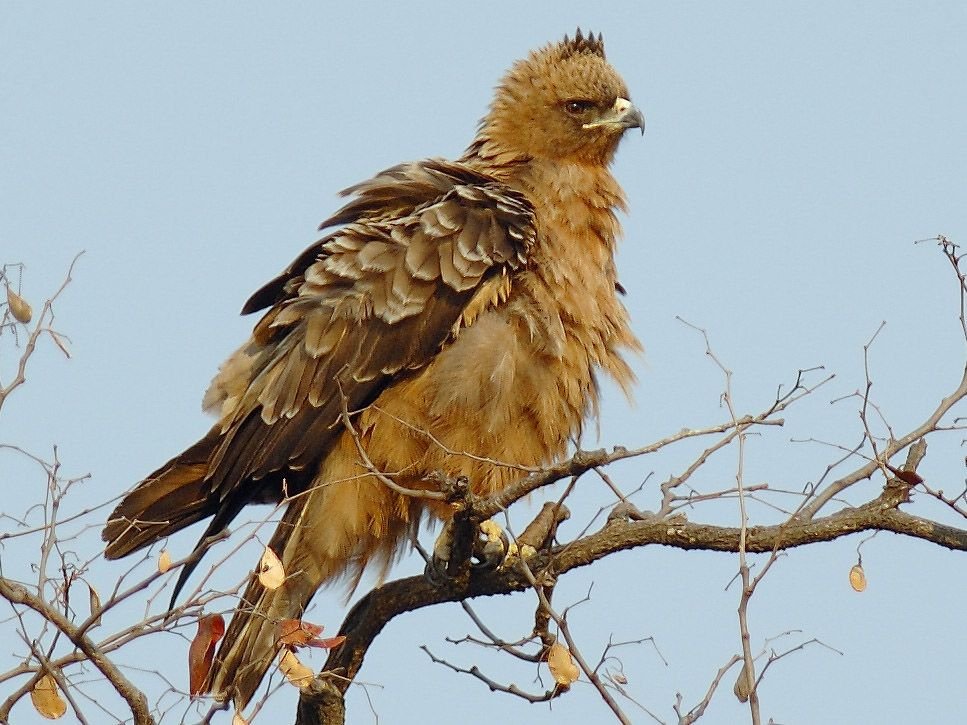
Wahlberg's Eagle
Hieraaetus wahlbergiA small brown eagle of the African savanna, known for its long-distance migrations.
Wahlberg's Eagle (Hieraaetus wahlbergi) is a medium-sized bird of prey in the family Accipitridae . It is a relatively small brown eagle with a wingspan of 130-146 cm and a length of 53-61 cm . This species is found in woodlands and savannas across Sub-Saharan Africa, and is notable for its remarkable migratory behavior .
Wahlberg's Eagle Quick Facts
What Is Wahlberg's Eagle?
Wahlberg's Eagle (Hieraaetus wahlbergi) is a medium-sized bird of prey in the family Accipitridae . It is a relatively small brown eagle with a wingspan of 130-146 cm and a length of 53-61 cm .
The species was described by the Swedish naturalist Carl Jakob Sundevall in 1850, and named in honor of Johan August Wahlberg, a Swedish naturalist who collected specimens in Africa .
It is a common raptor of African woodlands and savannas, often overlooked due to its relatively plain brown plumage, but it is a skilled hunter and notable for its long-distance migrations .
How to Identify a Wahlberg's Eagle
Wahlberg's Eagle is a smallish, uniformly brown eagle, often seen perched on a prominent branch or soaring on flat wings .
- Plumage: Mostly dark brown, but highly variable, from pale buff to dark brown .
- Head: Small, with a short crest on the nape .
- Bill: Small, with a yellow cere .
- Legs: Yellow legs .
- Eyes: Dark brown eyes .
- Tail: Long, with a faint darker subterminal band .
- In flight: Wings are long and broad, often held flat. It soars with a distinctive "kite-like" profile .
Distinguishing from Other Eagles
It can be confused with the Tawny Eagle and Steppe Eagle, but is smaller, more slender, and has a longer tail . The crown is always darkest, and its small size and long tail help separate it from these larger brown eagles .
Behavior & Social Life
Wahlberg's Eagle is a solitary and territorial bird, but is often seen perched on a favorite tree in its home range .
Daily Activity
- Hunting: It hunts from a perch, swooping down to catch prey on the ground .
- Soaring: Frequently seen soaring on flat wings, especially during the heat of the day .
- Vocalization: Calls are infrequent, but include a high-pitched "wee-oh" or a series of "kek-kek-kek" notes .
Migration
Wahlberg's Eagle is a partial migrant. Southern African populations migrate north to West and Central Africa during the austral winter, leaving breeding grounds in March-April and returning in September-October . This migration is one of the longest of any African eagle .
Habitat & Distribution
Wahlberg's Eagle is found in a variety of open habitats :
- Wooded savanna and acacia woodland .
- Forest edges and riparian forest .
- Cultivated areas and grasslands .
- Scrubland and semi-arid regions .
Distribution: The species has an extremely large range, with an Extent of Occurrence of approximately 14,800,000 km² . It is found throughout Sub-Saharan Africa, from Senegal and Ethiopia in the north to South Africa in the south .
Tanzania Distribution
In Tanzania, Wahlberg's Eagle is found in most national parks and game reserves, including Tarangire, Serengeti, Ruaha, and Nyerere (Selous) .
Wahlberg's Eagle in Tanzania
Wahlberg's Eagle is a common raptor of Tanzania's woodlands and savannas. Here are the best locations to see it:
Tarangire National Park
Confirmed sightings in the park's acacia woodlands and savannas .
Tarangire safariNyerere (Selous) Game Reserve
A large and important stronghold for the species in southern Tanzania .
Nyerere safariSerengeti National Park
Widespread in the Serengeti's grassland and woodland mosaics .
Serengeti safariSafari Methods
- Game drives through woodland and savanna habitats.
- Birdwatching – watch for soaring birds during the heat of the day .
- Wildlife photography – their distinctive shape and flight make them rewarding subjects.
Best Time to See Them
Wahlberg's Eagle is present in Tanzania year-round, though resident populations are augmented by migrants from southern Africa during the wet season .
Diet & Feeding
Wahlberg's Eagle is a carnivore with a varied diet .
Food Sources
- Reptiles: Lizards, chameleons, and snakes .
- Small mammals: Rodents, hares, and squirrels .
- Birds: Small to medium-sized birds, including pigeons and gamebirds .
- Insects: Locusts and grasshoppers, especially in the dry season .
Hunting Behavior
It hunts from a perch, scanning the ground below, then swoops down to capture prey . It is also known to hunt on the ground, walking among tall grass to flush insects and small animals .
Breeding & Life Cycle
Wahlberg's Eagle is a monogamous and territorial bird .
Nesting
- Nest: A large stick nest placed in the fork of a tall tree, often a flat-topped acacia .
- Eggs: 1-3 white eggs .
- Incubation: About 43-46 days, performed mainly by the female .
Chicks
Chicks fledge at approximately 70 days, but remain dependent on the parents for several more weeks . The breeding season coincides with the wet season, ensuring abundant food supply for the growing chicks .
Conservation Status
Wahlberg's Eagle is assessed as Least Concern on the IUCN Red List .
It has an extremely large range (Extent of Occurrence of approximately 14,800,000 km²) and does not approach the thresholds for Vulnerable. The population is suspected to be stable .
Despite its secure status, it faces some local threats:
- Habitat loss due to deforestation and agricultural expansion .
- Persecution in some areas, though it is generally tolerated .
- Electrocution on power lines in some regions .
Comparisons
Wahlberg's Eagle is sometimes confused with other brown eagles. Here are the key differences:
| Feature | Wahlberg's Eagle | Tawny Eagle | Steppe Eagle |
|---|---|---|---|
| Size | 53-61 cm | 65-72 cm | 62-81 cm |
| Wingspan | 130-146 cm | 165-185 cm | 165-210 cm |
| Tail | Long | Short | Short |
| Habitat | Woodland, savanna | Open savanna, arid | Grassland, steppe |
| Migration | Partial migrant | Resident | Migratory |
| Plumage | Uniform brown | Brown with pale head | Brown with pale nape |
Did You Know?
Long-Distance Migrant
Some populations migrate over 7,000 km between breeding and wintering grounds .
Species Name
It is named after the Swedish naturalist Johan August Wahlberg .
Variable Plumage
Plumage is highly variable, from pale buff to dark brown .
Lizard Hunter
In many areas, reptiles, especially lizards, are its primary prey .
Kite-Like Flight
Its long wings and tail give it a kite-like profile in flight .
Water-Carrier
Males have been observed carrying water to nestlings in their crop during hot weather .
There is a quiet reliability in the Wahlberg's Eagle. It is not the largest or flashiest eagle, but it is a constant presence over Africa's woodlands, a small brown silhouette on a branch or a soaring shape in the sky. Its long-distance migration, undertaken twice a year, is one of the great journeys of the raptor world. Watching one drift over the savanna is to see a bird that is both familiar and extraordinary.
Gallery
Frequently Asked Questions
Wahlberg's Eagle (Hieraaetus wahlbergi) is a medium-sized bird of prey in the family Accipitridae. It is a relatively small brown eagle with a wingspan of 130-146 cm and a length of 53-61 cm .
Wahlberg's Eagle is found in woodlands, savannas, and forest edges across Tanzania. Key locations include Tarangire National Park , Selous Game Reserve (Nyerere) , Ruaha National Park , and Serengeti National Park .
It feeds mainly on reptiles (lizards, snakes), small mammals, birds, and insects. It hunts from a perch and takes prey on the ground .
No. Wahlberg's Eagle is listed as Least Concern on the IUCN Red List, with an extremely large range and stable population trend .
Wahlberg's Eagle is notable for being a migratory species in parts of its range, breeding in southern Africa and wintering in West and Central Africa. This long-distance migration is remarkable for an eagle .
It builds a stick nest in a tall tree, often a flat-topped acacia, and lays 1-3 white eggs. The female incubates for about 43-46 days, and chicks fledge at approximately 70 days .
It is a smallish, uniformly brown eagle with a small head, long tail, and yellow legs. It is often seen perched on a branch or soaring on flat wings .
Yes, it is present in Tanzania year-round, though resident populations are augmented by migrants from southern Africa during the wet season .
References & Further Reading
- BirdLife DataZone – Wahlberg's Eagle species factsheet: IUCN Least Concern, Extent of Occurrence, range, threats .
- Wikipedia – Wahlberg's eagle: Scientific name, description, taxonomy, distribution, habitat, diet, migration, breeding .
- eBird – Wahlberg's Eagle: Identification, vocalization, range .
- Birds of the World (Kemp & Marks, 2020) – Wahlberg's Eagle: Detailed species account, measurements, diet, breeding .
- Raptors of the World (Ferguson-Lees & Christie, 2001) – Wahlberg's Eagle: Identification, flight, behavior .
- Oiseaux.net – Wahlberg's Eagle: Confirmed photo records from Tanzania .
- iNaturalist – Wahlberg's Eagle observation records from Tanzania .