

.png)
Violet Turaco
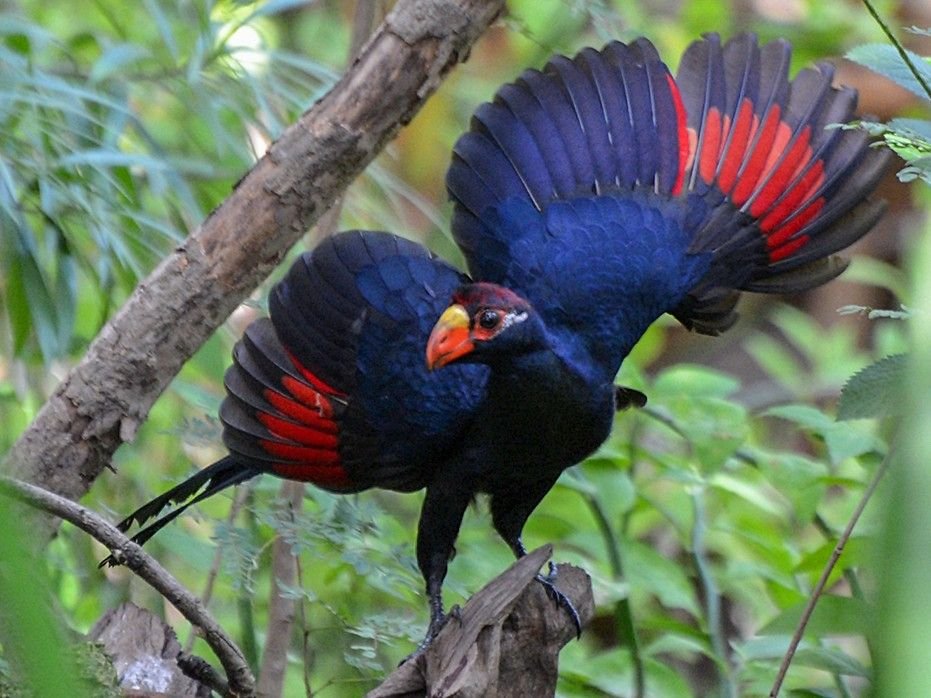
Musophaga violaceaA spectacular violet turaco of West African forests, flashing crimson wings through the canopy.
The Violet Turaco (Musophaga violacea) is a large, striking member of the turaco family Musophagidae. Glossy violet plumage, a yellow forehead, white ear coverts and a bold red-and-yellow bill make it distinctive. It is a resident of West Africa, using forests, gallery woodland and lush wooded habitats where fruiting trees provide much of its food.
Violet Turaco Quick Facts
What Is the Violet Turaco?
The Violet Turaco (Musophaga violacea), also known as the Violaceous Turaco or Violet Plantain-eater, is a large arboreal bird in the family Musophagidae. Its glossy violet body, crimson flight feathers, yellow forehead, white ear patch and red-and-yellow bill create one of the most dramatic colour combinations in the West African canopy.
It spends most of its time in trees, hopping along branches and moving between fruiting plants. When it flies, the bright crimson wing panels contrast sharply with the dark violet body. It is primarily a fruit-eater and is closely tied to productive woodland and forest habitats.
Modern authorities can differ in the genus used for this species: BirdLife sources retain Musophaga violacea, while some birding taxonomies use Tauraco violaceus. The page follows the BirdLife-style name while noting the alternate treatment.
How to Identify a Violet Turaco
Look high in leafy trees for a large bird with glossy violet-purple plumage and a distinctive red-and-yellow bill. The facial pattern is especially useful when the bird is partly hidden in foliage.
- Plumage: Glossy violet to deep purple over most of the body.
- Forehead: Bright yellow, contrasting with the darker crown.
- Crown: Rich chestnut to red at the rear of the head.
- Face: White ear coverts and red bare skin around the eye.
- Bill: Large and vividly coloured red and yellow.
- Wings: Crimson flight feathers flash strongly in flight.
Distinguishing from Other Turacos
Its purple body can resemble other vividly coloured turacos at a distance, but the combination of yellow forehead, white ear patch and red-and-yellow bill is especially diagnostic. The crimson wing panels are a useful confirmation when the bird takes flight.
Behavior & Social Life
Violet Turacos are social canopy birds that may travel in small groups. They can be surprisingly hard to see because they remain inside dense foliage and move deliberately between branches and fruiting trees.
Daily Activity
- Feeding: Searches fruiting trees and shrubs for figs and other soft fruits.
- Movement: Hops and runs along branches; flight consists of short bursts followed by glides.
- Vocalization: Loud rolling or rattling calls can reveal a group before the birds become visible.
Migration
The Violet Turaco is resident across its range rather than a long-distance migrant. Local movements may track seasonal fruiting and changes in food availability.
Habitat & Distribution
The species favours wooded habitats with mature canopy, cover and reliable fruit resources. Its range includes several related habitat types:
- Evergreen and semi-evergreen forest.
- Gallery forest and river-associated woodland.
- Forest edge, secondary woodland and lush savanna mosaics.
- Wooded wetlands and gardens with suitable fruiting trees.
Distribution: The species has an extremely large range, with an Extent of Occurrence of approximately 14,800,000 km² . It is found throughout Sub-Saharan Africa .
Geographic Distribution
The Violet Turaco is centred in West and west-central Africa, from the Senegambia region through Guinea-Bissau, Guinea, Sierra Leone, Liberia, Côte d’Ivoire, Ghana, Togo, Benin and Nigeria, with isolated populations farther east in Chad and the Central African Republic. It is not a regular Tanzanian species.
Violet Turaco in Its Natural Range
The most appropriate places to seek Violet Turaco are forest and gallery-woodland landscapes in West Africa. The examples below are range-based birding destinations, not Tanzanian safari claims.
Kakum National Park, Ghana
Humid forest canopy and forest-edge habitat provide suitable conditions for West African turacos.
Ghana forest birdingTaï National Park, Côte d’Ivoire
One of West Africa's major remaining forest blocks, offering extensive mature forest and canopy bird habitat.
Taï forest birdingGola Forest, Sierra Leone & Liberia
Large Upper Guinean forest landscapes preserve dense canopy habitat important to forest birds.
Gola forest birdingGhana forest belt
Forest reserves, gallery woodland and lush wooded landscapes across Ghana remain within the species' West African range.
Ghana birdingSafari Methods
- Canopy scanning — spend time checking fruiting trees and shaded branches.
- Listening — use the species' rolling calls to locate hidden groups.
- Photography — observe flight paths and fruiting trees where crimson wings may flash into view.
Best Time to See Them
As a resident species, the Violet Turaco can be seen year-round in suitable habitat. Early morning and late afternoon are productive for calling activity, while fruiting trees can concentrate feeding groups at other times.
Diet & Feeding
The Violet Turaco is primarily frugivorous, taking fruit from trees and shrubs and showing a particular association with figs. Plant material and small animal foods supplement the diet.
Food Sources
- Fruit: Figs and other soft fruits are the main food resource.
- Plant material: Leaves, buds and flowers may be eaten when available.
- Invertebrates: Insects, snails and similar small foods are taken opportunistically.
- Seasonal foods: Feeding may shift with local fruit availability.
Feeding Behavior
It feeds in the canopy, plucking fruit while moving along branches and sometimes gathering with other turacos where a tree is fruiting heavily. Its strong bill helps it handle a range of larger soft fruits.
Breeding & Life Cycle
Breeding is associated with periods of favourable food and seasonal rainfall. A pair maintains a close territory within wooded habitat and both adults participate in raising the young.
Nesting
- Nest: A loose, flimsy platform of sticks placed in a tree.
- Eggs: Usually 2 eggs.
- Incubation: Roughly 3–4 weeks, with both adults involved in care.
Chicks
The young remain dependent on the adults after hatching while they develop and learn to move through the canopy. They can become capable of flight at around one month, with independence developing later.
Conservation Status
BirdLife's 2025 regional Red List update moved the Violet Turaco from Least Concern to Near Threatened. The change reflects growing concern about its regional population and continuing pressure on forest habitats.
The species remains broadly distributed in West Africa, but habitat conversion, fragmentation and trapping can reduce local populations. Protecting mature forest and maintaining connected woodland corridors are important conservation measures.
Key conservation pressures include:
- Forest loss and fragmentation from agricultural expansion and other land-use change.
- Hunting and trapping for food or the wild-bird trade in parts of its range.
Comparisons
The Violet Turaco is best separated from other large turacos by its purple plumage, facial pattern and distinctly red-and-yellow bill.
| Feature | Violet Turaco | Great Blue Turaco | Purple-crested Turaco |
|---|---|---|---|
| Size | About 48 cm | About 70–75 cm | About 40–44 cm |
| Plumage | Glossy violet-purple | Blue-green, darker head and crimson wings | Green with purple crest |
| Bill | Red and yellow | Large pale bill | Red |
| Head pattern | Yellow forehead, red crown, white ear patch | Blue-green head | Purple crest |
| Habitat | West African forest and gallery woodland | African lowland forest | Woodland and forest edges |
| Diet | Mainly fruit, especially figs | Fruit and other forest foods | Fruit and plant foods |
Did You Know?
Purple Plumage
Its deep violet plumage is one of the most spectacular colour patterns among African turacos.
Two-coloured Bill
The large bill combines red and yellow, making it a valuable field mark.
Crimson Wings
When it flies, bright crimson wing feathers flash against the darker body.
Fruit Specialist
Figs and other fruits form the core of its diet.
Canopy Specialist
It often stays high inside foliage, where its brilliant colours can remain surprisingly concealed.
Resident Turaco
It is resident rather than migratory, although local movements can follow food availability.
A Violet Turaco can seem to materialize from the forest itself: a rich violet body, a bright two-coloured bill and a sudden crimson flare of the wings. Finding one is often less about chasing movement than listening, watching fruiting trees and giving the canopy time to reveal its hidden specialist.
Gallery
Frequently Asked Questions
The Violet Turaco (Musophaga violacea) is a large West African turaco with glossy violet plumage, a yellow forehead, white ear patch and red-and-yellow bill.
It occurs in West and west-central Africa, especially in forest, gallery woodland and other lush wooded habitats. It is not a regular Tanzanian species.
It eats mainly fruit, especially figs, with leaves, buds, flowers and occasional invertebrates supplementing the diet.
BirdLife's 2025 regional assessment lists it as Near Threatened; habitat loss, fragmentation and trapping are important concerns.
Look for glossy violet-purple plumage, a yellow forehead, white ear patch, red bare eye skin and a large red-and-yellow bill.
No. It is considered resident across its range, although local movements can follow fruiting trees and food availability.
It builds a loose stick nest in a tree, usually lays two eggs and is cared for by both adults. Young can become capable of flight at about one month.
Despite its bright colours, it often stays within dense canopy and moves quietly. Its rolling calls may reveal it before it is visible.
References & Further Reading
- BirdLife International – 2025 Red List status changes: Violet Turaco (Musophaga violacea) moved from Least Concern to Near Threatened in the regional assessment.
- BirdLife DataZone – current taxonomy framework and conservation assessment methodology for birds.
- eBird – Violet Turaco identification, habitat and distribution information; some current birding taxonomies use Tauraco violaceus.
- American Museum of Natural History – Phylogeography, species limits, phylogeny and classification of turacos.
- Oiseaux.net – Violet Turaco distribution and sedentary status.
- Tanzanian Birds & Butterflies – regional reference consulted to avoid incorrectly presenting this West African species as a Tanzanian bird.
- iNaturalist – Violet Turaco observation records from Tanzania .