

.png)
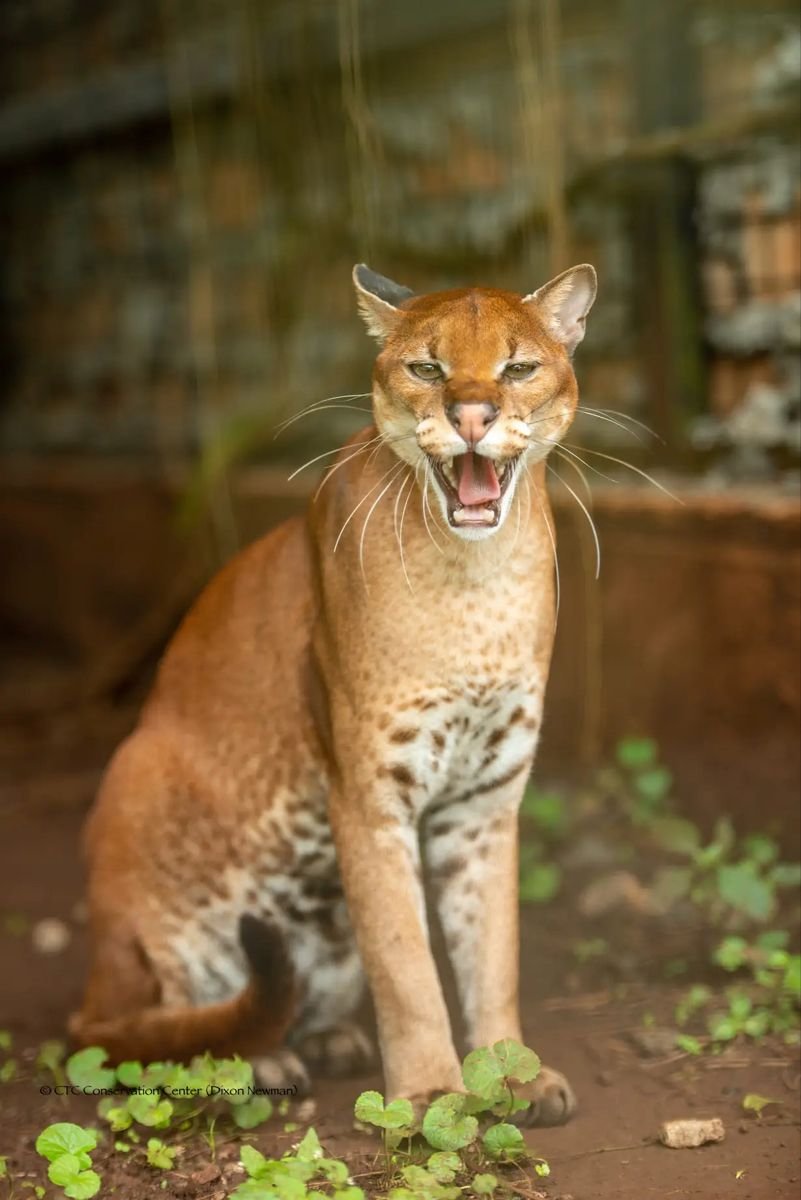
African Golden Cat
Caracal aurataAfrica’s elusive master of the forest.
Sightings are never guaranteed and depend on local conditions. Follow your guide and respect park rules.
Rare, solitary and remarkably difficult to observe, the African golden cat is one of the least-known wild cats on the continent. Its reddish-gold, gray or dark coat disappears effortlessly into the forest understory, where it hunts rodents, small antelope and other prey. From Uganda’s mountain forests to Tanzania’s Minziro Nature Forest Reserve, this secretive feline remains one of Africa’s most intriguing conservation species.
African Golden Cat Quick Facts
What Is an African Golden Cat?
The African golden cat is a medium-sized wild cat strongly associated with Africa’s moist forests. It is one of the least-known felids on the continent because it is elusive, difficult to observe and historically difficult to study. Importantly, it is a medium-sized wild cat, not one of Africa’s traditional “big cats.”
Modern molecular research places it in the genus Caracal, making it more closely related to the caracal and serval than to the visually similar Asiatic golden cat. It can occur in montane, bamboo, secondary and coastal forests and at the edges of wooded savanna, but savanna is not its core habitat — it is fundamentally a forest-dependent species.
Why Is It Called a Golden Cat?
The name comes from the warm reddish-gold coat worn by many individuals — although the species also occurs in gray, brown and near-black (melanistic) forms, so “golden” describes just one of its remarkable colour phases rather than the whole species.
Compact & muscular
A compact body with relatively short legs, a small head and a short tail built for moving through dense cover.
Extreme coat variation
From reddish-gold to gray, brown or melanistic — IUCN CatSG notes high variation across its range.
Pale facial markings
White areas around the eyes and cheeks, plus a white throat and chest, make its face distinctive.
Solitary
Camera-trap evidence confirms it is a solitary animal; adults mostly meet in reproductive contexts.
Cathemeral
Active in both day and night; often most active after dark, with peaks around 19:00, 22:00 and 03:00.
Physical Adaptations
The African golden cat has a compact, muscular body with relatively short legs and a small head relative to its body. Its dense coat can range from reddish-brown through golden-brown, gray and dark brown, and individuals may be plain, lightly spotted or heavily spotted.
Why Is It Not Always Golden?
Despite its name, the species isn’t always golden. It displays three broad morphs: a golden/reddish-brown morph, a gray/silver morph, and a dark/melanistic morph (melanistic individuals occur in some populations, reported at around 5% where recorded). This remarkable variation is a strong SEO and education angle.
Size
The IUCN Cat Specialist Group gives weight approximately 7–16 kg, head-and-body length approximately 65–90 cm, and tail length approximately 28–35 cm. (These replace less authoritative older figures such as 5–14 kg and 61–101 cm.)
How Fast Can It Run?
The IUCN Cat Specialist Group does not provide a reliable maximum-speed figure, and the literature stresses how little is known about its behavior. Rather than invent a number, the accurate statement is: top speed is not reliably established. That honestly distinguishes known facts from poorly documented biology.
Lifespan
Wild longevity is poorly known. The IUCN CatSG gives “up to approximately 12 years,” while captive records (Animal Diversity Web) report averages around 15 years and some individuals living longer. So the best wording is: wild lifespan is poorly known; captive individuals have lived for more than a decade. Do not claim “12–15 years in the wild.”
Where Does the African Golden Cat Live?
The African golden cat is strongly associated with moist forest. Preferred habitats include tropical rainforest, equatorial forest, montane forest, bamboo forest, secondary forest, coastal forest, dense forest edges, riverine forest and some wooded savanna bordering forest. The IUCN CatSG describes it as forest-dependent and strongly associated with moist forests.
Altitude
The species can occur at surprisingly high elevations — in Uganda it has been recorded up to approximately 3,600 metres, making it more ecologically flexible than a purely lowland forest cat.
Why Forests Matter
Forest provides cover, prey, hunting opportunities, denning areas, movement corridors and protection from human disturbance. This dependence makes habitat fragmentation particularly concerning.
African Golden Cat in Tanzania
A confirmed population has been documented in Minziro Nature Forest Reserve, northwestern Tanzania. A 2018 camera-trapping survey recorded 33 detection events at 26% of camera-trap sites, with a minimum of 10 individual cats identified across 257 km². Occupancy increased with increasing distance from the forest edge, suggesting human disturbance and habitat-edge effects influence where golden cats occur. Researchers concluded Minziro is an important site for African golden cat conservation.
Important Tourism Warning
We should not market Minziro as “go and see African golden cats.” The species is rarely seen, elusive, forest-dependent, poorly studied and primarily detected through camera traps — the Tanzania study itself used 70 camera traps. Therefore: African golden cat sightings in Tanzania are exceptionally rare and should not be guaranteed or marketed as a conventional safari attraction.
Camera Traps
The golden cat is so elusive that camera traps are among the most important research tools. The Minziro survey used 70 camera traps and identified multiple individuals — showing visitors that you don’t need to physically see an animal for science to know it exists in an ecosystem.
Where Can You See an African Golden Cat on Safari?
Its distribution is strongly tied to suitable forest across equatorial Africa: West Africa (Upper Guinean forests), Central Africa (especially the Congo Basin), and East/Central-East Africa including Uganda, Kenya and Tanzania. IUCN CatSG describes its range across equatorial Africa from West Africa through the Congo Basin toward Uganda, with confirmed Kenyan records also documented.
Uganda
Uganda is important for research. A golden cat was photographed in Kibale National Park (2008) and observed in Bwindi Impenetrable National Park (2009, catching a small mammal on a road); camera-trapping has since produced many more detections. But “documented there” is not the same as “easy to see there.”
Activity Pattern
The species is cathemeral — active during both daylight and darkness. Tanzanian research found activity mainly at night, with peaks around 19:00, 22:00 and 03:00, but individuals were also detected by day, and patterns shift with leopard presence and conditions. Rigid “6–10 AM / 10–3 PM / 3–6 PM” schedules don’t apply — wild golden cats don’t follow them.
African Golden Cat Behavior
Camera-trap evidence confirms African golden cats are solitary. Adults generally encounter one another primarily in reproductive contexts rather than forming permanent family groups. Unsupported claims such as “bachelor groups,” “family groups,” “group protection” and “experienced adults lead groups” should be avoided.
Cathemeral rhythm
Active day and night; often nocturnal, with peaks around 19:00, 22:00 and 03:00.
Forest specialist
Moves through dense understory; short legs suit thick cover rather than open ground.
Mostly ground hunter
Best-supported interpretation: hunts primarily on the ground, possibly sometimes in trees.
Solitary
No permanent groups; mostly alone outside breeding.
Camera-trap dependent
So elusive that most records come from remote sensors, not direct sightings.
African Golden Cat Family Life
Reproductive information is extremely limited. The IUCN CatSG notes that almost all reproductive data come from a captive pair studied in the 1970s, which produced four litters of two kittens each, with one gestation record of about 75 days. Animal Diversity Web reports litters of 1–2 cubs, occasionally 3, and a gestation of approximately 75–78 days. Best wording: litter size usually 1–2 kittens; larger litters occasionally reported; gestation approximately 75–78 days, based primarily on captive observations.
Kittens
Newborn kittens are small, blind at birth, dependent on their mother and kept in concealed locations (hollow logs, dense vegetation, tree cavities). ADW reports eyes open at about one week and climbing curiosity at about two weeks. Captive observations suggest weaning begins at around 6 weeks and females may reach sexual maturity around 11 months, but these values are based on very limited evidence and should be labelled accordingly.
What Does the African Golden Cat Eat?
The African golden cat is a carnivore. Its prey includes small mammals (rats, rodents, squirrels), small forest antelopes (especially small duikers), various birds, hyraxes, bats and some primates. Rodents appear particularly important — dense and secondary forest can support high small-mammal densities, which may help explain why golden cats can persist in certain logged forests.
Can It Hunt Monkeys?
Yes. There are documented observations of golden cats interacting with or killing primates — a red colobus monkey in Uganda and a talapoin monkey stalked in Gabon. But monkeys are not their primary prey; diet is heavily influenced by smaller mammals.
How Does It Hunt?
Very little is known about its hunting behavior. The best-supported interpretation is that it hunts primarily on the ground, though it may also hunt in trees to some extent. Its compact body and short legs are suited to moving through dense vegetation.
Finding One: Camera Traps
African Golden Cat Comparisons
African Golden Cat vs Leopard
Leopards are among the most important predators/competitors affecting golden cats. The IUCN CatSG reports leopards can prey upon African golden cats and both may target similar prey, creating predation plus competition pressure from a much larger cat. Golden cat activity can shift in relation to leopard presence.
vs Asiatic Golden Cat
| Feature | African Golden Cat | Asiatic Golden Cat |
|---|---|---|
| Scientific name | Caracal aurata | Catopuma temminckii |
| Continent | Africa | Asia |
| Relationship | Similar appearance is convergent evolution, not close relation | |
vs Caracal & Serval
Despite looking different, molecular evidence places the African golden cat in the genus Caracal: golden cat = Caracal aurata; caracal = Caracal caracal; and it is also closely related to the serval. All belong to the broader caracal lineage — a strong internal-link opportunity to the caracal and serval pages.
Predators of the African Golden Cat
Potential natural threats include leopards and other predators, plus competition for prey. However, the most important conservation threats are human-driven. The IUCN CatSG identifies bushmeat hunting and snaring, infrastructure development and human population growth as major concerns, and reports the species has lost approximately 44% of its former known range.
Snares
Wire snares intended for other forest wildlife can accidentally capture African golden cats. Reducing indiscriminate snaring benefits golden cats even when programs don’t specifically target the species.
Roads & Logged Forests
Roads divide habitat, increase human access, hunting pressure and mortality, and create movement barriers. Interestingly, research has found golden cats in some recently logged concessions — dense secondary vegetation can raise rodent abundance and create useful hunting habitat — but this does not mean logging is harmless; the species remains strongly tied to intact moist forest, and habitat quality and disturbance matter greatly.
Conservation Status
The African golden cat remains Vulnerable on the IUCN/SSC Cat Specialist Group’s current assessment — this part of the older page was correct. Major threats: (1) habitat loss from deforestation; (2) habitat fragmentation; (3) bushmeat hunting, which both directly catches cats in snares and indirectly reduces their prey.
Conservation Priorities
Protect forests
Protect moist forests and maintain connectivity between patches.
Reduce snaring
Control unsustainable bushmeat hunting and indiscriminate wire snares.
Monitor & research
Camera-trap surveys to study distribution, density, ecology and behavior.
Local communities
Work with communities to support forest stewardship and coexistence.
Did You Know?
Not a big cat
It is a medium-sized wild cat, not one of Africa’s traditional big cats.
Forest, not savanna
It is fundamentally forest-dependent; savanna is not its core habitat.
Not always golden
Coats range from reddish-gold to gray, brown or melanistic.
Solitary
Camera-trap evidence confirms it lives alone, not in groups.
Speed unknown
No reliable maximum-speed figure exists — we say “not reliably established.”
High-altitude cat
Recorded up to ~3,600 m in Uganda’s mountains.
Tanzania’s Minziro
A 2018 camera-trap survey confirmed a population in Minziro Nature Forest Reserve.
Rarely seen
It is one of Africa’s least-known wild cats; sightings are exceptionally rare.
Safari Guide’s Perspective
The African golden cat is the ultimate “patience” animal. Unlike lions or elephants, you will almost never see one on a standard game drive — it is a forest ghost, known mostly from camera-trap images. As a Tanzania-based operator, our safaris focus on the northern circuit; if a golden cat is on your wish list, the realistic option is a dedicated forest or primate trek in places such as Minziro or Uganda’s Kibale, and even then a sighting is a bonus rather than a promise. We’d rather be honest about that than oversell an encounter.
Seventy camera traps, weeks of waiting, and a glimpse of a cat most people will never see. The African golden cat reminds us that some of Africa’s rarest wildlife are known through patient science rather than roadside sightings.
African Golden Cat in Pictures
Frequently Asked Questions
Caracal aurata.
Not always. Individuals can be reddish-brown, golden, gray, brown or melanistic.
No. It is a medium-sized wild cat, not one of Africa’s traditional big cats.
Approximately 7–16 kg according to the IUCN Cat Specialist Group.
Primarily in moist African forests, including equatorial, montane, bamboo and secondary forests.
Yes. A population has been documented in Minziro Nature Forest Reserve in northwestern Tanzania.
Possibly, but it is an exceptionally rare sighting and should never be guaranteed.
No. Serengeti’s open savanna is not its core habitat; it is strongly associated with forests.
It should not be marketed as a normal Ngorongoro safari species; it is primarily forest-dependent.
It is currently classified as Vulnerable.
Yes. Molecular evidence places it in the genus Caracal and shows a close relationship to the caracal.
Despite similar appearance and name, the two are not closely related; their similarity is convergent evolution.
Primarily rodents and small mammals, with small duikers, birds, hyraxes, bats and some primates also recorded as prey.
No. They are generally solitary.
Available evidence suggests generally 1–2 kittens, with occasional larger litters reported.
Approximately 75–78 days, based primarily on limited captive observations.
Its wild lifespan is poorly known; captive individuals have lived for more than a decade.
Potentially, but the probability is extremely low — seeing one is an exceptionally rare wildlife encounter and should never be guaranteed.
References & Further Reading
- IUCN/SSC Cat Specialist Group: Caracal aurata — African golden cat assessment, taxonomy (genus Caracal) and conservation status.
- Minziro Nature Forest Reserve, Tanzania (2018 camera-trap survey): 33 detection events at 26% of sites; minimum 10 individuals across 257 km²; occupancy increased with distance from forest edge.
- Animal Diversity Web: Golden cat morphology, reproduction (gestation ~75–78 days, litters 1–2, occasionally 3) and captive longevity.
- Uganda records: Kibale National Park (photographed 2008) and Bwindi Impenetrable National Park (observed 2009).
- About these facts: Weight, speed and wild lifespan are approximate or poorly known; conservation status should be checked against the current IUCN/CatSG assessment.