

.png)
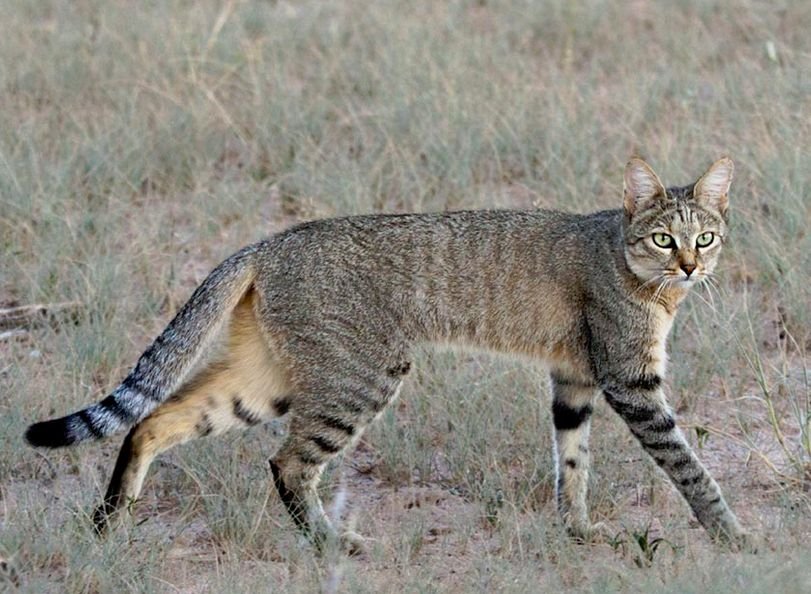
African Wildcat
Felis lybicaThe wild ancestor behind one of humanity’s most familiar companions.
Secretive, solitary and remarkably adaptable, the African wildcat is one of Africa’s most widespread small felids. From the savannas and grasslands of Tanzania to dry scrub and desert-edge habitats, this elusive hunter survives by stalking rodents, birds and other small prey under the cover of darkness.
African Wildcat Quick Facts
What Is an African Wildcat?
The African wildcat is a small wild felid, roughly comparable in size to a large domestic cat but generally more long-legged, robust and adapted to life in the wild. It is not simply a feral domestic cat — a genetically wild African wildcat has its own evolutionary history and adaptations. This distinction matters because African wildcats and domestic cats can interbreed.
The Ancestor of the Domestic Cat
African wildcats are widely regarded as the principal ancestors of today’s domestic cats. Domestication began thousands of years ago, particularly in the Near East, where early agricultural settlements attracted abundant rodents around human food stores. Over generations, some wildcats became increasingly tolerant of humans, leading from wildcat → human association → domestication → domestic cat. The African/Near Eastern wildcat lineage sits at the heart of one of humanity’s most familiar companion animals.
Why Is It Called a Wildcat?
The name is a direct contrast with the domestic cat: the African wildcat is the free-living, untamed progenitor from which house cats descend. “Wildcat” simply marks the original, undomesticated version of the species — not a separate, larger predator.
Sandy, tawny coat
Typically sandy, tawny or grayish, with dark leg stripes, faint body markings, a ringed tail and a dark tail tip.
Reddish ear backs
Many African populations show distinctive reddish coloring on the backs of the ears.
Solitary
Primarily solitary; alone except during mating and when females raise kittens.
Primarily nocturnal
Most active at night, sometimes around dawn and dusk; daylight activity is uncommon.
Scent territories
Uses urine, feces, scent, scratching and vocalizations to mark and defend territory.
How to Identify an African Wildcat
African wildcats can look remarkably similar to domestic cats. Typical features include a sandy, tawny or grayish coat, dark stripes on the legs, faint body markings, a ringed tail with a dark tip, relatively long legs and a narrower body than many domestic cats. The IUCN Cat Specialist Group notes regional variation: paler animals generally occur in drier environments and darker, more heavily marked individuals in more humid regions.
Coat Color & Environment
In dry environments individuals are often paler — sandy to buff — providing camouflage against dry soil and grasses. In more humid environments they may be darker and more strongly marked. This is a classic example of coloration varying across ecological conditions.
Wildcat vs Feral Cat
A feral domestic cat is Felis catus living independently of people; an African wildcat is a wild species with its own lineage. Visual clues include a more uniform sandy/tawny wildcat coat, subtle markings, longer legs and reddish ear backs, versus the extremely variable coat of domestic cats. But appearance alone is not always enough — where certainty matters, genetic analysis can distinguish wildcat, domestic cat and hybrid.
Physical Adaptations
The African wildcat is approximately the size of a large domestic cat. A good general range is body length about 45–75 cm and weight about 3–6.5 kg, but body size varies geographically and between individuals — so these should not be presented as exact universal measurements.
How Fast Can It Run?
The often-quoted figure is not sufficiently established to present as a definitive species fact. A better statement: short-distance bursts can be rapid, but a scientifically reliable maximum speed is not well established. This strengthens the page by not inventing precision.
Lifespan
Wild lifespan is difficult to measure accurately. Historical IUCN material records captive longevity of up to about 15 years, but that should not be presented as the standard wild lifespan. Recommended wording: wild longevity is poorly documented; individuals can live more than a decade, particularly under favorable conditions.
Where Does the African Wildcat Live?
The African wildcat has an exceptionally broad habitat tolerance. It can occur in savanna, grassland, scrubland, open woodland, semi-desert, dry riverbeds, mountainous dry habitats, agricultural landscapes, areas around human settlements and desert-edge environments. Historical IUCN material describes very broad tolerance, with absence primarily associated with dense tropical rainforest.
Dry Environments
African wildcats can survive in extremely dry landscapes, associated with mountains, dry river channels, vegetated valleys and places where prey concentrates. They can obtain moisture largely through prey, so the old claim that “reliable water is essential” is too simplistic.
Agricultural Landscapes
Wildcats can occur near farms because crops may support large rodent populations, creating a crops → rodents → wildcats relationship in which they act as natural rodent predators. But agriculture also exposes them to domestic cats, dogs, roads, persecution, habitat change and hybridization.
African Wildcat in Tanzania
The IUCN CatSG specifically records the African wildcat as widely distributed in Tanzania, mostly in the northern and central regions. So Tanzania is locally important — but that does not justify marketing it as “the best place in Africa to see African wildcats,” for which there is no evidence.
Where Can You See an African Wildcat on Safari?
The African wildcat has an enormous distribution across North, East, Southern and West Africa, plus parts of the Arabian Peninsula and Middle East. The IUCN CatSG describes Felis lybica lybica as occurring across much of Africa and parts of the Middle East and Arabian Peninsula. Tanzania is genuinely relevant as part of that range, but the species is far more widespread, so it should not be presented as primarily Tanzanian.
Activity & Safari Viewing
African wildcats are predominantly nocturnal, occasionally active at dawn and dusk. Rigid daily schedules (such as “6–10 AM active / 10–3 PM rest”) don’t reflect wild behaviour. Sighting likelihood is best described as uncommon / opportunistic: a guide may encounter one, but no ethical operator should guarantee it. The Serengeti and Tarangire hold suitable habitat and wildcats occur across Tanzania, but these should not be marketed as guaranteed wildcat destinations, and there is no reliably established “best month” for sightings.
African Wildcat Behavior
African wildcats are primarily solitary. They generally live alone except during mating and mother-and-kitten periods. The IUCN material explicitly distinguishes them from domestic-cat colonies and describes them as solitary. Unsupported claims such as “often found in groups,” “bachelor groups,” “family groups,” “group leadership,” “group defense” and “safety in numbers” should be avoided.
Nocturnal
Most active at night; daylight activity relatively uncommon, though dawn/dusk possible.
Territorial
Both sexes establish territories; size varies with prey, habitat, density, sex and climate.
Scent marking
Communicates territory, presence, reproductive status and identity without meeting rivals.
Solitary
Strongest bond is mother–kittens; otherwise alone.
Secretive
Small and well-camouflaged; even experienced guides can miss them.
African Wildcat Family Life
Contrary to the old “single young” claim, litters commonly contain 2–5 kittens; historical data give an average of about 3–4. Gestation is approximately 60–65 days (historical sources ~56–63, southern African literature ~65). Kittens are born in concealed locations — burrows, rock crevices, dense vegetation — chosen to reduce detection.
Kitten Development
Young progress from birth → nursing → opening eyes → exploration → play → learning to hunt → independence. The mother provides most early care; once independent, the normal solitary lifestyle resumes. Historical captive data suggest sexual maturity around 11 months, but this should be labelled approximate.
What Does the African Wildcat Eat?
African wildcats are carnivores whose diet is dominated by small animals: rodents (mice, rats, gerbils), other small mammals, birds, reptiles, amphibians, insects and arachnids. They may occasionally take larger prey such as young antelope, but that is not normal. Rodents are the big target — highly effective small-mammal predators, valuable even around agricultural landscapes.
How Does It Hunt?
Its hunting strategy resembles a domestic cat’s, but in a far more demanding environment: detect prey → stalk quietly → use cover → approach within striking distance → explosive pounce → capture with claws → kill with a bite. It exploits even minimal vegetation or terrain for concealment.
Camouflage
The muted gray, sandy, tawny and brown colors break up the animal’s outline among dry grass, soil, rocks, shrubs and woodland, letting it approach prey undetected.
African Wildcat Comparisons
African Wildcat vs Domestic Cat
| Feature | African Wildcat | Domestic Cat |
|---|---|---|
| Scientific name | Felis lybica | Felis catus |
| Lifestyle | Wild | Domesticated |
| Social structure | Mainly solitary | Highly variable |
| Coat | Usually sandy/tawny | Extremely variable |
| Hybridization | Can interbreed | Can interbreed |
vs Black-footed Cat
The black-footed cat (Felis nigripes) is much smaller, a southern-African arid specialist, versus the larger, broader-ranging, highly adaptable African wildcat — a useful internal link between the two species pages.
vs African Golden Cat
The African golden cat (Caracal aurata) is larger, forest-dependent and Vulnerable, while the African wildcat is smaller, broadly distributed across open habitats and Least Concern. Both are solitary; the golden cat’s confirmed Tanzanian population is at Minziro.
Predators of the African Wildcat
Potential natural predators include larger carnivores and large raptors (especially targeting kittens), with leopards possible in overlapping habitats. But the most important modern threats are human-driven: hybridization with domestic cats, habitat conversion, road mortality, disease, persecution and competition with domestic/feral cats.
Wildcat × Domestic Cat
This is arguably the most important conservation issue for the species. African wildcats can interbreed with domestic cats, producing genetic introgression/hybridization. Repeated breeding with domestic cats can make genetically pure wildcat populations increasingly hard to identify and preserve. The IUCN CatSG specifically recognizes hybridization with domestic cats as a conservation concern. Where certainty is needed, genetic testing distinguishes wildcat, domestic cat and hybrid.
Conservation Status
The African wildcat is currently treated as Least Concern at the relevant taxonomic level — this part of the existing page was correct. But Least Concern does not mean “no conservation problems.” It means the species doesn’t currently meet thresholds for a more threatened category globally; local populations can still face serious issues.
Major Threats
1. Hybridization
Domestic cats interbreed with wildcats, diluting wild genetics.
2. Habitat loss
Agricultural expansion and settlement remove habitat.
3. Road mortality
Small carnivores are killed by vehicles.
4. Disease
Domestic animals can transmit diseases.
5. Persecution
Killed when perceived as a threat to poultry or livestock.
6. Competition
Domestic and feral cats compete for food, territory and shelter.
Near People: A Double-Edged Sword
Their adaptability lets them survive near settlements (more rodents = food), but more domestic cats mean hybridization, disease, competition and conflict. Human landscapes can be both habitat and threat. Ecologically, by controlling rodents and small animals they contribute to prey-population dynamics and ecosystem balance — meaningful as a small carnivore, though not a “keystone species.”
Did You Know?
Not a big cat
It is a small wild cat in the genus Felis, not one of Africa’s big cats.
Ancestor of house cats
African/Near Eastern wildcats are the principal ancestors of domestic cats.
Not “found primarily in Tanzania”
Its range spans most of Africa and into the Middle East; Tanzania is just one part.
Solitary
It lives alone except when mating or raising kittens.
Speed unknown
No reliable max-speed figure; shouldn’t be stated as fact.
Litters of 2–5
Not a single kitten — litters commonly contain 2–5 kittens.
Hybridization threat
Breeding with domestic cats is a major conservation concern.
Uncommon sightings
Small, secretive and nocturnal; sightings are opportunistic, not guaranteed.
Safari Guide’s Perspective
The African wildcat is the small cat most visitors mistake for a stray house cat. On a Tanzania safari you might glimpse one near camp at dusk, but sightings are opportunistic and never guaranteed — and that restraint is exactly what makes it rewarding. As a Tanzania-based operator, we’d rather help you appreciate it in its real context than promise a sighting we can’t deliver.
A track in the dust, a flicker at a burrow, a pair of eyes caught in headlights after dark — the African wildcat is the wild thread connecting every domestic cat curled on a sofa to the African bush.
African Wildcat in Pictures
Frequently Asked Questions
Felis lybica.
No. It is a small wild cat belonging to the genus Felis.
African/Near Eastern wildcat populations are regarded as the principal ancestors of the domestic cat lineage.
Approximately 3–6.5 kg, although size varies geographically.
Approximately 45–75 cm in body length.
A precise maximum speed is not reliably established, so a definitive figure should be avoided.
No. They are generally solitary, except during mating and when females are raising kittens.
Mostly small mammals such as rodents, along with birds, reptiles, amphibians, insects and other small prey.
They have a remarkably broad habitat range including savanna, grassland, scrub, woodland, semi-desert and other open habitats.
Yes. The IUCN CatSG describes them as widely distributed in Tanzania, particularly in northern and central regions.
Yes. Agricultural landscapes can provide rodents and cover, but also expose wildcats to domestic animals, disease and hybridization.
Yes. Hybridization between African wildcats and domestic cats occurs and is an important conservation concern.
Typically multiple kittens; historical data report approximately 2–5 kittens per litter, averaging around 3–4 in some populations.
Approximately 60–65 days.
The species is currently classified as Least Concern globally.
Yes, it is possible, but sightings are uncommon and unpredictable and should never be marketed as guaranteed.
No. A feral domestic cat is Felis catus living independently of humans; an African wildcat is a wild species with its own evolutionary lineage.
They are natural small-mammal predators and are scientifically important because of their relationship to the evolution of domestic cats.
References & Further Reading
- IUCN/SSC Cat Specialist Group: Felis lybica — African wildcat taxonomy (Felis lybica), distribution, habitat tolerance and hybridization concern.
- Domestication literature: Near Eastern agricultural origins of the domestic cat from wildcat ancestors.
- Historical IUCN species accounts: Broad habitat tolerance, body size 45–75 cm, weight ~3–6.5 kg, gestation ~56–65 days, litters ~2–5.
- Tanzania distribution: IUCN CatSG records wide distribution, especially northern and central regions.
- About these facts: Measurements are approximate ranges; conservation status should be checked against the current IUCN assessment.