

.png)
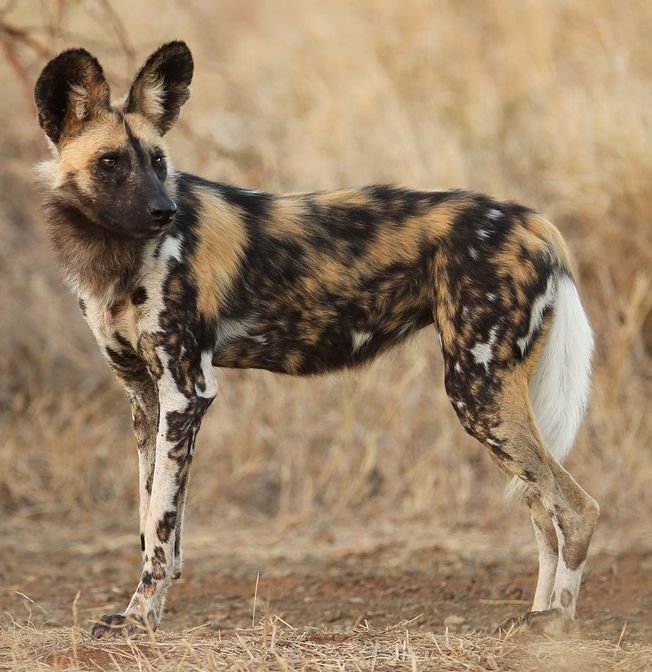
African Wild Dog
Lycaon pictus — the painted dog: Africa's most social carnivore, a pack of mottled coats, big round ears and a democracy of hunters that share every kill.Introduction to the African Wild Dog
The African wild dog (Lycaon pictus) - also called the painted dog or painted wolf - is one of Africa's most extraordinary and most endangered carnivores. Unlike solitary big cats, it is a supreme social specialist: it lives, hunts, eats and travels as a single cooperative unit. A pack is a family of mottled black-tan-white coats, enormous rounded ears and a culture of greeting ceremonies, food sharing and communal pup care. Watching a wild dog pack work together is among the great safari experiences - and one of the rarest, because so few remain.
Scientific Classification
The African wild dog is the lone species of the genus Lycaon, a canid specialised for endurance hunting in open country rather than the solitary ambush of cats.
Physical Characteristics
- Coat: A unique pied (painted) pattern of black, tan/yellow and white patches - no two dogs are marked alike, like a fingerprint.
- Ears: Large, rounded ears that give exceptional hearing and a distinctive silhouette.
- Build: Long-legged and lean, built for endurance rather than a sprint finish; a white-tipped tail helps pack members follow one another.
- Size: Shoulder height about 60–75 cm; weight 18–36 kg (males and females are similar in size, with some regional variation).
- Teeth: Fewer teeth than other canids and large rounded molars for shearing meat - an adaptation to a hyper-carnivorous diet.
Social Organization
African wild dogs are exceptionally social - far more so than most carnivores. The social unit is the pack, a bonded family group rather than a loose aggregation:
- Pack life: Strong, lifelong social bonds; pack members greet one another with loud, tail-wagging greeting ceremonies.
- Cooperative hunting: The pack hunts together, using stamina and teamwork to run down prey over long distances.
- Communal pup care: Pups are cared for by the whole pack; adults - including non-breeding members - regurgitate food for pups and for sick or injured packmates.
- Food sharing: Kills are shared freely among all members, including those that did not hunt.
- Breeding pair: Usually a single dominant breeding pair produces the litter; other adults help raise it.
- Dispersal: Both sexes can disperse to find or join other packs, and the pattern differs between populations - it is not a simple "bachelor group" system.
African Wild Dog Young & Reproduction
Wild dog reproduction is defined by large litters and communal care - the opposite of "a single young":
- Litter size: Large - often around 6–10 or more pups (records exceed a dozen), though litter size varies with pack and conditions.
- Dens: Pups are born in dens (often old aardvark or warthog holes) and stay near the den for the first weeks.
- Dependency: Pups are highly dependent on the pack; adults regurgitate food for them, and non-hunting members babysit and guard.
- Maturity: Young dogs begin joining hunts as they grow, and may disperse at maturity to form or join new packs.
- Lifespan: Around 10–12 years in the wild.
Habitat: Where They Thrive
The African wild dog is an open-country specialist, but its habitat is broader than savanna alone:
Key Habitat Types:
- Savanna & grassland: Open plains and grasslands are core hunting ground.
- Open woodland: Sparse woodland and wooded savanna, used for cover and denning.
- Semi-arid areas: Dry thorn and scrub country, where packs range widely.
- Montane & other open habitats: Some populations use higher or more open habitats where prey is available.
Range & Movement:
Wild dogs need large, connected landscapes. They are not strongly territorial: home ranges are huge - roughly 200–2,000 km² - with little territorial urine-marking compared with other canids, and packs may travel widely in search of prey.
Distribution Map
The African wild dog was once widespread across sub-Saharan Africa but is now fragmented into scattered populations, mainly in southern and East Africa:
In Tanzania, the strongest populations are in Ruaha and the Nyerere (Selous) ecosystem, with smaller numbers in places like Serengeti, Mikumi and Katavi.
Because packs range so widely, wild dog sightings depend on finding a pack's current range - which is exactly why patient tracking matters.
Where to See the African Wild Dog in Tanzania
Ruaha and Nyerere are among Tanzania's stronger areas for African wild dog - but sightings are never guaranteed and packs may range widely. A sighting is a reward for patient tracking:
Ruaha NP
Best: Year-round | Region: Southern Tanzania
Visible (patient tracking)
Home to one of Africa's largest wild dog populations; packs hunt the vast Ruaha plains.
Nyerere NP
Best: Year-round | Region: Southern Tanzania
Visible (patient tracking)
The Selous ecosystem - a vast wilderness where wild dogs range across huge home ranges.
Smaller populations also occur in Serengeti, Mikumi and Katavi, but Ruaha and Nyerere are the reliable places to focus a wild dog search.
African Wild Dog in Pictures
A closer look at the African wild dog - the painted, big-eared pack hunter of Africa's savanna and open woodland, and one of the continent's most endangered carnivores.
Where to Spot the African Wild Dog on Safari
Plan a southern-Tanzania safari to Ruaha and Nyerere - the country's wild dog strongholds. Explore the destinations below.
Diet: What They Eat
The African wild dog is a hyper-carnivore that hunts medium-sized prey in cooperative packs:
- Prey: Mainly antelope such as impala, gazelle, kudu and duiker; also warthog, hare and occasionally smaller animals.
- Hunting: Relentless, long-distance cooperative chases that exhaust prey rather than a short ambush.
- Feeding: The kill is shared by the whole pack, with pups and non-hunting members fed first through regurgitation.
- Ecosystem Role: A wide-ranging predator that helps keep prey populations healthy.
Daily Behaviour & Social Life
Daily Rhythm
Day: Wild dogs are often active by day; the pack typically rests at dawn, then sets out to hunt, travelling and chasing as a coordinated group.
Dusk: Returns to rest and den sites; there is no rigid hourly timetable - activity follows the pack's movements, prey and temperature.
Cooperative hunters
African wild dogs are among the most successful cooperative hunters in the animal kingdom, but hunting success varies by prey, habitat, pack size and study - it is not a single fixed percentage. The pack relies on stamina and teamwork, often running prey down over several kilometres.
Greeting ceremonies & decisions
Before a hunt the pack may perform greeting ceremonies - tail-wagging, vocalising, nuzzling - and pack members appear to reach a collective decision about when and where to hunt, a rare form of social coordination among carnivores.
Predators, competitors & Threats
Lions and spotted hyenas are the main natural threats: they can kill wild dogs (including adults) and compete for kills and space - but they are not simply "ordinary predators" that routinely hunt adult dogs. The greater dangers are human: habitat fragmentation, snaring, road kills, conflict with people and disease (notably canine distemper and rabies from domestic dogs).
Watching tip: Wild dog sightings reward patient pack tracking with an expert guide - not just a generic early-morning drive. Ask camps about recent pack movements in Ruaha and Nyerere.
Reproduction & Lifespan
- Mating: Usually the dominant pair within the pack breeds.
- Gestation: About 70–73 days.
- Litter: Large - typically 6–10 or more pups.
- Care: The whole pack feeds and protects the pups; adults regurgitate food for them.
- Lifespan: Around 10–12 years in the wild.
Conservation Status
IUCN Red List Status: The African wild dog (Lycaon pictus) is listed as Endangered. Estimates suggest only a few thousand adults remain across Africa (often quoted around 6,600 or fewer), with numbers still declining in many regions. It is also on CITES Appendix I.
Major Threats
- Habitat fragmentation: Wild dogs need enormous, connected ranges; farms, fences and roads split populations.
- Human conflict & snaring: Retaliatory killing and wire snares set for other animals maim and kill dogs.
- Disease: Canine distemper and rabies, spilled over from domestic dogs, cause severe outbreaks.
- Competition: Lions and hyenas kill dogs and take their kills.
Conservation Programs
Protected wilderness is the front line. In Tanzania, TANAPA (Tanzania National Parks Authority) manages Ruaha and Nyerere, and the Tanzania Wildlife Research Institute (TAWIRI) and the IUCN SSC Canid Specialist Group support monitoring. Regionally, transboundary efforts such as the KAZA TFCA and organisations like Painted Dog Conservation work to protect packs and reduce conflict.
Interesting Facts
African Wild Dog vs Other Predators
African Wild Dog vs Lion
| Feature | African Wild Dog | Lion |
|---|---|---|
| Social | Cooperative packs | Pride (social cat) |
| Hunt | Endurance teamwork | Ambush/group |
| Prey | Medium antelope | Large & medium |
African Wild Dog vs Cheetah
| Feature | African Wild Dog | Cheetah |
|---|---|---|
| Speed | ~55- sustained | ~ sprint |
| Style | Pack endurance | Solo sprint |
| Social | Highly social | Largely solitary |
African Wild Dog in Culture
The painted dog is woven into African folklore as a clever, restless hunter, and today it has become a symbol of conservation urgency. Few animals show such remarkable social devotion - greeting, sharing and raising young as one family - which is exactly why its decline feels like the loss of a unique way of life on the savanna.
Wildlife Photography Guide
- Best Camera Lens: A 100-400mm or 200-600mm lens for moving packs at distance.
- Best Time: Dry season game drives in Ruaha and Nyerere, when packs are more findable.
- Best Habitat: Ruaha and Nyerere (Tanzania).
- Best Behaviour: Capture the painted coats, big ears, greeting ceremonies and the cohesive pack on the move.
- Safety Distance: Stay in the vehicle, move slowly and never disturb a wild dog pack or den.
Frequently Asked Questions
The African wild dog (Lycaon pictus), also called the painted dog or painted wolf, is a highly social African carnivore that lives and hunts in cooperative packs across savanna and open woodland.
Adults weigh roughly 18-36 kg (about 40-80 lb); males and females are similar in size, with some geographic variation.
It is a fast, cursorial predator capable of sustained high-speed chases, with speeds around 55- reported depending on the source (ADW cites chases near ; conservation resources often quote about ).
Litters are large - often around 6-10 or more pups - born in dens and cared for communally by the whole pack, with adults regurgitating food for the pups.
Highly social: it rests and travels as a pack, performs greeting ceremonies, hunts cooperatively over long distances, and shares kills. Activity follows the pack's movements, not a rigid timetable.
Exceptionally so - it is one of the most social carnivores, with strong bonds, cooperative pup care, food sharing and pack-based decisions. It is not a loose bachelor-group species.
Game drives - but success needs patient pack tracking with an expert guide, especially in Ruaha and Nyerere, since packs range widely and sightings are never guaranteed.
Savanna, grassland, open woodland and semi-arid areas, plus some open/montane habitats - anywhere with open country and prey.
Lions and spotted hyenas can kill wild dogs (including adults) and compete for food; the larger threats are human - habitat loss, snares, disease and conflict.
Yes - it is Endangered on the IUCN Red List, with only a few thousand adults remaining and numbers still declining; it is also on CITES Appendix I.
Ruaha and Nyerere (Selous) hold Tanzania's strongest populations; smaller numbers occur in Serengeti, Mikumi and Katavi.
Few carnivores match its social devotion - greeting ceremonies, shared kills and communal pup care make the pack a single cooperative family, and one of Africa's rarest sights.
Related Safari Packages & Tours
Plan a southern-Tanzania safari to Ruaha and Nyerere - the country's wild dog strongholds. Patient tracking with our guides is the way to meet a pack.
References & Further Reading
- IUCN Red List: Lycaon pictus - Endangered.
- Animal Diversity Web (ADW): University of Michigan, Lycaon pictus account - weight 18-36 kg, chase speeds near , cooperative pup care, large home ranges and limited territorial marking.
- About these facts: Weight, speed, litter size and lifespan are approximate ranges that vary by sex, age, location and source; hunting success is context-dependent and not a fixed percentage. Conservation status should be checked against the current IUCN assessment.