

.png)
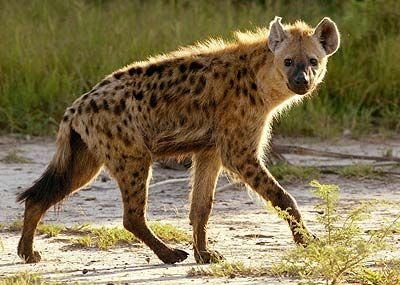
Spotted Hyena
Crocuta crocutaThe powerful hunter whose "laugh" carries across the plains.
Sightings are never guaranteed and depend on local conditions. Follow your guide and respect park rules.
A matriarchal carnivore with bone-crushing jaws.
Spotted Hyena Quick Facts
What Is a Spotted Hyena?
The spotted hyena (Crocuta crocuta) is Africa's most powerful and successful large carnivore after the lion. It belongs to the hyena family (Hyaenidae) and is a true hunter, not merely a scavenger.
Living in matriarchal clans led by dominant females, spotted hyenas are intelligent, social and astonishingly effective. Their famous "laugh" is just one of a rich vocabulary that keeps the clan in contact across the dark plains.
Why Does the Spotted Hyena "Laugh"?
The "laugh" — a series of giggling calls — is not an expression of joy. It is an excited, social call given during confrontations, feeding and greetings, and it tells clan members who is who and how tense the moment is.
Spotted hyenas have one of the richest vocal repertoires of any land mammal. Their whoops, grunts and giggles coordinate hunting, summon the clan to a kill and reinforce the strict social order — because in a hyena clan, status is everything.
What Does the Spotted Hyena Eat?
A formidable carnivore, the spotted hyena hunts large prey cooperatively in clans or hunting parties — from wildebeest and zebra to antelope — and scavenges whenever the opportunity arises. Individuals may also hunt alone.
- Large ungulates such as wildebeest and zebra
- Antelope and other medium mammals
- Carrion — highly efficient scavengers
- Smaller mammals and birds
- Bones — crushed and digested
How Does It Hunt?
Spotted hyenas hunt cooperatively in clans or hunting parties, exhausting prey through stamina. Individuals may also hunt alone.
Where Does the Spotted Hyena Live?
The Spotted Hyena is found across parts of Africa, with its main populations in eastern and, where applicable, southern regions. Its preferred habitat is Savanna & open plains.
Eastern Africa
- Tanzania
- Kenya
- Uganda
Southern Africa
- Southern Africa
- South Africa
Preferred Habitat
It favours savanna & open plains, where cover, food and shelter are in balance. Protected national parks across East Africa help maintain stable populations.
Spotted Hyena in Tanzania
Tanzania is one of the best places on Earth to see spotted hyenas, with large clans in the Serengeti and Ngorongoro ecosystems.
Where Sightings May Occur
- Serengeti — some of Africa's largest hyena clans.
- Ngorongoro Crater — dense hyena populations.
- Night drives — thrilling sightings after dark.
Where Can You See a Spotted Hyena on Safari?
The spotted hyena can be seen in suitable savanna habitat in Tanzania. The table below gives a realistic guide to habitat suitability.
| Destination | Habitat suitability | Sightings |
|---|---|---|
| Serengeti | Excellent — huge clans | Frequently encountered |
| Ngorongoro | Excellent — dense population | Frequently encountered |
| Night drives | Active after dark | Possible |
Spotted hyenas are frequently encountered in suitable Serengeti and Ngorongoro habitats, but individual sightings are never guaranteed.
Want to explore Tanzania's lesser-known wildlife?
Spotted Hyena Behavior
Clan society
Matriarchal clans with a strict hierarchy.
Communication
Whoops, grunts and the famous "laugh".
Hunting
Cooperative clan hunting; individuals may hunt alone.
Power
Bone-crushing jaws and huge bite force.
Dens
Communal dens where cubs are raised.
Spotted Hyena Family Life
Spotted hyena society is built on female dominance. Females are larger than males and lead the clan; cubs inherit their mother's rank, giving them social standing from birth. Cubs are raised in communal dens where the clan's young grow up together.
Physical Adaptations
Every feature of the Spotted Hyena is finely tuned for life in savanna & open plains.
- Powerful jaws and the strongest bite of any African carnivore
- Forequarters taller than the hind — built for endurance
- Coarse, spotted coat that fades with age
- Large, rounded ears used for social signalling
Vital statistics: body length approximately 95-165 cm long, weight 40–80+ kg (females larger), lifespan typically around 10-12 yrs in the wild (longer in captivity).
Spotted Hyena vs Striped Hyena & African Wild Dog
How does the Spotted Hyena compare with its fellow African carnivores?
| Feature | Spotted Hyena | Striped Hyena | African Wild Dog |
|---|---|---|---|
| Scientific name | Crocuta crocuta | Hyaena hyaena | Lycaon pictus |
| Weight | 40–80+ kg (females larger) | 25-45 kg | 30 kg |
| Size | 95-165 cm long | 90-130 cm long | 75-110 cm long |
| Activity | Nocturnal, clan hunter | Nocturnal, scavenger | Diurnal, pack hunter |
| Lifespan | 10-12 yrs | 12-15 yrs | 10-12 yrs |
| Diet | Carnivore | Carnivore | Carnivore |
| Conservation | Least Concern | Vulnerable | Endangered |
Spotted Hyena vs Other African Predators
Compare the Spotted Hyena with Africa's other carnivores on their own species pages:
- Striped Hyena — compare in detail.
- African Wild Dog — compare in detail.
- Golden Jackal, Black-backed Jackal & Side-striped Jackal — the canids.
- African Wild Dog — the cooperative hunter.
- Lion, Leopard & Cheetah — the big cats.
Predators of the Spotted Hyena
For such a spotted hyena, the savanna holds many dangers. It is important to distinguish between predators of adults and the greater threats facing young animals.
Lions are the spotted hyena's only serious rival, and the two species clash constantly over kills.
Cubs are vulnerable to lions and other predators, which is why they are kept hidden in communal dens.
Conservation Status
Least Concern does not mean the species has no conservation challenges. It means the species is not currently assessed in a higher IUCN threat category at the global level.
The spotted hyena is listed as Least Concern, though it faces persecution and habitat loss in parts of its range.
Did You Know?
The "laugh" is an excited social call, not humour.
Its jaws can crush bones that other carnivores cannot.
Females rule the clan and are larger than males.
It hunts by exhausting prey over long distances.
Safari Guide's Perspective
The spotted hyena is Africa's most misunderstood hero. Watch a clan bring down a wildebeest and you'll witness teamwork, strategy and strength the lion cannot match. Respect the "laugh".
Spotted Hyena in Pictures
A closer look at the Spotted Hyena in its natural East African habitat — its striking appearance, habitat and behaviour are best appreciated up close.
Frequently Asked Questions
No — the Spotted Hyena is currently listed as Least Concern on the IUCN Red List, though local populations can still face habitat pressure.
A formidable carnivore, the spotted hyena hunts large prey in packs — from wildebeest and zebra to antelope — and scavenges whenever the opportunity arises.
Across savanna & open plains in Sub-Saharan Africa, including parts of Tanzania.
Yes — in suitable habitat such as Serengeti & Ngorongoro, Tanzania, although sightings vary by species and season.
Approximately 95-165 cm long in body length and 40–80+ kg (females larger).
It is quick and agile with good stamina for endurance hunting, but relies on clan cooperation rather than outright speed.
Activity patterns vary by species — some are active by day, others almost entirely at night.
Crocuta crocuta — a member of the Hyaenidae family.
Key threats include habitat loss and local habitat changes, alongside natural predation.
Matriarchal clans with a strict hierarchy.
References & Further Reading
- IUCN Red List: Crocuta crocuta
- Animal Diversity Web (University of Michigan): Species accounts for African carnivores, including diet, size and behavior.
- Tanzania Wildlife Research Institute (TAWIRI): Monitoring wildlife populations in Tanzania.
- Estes, R. (1991). The Behavior Guide to African Mammals. University of California Press.
- Kingdon, J. (2015). The Kingdon Field Guide to African Mammals. Bloomsbury.
- About these facts: Weight, speed and lifespan are approximate adult ranges. They can vary with sex, age, season, location and the measurement method; conservation status should be checked against the current IUCN assessment.