

.png)
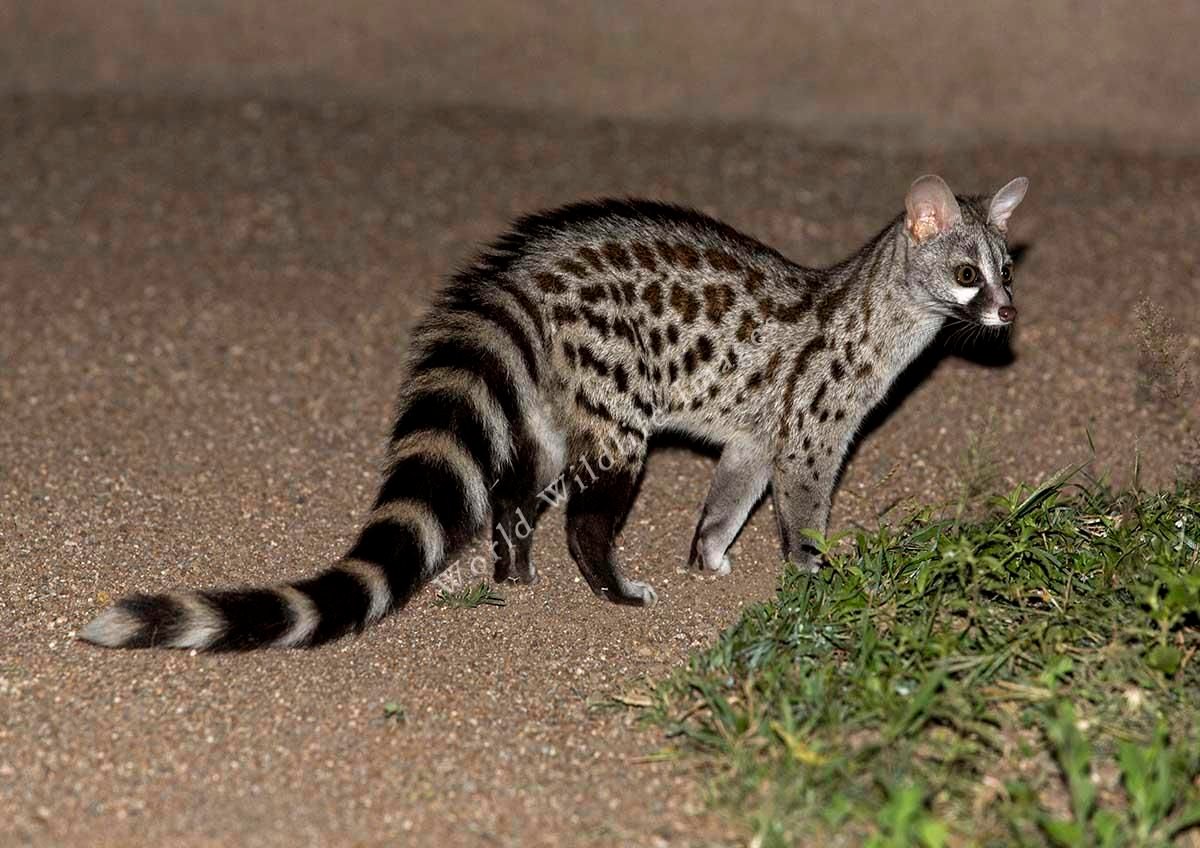
Small-spotted Genet
Genetta genettaA slender, spotted, cat-like carnivore.
Sightings are never guaranteed and depend on local conditions. Follow your guide and respect park rules.
With a long banded tail for hunting in trees and on the ground.
Small-spotted Genet Quick Facts
What Is a Small-spotted Genet?
The small-spotted genet (Genetta genetta) is a graceful, cat-like carnivore of the viverrid family (Viverridae). Its dark-spotted coat and long, black-and-white banded tail give it an almost feline elegance.
It hunts both in trees and on the ground, and is equally at home in savanna, woodland and scrub. Around camps and lodges, it is a familiar night-time visitor, moving silently through the dark.
Why Is the Small-Spotted Genet So Agile?
The small-spotted genet is built for the vertical world. Its long, banded tail is a living counterbalance, and its semi-retractable claws grip bark and branches with confidence, letting it climb, leap and land in the canopy.
This agility opens up the whole forest — prey that lives in the trees is not safe from a genet. On the ground, the same grace makes it a silent, precise hunter, stalking rodents and birds with a cat's patience.
What Does the Small-spotted Genet Eat?
A carnivore, the small-spotted genet hunts small mammals, birds, insects and other invertebrates, and takes fruit seasonally.
- Small rodents and shrews
- Birds and their eggs
- Insects and other invertebrates
- Frogs, lizards and reptiles
- Fruit when available
How Does It Hunt?
It hunts by night, both in trees and on the ground, stalking with slow, silent precision.
Where Does the Small-spotted Genet Live?
The Small-spotted Genet is found across parts of Africa, with its main populations in eastern and, where applicable, southern regions. Its preferred habitat is Savanna & woodland.
Eastern Africa
- Tanzania
- Kenya
- Uganda
Southern Africa
- South Africa
- Southern savanna
Preferred Habitat
It favours savanna & woodland, where cover, food and shelter are in balance. Protected national parks across East Africa help maintain stable populations.
Small-spotted Genet in Tanzania
In Tanzania, the small-spotted genet occurs in savanna and woodland, including Tarangire and the Serengeti, and may occur around lodges and camps at night.
Where Sightings May Occur
- Tarangire — woodland and savanna.
- Serengeti — open country and kopjes.
- Lodges & camps — may occur around lodges and camps at night.
Where Can You See a Small-spotted Genet on Safari?
The small-spotted genet can be seen in suitable savanna and woodland habitat in Tanzania. The table below gives a realistic guide to habitat suitability.
| Destination | Habitat suitability | Sightings |
|---|---|---|
| Tarangire | Good — woodland habitat | Possible |
| Serengeti | Suitable savanna | Possible |
| Lodges at night | May occur | Possible |
Small-spotted genets are present in suitable habitat, but they are secretive and strictly nocturnal, so individual sightings are never guaranteed.
Want to explore Tanzania's lesser-known wildlife?
Small-spotted Genet Behavior
Nocturnal
Hunts almost entirely after dark.
Climbing
Agile in trees and on the ground.
Solitary
Usually lives and hunts alone.
Communication
Scent marking and soft calls.
Resting
Hollow trees, thickets and rocky crevices.
Small-spotted Genet Family Life
Small-spotted genets are solitary. Females rear the kittens in a sheltered den, and the young learn to climb and hunt before leaving to establish their own territories.
Physical Adaptations
Every feature of the Small-spotted Genet is finely tuned for life in savanna & woodland.
- Small dark spots on a grey-yellow coat
- Very long black-and-white banded tail
- Semi-retractable claws for climbing
- Large, light-capturing eyes for night vision
Vital statistics: body length approximately 40-52 cm long + tail, weight 1.5-2.5 kg, lifespan typically around 8-10 yrs in the wild (longer in captivity).
Small-spotted Genet vs Large-spotted Genet & Banded Mongoose
How does the Small-spotted Genet compare with its fellow African carnivores?
| Feature | Small-spotted Genet | Large-spotted Genet | Banded Mongoose |
|---|---|---|---|
| Scientific name | Genetta genetta | Genetta maculata | Mungos mungo |
| Weight | 1.5-2.5 kg | 1.5-2.5 kg | 1.5-2.25 kg |
| Size | 40-52 cm long + tail | 40-52 cm long + tail | 30-45 cm long + tail |
| Spot pattern | Smaller, denser spots | Larger, distinct spots | Uniform grey-brown |
| Lifespan | 8-10 yrs (wild) | 8-10 yrs (wild) | 10-12 yrs (wild) |
| Diet | Small mammals, birds, insects, fruit | Small mammals, birds, reptiles, fruit | Omnivore |
| Conservation | Least Concern | Least Concern | Least Concern |
Small-spotted Genet vs Other African Predators
Compare the Small-spotted Genet with Africa's other carnivores on their own species pages:
- Large-spotted Genet — compare in detail.
- Banded Mongoose — compare in detail.
- Golden Jackal, Black-backed Jackal & Side-striped Jackal — the canids.
- African Wild Dog — the cooperative hunter.
- Lion, Leopard & Cheetah — the big cats.
Predators of the Small-spotted Genet
For such a small-spotted genet, the savanna holds many dangers. It is important to distinguish between predators of adults and the greater threats facing young animals.
Leopards, large owls and pythons may prey on genets.
Kittens are especially vulnerable to snakes and birds of prey.
Conservation Status
Least Concern does not mean the species has no conservation challenges. It means the species is not currently assessed in a higher IUCN threat category at the global level.
Widespread and adaptable, the small-spotted genet is listed as Least Concern.
Did You Know?
Its spotted coat and climbing skill give it a cat-like grace.
Almost purely nocturnal — rarely seen by day.
As at home in the trees as on the ground.
A familiar, silent visitor around safari lodges at night.
Safari Guide's Perspective
Spotting a small-spotted genet on a night drive is a small victory. Its torch-lit eyes are the opening notes of the night's quieter performance.
Small-spotted Genet in Pictures
A closer look at the Small-spotted Genet in its natural East African habitat — its striking appearance, habitat and behaviour are best appreciated up close.
Frequently Asked Questions
No — the Small-spotted Genet is currently listed as Least Concern on the IUCN Red List, though local populations can still face habitat pressure.
A carnivore, the small-spotted genet hunts small mammals, birds, insects and other invertebrates, and takes fruit seasonally.
Across savanna & woodland in Southern & Eastern Africa, including parts of Tanzania.
Yes — in suitable habitat such as Tarangire & Serengeti, Tanzania, although sightings vary by species and season.
Approximately 40-52 cm long + tail in body length and 1.5-2.5 kg in weight.
It is quick and agile in trees and on the ground, but relies on stealth and climbing rather than outright speed.
Activity patterns vary by species — some are active by day, others almost entirely at night.
Genetta genetta — a member of the Viverridae family.
Key threats include habitat loss and local habitat changes, alongside natural predation.
Usually lives and hunts alone.
References & Further Reading
- IUCN Red List: Genetta genetta
- Animal Diversity Web (University of Michigan): Species accounts for African carnivores, including diet, size and behavior.
- Tanzania Wildlife Research Institute (TAWIRI): Monitoring wildlife populations in Tanzania.
- Estes, R. (1991). The Behavior Guide to African Mammals. University of California Press.
- Kingdon, J. (2015). The Kingdon Field Guide to African Mammals. Bloomsbury.
- About these facts: Weight, speed and lifespan are approximate adult ranges. They can vary with sex, age, season, location and the measurement method; conservation status should be checked against the current IUCN assessment.