

.png)
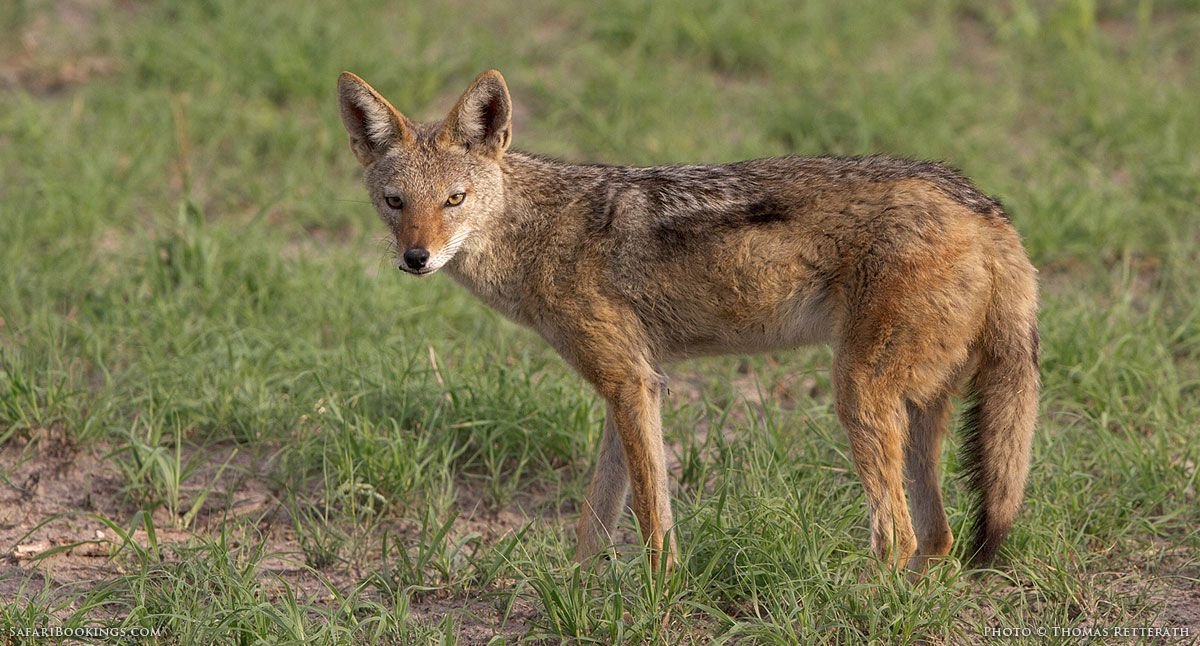
Black-backed Jackal
Lupulella mesomelasThe bold, opportunistic canid with the black saddle.
A confident hunter and scavenger of dawn and dusk across East African savanna.
Black-backed Jackal Quick Facts
What Is a Black-backed Jackal?
The black-backed jackal (Lupulella mesomelas) is a slender, alert canid named for the striking black-and-silver saddle across its back. It belongs to the dog family (Canidae) and is frequently described as one of the most adaptable predators on the savanna.
Bold, intelligent and endlessly resourceful, it hunts small prey in pairs, scavenges from larger kills and lives at the edge of human activity with remarkable confidence. Dawn and dusk tend to be its busiest periods, though it can also be seen hunting and scavenging at other times of day.
Why Is the Black-Backed Jackal So Bold?
The black saddle isn't just decoration — it breaks up the jackal's outline against the glare of the plains, helping it approach prey and slip through open country. That confidence comes from brains, speed and teamwork.
Black-backed jackals are famously audacious, trotting right through herds of grazing animals and ducking around predators to scavenge. In pairs, they hunt more efficiently than most lone canids: one flushes prey, the other intercepts. It is a partnership that makes the species remarkably successful.
What Does the Black-backed Jackal Eat?
An opportunistic carnivore, the black-backed jackal eats whatever the savanna offers — from rodents and birds to carrion and fruit.
- Small mammals such as rodents and hares
- Birds and their eggs
- Insects and other invertebrates
- Carrion from larger predators' kills
- Fruit and plant matter when available
How Does It Hunt?
Pairs often hunt together, with one partner flushing prey toward the other.
Where Does the Black-backed Jackal Live?
The Black-backed Jackal is found across parts of Africa, with its main populations in eastern and, where applicable, southern regions. Its preferred habitat is Open savanna & scrub.
Eastern Africa
- Tanzania
- Kenya
- Uganda
Southern Africa
- South Africa
- Botswana
- Namibia
Preferred Habitat
It favours open savanna & scrub, where cover, food and shelter are in balance.
Black-backed Jackal in Tanzania
In Tanzania, black-backed jackals are among the most commonly seen canids, patrolling roadsides and plains at dawn and dusk.
Where Sightings May Occur
- Serengeti National Park — pairs are frequently seen on the open plains.
- Ngorongoro Crater — the grassland floor holds healthy numbers.
- Other parks — present across most northern reserves.
Where Can You See a Black-backed Jackal on Safari?
The Black-backed Jackal can be seen in several parks and reserves in Tanzania. The table below gives a realistic guide to habitat suitability.
| Destination | Habitat suitability | Sightings |
|---|---|---|
| Serengeti | Excellent — open plains and roadsides | Possible |
| Ngorongoro | Good — crater grasslands | Possible |
| Other reserves | Suitable open habitat | Possible |
Black-backed jackals are regularly encountered in suitable Serengeti and Ngorongoro habitats, but individual sightings remain unpredictable.
Want to explore Tanzania's lesser-known wildlife?
Black-backed Jackal Behavior
Pair bonds
Monogamous pairs hunt and defend territory together.
Communication
A wide range of howls, yips and growls.
Activity
Most active at dawn and dusk.
Boldness
Confident around large herbivores and human edges.
Denning
Raises pups in burrows and sheltered sites.
Black-backed Jackal Family Life
Black-backed jackals form lasting pair bonds. Both parents feed and guard the pups, and older offspring may remain to help rear the next litter — a cooperative family structure shared with other canids.
Physical Adaptations
Every feature of the Black-backed Jackal is finely tuned for life in open savanna & scrub.
- Black and silver saddle across the back
- Slender, long-legged build for endurance
- Bushy tail with a dark tip
- Sharp canines suited to small prey and scavenging
Vital statistics: body length approximately 70-100 cm long, weight 7-12 kg, top speed up to , lifespan typically 10-14 yrs.
Black-backed Jackal vs Golden Jackal & Side-striped Jackal
How does the Black-backed Jackal compare with its fellow African carnivores?
| Feature | Black-backed Jackal | Golden Jackal | Side-striped Jackal |
|---|---|---|---|
| Scientific name | Lupulella mesomelas | Canis aureus | Lupulella adusta |
| Weight | 7-12 kg | 7-15 kg | 6-12 kg |
| Size | 70-100 cm long | 60-85 cm long | 65-80 cm long |
| Speed | |||
| Lifespan | 10-14 yrs | 10-12 yrs | 10-12 yrs |
| Diet | Carnivore | Carnivore | Carnivore |
| Conservation | Least Concern | Least Concern | Least Concern |
Black-backed Jackal vs Other African Predators
Compare the Black-backed Jackal with Africa's other carnivores on their own species pages:
- Golden Jackal — compare in detail.
- Side-striped Jackal — compare in detail.
- Golden Jackal, Black-backed Jackal & Side-striped Jackal — the canids.
- African Wild Dog — the cooperative hunter.
- Lion, Leopard & Cheetah — the big cats.
Predators of the Black-backed Jackal
For such a black-backed jackal, the savanna holds many dangers. It is important to distinguish between predators of adults and the greater threats facing young animals.
Larger predators — lions, leopards and spotted hyenas — may kill adult black-backed jackals.
Pups face additional threats from eagles and snakes while at the den.
Conservation Status
Least Concern does not mean the species has no conservation challenges. It means the species is not currently assessed in a higher IUCN threat category at the global level.
Widespread, adaptable and common, the black-backed jackal remains a species of Least Concern across most of its range.
Did You Know?
The black saddle helps break up its outline in the harsh savanna light.
Pairs often stay together for life, hunting as a team.
Dawn and dusk are often its most active windows for hunting and scavenging.
It fearlessly scavenges around lion and hyena kills.
Safari Guide's Perspective
The black-backed jackal is the savanna's underdog with attitude. Watch a pair work a herd of wildebeest at dawn, and you'll see intelligence, patience and boldness in equal measure.
Black-backed Jackal in Pictures
A closer look at the Black-backed Jackal in its natural East African habitat — its striking appearance, habitat and behaviour are best appreciated up close.
Frequently Asked Questions
No — the Black-backed Jackal is currently listed as Least Concern on the IUCN Red List, though local populations can still face habitat pressure.
An opportunistic carnivore, the black-backed jackal eats whatever the savanna offers — from rodents and birds to carrion and fruit.
Across open savanna & scrub in Eastern & Southern Africa, including parts of Tanzania.
Yes — in suitable habitat such as Serengeti & Ngorongoro, Tanzania, although sightings vary by species and season.
Approximately 70-100 cm long in body length and 7-12 kg in weight.
It can reach speeds of up to when needed.
Activity patterns vary by species — some are active by day, others almost entirely at night. Most active at dawn and dusk.
Lupulella mesomelas — a member of the Canidae family.
Key threats include habitat loss and local habitat changes, alongside natural predation.
Monogamous pairs hunt and defend territory together.
References & Further Reading
- IUCN Red List: Lupulella mesomelas
- Animal Diversity Web (University of Michigan): Species accounts for African carnivores, including diet, size and behavior.
- Tanzania Wildlife Research Institute (TAWIRI): Monitoring wildlife populations in Tanzania.
- Estes, R. (1991). The Behavior Guide to African Mammals. University of California Press.
- Kingdon, J. (2015). The Kingdon Field Guide to African Mammals. Bloomsbury.
- About these facts: Weight, speed and lifespan are approximate adult ranges. They can vary with sex, age, season, location and the measurement method; conservation status should be checked against the current IUCN assessment.