

.png)
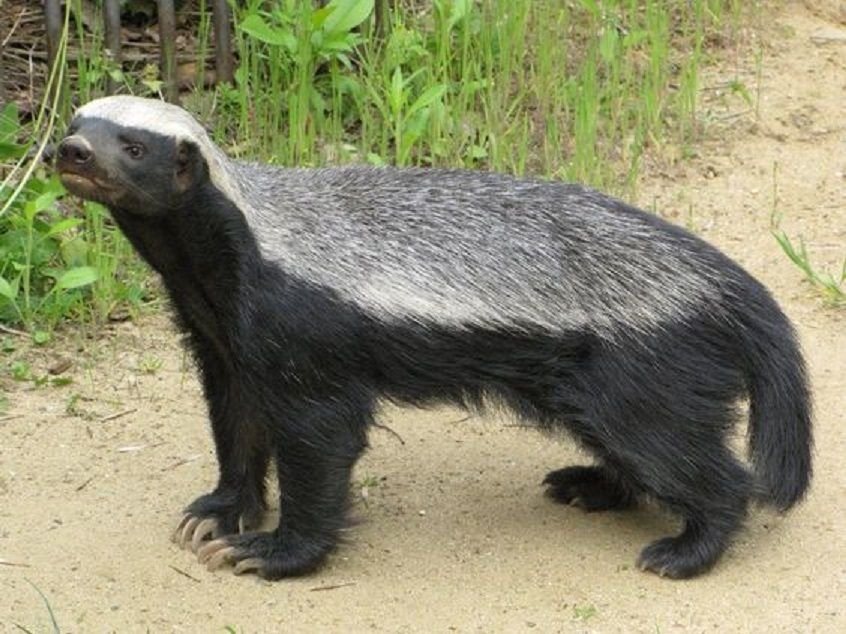
Honey Badger
Mellivora capensisThe fearless ratel.
Sightings are never guaranteed and depend on local conditions. Follow your guide and respect park rules.
Famous for taking on lions, snakes and scorpions with thick, loose skin.
Honey Badger Quick Facts
What Is a Honey Badger?
The honey badger (Mellivora capensis) is a stocky, powerfully built member of the mustelid family (Mustelidae), related to otters and badgers. Known locally as the ratel, it has earned a worldwide reputation for remarkable fearlessness.
Compact, muscular and armed with thick, loose skin and powerful jaws, the honey badger will tackle prey and opponents far larger than itself — from venomous snakes to young big cats. Its confidence is legendary across African savanna and woodland.
Why Is the Honey Badger So Fearless?
The honey badger's courage is backed by real armour. Its skin is thick and remarkably loose, letting it twist and bite even when gripped — a defence that allows it to escape predators that would kill almost any other animal its size.
Add razor-sharp claws, bone-crushing jaws and a famously stubborn temperament, and you have a carnivore that treats danger as an inconvenience. It attacks beehives for honey, raids snakes' coils, and when threatened, stands its ground with a ferocity that makes larger predators think twice.
What Does the Honey Badger Eat?
An opportunistic carnivore and forager, the honey badger eats a huge variety of food, from honey and larvae to snakes, small mammals and carrion.
- Honey and bee larvae — its famous craving
- Snakes, including venomous species
- Rodents, hares and other small mammals
- Birds, eggs, reptiles and insects
- Fruit, roots and carrion
How Does It Hunt?
It forages alone, covering vast distances and digging, climbing and raiding with relentless determination.
Where Does the Honey Badger Live?
The honey badger is found across Sub-Saharan Africa, with populations in both East and Southern Africa. Its preferred habitat is savanna, woodland & arid country.
Eastern Africa
- Tanzania
- Kenya
- Uganda
Southern Africa
- South Africa
- Botswana
- Namibia
Preferred Habitat
It favours savanna, woodland & arid country, where cover, food and shelter are in balance. Protected national parks across its range help keep populations stable.
Honey Badger in Tanzania
Throughout Tanzania's parks, the honey badger lives a secretive, wandering life, most often encountered on night drives or crossing roads by day.
Where Sightings May Occur
- Throughout Tanzania's parks — recorded in most major reserves.
- Night drives — best chance to spot one active.
- Woodland and scrub — favourite foraging habitat.
Where Can You See a Honey Badger on Safari?
The honey badger can be seen in suitable dry habitat across Tanzania. The table below gives a realistic guide to habitat suitability.
| Destination | Habitat suitability | Sightings |
|---|---|---|
| Tanzania's parks | Widespread | Unpredictable — but possible |
| Night drives | Best opportunity | Possible |
| Woodland & scrub | Suitable habitat | Possible |
Honey badgers are widespread in suitable habitat across Tanzania, but they are secretive and largely nocturnal, so individual sightings are never guaranteed.
Want to explore Tanzania's lesser-known wildlife?
Honey Badger Behavior
Fearlessness
Stands its ground against far larger animals.
Solitary
Usually lives and forages alone.
Activity
Active by day and night, depending on region.
Digging
Powerful digger, breaking into burrows and nests.
Wandering
Covers enormous home ranges, often nomadic, in search of food.
Honey Badger Family Life
Honey badgers are largely solitary. The female raises the young alone in a den, and the cub stays with her for 12-16 months, learning to hunt, dig and defend itself before striking out on its own.
Physical Adaptations
Every feature of the Honey Badger is finely tuned for life in savanna, woodland & arid country.
- Thick, loose skin that resists teeth and stings
- Powerful jaws and strong teeth
- Long, strong foreclaws for digging and tearing
- Compact, muscular body with a grey saddle
Vital statistics: body length approximately 55-77 cm long, weight 9-16 kg, lifespan typically around 7-8 yrs in the wild (longer in captivity).
Honey Badger vs Egyptian Mongoose & Marsh Mongoose
How does the Honey Badger compare with its fellow African carnivores?
| Feature | Honey Badger | Egyptian Mongoose | Marsh Mongoose |
|---|---|---|---|
| Scientific name | Mellivora capensis | Herpestes ichneumon | Atilax paludinosus |
| Weight | 9-16 kg | 1.5-4 kg | 2-4 kg |
| Size | 55-77 cm long | 48-60 cm long + tail | 44-62 cm long + tail |
| Home range | Very large, nomadic | Flexible | Territorial |
| Lifespan | 7-8 yrs (wild) | 15-20 yrs | 10-15 yrs |
| Diet | Carnivore | Carnivore | Omnivore |
| Conservation | Least Concern | Least Concern | Least Concern |
Honey Badger vs Other African Predators
Compare the Honey Badger with Africa's other carnivores on their own species pages:
- Egyptian Mongoose — compare in detail.
- Marsh Mongoose — compare in detail.
- Golden Jackal, Black-backed Jackal & Side-striped Jackal — the canids.
- African Wild Dog — the cooperative hunter.
- Lion, Leopard & Cheetah — the big cats.
Predators of the Honey Badger
For such a honey badger, the savanna holds many dangers. It is important to distinguish between predators of adults and the greater threats facing young animals.
Adult honey badgers have remarkably few predators thanks to their tough skin and aggression.
Lions and leopards occasionally kill them, while young are far more vulnerable than adults.
Conservation Status
Least Concern does not mean the species has no conservation challenges. It means the species is not currently assessed in a higher IUCN threat category at the global level.
Widespread across Africa, the honey badger is listed as Least Concern, though local populations face habitat loss and persecution.
Did You Know?
It raids beehives for honey — the source of its name.
Its thick, loose skin resists bites, stings and porcupine quills.
It readily hunts venomous snakes, tackling them with characteristic boldness — though it is not immune to their venom.
The Guinness Book of World Records once named it the world's most fearless animal.
Safari Guide's Perspective
Every guide has a honey badger story. Mine: a ratel striding through a lion pride's territory as if it owned the place — and the lions clearly agreeing to let it.
Honey Badger in Pictures
A closer look at the Honey Badger in its natural East African habitat — its striking appearance, habitat and behaviour are best appreciated up close.
Frequently Asked Questions
No — the Honey Badger is currently listed as Least Concern on the IUCN Red List, though local populations can still face habitat pressure.
An opportunistic carnivore and forager, the honey badger eats a huge variety of food, from honey and larvae to snakes, small mammals and carrion.
Across savanna, woodland & arid country in Sub-Saharan Africa, including parts of Tanzania.
Yes — in suitable habitat such as Throughout Tanzania's parks, although sightings vary by species and season.
Approximately 55-77 cm long in body length and 9-16 kg in weight.
It is quick and agile over short distances, but its reputation rests more on boldness than on outright speed.
Activity patterns vary by species — some are active by day, others almost entirely at night. Active by day and night, depending on region.
Mellivora capensis — a member of the Mustelidae family.
Key threats include habitat loss and local habitat changes, alongside natural predation.
Usually lives and forages alone.
References & Further Reading
- IUCN Red List: Mellivora capensis
- Animal Diversity Web (University of Michigan): Species accounts for African carnivores, including diet, size and behavior.
- Tanzania Wildlife Research Institute (TAWIRI): Monitoring wildlife populations in Tanzania.
- Estes, R. (1991). The Behavior Guide to African Mammals. University of California Press.
- Kingdon, J. (2015). The Kingdon Field Guide to African Mammals. Bloomsbury.
- About these facts: Weight, speed and lifespan are approximate adult ranges. They can vary with sex, age, season, location and the measurement method; conservation status should be checked against the current IUCN assessment.