

.png)
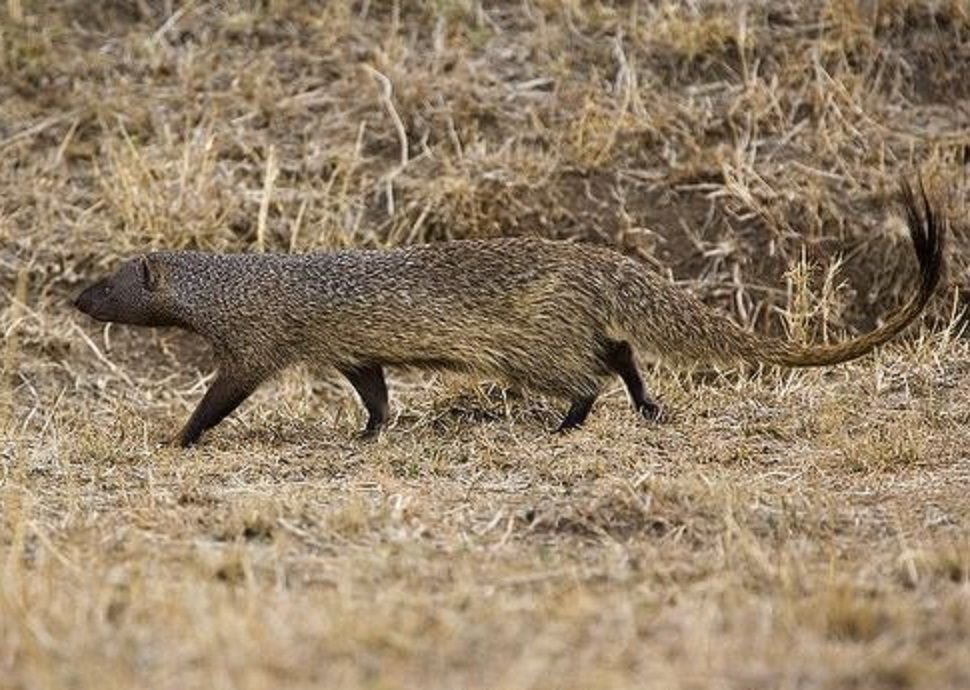
Egyptian Mongoose
Herpestes ichneumonThe confident grey ichneumon.
A large mongoose equally at home by water, in woodland and near farms.
Egyptian Mongoose Quick Facts
What Is an Egyptian Mongoose?
The Egyptian mongoose (Herpestes ichneumon) is a large, shaggy-grey mongoose, known across Africa as the ichneumon. It belongs to the mongoose family (Herpestidae) and has long been admired for its boldness and skill as a hunter.
Unlike many mongooses, it is comfortable near water, in open woodland and around farmland, moving confidently through landscapes that humans also use. Its presence near villages gave it a lasting place in African culture and history.
Why Is the Egyptian Mongoose Called "Ichneumon"?
The name ichneumon comes from ancient Greek, meaning "tracker" or "one that follows footprints" — a fitting title for a mongoose famous for pursuing its prey with relentless, nose-to-ground determination.
It was revered in ancient Egypt, where it was seen as a sacred guardian, celebrated for killing snakes and protecting crops and homes. Today it remains one of Africa's boldest and most adaptable mongooses, hunting by day across wetlands, woodland and farmland.
What Does the Egyptian Mongoose Eat?
A confident carnivore, the Egyptian mongoose hunts a wide range of prey, from snakes and rodents to birds, insects and eggs.
- Snakes — including venomous species
- Rodents and other small mammals
- Birds and their eggs
- Reptiles, frogs and crabs
- Insects and other invertebrates
How Does It Hunt?
It hunts by scent and sight, tracking prey relentlessly through grass, water margins and woodland.
Where Does the Egyptian Mongoose Live?
The Egyptian Mongoose is found across parts of Africa, with its main populations in eastern and, where applicable, southern regions. Its preferred habitat is Wetlands, woodland & farmland.
Eastern Africa
- Tanzania (incl. Zanzibar)
- Uganda
- Kenya
Southern Africa
- South Africa
- Southern coastal regions
Preferred Habitat
It favours wetlands, woodland & farmland, where cover, food and shelter are in balance.
Egyptian Mongoose in Tanzania
In Tanzania, the Egyptian mongoose is present near water and farmland, including on the island of Zanzibar where it is established.
Where Sightings May Occur
- Zanzibar — a known population on the island, often near farmland and shoreline.
- Tanzania wetland edges — rivers and marshes are prime habitat.
- Uganda — waterways and wetland edges support the species.
- Farmland and woodland — confident near human activity.
Where Can You See an Egyptian Mongoose on Safari?
The Egyptian Mongoose can be seen in several parks and reserves in Tanzania. The table below gives a realistic guide to habitat suitability.
| Destination | Habitat suitability | Sightings |
|---|---|---|
| Zanzibar | Good — island population | Possible |
| Wetland edges | Suitable | Possible |
| Farmland & woodland | Varies | Possible |
Egyptian mongooses are regularly encountered in suitable wetland and farmland habitats in Tanzania (including Zanzibar), but individual sightings remain unpredictable.
Want to explore Tanzania's lesser-known wildlife?
Egyptian Mongoose Behavior
Boldness
Confident hunter, comfortable near water and people.
Activity
Mostly diurnal — active during the day.
Communication
Uses scent and vocalisations to communicate.
Hunting skill
Renowned snake-killer and persistent tracker.
Dens
Rests in burrows and dense cover.
Egyptian Mongoose Family Life
Egyptian mongooses are flexible in their social lives — usually seen alone or in small family groups rather than tight pair bonds. Females raise their young in dens and teach them to hunt, with the young gradually learning the tracking skills for which the species is famous.
Physical Adaptations
Every feature of the Egyptian Mongoose is finely tuned for life in wetlands, woodland & farmland.
- Large, shaggy grey-brown coat
- Long, muscular body and thick tail
- Robust jaws and sharp teeth
- Slightly webbed feet suited to water margins
Vital statistics: body length approximately 48-60 cm long + tail, weight 1.5-4 kg, lifespan typically 15-20 yrs.
Egyptian Mongoose vs Marsh Mongoose & Slender Mongoose
How does the Egyptian Mongoose compare with its fellow African carnivores?
| Feature | Egyptian Mongoose | Marsh Mongoose | Slender Mongoose |
|---|---|---|---|
| Scientific name | Herpestes ichneumon | Atilax paludinosus | Herpestes sanguineus |
| Weight | 1.5-4 kg | 2-4 kg | 300-700 g |
| Size | 48-60 cm long + tail | 44-62 cm long + tail | 27-40 cm long + tail |
| Group size | Often solitary or small groups | Usually solitary | Often solitary or pairs |
| Lifespan | 15-20 yrs | 10-15 yrs | 10 yrs |
| Diet | Carnivore | Omnivore | Carnivore |
| Conservation | Least Concern | Least Concern | Least Concern |
Egyptian Mongoose vs Other African Predators
Compare the Egyptian Mongoose with Africa's other carnivores on their own species pages:
- Marsh Mongoose — compare in detail.
- Slender Mongoose — compare in detail.
- Golden Jackal, Black-backed Jackal & Side-striped Jackal — the canids.
- African Wild Dog — the cooperative hunter.
- Lion, Leopard & Cheetah — the big cats.
Predators of the Egyptian Mongoose
For such an egyptian mongoose, the savanna holds many dangers. It is important to distinguish between predators of adults and the greater threats facing young animals.
Adult Egyptian mongooses have few natural enemies, though large eagles and leopards may take them.
Young are vulnerable to snakes, birds of prey and domestic dogs.
Conservation Status
Least Concern does not mean the species has no conservation challenges. It means the species is not currently assessed in a higher IUCN threat category at the global level.
Widespread and adaptable, the Egyptian mongoose is listed as Least Concern and remains common across much of its range.
Did You Know?
Ancient Egyptians venerated the ichneumon as a sacred guardian.
It is a celebrated snake hunter, fearless against venomous species.
Unlike many mongooses, it is happy near water and wetlands.
It thrives close to farms and villages, not just wilderness.
Safari Guide's Perspective
Seeing an Egyptian mongoose patrol a Zanzibar shoreline is to watch a hunter with thousands of years of confidence. It glides, it tracks, and it simply doesn't back down.
Egyptian Mongoose in Pictures
A closer look at the Egyptian Mongoose in its natural East African habitat — its striking appearance, habitat and behaviour are best appreciated up close.
Frequently Asked Questions
No — the Egyptian Mongoose is currently listed as Least Concern on the IUCN Red List, though local populations can still face habitat pressure.
A confident carnivore, the Egyptian mongoose hunts a wide range of prey, from snakes and rodents to birds, insects and eggs.
Across wetlands, woodland & farmland in Northern, Eastern & Central Africa, including parts of Tanzania.
Yes — in suitable habitat such as Zanzibar, Tanzania & Uganda, although sightings vary by species and season.
Approximately 48-60 cm long + tail in body length and 1.5-4 kg in weight.
It is quick and agile, and thrives on a varied diet and adaptable hunting rather than raw speed.
Activity patterns vary by species — some are active by day, others almost entirely at night. Mostly diurnal — active during the day.
Herpestes ichneumon — a member of the Herpestidae family.
Key threats include habitat loss and local habitat changes, alongside natural predation.
They are flexible in their social lives — most often seen alone or in small family groups rather than tight pair bonds.
References & Further Reading
- IUCN Red List: Herpestes ichneumon
- Animal Diversity Web (University of Michigan): Species accounts for African carnivores, including diet, size and behavior.
- Tanzania Wildlife Research Institute (TAWIRI): Monitoring wildlife populations in Tanzania.
- Estes, R. (1991). The Behavior Guide to African Mammals. University of California Press.
- Kingdon, J. (2015). The Kingdon Field Guide to African Mammals. Bloomsbury.
- About these facts: Weight, speed and lifespan are approximate adult ranges. They can vary with sex, age, season, location and the measurement method; conservation status should be checked against the current IUCN assessment.