

.png)
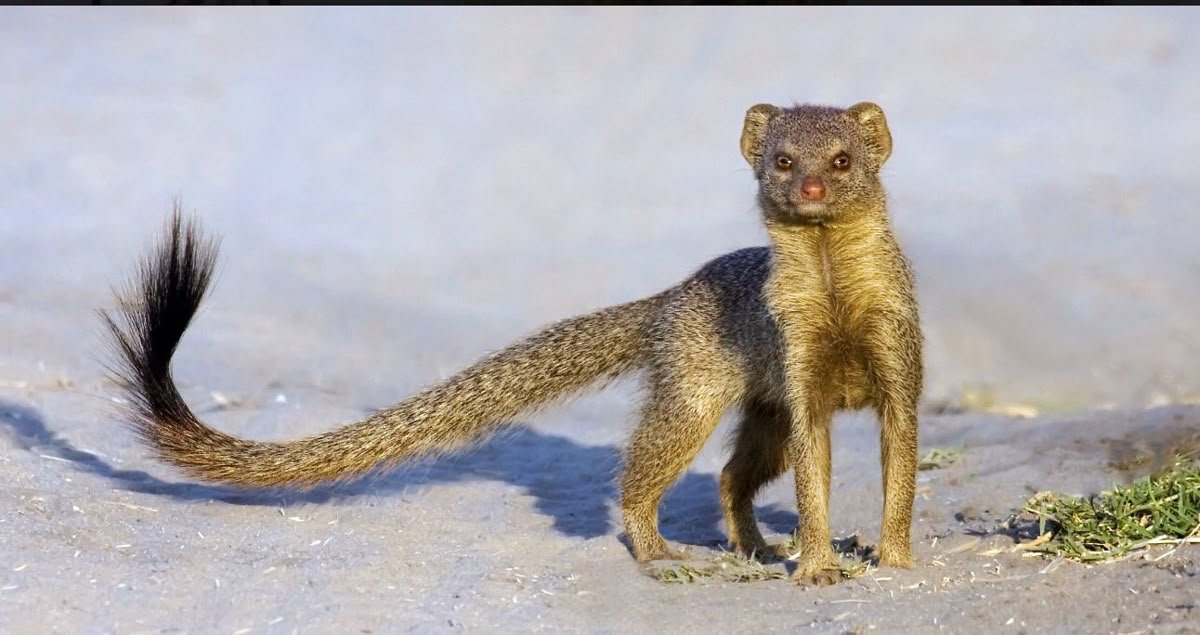
Slender Mongoose
Herpestes sanguineusA sleek, solitary mongoose that dashes across roads.
Sightings are never guaranteed and depend on local conditions. Follow your guide and respect park rules.
A confident diurnal hunter of small prey.
Slender Mongoose Quick Facts
What Is a Slender Mongoose?
The slender mongoose (Herpestes sanguineus) is a sleek, slim and often reddish-grey mongoose of the family (Herpestidae) that hunts alone by day.
With a nervous, darting energy, it crosses roads, skims through grass and probes every bush and rock in search of small prey.
Why Is the Slender Mongoose So Fast?
The slender mongoose's speed is its survival strategy. Hunting alone in the open, it relies on sudden, explosive dashes to catch wary prey and to cross dangerous gaps in the open — moving so fast it often seems to vanish.
That agility also serves it in defence. When startled, it bolts for cover with a zig-zag dash that confuses pursuers, making its speed both a hunting tool and a shield.
What Does the Slender Mongoose Eat?
A carnivore, the slender mongoose hunts a wide range of small prey, from insects to snakes, birds and eggs.
- Insects, especially beetles and grasshoppers
- Rodents and other small mammals
- Birds and their eggs
- Snakes and lizards
- Frogs and other invertebrates
How Does It Hunt?
It hunts by day with quick, darting movements, probing every crevice and bush.
Where Does the Slender Mongoose Live?
The Slender Mongoose is found across parts of Africa, with its main populations in eastern and, where applicable, southern regions. Its preferred habitat is Savanna & woodland.
Eastern Africa
- Tanzania
- Uganda
- Kenya
Southern Africa
- Southern Africa
- South Africa
Preferred Habitat
It favours savanna & woodland, where cover, food and shelter are in balance. Protected national parks across East Africa help maintain stable populations.
Slender Mongoose in Tanzania
In Tanzania and Uganda, the slender mongoose occurs in savanna and woodland, often seen along roadsides and in open grassy areas.
Where Sightings May Occur
- Throughout Tanzania — occurs in suitable savanna and woodland.
- Uganda — widespread in suitable habitat.
- Roadsides & open woodland — often seen crossing tracks.
Where Can You See a Slender Mongoose on Safari?
The slender mongoose can be seen in suitable savanna and woodland habitat in Tanzania. The table below gives a realistic guide to habitat suitability.
| Destination | Habitat suitability | Sightings |
|---|---|---|
| Most parks | Widespread | Possible |
| Roadsides | Frequent | Possible |
| Open woodland | Suitable habitat | Possible |
Slender mongooses are present in suitable habitat across Tanzania, but they are small, fast and solitary, so individual sightings are never guaranteed.
Want to explore Tanzania's lesser-known wildlife?
Slender Mongoose Behavior
Solitary
Hunts and lives alone.
Diurnal
Active during daylight hours.
Speed
Explosive dashes across open ground.
Communication
Scent marking and high-pitched calls.
Dens
Burrows, rock piles and hollows.
Slender Mongoose Family Life
Slender mongooses are usually solitary. Females raise their young in a den, and the young begin hunting independently before long, inheriting their mother's darting, opportunistic style.
Physical Adaptations
Every feature of the Slender Mongoose is finely tuned for life in savanna & woodland.
- Sleek, slim body — reddish-grey or yellowish
- Long, black-tipped tail
- Short legs built for speed
- Sharp teeth for a wide range of prey
Vital statistics: body length approximately 27-40 cm long + tail, weight 300-700 g, lifespan typically around 8-10 yrs in the wild (longer in captivity).
Slender Mongoose vs Dwarf Mongoose & Egyptian Mongoose
How does the Slender Mongoose compare with its fellow African carnivores?
| Feature | Slender Mongoose | Dwarf Mongoose | Egyptian Mongoose |
|---|---|---|---|
| Scientific name | Herpestes sanguineus | Helogale parvula | Herpestes ichneumon |
| Weight | 300-700 g | 200-350 g | 1.5-4 kg |
| Size | 27-40 cm long + tail | 18-28 cm long + tail | 48-60 cm long + tail |
| Habitat preference | Savanna, woodland | Savanna, termite mounds | Savanna, scrub |
| Social | Solitary | Social groups | Solitary |
| Lifespan | 8-10 yrs (wild) | 10-12 yrs (wild) | 15-20 yrs (wild) |
| Diet | Insects, rodents, snakes, birds, eggs | Insects, small vertebrates, fruit | Carnivore |
| Conservation | Least Concern | Least Concern | Least Concern |
Slender Mongoose vs Other African Predators
Compare the Slender Mongoose with Africa's other carnivores on their own species pages:
- Dwarf Mongoose — compare in detail.
- Egyptian Mongoose — compare in detail.
- Golden Jackal, Black-backed Jackal & Side-striped Jackal — the canids.
- African Wild Dog — the cooperative hunter.
- Lion, Leopard & Cheetah — the big cats.
Predators of the Slender Mongoose
For such a slender mongoose, the savanna holds many dangers. It is important to distinguish between predators of adults and the greater threats facing young animals.
Birds of prey and snakes threaten slender mongooses.
Larger carnivores such as jackals may also take them.
Conservation Status
Least Concern does not mean the species has no conservation challenges. It means the species is not currently assessed in a higher IUCN threat category at the global level.
Common, widespread and adaptable, the slender mongoose is listed as Least Concern.
Did You Know?
Its explosive speed makes it one of the fastest mongooses.
Lizards and snakes are among its preferred prey.
One of the few mongooses that hunts mainly by day.
Safari drivers often see it dashing across roads.
Safari Guide's Perspective
The slender mongoose is a flash of motion — gone before you can raise the camera. Watch one long enough and you'll see a perfect, focused little hunter at work.
Slender Mongoose in Pictures
A closer look at the Slender Mongoose in its natural East African habitat — its striking appearance, habitat and behaviour are best appreciated up close.
Frequently Asked Questions
No — the Slender Mongoose is currently listed as Least Concern on the IUCN Red List, though local populations can still face habitat pressure.
A carnivore, the slender mongoose hunts a wide range of small prey, from insects to snakes, birds and eggs.
Across savanna & woodland in Sub-Saharan Africa, including parts of Tanzania.
Yes — in suitable habitat such as Throughout Tanzania & Uganda, although sightings vary by species and season.
Approximately 27-40 cm long + tail in body length and 300-700 g in weight.
It is quick and agile with explosive dashes, but relies on stealth and speed for short bursts rather than sustained speed.
Activity patterns vary by species — some are active by day, others almost entirely at night.
Herpestes sanguineus — a member of the Herpestidae family.
Key threats include habitat loss and local habitat changes, alongside natural predation.
Hunts and lives alone.
References & Further Reading
- IUCN Red List: Herpestes sanguineus
- Animal Diversity Web (University of Michigan): Species accounts for African carnivores, including diet, size and behavior.
- Tanzania Wildlife Research Institute (TAWIRI): Monitoring wildlife populations in Tanzania.
- Estes, R. (1991). The Behavior Guide to African Mammals. University of California Press.
- Kingdon, J. (2015). The Kingdon Field Guide to African Mammals. Bloomsbury.
- About these facts: Weight, speed and lifespan are approximate adult ranges. They can vary with sex, age, season, location and the measurement method; conservation status should be checked against the current IUCN assessment.