

.png)
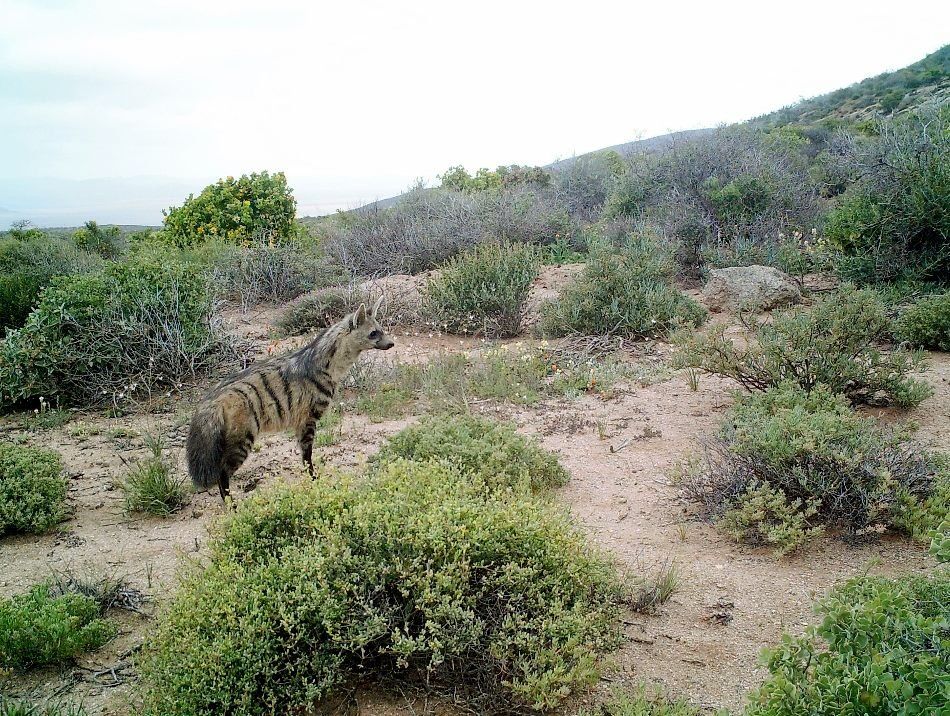
Aardwolf
Proteles cristata — the small, striped, termite-eating hyena of Africa's dry savannas; solitary, nocturnal and almost exclusively termite-fed.Introduction to the Aardwolf
The aardwolf (Proteles cristata) is one of Africa's most misunderstood mammals. A member of the hyena family (Hyaenidae), it looks like a small, striped hyena yet it is a near-exclusive termite eater - not a scavenger. Weighing only 8–14 kg, it is about a quarter the mass of a striped hyena and relies on a flat, sticky tongue to lap up termites by the hundred thousand each night.
Aardwolves are solitary or paired, secretive and nocturnal, spending daylight in burrows and emerging after dark to follow the columns of surface-foraging termites. In Tanzania they occur in the dry open savannas of the north and centre, and are best looked for on dedicated night drives. Sightings are rare: densities usually fall below one adult per square kilometre, and their timid nature keeps them well away from people and vehicles.
Why the Aardwolf is Ecologically Vital
As a specialist termite predator it provides natural pest control, consuming enormous numbers of harvester termites each year and helping protect grasslands used by livestock and crops.
A Species Worth Understanding
Understanding the real aardwolf - its termite diet, dry-savanna life and shy nocturnal habits - replaces vague template copy with one of Africa's most specialised small carnivores.
Scientific Classification
The aardwolf is the only member of Hyaenidae built around a soft, insect diet; its reduced teeth and sticky tongue set it apart from the bone-cracking spotted and striped hyenas. The IUCN recognises it as Proteles cristata, listed as Least Concern.
Physical Characteristics
The aardwolf is built for life in dry, open savanna:
- Size: Head-and-body length about 55–80 cm; the tail adds a further 20–30 cm.
- Weight: Adults weigh about 8–14 kg.
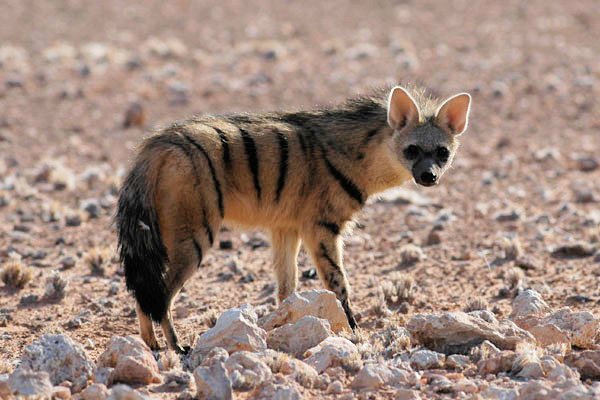
- Coat: A buff-yellow to brown coat marked with dark vertical stripes, plus a thick mane of longer hair along the back and neck.
- Mane: The dorsal mane erects when alarmed, making the animal look nearly twice its size.
- Face: Large, pointed ears and a slender skull; the snout is hairless so termite toxin does not stick to it.
- Teeth: Cheek teeth are reduced to small pegs because the diet is soft termites; only the canines remain well developed, for defence.
- Build: Forelegs longer than hind legs give the sloping stance typical of hyenas.
Social System & Behaviour
The aardwolf is solitary or paired - not the generic 'group / bachelor' template:
- Pair territory: A socially monogamous male-female pair shares a territory of about 1–4 km²; the only durable grouping is the pair with its dependent young.
- Solitary foraging: Adults forage alone and do not share food, because termites cannot be carried back to a den.
- Not bachelor animals: Describing aardwolves as 'bachelor groups' is not supported; their society is built around a quiet, low-density pair bond.
- Territory marking: Both sexes smear anal-gland secretions ('pasting') on grass to mark territory; the male marks most often.
- Vocal: Largely silent - a cluck or roar only when startled, fighting or stressed.
Aardwolf Young & Reproduction
Young develop slowly, as is typical of hyenas:
- Mating: Seasonal - in southern Africa, mating falls in late June to mid-July.
- Litter: Usually 2–4 cubs (occasionally up to five) after a gestation of about 90 days.
- Care: The mother forages nightly while the male guards the den; both parents later feed the cubs regurgitated termites.
- Dependency: Cubs are born underdeveloped and remain dependent for months - they are not 'soon able to follow' independently.
Habitat: Where They Thrive
The aardwolf is a dry, open savanna and grassland specialist. 'Forest' alone is wrong:
Key Habitat Types:
- Dry open savanna: The core habitat - short grass and open ground where harvester termites flourish.
- Grassland: Open grassland with scattered acacias, away from dense bush.
- Arid thresholds: It avoids true desert and dense forest, needing country where termites are abundant.
- Climate: Areas with annual rainfall below about 80 cm; it uses burrows to escape heat.
Climate & Cover:
It depends on intact termite-rich grassland; conversion of this habitat and loss of termites are the main pressures on local populations.
Distribution Map
The aardwolf occurs across eastern and southern Africa wherever dry savanna and abundant termites coincide - not a Tanzania-only species, but Tanzania holds strong populations:
In Tanzania, aardwolves occur in the dry savannas of Serengeti, Tarangire and Ruaha - seen on patient night drives.
Because it is a shy, nocturnal forager, a sighting means a guided night drive - present in the right dry habitat but never guaranteed.
Where to See the Aardwolf in Tanzania
The aardwolf is seen on night drives through Tanzania's dry savannas. These are the headline spots:
Serengeti NP
Best: Jun–Oct | Region: Tanzania, dry savanna
Rare (nocturnal)
Tip: Night drives on the open plains; watch for low eyeshine near termite trails.
Tarangire NP
Best: Jun–Oct | Region: Tanzania, dry savanna
Rare (nocturnal)
Tip: Open grassland and seasonal swamps hold abundant termites - the aardwolf's food.
Ruaha NP
Best: Jun–Oct | Region: Tanzania, dry savanna
Rare (nocturnal)
Tip: A vast dry-savanna wilderness; sightings are rare and almost entirely after dark.
Mikumi NP
Best: Jun–Oct | Region: Tanzania, dry savanna
Rare (nocturnal)
Tip: Accessible southern savanna; a good option for a night drive near Dar es Salaam.
Aardwolf in Pictures
A closer look at the aardwolf (Proteles cristata) - the small, striped, termite-eating hyena of Africa's dry savannas.
Where to Spot the Aardwolf on Safari
Plan a night-drive safari into Tanzania's dry savannas to look for the elusive aardwolf. Explore the destinations below.
Diet: What They Eat
The aardwolf is a highly specialised termite feeder - far more specific than a generic 'insectivore':
- Primary Diet: Termites almost exclusively, especially the harvester termites Trinervitermes and Hodotermes.
- Foraging method: It feeds on termites that forage on the surface at night, lapping them up with a broad, flat, sticky tongue - a single animal may eat 200,000–300,000 termites in one night.
- Seasonal switching: Trinervitermes are active in warmer months; Hodotermes stay active into cooler months, so the aardwolf switches prey by season.
- Toxin tolerance: Soldier termites of Trinervitermes release a terpene toxin that deters most predators; the aardwolf is unfazed by it.
- Water: Termites are about 74% water, so the aardwolf rarely drinks - it gets almost all fluid from its prey.
- Rare extras: The odd insect, egg or scrap of carrion is taken only occasionally; termites dominate.
Ecosystem Role: A natural termite-control agent that can consume around 100 million termites per individual per year, protecting rangeland and crops.
Daily Behaviour & Social Life
Daily Rhythm
Day: Nocturnal - rests in a subterranean burrow through the heat of the day.
Dusk & Night: Emerges after dark to follow surface-foraging termite columns, moving steadily and pausing to lick termites from the ground.
Cooler months: In winter it may surface in the late afternoon to forage, but the core routine is a night-time termite hunt.
Social Structure
- Pair territory: A socially monogamous male-female pair holds a territory of 1–4 km²; young stay only while dependent.
- Communication: Quiet - scent marking (anal-gland 'pasting') defines territory; loud calls are rare.
- Movement: A low, shuffling forager that listens and smells for termites rather than chasing prey.
Predators & Threats
Adult aardwolves have few natural predators; the greater threats are persecution by farmers, roadkill, habitat conversion and loss of termite prey. Its best defence is secrecy and a bolt to the burrow.
Watching tip: On a night drive, scan the roadside grassland with a spotlight for low eyeshine and the striped silhouette moving through short grass.
Reproduction & Lifespan
- Mating: Seasonal (late June–July in southern Africa); a socially monogamous pair.
- Gestation: About 90 days.
- Litter: Usually 2–4 cubs.
- Care: Mother forages nightly; the male guards the den; both feed cubs regurgitated termites.
- Lifespan: Up to about 15–20 years (captive record ~20 years).
Conservation Status
IUCN Red List Status: Least Concern - the aardwolf (Proteles cristata) has stable populations across its dry African range.
Major Threats
- Persecution: mistaken killing by farmers who wrongly believe it attacks livestock (it does not).
- Roadkill: aardwolves are frequently hit on rural roads at night.
- Habitat loss: conversion of open grassland to agriculture or dense woodland.
- Termite decline: pesticides and overgrazing that reduce harvester-termite abundance.
Conservation Programs
Protected parks are the front line. In Tanzania the Tanzania National Parks (TANAPA) and Wildlife Division manage Serengeti, Tarangire, Ruaha and Mikumi; the IUCN SSC Hyaena Specialist Group and African Parks support carnivore research and coexistence programmes across the range.
20 Interesting Facts
Aardwolf vs Other Mammals
Aardwolf vs Aardvark
| Feature | Aardwolf | Aardvark |
|---|---|---|
| Order / Family | Carnivora, Hyaenidae | Tubulidentata (own order) |
| Diet | Almost entirely termites (surface) | Termites & ants (dug from mounds) |
| Foraging | Laps termites with sticky tongue | Digs mounds with massive claws |
| Size | 8–14 kg | 40–65 kg |
| Teeth | Reduced peg teeth | Tubular prismatic teeth |
Aardwolf vs Striped Hyena
| Feature | Aardwolf | Striped Hyena |
|---|---|---|
| Diet | Near-exclusive termites | Scavenger (carrion, bone) |
| Size | 8–14 kg (small) | ~25–45 kg (larger) |
| Coat | Buff-yellow, dark vertical stripes | Grey, vertical stripes |
| Social | Solitary / paired | Solitary / small clan |
Aardwolf in African Context
The aardwolf's shy, nocturnal ways make it one of the least-seen carnivores of the savanna - a quiet counterpart to the better-known spotted hyena. By keeping harvester-termite numbers in check, it quietly supports the health of the grasslands that livestock and people depend on, making it a small but valuable part of Africa's dry-country ecosystem.
Wildlife Photography Guide
- Best Camera Lens: A 100-400mm or longer lens; aardwolves are small and shy, so reach matters.
- Best Time: On guided night drives; use a spotlight with a red or diffused beam to find eyeshine without alarming it.
- Best Habitat: Serengeti, Tarangire and Ruaha (Tanzania) dry savannas.
- Best Behaviour: Capture the striped coat and bushy tail at the roadside; shoot at high ISO with a stabilised lens.
- Safety Distance: Keep the vehicle's distance, use a soft light and never disturb a foraging animal.
Frequently Asked Questions
The aardwolf (Proteles cristata) is a small member of the hyena family with a striped coat, living in Africa's dry savannas. It is a near-exclusive termite eater, not a scavenger.
It is a true hyena (family Hyaenidae). The 'wolf' in the name is misleading - it is not closely related to wolves.
Almost entirely termites - especially Trinervitermes and Hodotermes. It laps them from the surface with a sticky tongue and may eat 200,000–300,000 in a night.
No. Its diet is soft termites and it cannot kill or eat livestock. It is entirely harmless to people and domestic animals.
Yes. It rests in burrows by day and forages after dark, switching to late-afternoon foraging only in cooler winter months.
Largely solitary or paired. A monogamous male-female pair shares a territory with its young; adults avoid one another and do not share food.
Weight about 8–14 kg; head-body 55–80 cm plus a 20–30 cm tail. It is roughly a quarter the size of a striped hyena.
In dry savanna parks such as Serengeti, Tarangire, Ruaha and Mikumi, almost exclusively on night drives. Sightings are rare.
Least Concern (IUCN), with stable populations. Main threats are accidental persecution, roadkill and loss of termite-rich grassland.
The aardvark is unrelated (order Tubulidentata), much larger, digs open termite mounds with claws, and has tubular teeth; the aardwolf laps surface termites and is a hyena.
Some scientists suggest Batesian mimicry - the harmless aardwolf gaining protection by resembling the tougher striped hyena - though evidence is not conclusive.
Yes - on night drives with a long lens, a high ISO and a soft spotlight; keep the guided distance and move slowly.
Related Safari Packages & Tours
Plan a night-drive safari into Tanzania's dry savannas to look for the elusive aardwolf with our expert guides.
References & Further Reading
- IUCN Red List: Proteles cristata - Least Concern.
- Animal Diversity Web (University of Michigan): Proteles cristata account.
- About these facts: Weight, size and lifespan are approximate adult ranges that vary by sex, age, location and measurement method; conservation status should be checked against the current IUCN assessment.
Sightings are never guaranteed and depend on local conditions.