

.png)
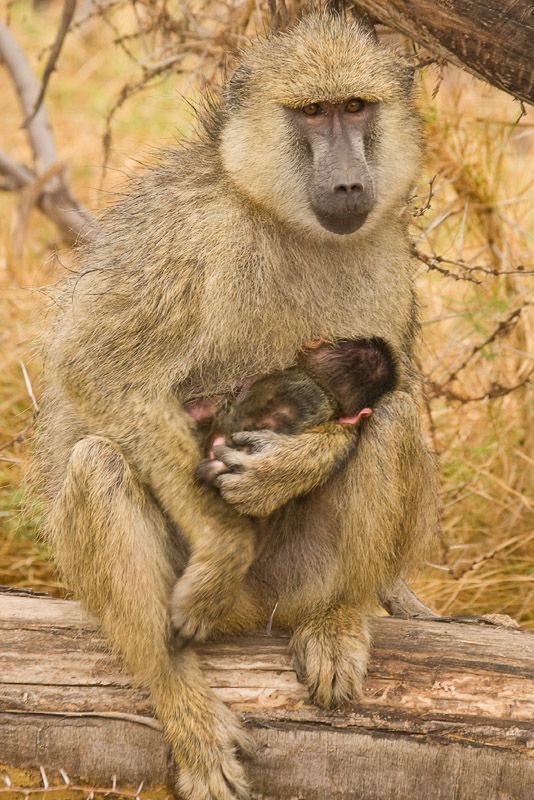
Yellow Baboon
Papio cynocephalus — a robust, dog-muzzled savanna baboon of East Africa, living in large, politically complex troops and capable of hunting small prey.Introduction to the Yellow Baboon
The yellow baboon (Papio cynocephalus) is one of the most successful large primates of East Africa — a robust, ground-living monkey with a distinctive yellowish-brown coat and a long, dog-like muzzle. It thrives across the savannas and open woodlands of eastern Africa, including most of Tanzania, and is a regular sight on southern-circuit safaris in Nyerere, Ruaha and Mikumi. Living in big, layered troops, yellow baboons are a showcase of primate social complexity — and surprisingly capable hunters.
Why the Yellow Baboon is Ecologically Vital
As a wide-ranging omnivore it links plants, seeds, insects and small animals, and its hunting of small vertebrates makes it a small but real predator in the savanna food web.
A Species Worth Understanding
Understanding the real yellow baboon — its troop politics, matrilines and hunting — replaces vague template copy with one of Africa's best-known primates.
Scientific Classification
A member of the Old World monkey family (Cercopithecidae), the yellow baboon is one of several savanna baboons of the genus Papio. The IUCN lists it as Papio cynocephalus, assessed as Least Concern.
Physical Characteristics
The yellow baboon is built for life on the ground with strong climbing ability:
- Size & weight: Adults weigh about 10–25 kg (males much larger than females); head-body length is 50–60 cm, with total length up to ~114 cm including the tail.
- Long tail: A 45–60 cm tail carried in a characteristic arch; it is not prehensile but helps with balance and signalling.
- Coat & muzzle: Yellowish-brown fur with a dark, hairless, dog-like muzzle and close-set eyes built for binocular vision.
- Sexual dimorphism: Males are markedly larger with bigger canines and a mane-like cape of longer hair on the shoulders.
- Hands & ischial callosities: Dexterous fingers for foraging and tough sitting pads for resting on the ground.
Social System & Behaviour
The yellow baboon lives in large, complex, multi-level troops:
- Troop size: Typically 20–80 individuals (occasionally over 100), made of several adult males, many females and their offspring.
- Matrilines: Females stay in their natal troop for life, forming stable kinship networks; rank is inherited through the female line.
- Male rank & competition: Males compete for dominance and access to females; rank shapes feeding priority and mating. Coalitions and alliances are central to male politics.
- Male turnover & infanticide: When a new male rises to dominance he may kill unrelated infants, bringing females back into breeding condition — a documented cost of baboon social life.
- Communication: More than ten vocalizations, including the famous "wahoo" call of males; grooming, facial signals and posture manage daily life.
Yellow Baboon Young & Reproduction
- Mating: Females cycle roughly yearly; mating is not strictly seasonal across the range.
- Litter: Usually a single infant (twins very rare) after a gestation of about 6 months.
- Care: The mother carries the infant on her belly and later on her back; infants are groomed and defended by many troop members. Males may be protective of infants they likely fathered.
- Independence: Young are weaned at about a year and integrated into the troop's social life.
Habitat: Where They Thrive
The yellow baboon is a savanna and open-woodland generalist:
Key Habitat Types:
- Open savanna & grassland: The core habitat, where troops forage on the ground.
- Riverine & miombo woodland: Tree lines and woodlands provide sleeping sites, shade and extra food.
- Rock outcrops & escarpments: Used for sleeping and refuge from predators.
- Farmland edges: Like vervets, they use croplands, which brings conflict.
Climate & Cover:
They need trees or cliffs for sleeping and water nearby, but tolerate hot, dry savanna better than most monkeys.
Distribution Map
The yellow baboon occurs across eastern Africa, from South Sudan and Ethiopia south through Kenya, Tanzania and into Mozambique and eastern DR Congo:
In Tanzania it is widespread, especially in the south (Nyerere, Ruaha, Mikumi) and across the north (Serengeti, Tarangire, Lake Manyara).
Because it is diurnal and often near roads, a sighting means a game drive — common in the right habitat but never guaranteed.
Where to See the Yellow Baboon in Tanzania
The yellow baboon is seen on game drives across Tanzania — it is one of the easier large primates to find:
Nyerere NP
Best: Year-round | Region: Southern Tanzania
Visible – not guaranteed
Tip: The vast Selous (now Nyerere) wilderness holds large baboon troops along the rivers and woodlands.
Ruaha NP
Best: Year-round | Region: South-central Tanzania
Visible – not guaranteed
Tip: A stronghold for big game and baboons in dry savanna and riverine woodland.
Mikumi NP
Best: Year-round | Region: Southern Tanzania
Visible – not guaranteed
Tip: Easy to reach from Dar es Salaam, with habituated troops along the main game-drive tracks.
Serengeti NP
Best: Year-round | Region: Northern Tanzania
Visible – not guaranteed
Tip: Open savanna across the Serengeti supports baboon troops on game-drive routes.
Yellow Baboon in Pictures
A closer look at the yellow baboon (Papio cynocephalus) - the robust, dog-muzzled savanna baboon of East Africa.
Where to Spot the Yellow Baboon on Safari
Plan a game drive in Tanzania to look for yellow baboon troops and their complex social life. Explore the destinations below.
Diet: What They Eat
The yellow baboon is a true opportunistic omnivore — a generalist that shifts with season and opportunity, and is also a capable hunter:
- Grasses: Grass blades, rhizomes and seeds are staple foods across the year.
- Fruits & seeds: Ripe fruit and seeds are favoured when available.
- Roots & tubers: Dug from the ground, especially in dry seasons.
- Leaves, shoots, flowers & bark: Foliage and other plant parts supplement the diet.
- Insects: Grasshoppers, caterpillars and other arthropods add protein.
- Eggs & small vertebrates: Birds' eggs, lizards, rodents, nestlings - and baboons actively hunt small prey such as hares, young antelope and birds, not just scavenge.
- Crops: Near farmland, troops raid maize, fruit and vegetables - a major source of conflict.
Ecosystem role: As a wide-ranging omnivore (and occasional predator) it influences seeds, insects and small-animal populations, and is prey for large carnivores.
Daily Behaviour & Social Life
Activity Pattern (diurnal, terrestrial)
Diurnal and largely terrestrial: a typical day mixes long periods of ground foraging with resting, grooming, travelling and drinking. When the troop moves, dominant males often lead, females and young stay in the protected middle, and lower-ranking males trail behind.
Day: Foraging on the ground, with sentinels and midday rests in shade or trees.
Night: Sleeps in trees or on cliffs, safe from ground predators.
Social Structure
- Troops: 20–80+ individuals built around female kin networks and shifting male rank.
- Alliances: Coalitions of females and of males challenge rivals; grooming cements bonds and eases tension.
- Infants: Central to social life - carried, groomed and defended by many troop members.
Predators & Threats
Natural predators include lions, leopards, hyenas, crocodiles and martial eagles (which take infants). On the ground, baboons rely on numbers, vigilance and flight to trees. The main human-driven threats are persecution as crop pests, roadkill, the pet trade and habitat loss.
Watching tip: On a game drive, watch a troop's "wahoo" calls and the way the dominant male positions himself - it reveals the troop's social order.
Reproduction & Lifespan
- Mating: Females cycle about yearly; not strictly seasonal across the range.
- Gestation: About 6 months.
- Litter: Usually one infant.
- Care: The mother carries and raises the infant with troop support; weaned at about a year.
- Lifespan: Around 15–20 years in the wild (to ~30+ in captivity).
Conservation Status
IUCN Red List Status: Least Concern — the yellow baboon (Papio cynocephalus) is assessed as Least Concern, though locally affected by conflict.
Major Threats
- Crop conflict: Shot or poisoned as a pest where troops raid farms.
- Roadkill & pet trade: Killed on roads and captured for the pet trade (often killing the mother).
- Habitat loss: Conversion of woodland and savanna reduces refuge and food.
Conservation Programs
Protected areas are the main safeguard. In Tanzania the Tanzania National Parks (TANAPA) and Wildlife Division protect baboon habitat across Nyerere, Ruaha, Mikumi, the Serengeti and Tarangire. The IUCN SSC Primate Specialist Group supports monitoring and human-wildlife coexistence work.
20 Interesting Facts
Yellow Baboon vs Other Primates
Yellow Baboon vs Vervet Monkey
| Feature | Yellow Baboon | Vervet |
|---|---|---|
| Build | Robust, dog-muzzled | Slender, long-tailed |
| Troop | 20–80+, multi-male | 10–50, matrilineal |
| Diet | Omnivore + hunts | Omnivore |
| Habitat | Savanna/woodland | Savanna/woodland |
Yellow Baboon vs Olive Baboon
| Feature | Yellow Baboon | Olive Baboon |
|---|---|---|
| Range | Eastern Africa | Wider, incl. central/west |
| Coat | Yellowish-brown | Olive-grey |
| Muzzle | Long, dog-like | Long, dog-like |
| Social | Large multi-male troops | Large multi-male troops |
Yellow Baboon in African Context
The yellow baboon is one of the most visible primates of the East African savanna — a symbol of social intelligence, adaptability and resilience. Living alongside people, it is both admired and persecuted; reducing crop conflict and keeping wild spaces connected helps this big, brainy monkey remain a common resident of the bush.
Wildlife Photography Guide
- Best Camera Lens: A 100-400mm or super-telephoto; troops move on the ground but tolerate vehicles.
- Best Time: Early morning and late afternoon game drives, when troops are active.
- Best Habitat: Savanna and riverine woodland in Nyerere, Ruaha, Mikumi, Serengeti.
- Best Behaviour: Capture the "wahoo" call, grooming sessions and the dominant male's posture.
- Safety Distance: Never feed; keep a respectful distance from the troop.
Frequently Asked Questions
The yellow baboon (Papio cynocephalus) is a large, ground-living savanna primate of East Africa, with a yellowish-brown coat and a long dog-like muzzle.
Yes - it lives in large multi-male, multi-female troops of 20–80+ built around female matrilines, with shifting male dominance and alliances.
Yes - beyond omnivorous foraging, yellow baboons actively hunt small prey such as hares, young antelope, birds, lizards and rodents, not just scavenge.
An opportunistic omnivore: grasses, fruit, seeds, roots, tubers, leaves, insects, eggs and small vertebrates; it also raids crops.
On game drives in Nyerere, Ruaha, Mikumi and the Serengeti - it is one of the easier large primates to find.
Least Concern (IUCN), though locally persecuted as a crop pest and by the pet trade.
Adults weigh about 10–25 kg (males much larger); body 50–60 cm with a 45–60 cm tail.
When a new male takes over a troop he may kill unrelated infants; this brings the mothers back into breeding condition and can improve his own reproductive success.
Savanna and open woodland with trees or cliffs for sleeping and water nearby; it tolerates dry, hot country.
Yes - on a game drive with a long lens in the early morning; watch for the "wahoo" call and grooming behaviour.
Lions, leopards, hyenas, crocodiles and martial eagles (infants); humans through shooting, roadkill and the pet trade.
The mother carries a single infant (helped by the troop) and is protective; young are weaned at about a year.
Related Safari Packages & Tours
Plan a game drive in Tanzania to look for yellow baboon troops and their complex social life with our expert guides.
References & Further Reading
- IUCN Red List: Papio cynocephalus - Least Concern.
- About these facts: Weight, size and lifespan are approximate adult ranges that vary by sex, age, location and measurement method; conservation status should be checked against the current IUCN assessment.