

.png)
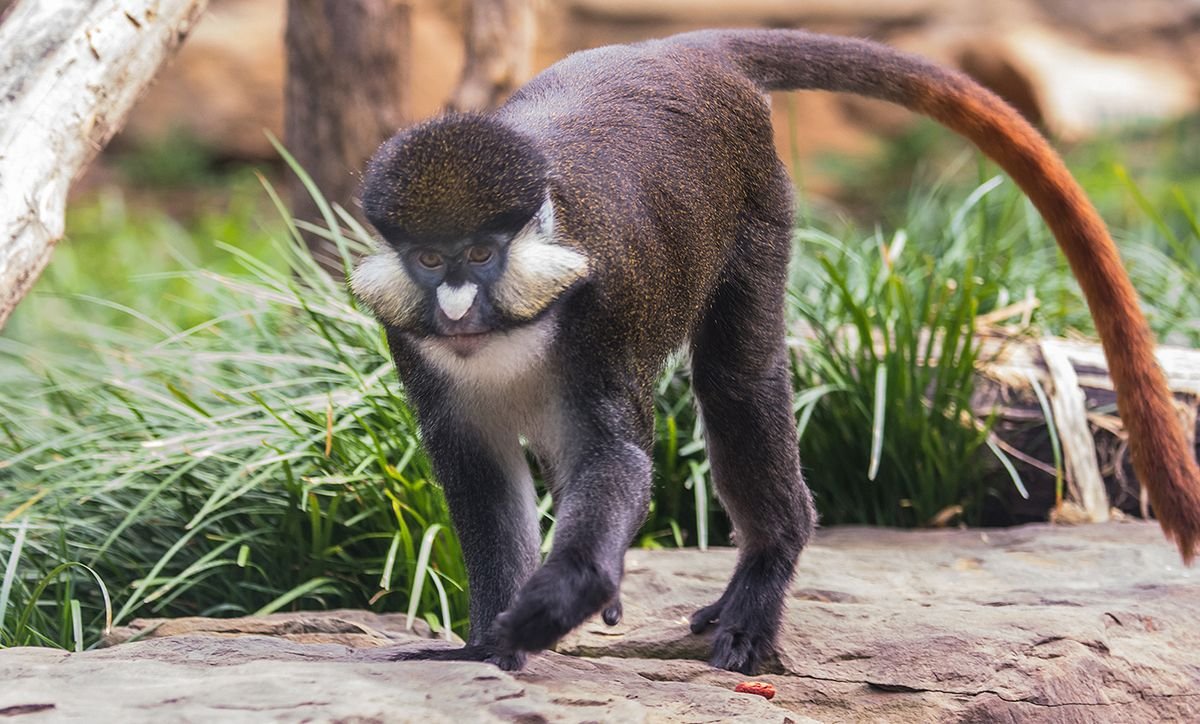
Red-tailed Monkey
Cercopithecus ascanius — a slender, long-tailed, fruit-eating guenon of Africa's rainforests, often seen moving through the canopy in mixed monkey troops.Introduction to the Red-tailed Monkey
The red-tailed monkey (Cercopithecus ascanius) — also called the black-cheeked white-nosed monkey or red-tailed guenon — is one of Africa's most widespread and frequently seen forest monkeys. A slender guenon with a dark face mask, a pale nose stripe and a long reddish tail, it thrives in the rainforests of the Congo Basin and East Africa. Largely fruit-eating and endlessly active in the canopy, it is a highlight of any forest primate walk.
Why the Red-tailed Monkey is Ecologically Vital
As a major fruit-eater it is an important seed disperser for many forest trees, and by joining mixed-species troops it helps the whole monkey community detect predators.
A Species Worth Understanding
Understanding the real red-tailed monkey — its frugivorous diet, canopy life and mixed troops — replaces vague template copy with one of Africa's best-loved forest primates.
Scientific Classification
A member of the Old World monkey family (Cercopithecidae), the red-tailed monkey is one of the many forest guenons of the genus Cercopithecus. The IUCN lists it as Cercopithecus ascanius, assessed as Least Concern.
Physical Characteristics
The red-tailed monkey is built for fast, agile life in the canopy:
- Size & weight: Adults weigh about 3–4.5 kg; head-body length is roughly 38–55 cm.
- Long tail: The tail is 55–80 cm — longer than the body — and reddish, giving the species its name; it is used for balance and signalling.
- Coat: Olive-grey to brown upperparts, a pale belly, a dark "cheek" mask and a white or pale nose stripe; the distinctive red tail is the namesake feature.
- Face & hands: A dark face, large eyes for canopy vision, and cheek pouches used to cram in food while foraging.
- Sexes: Males are slightly larger than females, with bigger canines.
Social System & Behaviour
The red-tailed monkey is a highly social, diurnal, arboreal primate living in structured troops:
- Troop size: Typically 10–40 individuals (often 20–30), made of several adult females, their offspring and one or a few adult males.
- Female core: Females form the stable, philopatric core of the troop; they stay in their natal group for life and maintain the strongest bonds.
- Male dispersal: Males disperse from their birth troop; all-male bands of bachelor males also move on the periphery of the group system.
- Mixed-species troops: Red-tailed monkeys are famous for joining mixed-species associations with blue monkeys, red colobus and other guenons — these combined troops improve predator detection and foraging efficiency.
- Communication: A rich set of calls including alarm calls, contact calls and the male's "pyow-hack" series; grooming reinforces bonds.
Red-tailed Monkey Young & Reproduction
- Mating: Breeding can occur year-round, with seasonal peaks in some populations.
- Litter: Usually a single infant (twins are rare) after a gestation of about 5–6 months.
- Care: The mother carries and nurses the infant; troop females may allomother. The bright natal coat makes the young easy for the troop to track.
- Independence: Young are weaned at several months and join the troop's foraging.
Habitat: Where They Thrive
The red-tailed monkey is an arboreal forest primate of equatorial Africa:
Key Habitat Types:
- Rainforest: Lowland and swamp rainforest is core habitat across the Congo Basin and East Africa.
- Montane & secondary forest: Also uses mid-altitude forest and regenerating woodland.
- Gallery & riverine forest: Forest along rivers and lake shores, including the shores of Lake Tanganyika.
- Canopy life: It spends almost all its time in the trees, rarely descending except to cross gaps or drink.
Climate & Cover:
It needs intact or recovering forest with a continuous canopy; deforestation and forest fragmentation are the main pressures.
Distribution Map
The red-tailed monkey occurs across the equatorial belt of Africa, from the Congo Basin eastwards to western Kenya, Uganda and western Tanzania:
In Tanzania it is found in the western forests of Mahale and Gombe; in Uganda in Kibale and Bwindi.
Because it moves quickly through the high canopy, a sighting means a patient forest or primate walk — present in the right forest but never guaranteed.
Where to See the Red-tailed Monkey in Tanzania & Uganda
The red-tailed monkey is seen on guided forest / primate walks — never a game drive. These are the headline spots (correct countries and flags):
Mahale Mountains NP
Best: Year-round | Country: Tanzania, Lake Tanganyika forest
Visible – not guaranteed
Tip: Forest walks here double as chimpanzee treks; red-tailed monkeys are regular in the canopy.
Gombe Stream NP
Best: Year-round | Country: Tanzania, Lake Tanganyika forest
Visible – not guaranteed
Tip: Jane Goodall's chimp site also holds red-tailed monkeys along the forest trails.
Kibale Forest NP
Best: Year-round | Country: Uganda, tropical rainforest
Visible – not guaranteed
Tip: Uganda's primate capital - red-tailed monkeys are regular on guided forest walks.
Bwindi Impenetrable NP
Best: Year-round | Country: Uganda, montane rainforest
Visible – not guaranteed
Tip: On gorilla-tracking approaches, scan the canopy for foraging troops.
Red-tailed Monkey in Pictures
A closer look at the red-tailed monkey (Cercopithecus ascanius) - the slender, long-tailed fruit-eating guenon of Africa's rainforests.
Where to Spot the Red-tailed Monkey on Safari
Plan a guided forest or primate walk into Tanzania and Uganda's rainforests to look for the red-tailed monkey. Explore the destinations below.
Diet: What They Eat
The red-tailed monkey is primarily a fruit-eater (frugivorous) — not a generic omnivore. Fruit makes up the majority of its intake:
- Fruit: The staple — ripe fruit and seeds can be well over half the diet. Figs and other seasonal fruits are especially important energy sources.
- Leaves: Young and mature leaves supplement the fruit, particularly when fruit is scarce.
- Flowers, buds & gum: Flowers, buds and tree gums add variety through the year.
- Insects: Insects (caterpillars, beetles and other arthropods) are a notable protein source, especially for growing young.
- Small animal prey: Occasionally other small invertebrates or tiny vertebrates are taken.
- Cheek pouches: It uses its cheek pouches to cram in food while foraging, then retreats to a safe perch to chew.
Ecosystem role: By swallowing and passing fruit seeds, it is a major forest seed disperser.
Daily Behaviour & Social Life
Activity Pattern (diurnal, arboreal)
Diurnal and almost entirely arboreal: a typical day is spent high in the canopy — foraging for fruit, moving through the treetops in a cohesive troop, grooming and resting between feeding bouts.
Day: Active from dawn, foraging and travelling through the canopy.
Night: Rests in the trees, hidden among foliage.
Social Structure
- Troops: 10–40 individuals built around a female core; one or a few dominant males; bachelor all-male bands on the edge.
- Mixed-species troops: Frequently associates with blue monkeys, red colobus and other guenons — a classic African forest "mixed troop."
- Communication: Contact calls keep the troop together; alarm calls warn of crowned eagles, chimpanzees and leopards.
Predators & Threats
Natural predators include crowned eagles, chimpanzees, leopards and wild cats. The main human-driven threats are deforestation, forest fragmentation and the bushmeat trade.
Watching tip: On a forest walk, look up into the canopy and listen for the troop's calls; scan for the flash of a red tail moving through the leaves.
Reproduction & Lifespan
- Mating: Year-round, with seasonal peaks in some areas.
- Gestation: About 5–6 months.
- Litter: Usually one infant.
- Care: The mother raises the infant with support from troop females; young weaned at several months.
- Lifespan: Around 15–20 years in the wild (longer in captivity).
Conservation Status
IUCN Red List Status: Least Concern — the red-tailed monkey (Cercopithecus ascanius) is assessed as Least Concern, though local populations decline with forest loss.
Major Threats
- Deforestation: Loss and fragmentation of rainforest removes canopy and fruiting trees.
- Bushmeat trade: Hunted for meat in parts of its range.
- Pet trade: Infants are occasionally taken.
Conservation Programs
Protected forests are the main safeguard. In Tanzania the Tanzania National Parks (TANAPA) protects Mahale and Gombe; in Uganda the Uganda Wildlife Authority (UWA) protects Kibale and Bwindi. The IUCN SSC Primate Specialist Group supports monitoring across the range.
20 Interesting Facts
Red-tailed Monkey vs Other Guenons
Red-tailed Monkey vs Blue Monkey
| Feature | Red-tailed | Blue Monkey |
|---|---|---|
| Tail | Long, reddish | Dark, less contrasting |
| Nose | Pale nose stripe | Dark, no stripe |
| Diet | Very frugivorous | More leaves |
| Associations | Mixed troops | Mixed troops |
Red-tailed Monkey vs Red Colobus
| Feature | Red-tailed | Red Colobus |
|---|---|---|
| Diet | Fruit + insects | Mostly leaves |
| Thumb | Present | Reduced |
| Tail | Long reddish | Long, dark |
| Associations | Mixed troops | Mixed troops |
Red-tailed Monkey in African Context
The red-tailed monkey is a familiar voice of the African rainforest — moving through the canopy in mixed troops, it helps disperse the seeds that regenerate the forest. Protecting equatorial forest, from Gombe to Kibale, protects this slender, long-tailed guenon and the whole community of monkeys it travels with.
Wildlife Photography Guide
- Best Camera Lens: A 100-400mm or longer lens; monkeys move fast in low canopy light.
- Best Time: Forest walks in the early morning, when troops are active.
- Best Habitat: Canopy along forest trails in Mahale, Gombe, Kibale, Bwindi.
- Best Behaviour: Capture the red tail and pale nose stripe; shoot in the open gaps between trees.
- Safety Distance: Keep a respectful distance; never feed or provoke.
Frequently Asked Questions
The red-tailed monkey (Cercopithecus ascanius), also the black-cheeked white-nosed monkey or red-tailed guenon, is a slender, fruit-eating forest monkey of Central and East Africa.
Yes - it lives in troops of 10–40 with a female core, one or few males, and bachelor all-male bands; it often joins mixed-species troops.
Mainly fruit (often over half the diet, with figs important), plus leaves, flowers, gum and insects; it uses cheek pouches to store food.
No - it is diurnal and almost entirely arboreal, resting in the trees at night.
On forest/primate walks in the western forests of Mahale Mountains NP and Gombe Stream NP, alongside chimpanzee treks.
Least Concern (IUCN), though local populations decline with deforestation and hunting.
Adults weigh about 3–4.5 kg; head-body 38–55 cm with a longer (55–80 cm) reddish tail.
Often - red-tailed monkeys form mixed-species troops with blue monkeys, red colobus and other guenons, which helps the group spot predators.
Rainforest and riverine forest with a continuous canopy; it is almost entirely tree-living.
Yes - on a forest walk with a long lens in the early morning; be ready for fast movement in the canopy.
Crowned eagles, chimpanzees, leopards and wild cats; humans through deforestation and bushmeat hunting.
The mother carries a single infant and is helped by other troop females; young are weaned at several months.
Related Safari Packages & Tours
Plan a guided forest or primate walk into Tanzania and Uganda's rainforests to look for the red-tailed monkey with our expert guides.
References & Further Reading
- IUCN Red List: Cercopithecus ascanius - Least Concern.
- About these facts: Weight, size and lifespan are approximate adult ranges that vary by sex, age, location and measurement method; conservation status should be checked against the current IUCN assessment.