

.png)
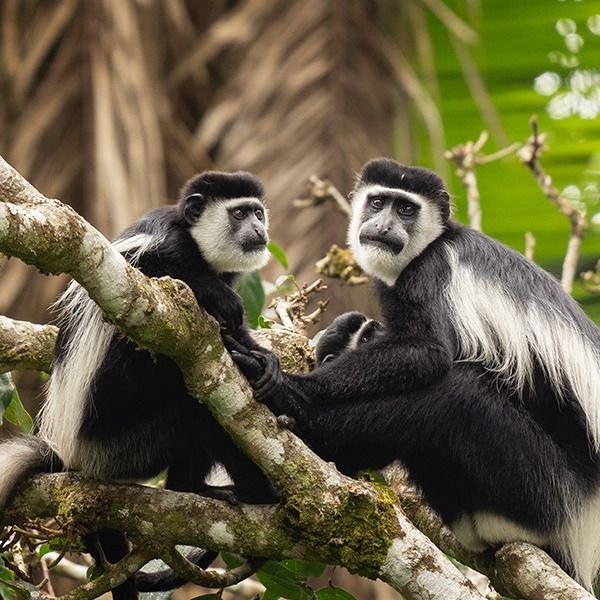
Black-and-white Colobus
Colobus guereza — Africa's elegant canopy leaf-monkey, a black-and-white acrobat with a flowing white mantle and a long white-tufted tail.Introduction to the Black-and-white Colobus
The Black-and-white Colobus (Colobus guereza, the mantled guereza) is one of Africa's most beautiful primates - a slender, long-tailed monkey built for life in the trees. Its jet-black body is set off by a dramatic white mantle of long hair over the shoulders and a long tail ending in a white tuft. It is a true leaf-eater, spending its days in the forest canopy and barely touching the ground. It is currently listed as Least Concern by the IUCN, although forest loss threatens local populations.
Unlike the antelopes and pigs of the open plains, the colobus is an arboreal acrobat: it leaps boldly between branches high above the forest floor, gripping with four long fingers and only a vestigial thumb. Its entire biology - from a complex, multi-chambered stomach to pure-white newborn infants - is tuned to a leafy, treetop life.
Why the Colobus is Ecologically Vital
As a folivore it prunes and recycles leaves, disperses seeds in its dung, and forms an important prey base for forest predators such as leopards and crowned eagles. Healthy colobus populations are a sign of intact forest.
A Species Worth Understanding
Too often described with generic 'rainforest animal' filler, the colobus is in fact a highly specialised primate. Understanding its digestive system, gripping hands and social territory replaces vague description with genuine wonder.
Scientific Classification
The black-and-white colobuses are colobines - the leaf-eating branch of the Old World monkeys (Cercopithecidae). Their genus name, Colobus, means 'maimed' or 'cut short' in Greek, a reference to their reduced thumb. The guereza is the most widespread and familiar of the East African black-and-white species.
Physical Characteristics
The colobus is unmistakable and full of primate-specific adaptations:
- Body length: Head-and-body about 45–72 cm; the tail adds a further 52–100 cm.
- Weight: Adults weigh about 5–14 kg, with males noticeably larger than females.
- Coat: Glossy black fur with a striking white mantle (long shoulder/flank hairs) and a white tail tuft; the face has white facial markings in some forms.
- Hands - the key trait: Four long fingers with no functional thumb (the thumb is absent or reduced to a vestigial knob), forming a secure hook grip for brachiating through branches.
- Digestive system: A complex, multi-chambered (sacculated) stomach that ferments leaves with symbiotic bacteria - the colobine answer to a cow's rumen.
- Build: A long, powerful tail (not prehensile) used for balance during spectacular leaps; long limbs for canopy travel.
Colobus Young
Reproduction is slow and investment-heavy, like most primates:
- Birth: Usually a single infant is born (twins are rare) after a gestation of roughly 5–6 months.
- White newborn: Infants are born pure white (a stark contrast to the adults) and gradually develop the black-and-white adult coloration over their first months - one of the species' most remarkable traits.
- Early care: The mother carries the clinging infant; other females in the troop often handle and groom it (allomothering). Infants ride on the mother's belly, then her back.
- Growth: Young are dependent for many months, weaned at roughly 6–8 months and mature at about 3–4 years (females earlier than males).
Habitat: Where They Thrive
The colobus is a forest primate. 'Rainforest' alone is too narrow - it occupies a range of wooded habitats:
Key Habitat Types:
- Lowland tropical rainforest: The classic home of the guereza, especially dense, tall forest.
- Montane forest: It ranges into cooler highland forest at moderate elevations.
- Riverine / gallery forest: Forest along rivers and streams - a reliable place to find troops.
- Evergreen thicket forest: Thick, shrubby woodland and forest edges are also used.
Climate & Altitude:
It needs continuous tree cover and is absent from open grassland and savanna. In Tanzania and Uganda it is best sought in forested parks and reserves rather than on the open plains.
Distribution Map
The black-and-white colobus group spans equatorial Africa. The mantled guereza (Colobus guereza) occurs across East Africa, including Tanzania, Uganda, Kenya and Ethiopia, and west into parts of Central Africa:
In Tanzania, Lake Manyara is a well-known place to see them; in Uganda they are common in forested parks.
Because they live in trees, a sighting depends on being in the right forest - but troops can be surprisingly conspicuous when they call and move through the canopy.
Where to See Colobus on Safari
Colobus are forest monkeys, so the best encounters come on guided forest walks rather than plains drives:
Lake Manyara (Tanzania)
Best: Year-round | Region: Groundwater forest
Visible
Tip: Walk the forest trails and look up - troops feed and call in the canopy.
Tanzania forests
Best: Year-round | Region: Arusha, Kilimanjaro, Udzungwa
Visible
Tip: Montane and riverine forest hold healthy troops.
Uganda forests
Best: Year-round | Region: Kibale, Bwindi, Budongo
Visible
Tip: Guided primate walks give the best views of black-and-white colobus.
Wider range
Best: Year-round | Region: Kenya, Ethiopia, DRC
Visible
Tip: Any East African rainforest or montane forest may hold them.
Black-and-white Colobus in Pictures
A closer look at the colobus in its forest canopy home - the white mantle, the long white-tufted tail and the four-fingered grip.
Where to Spot the Black-and-white Colobus on Safari
Plan your trip around the forested reserves where colobus troops are most easily seen. Explore the destinations below.
Diet: What They Eat
The colobus is a folivore - a specialised leaf-eater - and its diet is the reason for its remarkable stomach:
- Primary Diet: Leaves, especially young, tender leaves; also shoots, seeds, unripe fruit, flowers and bark.
- Digestive adaptation: A large, multi-chambered (sacculated) stomach ferments cellulose with symbiotic bacteria, letting it extract energy from leaves that other monkeys cannot digest.
- Feeding style: Almost entirely in the trees; it selects leaves carefully and may eat soil or charcoal to buffer plant toxins.
- Water: Gets most moisture from leaves; drinks when available.
- Ecosystem Role: A canopy herbivore that recycles foliage and disperses seeds, and is prey for forest predators.
Daily Behaviour & Social Life
Daily Rhythm
Day: Active by day (diurnal), feeding and moving through the canopy, resting in bouts.
Roosting: Sleeps in the trees, often in a favourite part of the territory.
Territory: The adult male's roaring display carries far and marks the group's space.
Social Structure
- Troops: Stable groups of several females, their young and one or more adult males.
- Male defence: Resident males defend the territory and lead intergroup displays; takeovers can be violent.
- Communication: Loud roars, grunts and 'snorts'; visual displays with the mantle and tail; scent from cheek glands.
- Movement: Leaps between branches and careful canopy walking; the long tail balances each jump.
- Defence: Alarm calls warn the troop; leopards and crowned eagles are the main wild predators, so vigilance is high.
Predators & Threats
In the wild, leopards and crowned eagles take colobus (eagles especially target infants), and chimpanzees may hunt them. Its best defences are canopy height, alarm calling and group vigilance.
Watching tip: On a forest walk, listen for the male's roar and scan the mid-to-high canopy; a resting troop is often quieter than you expect.
Reproduction & Lifespan
- Mating: Within the troop; a resident male may sire most infants, but multi-male groups spread parentage.
- Gestation: About 5–6 months.
- Litter: Usually a single infant (twins rare); born pure white and darkening to adult colours over months.
- Maturity: Females mature at roughly 3 years, males a bit later; lifespan about 15–20 years in the wild.
Conservation Status
IUCN Red List Status: Least Concern for the mantled guereza (Colobus guereza) overall, though some regional populations and several other colobus species are threatened.
Major Threats
- Habitat loss: Deforestation for agriculture, logging and settlement shrinks and fragments forest.
- Hunting: Hunted for bushmeat and, historically, for the fur trade; infants are taken for the pet trade in places.
- Fragmentation: Small, isolated forests cannot support viable troops.
Conservation Programs
Protected national parks and forest reserves are the backbone of colobus conservation. In Tanzania, TANAPA and TAWA protect forests such as Lake Manyara; in Uganda, the Uganda Wildlife Authority (UWA) protects Kibale, Bwindi and Budongo. Organisations such as the IUCN SSC Primate Specialist Group, WWF and African Parks support habitat protection and community-based conservation.
32 Interesting Facts
Black-and-white Colobus vs Other Primates
Colobus vs Red Colobus
| Feature | Black-and-white Colobus | Red Colobus |
|---|---|---|
| Coat | Black with white mantle | Reddish-brown |
| Thumb | Vestigial/absent | Vestigial/absent |
| Diet | Leaves (folivore) | Leaves & fruit |
| Status | Least Concern | Several species threatened |
Colobus vs Vervet Monkey
| Feature | Black-and-white Colobus | Vervet Monkey |
|---|---|---|
| Coat | Black & white, mantled | Grey-green, black face |
| Thumb | Vestigial/absent | Full opposable thumb |
| Diet | Mostly leaves | Omnivore (fruit, insects) |
| Habitat | Forest canopy | Woodland, savanna, near water |
Colobus vs Blue Monkey
| Feature | Black-and-white Colobus | Blue Monkey |
|---|---|---|
| Coat | Black & white | Grey-blue, no mantle |
| Thumb | Vestigial/absent | Full thumb |
| Diet | Mostly leaves | Fruit & leaves |
| Stomach | Complex, leaf-fermenting | Simple |
Colobus in African Culture
The colobus, with its striking black-and-white coat and quiet canopy life, appears in the stories of many forest peoples, often as a symbol of agility and the living forest.
- Symbolism: In some traditions the colobus represents the forest's spirit and the value of community.
- Fur trade: Historically its beautiful mantle made it a target for the fur trade, which drove local declines in the past.
- Modern view: Today it is a flagship of forest conservation and a highlight of any primate walk.
Wildlife Photography Guide
- Best Camera Lens: A 100–400mm or 200–600mm lens for canopy distances and detail.
- Best Time: Morning forest walks, when troops are active and light filters through the leaves.
- Best Habitat: Forest trails at Lake Manyara (Tanzania) and Kibale/Bwindi (Uganda).
- Best Behaviour: Capture the white mantle spread, the leaping gait, and (with luck) a pure-white infant.
- Safety Distance: Keep a respectful distance, move slowly and never attempt to feed or touch a wild monkey.
Frequently Asked Questions
The black-and-white colobus (Colobus guereza, the mantled guereza) is an arboreal African leaf-monkey with a black coat, a flowing white mantle and a long white-tufted tail. A folivore with a complex, leaf-fermenting stomach, it is listed as Least Concern by the IUCN.
Across East Africa - Tanzania (notably Lake Manyara and mountain/riverine forests), Uganda (Kibale, Bwindi, Budongo), Kenya and Ethiopia - and parts of Central Africa.
It is a folivore - it eats mostly leaves (especially young leaves), plus shoots, seeds, unripe fruit, flowers and bark. A multi-chambered stomach ferments the leaves with bacteria.
Adults are 45-72 cm in head-body length, with a tail of 52-100 cm.
About 5-14 kg, with males noticeably larger than females.
It is built for leaping through the canopy rather than speed on the ground; its long tail balances spectacular branch-to-branch leaps.
About 15-20 years in the wild.
The mantled guereza is Least Concern on the IUCN Red List, but several other colobus species are threatened, and forest loss endangers local populations.
Forest habitats ranging from lowland tropical rainforest and montane forest to riverine gallery forest and evergreen thickets. It needs continuous tree cover and avoids open grassland.
Deforestation for agriculture and logging, hunting for bushmeat and (historically) fur, and forest fragmentation that isolates troops.
Diurnal and almost entirely arboreal, it feeds and travels through the canopy, resting in bouts and sleeping in trees. Troops defend a territory with the male's loud roar.
Yes - it lives in stable troops of several females, their young and one or more adult males. Troops are territorial and the males lead defence and display.
Leopards and crowned eagles take colobus (eagles especially target infants), and chimpanzees may hunt them. Its defences are canopy height, alarm calls and group vigilance.
Year-round on guided forest walks; troops are present in suitable forest but not guaranteed, so a patient walk gives the best chance.
In many forest traditions it represents the living forest and community; historically its mantle made it a target of the fur trade.
After a 5-6 month gestation a single infant is born pure white and gradually darkens to the adult black-and-white pattern. The mother carries it (often with help from other females), and it is weaned at about 6-8 months.
Through loud roars and grunts, visual displays with the mantle and tail, and scent from cheek glands.
As a canopy folivore it recycles foliage, disperses seeds in its dung, and is prey for forest predators - a sign of healthy, intact forest.
Yes - on forest walks at Lake Manyara (Tanzania) and Kibale or Bwindi (Uganda), with a long lens for canopy shots of the mantle and leaps.
Guided forest walks in forested parks and reserves, rather than open-plains game drives.
Support protected forest reserves and responsible operators, and back community-based conservation that keeps forests standing.
Yes - protected parks and anti-poaching work (TANAPA/TAWA in Tanzania, UWA in Uganda) plus the IUCN SSC Primate Specialist Group, WWF and African Parks.
The only African monkeys with a vestigial thumb and a leaf-fermenting stomach, plus the unforgettable sight of a white-mantled monkey leaping through the canopy.
For colobus, a forest-focused trip works best: Tanzania's Lake Manyara and mountain forests, or Uganda's Kibale and Bwindi, reached via the northern safari circuit or a tailored primate itinerary.
No precise global total is published; the IUCN lists the mantled guereza as Least Concern, though deforestation and hunting threaten local populations.
Related Safari Packages & Tours
Plan a forest and primate safari to see the black-and-white colobus and the rest of Africa's incredible wildlife with our expert guides.
References & Further Reading
- IUCN Red List: Colobus guereza - Least Concern.
- Animal Diversity Web (University of Michigan): Colobus guereza account.
- Smithsonian National Zoo: Colobus fact sheet.
- Kingdon, J. (2015). The Kingdon Field Guide to African Mammals. Bloomsbury.
- About these facts: Weight, size and lifespan are approximate adult ranges. They can vary with sex, age, season, location and measurement method; conservation status should be checked against the current IUCN assessment.

Social Life & Group Behaviour
The colobus is a group-living primate, not a solitary or bachelor-herd animal. Its social world is built around stable, territorial troops: