

.png)
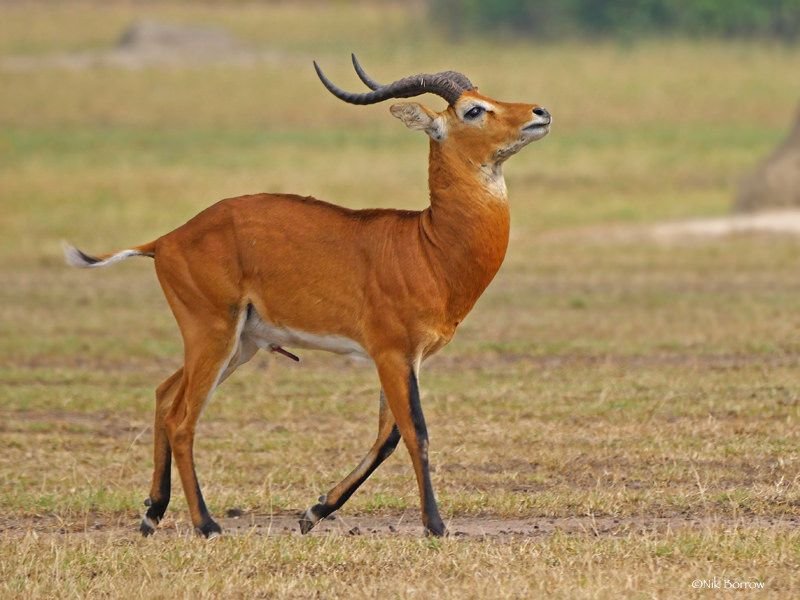
Uganda Kob
Kobus kob thomasiThe golden floodplain kob on Uganda's coat of arms.
Sightings are never guaranteed and depend on local conditions. Follow your guide and respect park rules.
The Uganda kob (Kobus kob thomasi) is a subspecies of the kob, a robust floodplain antelope and one of the two animals on Uganda's national coat of arms. It once grazed Tanzania's Lake Victoria shore but is extirpated from Tanzania today - you will find it in Uganda, South Sudan and the DRC instead.
Uganda Kob Quick Facts
What Is the Uganda Kob?
The Uganda kob (Kobus kob thomasi) is a subspecies of the kob, a robust, impala-like floodplain antelope of the genus Kobus (the same group as the puku and waterbuck). It is famous as one of the two animals on Uganda's coat of arms, symbolising the country's abundant wildlife.
Although the kob's range once reached north-western Tanzania along the Lake Victoria shore, the Uganda kob has been extirpated from Tanzania and from south-western Kenya. Today it lives only in Uganda, South Sudan (west of the Nile) and the north-eastern Democratic Republic of the Congo. It is another headline antelope you will not see on a Tanzania safari.
Why “Kob”?
"Kob" is the antelope's common name across its West and Central African range. The scientific name Kobus kob thomasi marks it as the Uganda form (thomasi) of the kob Kobus kob. The subspecies was described by the British zoologist P. L. Sclater in 1896.
Signature Features
The Uganda kob's signature is its lekking system. Breeding males hold tiny territories on traditional display grounds (leks) and posture, horn-wrestle and roar to attract females that visit to mate - one of the best-studied examples of lek behaviour in African mammals. Territorial males are darker and more muscular than the rest of the herd.
Visually the kob is golden to reddish-brown with a white throat bib, a white ring around each eye, white underparts and a black stripe down the front of the forelegs. Only the males carry horns - lyre-shaped, heavily ridged spikes.
How Big Is a Uganda Kob?
Kobs are more heavily built than impala. Males stand 90-100 cm at the shoulder and weigh about 94 kg, while females are 82-92 cm and around 63 kg. The coat is golden to reddish-brown with the white throat patch, eye-ring and inner-ear markings that separate it from other kob subspecies; males darken with age. The build is typical of a floodplain grazer - long legs, a sloping back and a narrow head.
Horns & Defence
Only male kobs have horns. They are lyre-shaped, strongly ringed (ridged almost to the tip) and divergent, typically 50-62 cm long. Females are hornless. Males use the horns in ritualised sparring on the lek and in real fights for territorial ownership; the horns are shorter, thicker and more heavily ringed than those of the similar-looking impala.
Habitat & Range
Uganda kobs favour moist savanna, alluvial floodplains and the margins of woodland and swamps where short grass grows and water is close. They avoid tall grass and closed forest, and they need daily access to drinking water. In Uganda this means the open grasslands of Queen Elizabeth, Murchison Falls and Kidepo, plus the Nile and lake-shore floodplains.
Uganda Kob in Uganda & Neighbours
The Uganda kob is not found in Tanzania, so seeing one means a Uganda (or South Sudan/DRC) safari. It is common and easy to watch on the country's savanna plains.
Queen Elizabeth NP, Uganda
Classic Uganda kob lek country on the savanna between the rift lakes.
Uganda safariTanzania + Uganda
Love kobs? Combine a Tanzania safari with a Uganda extension to add the Uganda kob.
Plan a safariBehavior & Social Life
Uganda kobs are gregarious and diurnal grazers. Females and young form loose herds that move with the grass and water, while non-breeding males gather in their own bachelor groups. Breeding males defend small lek territories and display to visiting females; most mating happens on these traditional grounds. When alarmed, kobs explode into fast, bouncing gallops across the open plain.
Diet & Feeding
The Uganda kob is a dedicated grazer, feeding on short grasses (C4 tropical grasses make up the bulk of its diet) and, when green, sedges and herbs. It prefers sward heights of about 10-25 cm and needs to drink daily, so it stays close to water and fresh regrowth after rains or fire.
Predators & Defense
Adults are hunted by lion, leopard and spotted hyena, and calves by smaller predators and crocodiles near water. The kob's main defences are open-country vigilance, speed and the safety of the herd; lek sites are often chosen in high-visibility spots that help watch for lions.
Young & Lifespan
Uganda kobs breed year-round, peaking with the rains. After a gestation of about eight to nine months a single calf is born and concealed in tall grass for four to six weeks, then joins the nursery herd. Females mature at roughly 15-18 months; males only start breeding much later, once they can win and hold a lek territory. They can live up to about 17 years in the wild.
Conservation Status
The kob as a species is Least Concern on the IUCN Red List, and Uganda's protected areas hold stable, abundant kob populations - the subspecies is even a national symbol. The main historical threat was overhunting during Uganda's troubled 1970s-80s, from which parks have recovered. Outside reserves, agricultural expansion and cattle grazing have fragmented the range, so protected savanna remains the kob's safe haven.
Safari Experience
The Uganda kob is one of the easiest antelopes to see - drive the savanna tracks of Queen Elizabeth or Murchison Falls and you will pass lekking males and grazing herds within minutes. Because it is absent from Tanzania, African Majestic Adventure can help you combine a northern Tanzania safari with a Uganda extension so you can add the Uganda kob (and its lek drama) to your list.
Comparisons
The Uganda kob's closest Tanzanian relative is the puku - both are golden, male-only-horned Kobus floodplain grazers. The difference is geography: the puku lives in Tanzania's southern floodplains (Kilombero, Rukwa, Selous), while the Uganda kob is a Uganda/South Sudan/DRC animal that no longer occurs in Tanzania. The kob is also a lek-breeder with darker territorial males, whereas puku males hold looser territories. For a Tanzania floodplain antelope, see the puku.
Did You Know?
On the coat of arms
The Uganda kob appears on Uganda's national coat of arms beside the grey crowned crane.
Lek master
Breeding males display on traditional leks - one of Africa's best-known lek systems.
Once in Tanzania
The kob used to graze Tanzania's Lake Victoria shore but is now extirpated there.
Males only horned
Only the male carries the lyre-shaped, heavily ringed horns; females are hornless.
Daily drinker
It is a short-grass grazer that stays close to water and fresh regrowth after rains or fire.
Least Concern
Stable and abundant in Uganda's protected areas; the main risk is habitat loss outside reserves.
There is something almost theatrical about a Uganda kob lek: a cluster of dark, muscular males standing stiff-legged on bare ground, horns locked, while golden females drift past to choose. It is a northern spectacle - Uganda, not Tanzania - but it belongs in the same mental album as the Serengeti's herds. Knowing which antelope lives where is part of reading Africa, and African Majestic Adventure can stitch both halves into one journey.
Gallery
Frequently Asked Questions
No - not today. The Uganda kob's range once reached north-western Tanzania along Lake Victoria but it has been extirpated there. It now lives only in Uganda, South Sudan and the north-eastern DRC.
No. Only males carry the lyre-shaped, heavily ridged horns; females are hornless, like the puku and waterbuck.
A lek is a traditional display ground where breeding males hold small territories and posture and fight to attract visiting females. Uganda kobs are a classic example.
They are grazers, feeding mainly on short tropical grasses with some sedges and herbs, and they drink daily.
No - the kob is Least Concern and Uganda's parks hold abundant, stable populations. The main risk is habitat loss outside reserves.
References & Further Reading
- IUCN Red List of Threatened Species - Kobus kob (Kob), Least Concern.
- Uganda Wildlife Authority - Uganda Kob: range in Uganda, South Sudan and DRC; formerly north-western Tanzania, now extirpated.
- Animalia.bio - Ugandan Kob fact sheet: Kobus kob thomasi, male-only lyre horns.
- Animal Diversity Web (University of Michigan) - Kobus kob: lek behaviour and ecology of Uganda kob.
- Wikipedia - Kob / Ugandan kob: distribution, extirpation from Tanzania and Kenya.