

.png)
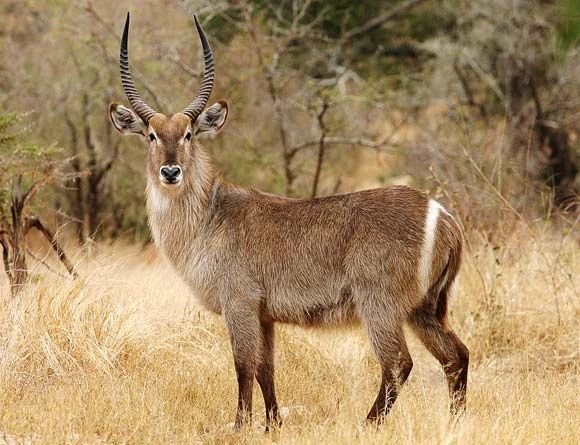
Common Waterbuck
Kobus ellipsiprymnusThe big, shaggy antelope that never strays far from water.
Sightings are never guaranteed and depend on local conditions. Follow your guide and respect park rules.
Among the largest antelopes in Africa, the Common Waterbuck is defined by its dependence on water. You will almost never find one far from a river, lake or swamp - and when threatened it simply dives in. Marked by a white ring on the rump (or a white patch in the defassa form) and a coat that carries a faint musky scent, it grazes the green margins of Tanzania's lakes and rivers, where it is one of the most reliably seen of the big antelopes.
Common Waterbuck Quick Facts
What Is the Common Waterbuck?
The Common Waterbuck (Kobus ellipsiprymnus) is a large antelope of the genus Kobus, in the subfamily Reduncinae (the "reedbucks" and relatives). It is one of the largest antelopes in Africa and, unlike most, is tied to water: it rarely strays more than a short distance from a river, lake or swamp and will plunge into the water to escape predators.
Two main forms are recognised. The common waterbuck (K. e. ellipsiprymnus) carries a white ring or ellipse of hair around the tail on its rump, while the defassa waterbuck (K. e. defassa) has a solid white patch instead. Both are the same species; this page focuses on the common form, the one with the ring, which ranges across east and southern Africa.
Why “Waterbuck”?
The English name is straightforward: the waterbuck lives at the water's edge and, when alarmed, runs into the water - sometimes swimming or submerging with only its nostrils above the surface. Few antelopes are so reliably found beside a lake or river.
The scientific name is just as descriptive. Kobus comes from "koba", a local African name for these antelopes. Ellipsiprymnus joins the Greek ellipes ("ellipse" or "ring") with prymnos ("hind part"), a direct reference to the white ring on the rump - the common waterbuck's key field mark.
Signature Features
Waterbuck are big, robust antelopes with a shaggy reddish-brown to grey coat that darkens with age; adult males are noticeably darker than females. A greasy, oily secretion from the skin gives the coat a waterproof quality and a musky odour - so strong that some predators avoid the meat, earning the waterbuck the nickname "greasy kob".
Field marks to look for:
- Rump ring: a white ellipse of hair encircling the tail (in the defassa form this is a solid white patch).
- White markings: pale muzzle, light eyebrows, white around the eyes, and a creamy "bib" on the throat.
- Build: long neck, short strong black legs, and a heavy body.
- Horns: only males carry them - long, ringed and lyre-shaped, curving back then forward.
How Big Is a Common Waterbuck?
The waterbuck is one of the heaviest antelopes. Adults stand about 120-136 cm at the shoulder (males roughly 127 cm, females about 119 cm) and measure 177-235 cm from head to tail - well over two metres for a big male. The tail adds another 22-45 cm.
Weight ranges from about 161-214 kg in females to 198-262 kg in males (roughly 160-300 kg across the species). Males are both taller and substantially heavier, with thicker necks and darker, more grizzled coats.
Horns & Defence
Only male waterbuck carry horns. They are 55-99 cm long, heavily ringed, and curve backward and then forward in a distinctive lyre or spiral shape. Horn length grows with age, so old males sport the most impressive sets.
Females are normally hornless, though a small bony bump may sit on the skull. Males use their horns in ritualised pushing contests to defend territories - typically a stretch of waterfront grassland.
Habitat & Range
Water is the thread that runs through everything about this antelope. Waterbuck occupy savanna, open woodland, floodplains and grassland that sit next to permanent water - lakeshores, riverbanks, swamps, reed beds and seasonal floodplains. They prefer areas with tall grass and nearby cover, but they will not live far from a reliable supply.
This water dependence shapes their whole distribution. They avoid dry open plains far from rivers, true deserts, and the dense interior of equatorial rainforest. In Tanzania that means they concentrate around the country's lakes and major river systems rather than in arid bush.
Common Waterbuck in Tanzania
Across its African range the common waterbuck is found through sub-Saharan Africa, from the east and south to parts of the centre and west, wherever permanent water and grassy cover coincide. In Tanzania the species is widespread but always tied to water - so the best places to look are the national parks built around lakes and rivers, especially at dawn and dusk when waterbuck move out to graze the margins.
Waterbuck are among the more reliably seen large antelopes on a Tanzania safari precisely because they gather near obvious water features - but sightings still depend on the season, water levels and cover, so they should never be promised as guaranteed.
Lake Manyara
The lakeshore and groundwater-forest edge are classic waterbuck habitat; look along the roadside grassland near the water.
Manyara safariNyerere (Selous)
The Rufiji River system and its channels draw waterbuck to the riverine grasslands and floodplains.
Nyerere safariRuaha
The Great Ruaha River and its seasonal tributaries hold waterbuck through the dry season.
Ruaha safariKatavi
Remote and water-rich, Katavi's rivers and seasonal lakes are prime waterbuck country in the dry months.
Katavi safariYou may also meet waterbuck in Tarangire (along the river), Mikumi, and the riverine corridors of the Serengeti - anywhere permanent water meets grass.
Behavior & Social Life
Waterbuck are diurnal but, like many large herbivores, they ease off during the hottest midday hours, resting in shade or tall cover close to water before feeding again in the late afternoon. Activity peaks around dawn and dusk rather than on a fixed clock.
They are social but in separate groups. Nursery herds of females and young (often 5-30 animals) graze together, while bachelor groups of males and lone territorial males hold stretches of waterfront grassland, defending them with scent marking and horn displays. Their signature escape is to bolt for the nearest water and either swim across or sink low with only the nose showing.
Diet & Feeding
The waterbuck is fundamentally a grazer. It feeds mainly on grasses - including coarse, stalky grasses that many other grazers ignore, which is why it can thrive where shorter-grass specialists struggle. It also browses leaves, herbs and shoots, especially near water and in the wet season.
Because it is so water-dependent, it drinks daily and grazes the lush margins of lakes and rivers. This grass-and-water ecology is what separates it from browsers such as bushbuck, which favour dense thicket away from open water.
Predators & Defense
A full-sized adult waterbuck is a serious prize, so it is hunted by most of Africa's large predators: lions, leopards, spotted hyenas, African wild dogs, cheetahs and, where their ranges meet water, Nile crocodiles. Humans are also a major cause of mortality through hunting.
Calves are the most vulnerable, and lions and hyenas often target the young. The waterbuck's musky odour may put some predators off the meat, but it is no guarantee of safety - which is why the dash to water is the animal's front-line defence.
Young & Lifespan
After a gestation of about nine months, a single calf is born. Like many hiding strategists, the calf spends its first 2-8 weeks concealed in tall grass, while the mother returns only briefly - a few times a day - to nurse and to clean the calf so no scent lingers for predators.
Calves begin nibbling grass within weeks but are not fully weaned until 6-8 months. Young males eventually leave to join bachelor groups, while females remain in the maternal herd. Females reach maturity around three years, males later (about six); lifespan is roughly 10-12 years in the wild and up to 18 in captivity.
Conservation Status
The waterbuck is listed as Least Concern on the IUCN Red List and remains widespread, but numbers are declining in many areas. The main pressures are habitat loss and fragmentation from agriculture, roads and settlement, plus hunting for meat. One estimate puts fewer than 200,000 remaining across Africa.
Tanzania's protected parks - Manyara, Nyerere, Ruaha, Katavi and others - are important strongholds. Interestingly, the very musky secretion that repels predators has even been studied as the basis for repellents against tsetse flies that spread sleeping sickness.
Safari Experience
The waterbuck is a rewarding safari animal precisely because it is predictable about water. Rather than scanning endless plains, focus on lakeshores, riverbanks and floodplain grasslands - particularly in the early morning and late afternoon when waterbuck move out to feed.
Realistic expectation: waterbuck are commonly seen near permanent water in several Tanzanian parks, but a sighting is never a certainty and should not be sold as "guaranteed". A 100-400 mm lens and a steady vehicle are ideal for photographs of these shaggy, ring-rumped grazers. The reward is one of Africa's most quintessentially watery scenes - a big antelope standing knee-deep at the lake's edge.
Comparisons
Three close wetland grazers help tell the waterbuck apart. All belong to the same group (Kobus / Reduncinae) and all favour water, but they differ in size and rump marking:
| Feature | Common Waterbuck | Defassa Waterbuck | Puku |
|---|---|---|---|
| Scientific name | Kobus ellipsiprymnus (ellipsiprymnus) | Kobus ellipsiprymnus (defassa) | Kobus vardonii |
| Weight | ~160-300 kg | ~160-300 kg | ~70-90 kg |
| Rump mark | White ring / ellipse | Solid white patch | None; reddish coat |
| Habitat | Lakes, rivers, floodplains | Wetland & woodland near water | Floodplains (southern Tanzania) |
| Range in Tanzania | Manyara, Nyerere, Ruaha, Katavi | Locally (west/centre) | Katavi, Rukwa, Luangwa |
Did You Know?
Never far from water
A waterbuck stays within roughly a kilometre or two of permanent water and dives in to escape predators.
White rump ring
The common form's key field mark is a white ellipse around the tail; the defassa has a solid white patch.
Smells musky
An oily coat secretes musk; some predators avoid the meat because of its strong odour.
Coarse grazer
It eats tough grasses other grazers ignore, spending much of the day feeding near water.
Two forms, many names
About 13 subspecies are grouped into the common and defassa waterbuck across sub-Saharan Africa.
Waterproof coat
The greasy coat repels water, helping it swim and submerge when threatened.
There is a particular stillness to a waterbuck at the lake's edge - huge, shaggy, unmistakable, watching you with the water at its heels. It does not need to run far. The lake is its refuge, and the ring on its rump is a punctuation mark on the African shoreline.
Gallery
Frequently Asked Questions
Kobus ellipsiprymnus. The common form is the subspecies K. e. ellipsiprymnus; the defassa form is K. e. defassa.
Because it lives at the water's edge and, when threatened, runs into the water - often swimming or submerging with only its nostrils showing.
They are the same species. The common form has a white ring (ellipse) of hair around the rump, while the defassa has a solid white patch.
Savanna, woodland, floodplains and grassland beside permanent water across sub-Saharan Africa. They avoid dry country far from rivers and lakes.
Yes. They are found around lakes and rivers in parks such as Lake Manyara, Nyerere (Selous), Ruaha, Katavi, Tarangire and the Serengeti's riverine corridors.
They are mainly grazers, feeding on grasses - including coarse grasses others avoid - and also browse leaves and herbs near water. They must drink daily.
They live in female nursery herds, bachelor groups of males, and lone territorial males that defend waterfront grassland territories.
It can run at roughly (about 35 mph) over short distances, but its usual escape is a dash into the nearest water rather than a long run.
Lions, leopards, spotted hyenas, African wild dogs, cheetahs and Nile crocodiles (near water), with humans also a major threat through hunting.
They stand about 120-136 cm at the shoulder, measure 177-235 cm head-to-body, and weigh roughly 160-300 kg, with males the larger sex.
Least Concern on the IUCN Red List, but populations are declining locally from habitat loss, fragmentation and hunting.
References & Further Reading
- Animal Diversity Web - Kobus ellipsiprymnus: taxonomy, range, habitat near water, physical measurements (body 177-235 cm; shoulder 120-136 cm; horns 55-99 cm) and Least Concern status.
- African Wildlife Foundation (AWF): weight 160-300 kg, shoulder height 120-136 cm, horns to 100 cm, two subspecies, predators and threats.
- Wikipedia - Waterbuck: description, subspecies (common vs defassa rump marking), measurements, ecology and IUCN assessment.
- The Animal Files: body length 1.3-2.4 m, weight 160-300 kg, habitat and predator list including crocodiles.
- Ultimate Ungulate - Kobus ellipsiprymnus: etymology of Kobus and ellipsiprymnus (white rump ring).