

.png)
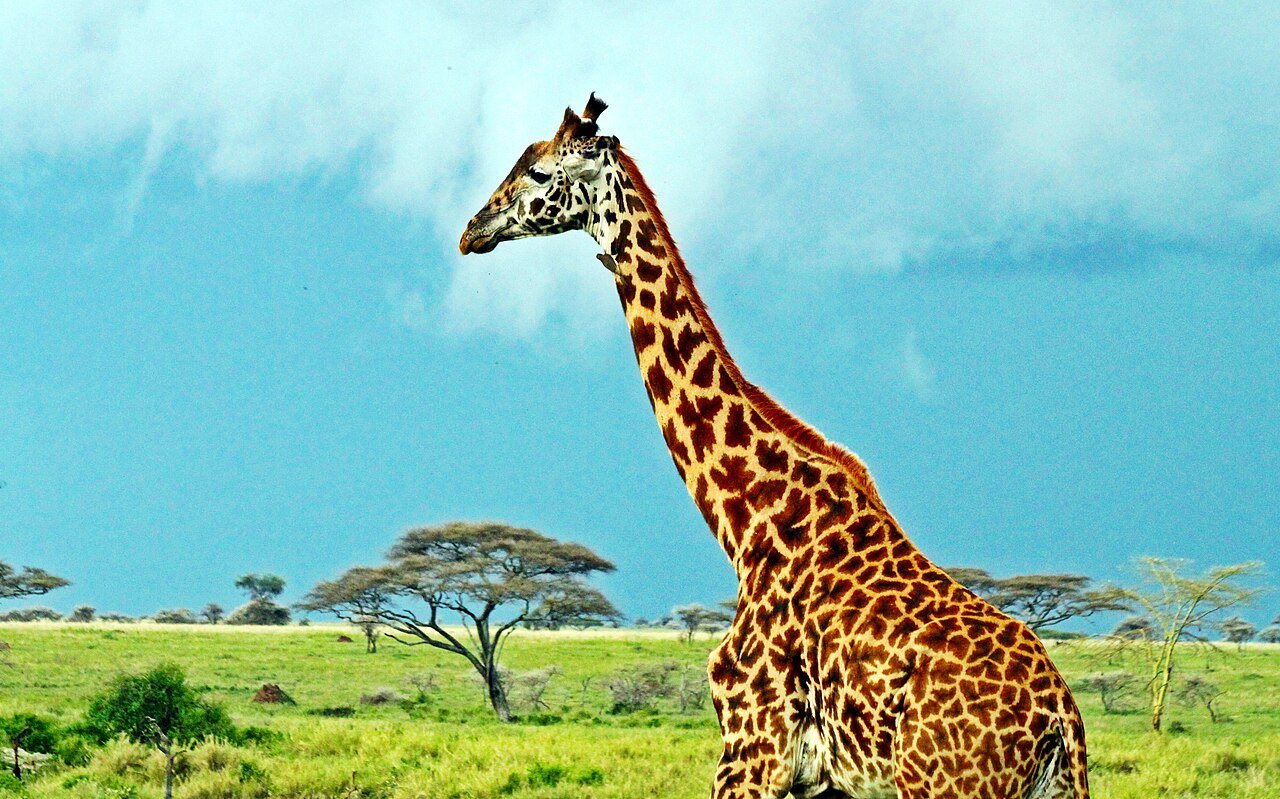
Masai Giraffe
Giraffa tippelskirchiTanzania’s towering icon of the African savanna.
Sightings are never guaranteed and depend on local conditions. Follow your guide and respect park rules.
Standing higher than any other living land animal, the Masai giraffe moves gracefully through Tanzania’s woodlands and grasslands, using its extraordinary height and 50-centimetre tongue to browse leaves far above the reach of most herbivores. From the plains of the Serengeti to the baobab-studded landscapes of Tarangire and Ruaha, meeting a wild giraffe is one of Africa’s most unforgettable safari experiences. Stand tall. Stay wild.
Masai Giraffe Quick Facts
What Is the Masai Giraffe?
The Masai giraffe is Tanzania’s characteristic giraffe species and one of Africa’s most recognizable large herbivores — the tallest living land animal. Under the 2025 IUCN SSC Giraffe and Okapi Specialist Group taxonomy, Tanzania’s giraffes are classified as Masai giraffe, Giraffa tippelskirchi (including G. t. tippelskirchi and G. t. thornicrofti), not the older universal name Giraffa camelopardalis, which now applies to the Northern giraffe. The Masai giraffe is famous for its extraordinary height, irregular dark-brown jagged patches, long neck, powerful legs, prehensile tongue, ossicones and specialized cardiovascular system that lets it browse vegetation far above most other herbivores.
Signature Features
Towering height
Tallest land animal; males ~5.3 m, females ~4.3 m on average.
High vantage
Height acts as a surveillance system across open landscapes.
50 cm tongue
Long, muscular, prehensile; dark to resist sun exposure.
Powerful heart
High blood pressure and specialized vessels feed a brain ~2 m up.
Ossicones
Horn-like bony structures covered in skin; both sexes have them.
Powerful kick
A hind-leg kick can seriously injure or kill a lion.
Physical Characteristics
Male Masai giraffes average roughly 5.3 m tall and can approach 6 m; females average about 4.3 m (Giraffe Conservation Foundation). Adult males average around 1,200 kg and females around 830 kg — so don’t present 1,200 kg as if every giraffe weighs that much. The neck is about 2 m long with 7 cervical vertebrae (like humans) but enormously elongated. The tongue reaches about 50 cm; its dark bluish-purple/black pigmentation may help protect exposed tissue from sunlight during prolonged browsing, though the exact evolutionary significance isn’t fully established. Giraffes are browsers, not grazers — feeding mainly on leaves, shoots, twigs, flowers, seed pods and fruits (Acacia/Vachellia and Commiphora are important), using lips, tongue and teeth to strip leaves around thorns.
The Cardiovascular System
Blood must travel from a powerful heart to a brain ~2 m above, so blood pressure is much higher than in humans. Thick vessels, tight leg tissues and a rete mirabile network help regulate brain blood flow — especially important when the giraffe lowers its head to drink (spreading its front legs to reach the ground).
Necking
Adult males compete using necking: swinging their necks against one another to establish dominance and mating access. This is male-male competition, not “fighting to protect a herd.” Males generally have larger ossicones, heavier skulls and more robust necks.
Habitat & Range
The Masai giraffe’s core range is East Africa — Tanzania and Kenya (with the Thornicroft’s/Luangwa lineage in Zambia). Core populations are not concentrated in East and Southern Africa; under the 2025 taxonomy, Southern African giraffes belong to a separate species (Giraffa giraffa). Masai giraffes use not just “savannah” but a mosaic of savanna, acacia woodland, bushland, open woodland, grassland, shrubland and semi-arid landscapes. They can obtain substantial moisture from vegetation and tolerate dry conditions, so “water is essential” should be rephrased rather than stated as absolute.
Where to See Masai Giraffes
Tanzania is one of the most important countries for Masai giraffes, and Kenya is the other core range — so remove Uganda as a “key Masai range.” In Tanzania, the Serengeti offers woodland, open grassland and acacia browse; Tarangire is famous for baobabs, dry-season concentrations and excellent giraffe habitat; Ruaha provides dry woodland, baobabs and seasonal rivers; and the broader Ngorongoro ecosystem holds giraffes though sightings vary. Giraffes are resident wildlife in many Tanzanian ecosystems, so they can be seen year-round, but local distribution and habitat determine luck. Avoid unsupported superlatives like “best place in the world” and replace blanket “High sighting” claims with “common/good opportunity in suitable habitats.”
In Kenya, the Maasai Mara, Amboseli and Tsavo ecosystems also hold Masai giraffes — a natural Tanzania ↔ Kenya internal link.
Behavior & Social Life
Giraffes are social but flexible — they don’t form rigid permanent herds. Their societies are best described as fission–fusion: individuals join groups, groups split, and associations change over time. Female and mother-calf relationships can be especially strong, while adult males tend to be more independent (young males leave their mother’s social environment; older males often travel alone). Avoid “experienced adults lead group movement” and “family groups cooperate to protect young” language; instead explain calf crèches / nursery groups and alloparental care, where several calves stay together while adults forage. Don’t state a fixed group size like “always 10–20.”
Activity & Sleep
The rigid 6–10 AM / 10 AM–3 PM / 3–6 PM / Night schedule doesn’t apply. Giraffes feed throughout the day, with activity shaped by temperature, food, disturbance and local conditions; they may feed at night too. They sleep surprisingly little — the Giraffe Conservation Foundation gives roughly 4.5 hours, mainly at night, in short fragmented bouts, standing or lying down, favoring vigilance because lying down is vulnerable.
Movement, Speed & Defense
Giraffes can reach roughly 50– in short bursts (GCF notes ~ sustained); they move with a distinctive pacing gait (front and hind legs on the same side moving together). Their long legs deliver a very powerful kick — an adult can seriously injure or kill a lion — so healthy adult giraffes are dangerous prey.
Diet & Feeding
Giraffes are herbivorous browsers. Don’t write “they mainly eat grass” — grass is much less important than leaves, shoots, twigs, flowers, seed pods and fruits. Acacia/Vachellia, Commiphora and other woody plants are key browse; the long tongue and mobile lips let them select leaves between thorns. By eating fruits and moving through landscapes, giraffes also contribute to seed dispersal and influence vegetation structure, making them ecologically important beyond their beauty.
Their height lets them exploit high branches that most herbivores can’t reach, reducing direct competition for food.
Reproduction & Life Cycle
A female normally gives birth to one calf (twins rare but possible). Gestation is approximately 15 months (~453–464 days, GCF). The mother gives birth standing up, so the calf drops about 2 m to the ground; newborns can be ~1.8 m tall, stand within about an hour and nurse soon after. Calves begin sampling leaves at about 4 months and nurse for roughly 9–12+ months. Because lions and other predators target young giraffes — calf mortality is especially high in the first months (notably in the Serengeti) — calves must become mobile quickly. Young giraffes can form crèches/nursery groups, providing social learning and vigilance.
Predators
Healthy adults have few predators thanks to size, height, kicks and vigilance. Lions are the principal predator capable of hunting giraffes, usually targeting calves, young or vulnerable individuals. Leopards generally threaten calves (a natural internal link to the Leopard page), hyenas and wild dogs can take young animals, and crocodiles can be a risk near water.
Comparisons & 2025 Taxonomy
The 2025 Four-Species Split
Historically giraffes were treated as one species, Giraffa camelopardalis, with subspecies. The 2025 IUCN SSC assessment now recognizes four species: Northern giraffe (G. camelopardalis), Reticulated giraffe (G. reticulata), Masai giraffe (G. tippelskirchi) and Southern giraffe (G. giraffa). Tanzania’s giraffes are Masai giraffes.
| Feature | Masai Giraffe | Reticulated Giraffe |
|---|---|---|
| Scientific name | Giraffa tippelskirchi | Giraffa reticulata |
| Core range | Tanzania & Kenya | Kenya & neighboring regions |
| Pattern | Irregular, jagged patches | Network-like geometric pattern |
| Habitat | Savanna/woodland | Dry woodland & savanna |
| Tanzania | Major species | Much less widespread |
Under the new taxonomy, the Northern giraffe is G. camelopardalis (not a universal name for every giraffe), and Southern African giraffes are G. giraffa.
Conservation Status
Here we must be careful. The older single-species giraffe was assessed as Vulnerable. But the 2025 taxonomic reassessment recognizes four species and explicitly says the revision will inform future Red List assessments. Therefore, don’t blindly write “Masai giraffe = Vulnerable” as a settled species-specific status. Use: the 2025 IUCN SSC taxonomy recognizes the Masai giraffe as a distinct species; species-specific Red List assessments are being aligned with the revised taxonomy, while the former single-species giraffe assessment was Vulnerable. The Giraffe Conservation Foundation reports giraffe numbers across Africa declined by nearly 30% over the past ~35 years.
Major Threats
1. Habitat loss
Agricultural expansion and settlement.
2. Fragmentation
Roads, fences and development split habitats.
3. Human-wildlife conflict
Competition over land and resources.
4. Illegal hunting
For meat, hides, tail hair and other parts.
Why Giraffes Matter
Giraffes shape woody vegetation, open access to high foliage, transport seeds and influence plant growth, supporting broader ecosystem interactions with other herbivores.
Did You Know?
Tallest land animal
Males average ~5.3 m; exceptional individuals ~6 m.
2025 taxonomy
Tanzania’s giraffes are Masai (G. tippelskirchi), not G. camelopardalis.
50 cm tongue
Long, prehensile and dark to resist sun exposure.
7 neck bones
Same count as humans — just hugely elongated.
Necking
Males duel with necks to win mating access.
Kick of death
A hind-leg kick can kill a lion.
Born dropping 2 m
Calves hit the ground standing up, from ~2 m.
Unique coat
Each giraffe’s patch pattern is like a fingerprint.
Little sleep
~4.5 h total, in short fragmented bouts.
Night humming
Low-frequency humming documented, especially at night.
A Masai giraffe lowers its long neck to the grass, legs splayed like a stilt-walker, and for a moment the tallest animal on Earth becomes unexpectedly humble — then it lifts its head and the savanna opens again, surveyed from a height no other herbivore can reach.
Gallery
Frequently Asked Questions
Under the 2025 IUCN SSC taxonomy, Tanzania’s giraffes are classified as Masai giraffe, Giraffa tippelskirchi.
The 2025 IUCN SSC taxonomy assessment now uses Giraffa camelopardalis for the Northern giraffe, rather than treating it as the scientific name for all giraffes.
Adult males average around 5.3 m, while adult females average around 4.3 m. Exceptional individuals can approach 6 m.
Adult males average approximately 1,200 kg, while females average around 830 kg.
Primarily leaves, shoots, twigs, flowers, fruits and other woody vegetation.
They can, but they are primarily browsers, not grazers.
Approximately 50 cm.
Approximately 15 months, or around 453–464 days.
Usually one calf. Twins are rare but possible.
Yes. They form flexible social associations rather than rigid permanent herds.
They can form groups containing females, calves, relatives and other individuals, but their social organization is flexible.
Necking is a male-male competitive behavior in which giraffes swing their necks against each other to establish dominance.
Their anatomy makes swimming difficult and unusual, and they are not considered strong swimmers.
They can reach approximately 50–, depending on circumstances.
They sleep relatively little, often in short bouts. The Giraffe Conservation Foundation gives roughly 4.5 hours, mainly at night.
Lions are the major predator capable of hunting giraffes, especially calves and vulnerable individuals. Leopards, hyenas and wild dogs can threaten young giraffes.
A powerful kick from an adult giraffe can seriously injure or kill a lion.
Excellent opportunities exist in places such as Serengeti, Tarangire and Ruaha, depending on habitat and local conditions.
Yes. Giraffes are resident wildlife in many Tanzanian ecosystems, although sightings and local distribution can vary.
This requires care because the taxonomy changed in 2025. The former single-species giraffe was classified Vulnerable, while the new four-species framework is being incorporated into future species-specific Red List assessments.
Habitat loss, habitat fragmentation, human-wildlife conflict and illegal hunting are among the major concerns.
References & Further Reading
- Giraffe Conservation Foundation (GCF): Masai giraffe taxonomy, height/weight averages (~5.3 m males, ~4.3 m females; ~1,200 kg / ~830 kg), ~50 cm tongue, ~ speed, ~4.5 h sleep, gestation ~453–464 days, calf mortality, ~30% decline over ~35 years.
- IUCN SSC Giraffe and Okapi Specialist Group (2025): Recognition of four giraffe species — Northern (G. camelopardalis), Reticulated (G. reticulata), Masai (G. tippelskirchi) and Southern (G. giraffa) — with species-specific Red List assessments to follow.
- Taxonomy note: Tanzania’s giraffes are Masai giraffes (Giraffa tippelskirchi), not Giraffa camelopardalis.
- About these facts: Measurements are approximate ranges; conservation status should be checked against the current IUCN assessment.