

.png)
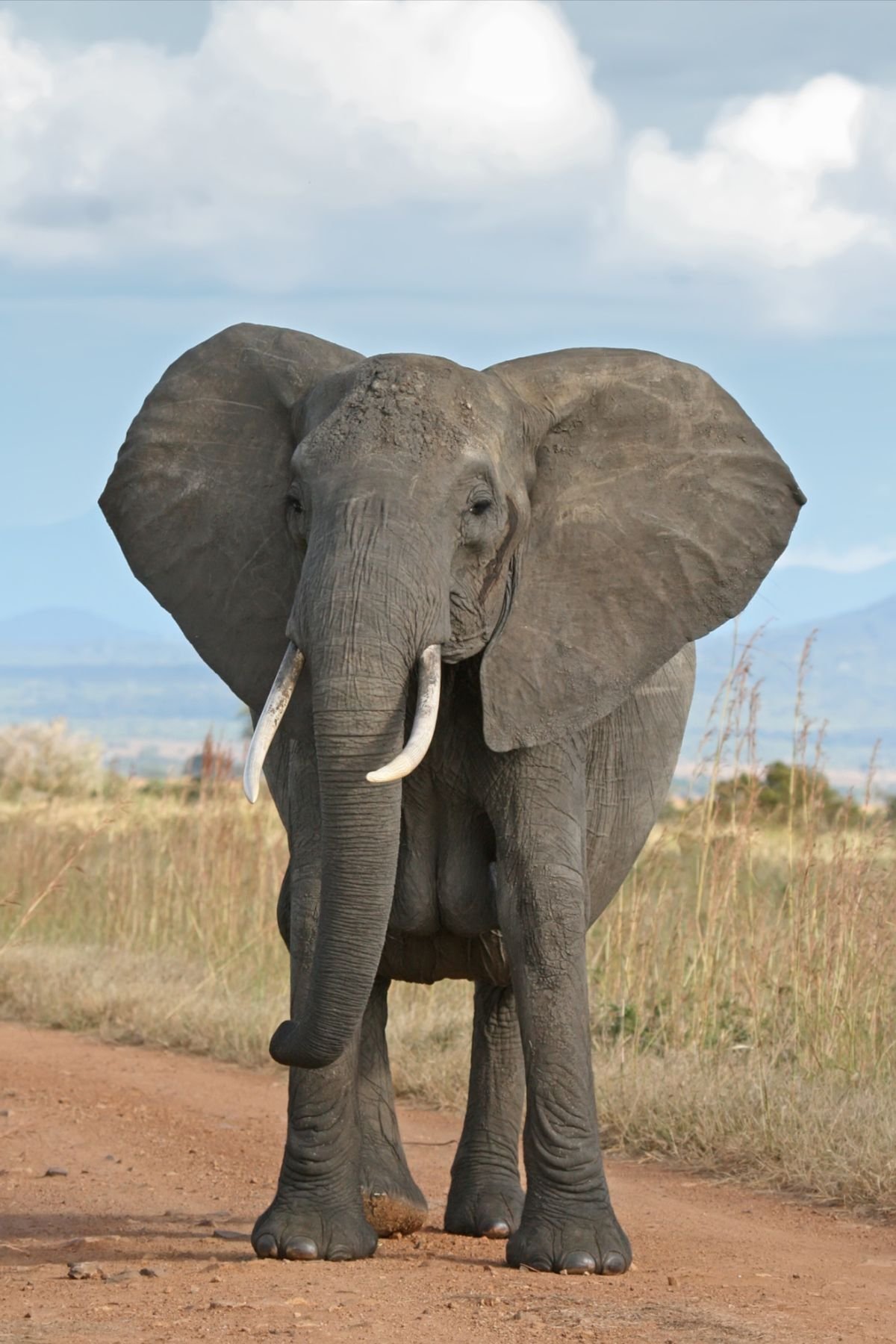
African Bush Elephant
Loxodonta africanaThe largest living land animal—and one of Africa's greatest ecosystem engineers.
Sightings are never guaranteed and depend on local conditions. Follow your guide and respect park rules.
Towering over the savanna, the African bush elephant shapes its environment with every step, feeds on hundreds of kilograms of vegetation, travels across vast landscapes and lives within complex family societies led by experienced matriarchs. From the elephant-rich landscapes of Tanzania's Tarangire National Park to the plains of the Serengeti, encountering these remarkable giants is one of Africa's unforgettable wildlife experiences.
African Bush Elephant Quick Facts
What Is an African Bush Elephant?
Loxodonta africana is the largest living land animal on Earth. It belongs to the order Proboscidea and the family Elephantidae. Once historically widespread across sub-Saharan Africa, its distribution is now fragmented, with important populations in East, Southern and parts of Central Africa.
Unlike Asian elephants, African bush elephants have very large fan-shaped ears, which help with heat management and are also important in visual communication.
Why Are African Elephant Ears So Enormous?
The enormous ears are one of the easiest ways to distinguish African elephants from Asian elephants. The ears help with:
Thermoregulation: Blood flowing through the ear's extensive network of vessels can release heat. The elephant can flap its ears to increase heat exchange.
Communication: Ear position can also communicate emotional or behavioral states. For example, an elephant may spread its ears when displaying aggression, excitement or alertness.
What Does the African Bush Elephant Eat?
African Bush Elephants are herbivores that consume enormous quantities of vegetation daily. Their diet can include: Grass, Leaves, Bark, Twigs, Roots, Fruits, Seeds, Flowers, Branches and Other vegetation. The exact diet changes according to season, habitat and food availability.
How Elephants Feed: An elephant doesn't simply eat grass all day. It constantly changes its feeding strategy depending on the landscape: graze, browse, strip bark, pull branches, dig roots, eat fruit. The trunk allows the elephant to select and manipulate food with remarkable precision.
The Trunk: The trunk is one of the most extraordinary structures in the animal kingdom. It combines the functions of nose, upper lip, grasping tool, drinking apparatus, food-handling tool, communication organ and sensory organ. An elephant can use its trunk to: pick up grass, pull branches, strip vegetation, smell, touch another elephant, produce sounds, draw water, spray water, move objects, and investigate unfamiliar objects.
How Does an Elephant Drink? An elephant does not normally drink by placing its mouth directly into the water. Instead: Trunk draws water, trunk lifts, water enters mouth. An elephant can also spray water over its body using its trunk.
Physical Characteristics
African Bush Elephant has an enormous body, four pillar-like legs, a long muscular trunk, large fan-shaped ears and, in many populations, prominent tusks. Its most recognizable adaptations include: Massive body, very large ears, long muscular trunk, two tusks, pillar-like legs, highly sensitive trunk tip, thick wrinkled gray skin, long tail with terminal tuft, large head, broad sloping back.
- Grasses (wet season staple)
- Leaves and twigs from acacia, commiphora and other trees
- Bark and cambium (stripped with tusks)
- Roots and tubers (dug with tusks and feet)
- Fruits and seed pods (seasonal)
- Branches and foliage (pulled down with trunk)
Herbivorous Feeding
Elephants are not hunters—they are megaherbivores that feed for 12–18 hours per day. Their feeding movements across vast home ranges make them ecosystem engineers: knocking down trees creates clearings for grazers, digging for water creates waterholes for other species, and seed dispersal via dung transports seeds over long distances.
Where Does the African Bush Elephant Live?
African Bush Elephant occupy a remarkably broad range of environments: Open savanna, Woodland, Grassland, Shrubland, Wetlands, Riverine environments, Semi-arid landscapes, and Some desert-edge environments. Their habitat requirements vary by region. Access to food, water and movement corridors is extremely important. The IUCN emphasizes habitat loss and fragmentation as major threats to African savanna elephants.
Eastern Africa
- Tanzania
- Kenya
- Uganda
Southern Africa
- Botswana
- Zimbabwe
- Namibia
- South Africa
- Zambia
Geographic Range
Historically, African bush elephants occupied a much larger area of Africa. Today their distribution is fragmented. Important populations remain in East Africa (Tanzania, Kenya, Uganda) and Southern Africa (Botswana, Zimbabwe, Namibia, Zambia, South Africa), with smaller populations in Central/West Africa. Animal Diversity Web describes the current distribution as patchy.
African Bush Elephant in Tanzania
Tanzania is one of Africa's most important countries for elephant conservation and safari tourism. African savanna elephants occur across several Tanzanian ecosystems. Important safari landscapes include Tarangire National Park, Serengeti ecosystem, Ngorongoro Conservation Area, Lake Manyara ecosystem, and Ruaha ecosystem.
Elephant Country — Tarangire
TANAPA currently describes Tarangire as having one of Tanzania's highest concentrations of elephants and highlights the spectacular dry-season gathering. The Tarangire River becomes especially important during the dry season because it provides a reliable water source while surrounding areas become increasingly dry. Research has also documented elephant population recovery in Tarangire following severe historical poaching pressure.
Best viewing period: June–October is often particularly rewarding for elephant viewing because dry-season conditions concentrate wildlife around water and suitable feeding areas. Sightings are never guaranteed because elephants are wild animals and their movements change with season, food, water and environmental conditions.
Where Sightings May Occur
- Tarangire National Park — dry-season concentrations along the Tarangire River; one of Africa's highest elephant densities.
- Serengeti National Park — widespread across the ecosystem; often seen on plains and around water.
- Ngorongoro Conservation Area — crater floor and highlands; elephants in diverse habitats.
- Lake Manyara — groundwater forest and lake shore; elephants in lush vegetation.
- Ruaha National Park — vast herds in remote wilderness, fewer vehicles.
Where Can You See an African Bush Elephant on Safari?
The African Bush Elephant can be seen in several parks and reserves in Tanzania. The table below gives a realistic guide to habitat suitability.
| Destination | Habitat suitability | Sightings |
|---|---|---|
| Tarangire | Excellent — highest density in Tanzania, dry-season river gatherings | Possible |
| Serengeti | Excellent — widespread, often on plains | Possible |
| Ngorongoro | Excellent — crater floor and highlands | Possible |
| Lake Manyara | Good — groundwater forest and lake edge | Possible |
| Ruaha / Nyerere | Excellent — vast populations, remote | Likely (requires time) |
Sightings are never guaranteed because elephants are wild animals and their movements change with season, food, water and environmental conditions.
African Bush Elephant Behavior
Matriarchal Herds
Female elephants and their offspring generally form family groups. The oldest experienced female is commonly known as the Matriarch. She plays an important role in movement decisions, water-source knowledge, threat responses, social cohesion, and guiding younger elephants. Maryland Zoo describes elephant family groups as centered around related females and their offspring, with experienced females playing leadership roles.
Ecosystem Engineering
African bush elephants are often described as ecosystem engineers because their feeding and movement can physically alter their environment. They can: knock down vegetation, break branches, strip bark, create pathways, dig for water, create openings in dense vegetation, and transport seeds. Their activities influence the habitats used by many other species.
Mud & Dust Bathing
Regular wallowing and dusting cools skin, protects from sun/insects, and maintains skin health.
Communication
Elephants communicate through: trumpeting, rumbles, roars, body posture, ear movements, touch, smell, and vibrations. Some elephant vocalizations contain very low-frequency components capable of travelling long distances, meaning an elephant herd can communicate beyond what humans can easily hear.
Intelligence & Memory
Elephants have complex social relationships and sophisticated behaviors. They can: recognize individuals, remember locations, learn social behavior, cooperate, protect calves, respond to social distress, investigate unfamiliar objects, and use environmental information to navigate. Elephants possess strong learning and memory abilities that help them navigate complex social and environmental landscapes.
African Bush Elephant Family Life
Elephant family groups may include: mothers, daughters, sisters, aunts, grandmothers, calves, and juvenile males. Young males eventually leave their natal family groups as they mature. They may form bachelor associations or spend substantial time alone. Adult bulls may associate with females primarily around breeding opportunities.
Male Elephants: Adult males have a different social pattern from females. Large bulls may travel alone or associate loosely with other males. They may join female groups when breeding opportunities arise. Adult males also experience a reproductive state known as Musth — associated with elevated testosterone and significant behavioral and physiological changes. A bull in musth can become highly competitive and potentially dangerous. National Geographic describes musth as a period associated with increased testosterone and heightened aggression in male elephants.
African bush elephants have one of the longest gestation periods among mammals—approximately 22 months. A female normally gives birth to one calf. A newborn calf can weigh around 100 kg or more. The calf immediately becomes part of the family system. Young elephants learn through: mother, relatives, observation, imitation, experience. Older females can contribute to calf care and protection. Calves remain dependent on their mothers for years. Young males eventually leave their family groups as they mature, while females typically maintain stronger lifelong relationships with their maternal family. This creates one of the most complex social structures among terrestrial mammals.
Physical Adaptations
Every feature of the African Bush Elephant is finely tuned for life in savanna, woodland, grassland, wetlands, riverine & semi-arid areas.
Physical Characteristics
The African bush elephant has an enormous body, four pillar-like legs, a long muscular trunk, large fan-shaped ears and, in many populations, prominent tusks. Its most recognizable adaptations include a massive body, very large ears, long muscular trunk, two tusks, pillar-like legs, highly sensitive trunk tip, thick wrinkled gray skin, long tail with terminal tuft, large head, and a broad sloping back. Unlike Asian elephants, African bush elephants have very large ears which help with heat management and communication.
Size: African bush elephants are sexually dimorphic—males are generally substantially larger than females. Large adult bulls can reach: shoulder height around 3–4 m, body length up to roughly 7–7.5 m, weight commonly several tonnes with exceptionally large bulls capable of exceeding 10 tonnes.
Speed: Despite its enormous size, the African bush elephant can move surprisingly quickly, reaching approximately 25– depending on terrain. Top speed: Approximately .
Tusks: African bush elephants generally have tusks in both males and females. Tusks are elongated incisor teeth used for: digging, stripping bark, moving objects, accessing food, defense, and competition between males. Tusks are not simply weapons—they are multifunctional tools.
Elephant Teeth: Elephants replace their large molars through a tooth replacement system in which new teeth move forward as older teeth wear down. This allows them to process huge quantities of tough vegetation throughout life.
- Pointed prehensile upper lip — key adaptation for browsing
- Grey skin (not black) — appears darker or lighter depending on mud and dust
- Thick skin (1.5–5 cm) with minimal hair; sensitive to sun and insects, hence wallowing
- Rotating ears and poor eyesight compensated by acute hearing and smell
- Compact, barrel-shaped body; three-toed feet with semi-circular tracks
Vital statistics: shoulder height 3–4 m, body length up to 7–7.5 m, weight Several tonnes; exceptionally large bulls can exceed 10 tonnes, top speed up to , lifespan Up to around 60-70 years.
African Bush Elephant vs African Forest Elephant & Asian Elephant
How does the African Bush Elephant compare with other elephant species?
| Feature | African Bush Elephant | Forest Elephant | Asian Elephant |
|---|---|---|---|
| Scientific name | Loxodonta africana | Loxodonta cyclotis | Elephas maximus |
| Main habitat | Savanna, woodland, grassland | Tropical forests | Asian forests/grasslands |
| Size | Larger | Smaller | Smaller |
| Ears | Very large | Smaller, more rounded | Smaller |
| Tusks | Generally larger | Often straighter/downward pointing | Usually more pronounced in males |
| Range | Eastern, southern & parts of central Africa | Central & western African forests | Asia |
| IUCN status | Endangered | Critically Endangered | Endangered |
African Bush Elephant vs Asian Elephant:
| Feature | Bush Elephant | Asian Elephant |
|---|---|---|
| Scientific name | Loxodonta africana | Elephas maximus |
| Ears | Much larger | Smaller |
| Back | More concave/sloping | Generally more rounded |
| Head | Different head structure | More domed |
| Size | Generally larger | Smaller |
| Habitat | African savannas/woodlands | Asian forests/grasslands |
Natural Predators of the African Bush Elephant
Healthy adult elephants have few natural predators; size, thick skin and tusks deter even lions. Calves are more vulnerable.
Are African Bush Elephants Dangerous?
Yes. They are wild megafauna capable of causing fatal injuries. Risk increases when elephants are: surprised, threatened, cornered, protecting calves, in musth, habituated to human food or vehicles, or experiencing conflict with people. Safari rule: never leave a safari vehicle or approach an elephant without following your professional guide's instructions.
How Elephants Defend Calves
When a threat approaches, adult females can form protective formations around calves. Adults may: face the threat, raise their heads, spread their ears, trumpet, charge, and surround young elephants.
- Potential predators include lions, hyenas, and other large carnivores.
- However, healthy adult elephants are extremely difficult and dangerous prey.
- The only significant predator is humans — poaching for the illegal ivory trade has been the primary driver of decline.
Conservation Status
This is an important correction to some older wildlife pages. The African savanna elephant (Loxodonta africana) was assessed by the IUCN as Endangered, following major population declines driven by poaching and habitat loss. Older sources may still say Vulnerable, so our page clearly states: IUCN Red List: Endangered.
Major Threats
- Ivory poaching: Illegal killing for ivory has historically caused severe population declines.
- Habitat loss: Agriculture, settlement expansion and infrastructure can remove elephant habitat.
- Habitat fragmentation: Even when habitat remains, roads, farms and development can divide populations.
- Human-elephant conflict: As people and elephants increasingly share limited landscapes, conflict can occur.
- Loss of wildlife corridors: Elephants need large connected landscapes. When corridors disappear, populations can become isolated.
Conservation
Elephant conservation involves: anti-poaching patrols, protected areas, wildlife corridors, community conservation, human-elephant conflict mitigation, ivory-trade controls, population monitoring, transboundary conservation, and habitat restoration. The long-term survival of elephants requires not only protected parks but also connected landscapes and communities that benefit from conservation.
Tourism & Conservation
Responsible wildlife tourism can help generate revenue that supports protected areas, conservation programs, guides, local communities and the broader wildlife economy.
Did You Know?
It is the largest land animal.
Its trunk combines the functions of the nose and upper lip with extraordinary grasping ability.
Females lead family groups.
Male elephants often become more solitary as they mature.
Elephant pregnancy lasts about 22 months.
Elephants can consume enormous quantities of vegetation each day.
Tusks are modified incisors.
African bush elephants are important ecosystem engineers.
Tarangire is particularly famous for its elephants and dry-season wildlife concentrations.
The species is currently classified as Endangered.
Safari Guide's Perspective
To watch a breeding herd cross the Tarangire riverbed at sunset—matriarch leading, calves tucked between aunties, bulls trailing behind—is to witness deep evolutionary history. They are the architects of the savanna. Our job is simply to make sure they always have a savanna to architect.
African Bush Elephant in Pictures
A closer look at the African Bush Elephant in its natural East African habitat — its striking appearance, herd behaviour and sheer scale are best appreciated up close.
Frequently Asked Questions
Loxodonta africana.
Yes. The African savanna/bush elephant is classified as Endangered by the IUCN.
Adults weigh several tonnes; exceptionally large bulls can exceed 10 tonnes.
Large bulls can reach around 3–4 metres at the shoulder.
It can reach roughly 25– in short bursts.
Grass, leaves, bark, branches, roots, fruit and other vegetation.
Approximately 22 months.
Usually one calf at a time.
Tarangire, Serengeti, Ngorongoro, Lake Manyara and Ruaha are among the important Tanzanian landscapes where African bush elephants occur.
Their large ears help with heat dissipation and also contribute to visual communication.
African bush elephants of both sexes can have tusks, although tusk size varies and some individuals have very small or absent visible tusks.
Yes. They are powerful wild animals and can become defensive or aggressive. Visitors should always follow their safari guide's instructions.
They are separate species. The bush/savanna elephant is generally larger and associated with more open habitats, while the forest elephant is smaller and adapted to Central and West African forests.
References & Further Reading
- IUCN Red List: Loxodonta africana
- Animal Diversity Web (University of Michigan): Species accounts for African elephants, including diet, size and behavior.
- Tanzania Wildlife Research Institute (TAWIRI): Monitoring wildlife populations in Tanzania.
- Estes, R. (1991). The Behavior Guide to African Mammals. University of California Press.
- Kingdon, J. (2015). The Kingdon Field Guide to African Mammals. Bloomsbury.
- About these facts: Weight, speed and lifespan are approximate adult ranges. They can vary with sex, age, season, location and the measurement method; conservation status should be checked against the current IUCN assessment.