

.png)
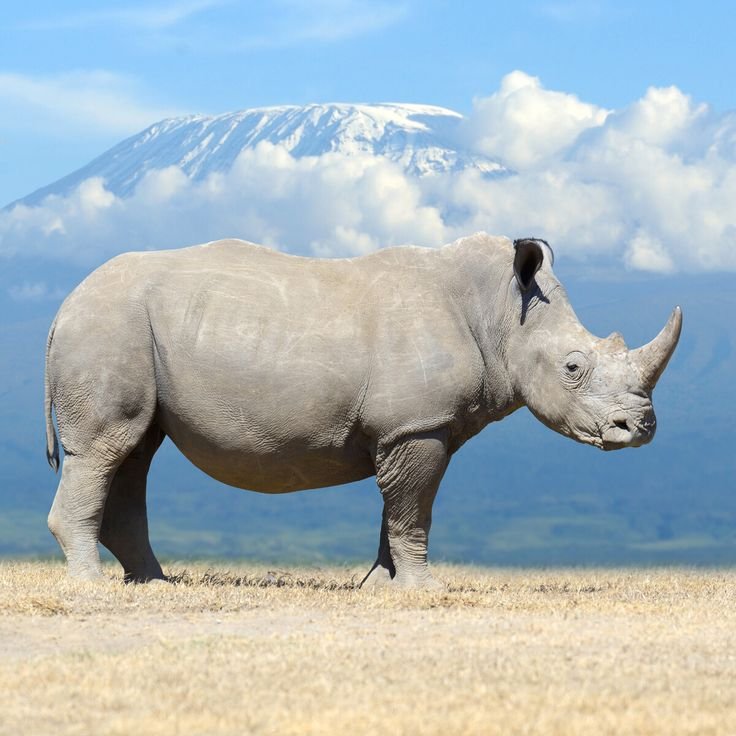
White Rhinoceros
Ceratotherium simumAfrica’s giant square-lipped grazer.
Sightings are never guaranteed and depend on local conditions. Follow your guide and respect park rules.
One of Africa’s largest land mammals, the white rhinoceros is instantly recognizable by its enormous body, two horns and broad mouth designed for cropping grass. More social than the black rhinoceros and perfectly adapted to open grasslands and savannas, this remarkable giant represents both the success of modern rhino conservation and the continuing challenge of protecting Africa’s wildlife from habitat loss and poaching.
White Rhinoceros Quick Facts
What Is a White Rhinoceros?
The white rhinoceros is the largest living rhinoceros species and one of Africa’s most recognizable large herbivores. Its broad, square-shaped mouth is specialized for grazing grasses, distinguishing it from the black rhinoceros, whose pointed upper lip is adapted primarily for browsing.
The name “white rhino” is misleading: the animal is generally gray, not white.
Why Is It Called a White Rhinoceros?
The white rhinoceros does not have white skin. Its skin is generally gray, often appearing dusty, muddy or brownish depending on the environment. The common English name is generally associated with the animal’s wide mouth, with historical naming interpretations linking “wide” to the English word “white.” For visitors, the simplest explanation is: white rhinos aren’t actually white — their name is associated with their characteristic wide, square-shaped mouth rather than their skin color.
The Square-Lipped Mouth
This is the defining feeding adaptation of the species. The white rhinoceros has a broad, square-shaped upper lip that allows it to crop grasses efficiently. Compare: White Rhino → broad mouth → grazing; Black Rhino → pointed hooked lip → browsing. SANBI specifically describes the white rhinoceros as a pure grazer and contrasts its broad mouth with the black rhino’s browsing adaptation.
Why Is It Called a ‘White’ Rhinoceros?
The name is a historical mix-up. Early settlers confused the Afrikaans wijde (“wide”), describing this rhino’s broad, square upper lip, with the English “white” — so the grey giant became the “white” rhino. That wide lip is the single clearest field mark separating it from the black rhino.
Square lip
A broad, square upper lip built for cropping short and tall grasses efficiently.
Two horns
A longer front horn and a smaller rear horn, both made primarily of keratin — not bone.
Enormous size
Adults commonly weigh 1,800–2,500+ kg, with body length around 3.5–4+ m and shoulder height up to ~1.9 m.
Social grazer
Generally more social than the black rhino — seen alone, in mother-calf pairs or in loose groups.
Keen senses, weak sight
Excellent smell and hearing, but relatively poor eyesight — a rhino may react to what it has not yet seen.
What Does the White Rhinoceros Eat?
White rhinoceroses are herbivores, more specifically primarily grazers. Their diet consists predominantly of short grasses, taller grasses, other herbaceous vegetation and fresh grass shoots. Unlike black rhinos, white rhinos are not primarily browsers. SANBI describes them as pure grazers that live largely on grasses.
How Does a White Rhino Graze?
The broad mouth allows the rhino to lower its head, crop grass, chew, move forward and crop again. This feeding method lets white rhinos efficiently exploit open grasslands, and their grazing can influence the structure of grassland vegetation.
Where Does the White Rhinoceros Live?
White rhinos are primarily associated with grasslands, open savanna, short-grass plains, woodland edges and water-associated grasslands. They need sufficient grass, water, cover and space. SANBI notes that white rhinos can inhabit grassland and savanna across a fairly broad rainfall range.
Daily Activity
White rhinos are often most active in the early morning (feeding while cool) and late afternoon/evening (grazing and moving between feeding and resting areas). During the hot midday they may rest in shade or wallow. Wild animals do not follow a fixed human timetable, so avoid inventing rigid schedules such as “6–10 AM always feeding, 10–3 PM always sleeping.”
Mud Wallows
White rhinos may use mud wallows to cool the body, protect the skin, reduce irritation and reduce insect nuisance. Mud can also help protect the skin from environmental conditions.
Water
White rhinos depend on access to water, although their exact requirements vary with habitat and climate. During dry periods, water availability can strongly influence movement. Avoid claiming an unnecessary fixed drinking interval — populations differ.
White Rhinoceros in Tanzania
White rhinoceroses are not a widespread native safari species across Tanzania. Any Tanzanian populations are associated with conservation introductions / assisted colonisation rather than representing the country’s historic native rhino population. Tanzania’s official wildlife-corridor assessment records Ceratotherium simum as extant through assisted colonisation — an important distinction. So we do not tell tourists that Ngorongoro is a major white-rhino destination.
What About Ngorongoro?
Ngorongoro is famous for BLACK rhinos — not white rhinos. The famous rhinos of the Ngorongoro ecosystem are the eastern black rhinoceros (Diceros bicornis michaeli). That information belongs much more strongly on the Black Rhinoceros page.
Why This Matters for SEO
This is good for African Majestic Adventure. We don’t want to rank through inaccurate claims. Instead, the page can own the query “White Rhinoceros — facts, habitat, conservation and where to see white rhinos in Africa,” then internally link to the Black Rhinoceros in Tanzania and explain: “If your Tanzania safari priority is seeing a wild rhinoceros, the species you are most likely seeking is the eastern black rhinoceros.” That is far more authoritative than pretending white rhinos are abundant in Tanzania.
Where Can You See a White Rhinoceros on Safari?
For genuine white-rhino safari experiences, major destinations are concentrated outside Tanzania. A practical plan:
South Africa — Kruger & Hluhluwe–iMfolozi
South Africa holds the world’s largest white-rhino population. The key strongholds are Kruger National Park and Hluhluwe–iMfolozi Park — the reserve where the southern white rhino was pulled back from the brink. Pilanesberg, Addo and Madikwe also offer reliable sightings.
Zimbabwe — Matobo National Park
Zimbabwe’s key white-rhino stronghold is Matobo National Park (Matopos), where rhino tracking on foot is a signature experience.
Namibia — Etosha National Park
Etosha National Park supports a growing white-rhino population, with dependable daytime sightings around the pan’s waterholes.
Botswana — Khama Rhino Sanctuary
White rhinos have been reintroduced at Khama Rhino Sanctuary and across the Okavango Delta’s private concessions.
Kenya — Ol Pejeta, Lake Nakuru & Lewa
Kenya’s strongest white-rhino populations are at Ol Pejeta Conservancy (near Nanyuki), with Lake Nakuru and Lewa Wildlife Conservancy also protecting southern white rhinos. For an African Majestic Adventure traveller, Kenya — not Tanzania — is the realistic East African white-rhino option.
African Majestic Adventure is a Tanzania-based operator: our safaris showcase the Ngorongoro black rhino and other northern-circuit wildlife. If you’d like to add a white-rhino stronghold (Ol Pejeta in Kenya, or Kruger and Hluhluwe–iMfolozi in South Africa), our team can help build a combined itinerary.
White Rhinoceros Behavior
White rhinoceroses are generally more social than black rhinoceroses. They may be seen alone, in mother-calf pairs, in loose groups, or in associations around food and water. However, we should avoid saying “white rhinos always live in herds” — they don’t.
Daily grazing
Most active early morning and late afternoon; resting or wallowing during the hot midday.
Mud wallowing
Cools the body and protects skin from sun, dryness and insects.
Scent & dung
Males use dung, urine, scent, scraping, vocalizations and physical displays to communicate.
Semi-social
Seen alone, in mother-calf pairs or loose groups — not rigidly herd-living.
Mother & calf
A calf may remain closely associated with its mother for several years.
White Rhinoceros Family Life
Adult Males
Adult bulls can become territorial, establishing an area and defending access to important resources and receptive females. Males communicate using dung, urine, scent, scraping, vocalizations and physical displays.
Females
Females generally have larger ranges and may move with calves. A mother and calf can remain closely associated for several years, making females an important component of white-rhino social structure.
Male Competition
Male white rhinos can fight over territory, access to females and dominance. Encounters can be violent: rhinos may charge, push, hook with their horns and injure one another; severe fights can occasionally result in death.
Reproduction
White rhinos have a relatively slow reproductive rate. Gestation lasts approximately 16 months (SANBI). Usually one calf is born; twins are extremely uncommon. A newborn calf can weigh roughly 40–60 kg, stand and follow its mother soon after birth, and remain dependent for an extended period. SANBI reports young white rhinos can become independent around the time of the mother’s next calf (generally 2–3 years), first calves in wild populations averaging around 5–6 years, and a typical inter-calving interval of about 2.5–3 years. This slow reproduction is central to conservation: if poaching removes adults, populations cannot recover rapidly.
Physical Adaptations
Size
Adult body length is approximately 3.5–4 m or more; shoulder height is roughly 1.7–1.9 m; weight is commonly around 1,800–2,500 kg, with exceptionally large individuals potentially exceeding 2,500 kg. (This is clearer than mixing length and weight into a single field.)
How Fast Can a White Rhino Run?
Despite its enormous size, a white rhinoceros can move surprisingly quickly — top speed approximately 40–. Treat as an upper-end, short-distance burst rather than normal travelling speed. A charging rhino can therefore be extremely dangerous.
The Two Horns
White rhinos normally have a longer, more prominent front horn and a smaller rear horn. The horns are made primarily of keratin — not bone — the same structural protein found in human hair and fingernails. Horns are multifunctional: defense, fighting, territorial disputes, competition, protecting calves, digging and manipulating vegetation. So don’t describe them simply as “weapons.”
Senses & Tracks
White rhinos have excellent smell and strong hearing, but relatively poor eyesight. A guide can read the enormous three-toed footprints to determine direction of travel, approximate freshness, group movement and feeding-area activity — a nice Safari Guide Insight.
White Rhinoceros vs Black Rhinoceros
This is one of the most valuable comparisons on the page, because users frequently confuse the two species.
| Feature | White Rhinoceros | Black Rhinoceros |
|---|---|---|
| Scientific name | Ceratotherium simum | Diceros bicornis |
| Mouth | Broad / square | Pointed / hooked |
| Feeding | Mainly grazing | Mainly browsing |
| Body | Larger / heavier | Smaller / lighter |
| Social behavior | Generally more social | Generally more solitary |
| Typical habitat | Open grassland / savanna | Woodland, bushland, savanna |
| Conservation | Near Threatened (species level) | Endangered |
| Tanzania | Introduced / assisted populations | Native eastern black rhino |
White Rhino: broad mouth → grass → grazer. Black Rhino: pointed lip → leaves/shrubs → browser. This is probably the single most important educational comparison on the page.
White Rhino vs African Bush Elephant
| Feature | White Rhino | African Bush Elephant |
|---|---|---|
| Feeding | Mainly grazing | Grazing + browsing |
| Sociality | Semi-social | Highly social |
| Trunk | No | Yes |
| Horns / tusks | Two horns | Tusks |
| Size | Up to several tonnes | Larger overall |
| Conservation | Near Threatened (species level) | Endangered |
Predators of the White Rhinoceros
Healthy adult white rhinos have essentially no regular natural predators. Calves are different: very young calves can be vulnerable to lions, hyenas and other large predators. So the broad claim that “large predators such as lions, leopards and hyenas may pose a threat” is too broad for adults. A more accurate statement: healthy adult white rhinos have few natural predators, while young calves may occasionally face predation, particularly from large carnivores.
Conservation Status
The species-level IUCN category for the white rhinoceros is Near Threatened — not Vulnerable. Tanzania’s official wildlife-corridor assessment records Ceratotherium simum as NT, with the southern subspecies also listed as NT and the northern subspecies as CR. The IUCN defines Near Threatened as a species that does not currently qualify for Vulnerable, Endangered or Critically Endangered, but is close to doing so or likely to qualify in the near future.
Northern White Rhinoceros
The northern white rhinoceros (Ceratotherium simum cottoni) is Critically Endangered, with extremely few individuals remaining under intensive human care. Never use “white rhino” and “northern white rhino” interchangeably: most white rhinos encountered on safari belong to the southern white rhinoceros population, not the northern subspecies.
Major Threats
1. Poaching
The illegal demand for rhino horn has historically been the greatest conservation threat.
2. Habitat loss
Agricultural and settlement expansion can reduce habitat.
3. Fragmentation
Development can isolate populations.
4. Small populations
Small populations are more vulnerable to disease, genetic problems, demographic fluctuations and local disasters.
5. Human conflict
Competition over land and resources can create conflict.
6. Climate pressure
Changes in rainfall and vegetation can affect food and water availability.
Rhino Horn & Conservation
Rhino horn is composed primarily of keratin and does not have scientifically established medicinal properties that justify the illegal trade. The illegal trade has nevertheless driven devastating poaching pressure. Conservation requires anti-poaching, law enforcement, protected areas, community engagement, population monitoring, translocations, veterinary intervention and international cooperation.
White Rhino as an Ecosystem Engineer
White rhinos alter grassland environments through grazing. Their feeding can influence grass height, vegetation structure, nutrient cycling, habitat availability and other herbivore interactions. SANBI describes the species as an ecosystem engineer whose grazing can shape landscapes and support broader biodiversity.
Why White Rhinos Matter to Tourism
White rhinos are one of Africa’s iconic safari animals, contributing to wildlife tourism, conservation funding, local employment, guiding industries and protected-area economies. Avoid claiming “every tourist dollar directly funds anti-poaching” — revenue flows differ between parks, private reserves, governments and operators. A more accurate statement: well-managed wildlife tourism can generate economic incentives for protecting rhino habitat and supporting conservation programs.
Did You Know?
Not actually white
The name comes from its wide, square-shaped mouth — the skin is generally gray.
Square-lipped grazer
A broad upper lip lets it crop grasses efficiently, unlike the black rhino’s pointed lip.
Horns of keratin
Both horns are made mostly of keratin — the same protein as human hair and fingernails.
Surprisingly fast
Despite weighing over two tonnes, it can burst at roughly 40–.
Long-lived
Wild white rhinos can live around 40–50 years.
Northern is critical
The northern white rhino subspecies is Critically Endangered, with only a few individuals left.
Ecosystem engineer
Its grazing shapes grassland structure and supports broader biodiversity.
Ngorongoro = black rhino
The famous rhinos of Ngorongoro are eastern black rhinos, not white rhinos.
Safari Guide’s Perspective
White rhinos are the gentle giants of the rhino world — bulkier and more placid than their black cousins, and the easiest of all rhinos to watch on foot from a safe distance. As grazers, they often feed out in open grassland rather than thick bush, which makes for relaxed, rewarding sightings.
A frank note for travellers: as a Tanzania-based operator, our own safaris showcase the Ngorongoro black rhino and the rest of the northern circuit. White rhinos aren’t a Tanzanian species, so if they’re on your bucket list we’ll usually build them in via a Kenya extension (Ol Pejeta is superb) or a South Africa add-on (Kruger and Hluhluwe–iMfolozi). Seeing both rhino species in one trip is a genuine highlight we’re happy to plan.
A white rhino leaves a track like a dinner plate pressed into the earth. Read it right, and you know which way a two-tonne grazer walked, how recently, and whether a calf followed. That quiet sign is often the first hint of an extraordinary sighting.
White Rhinoceros in Pictures
Frequently Asked Questions
No. Its skin is generally gray. The common name is associated with its broad, square-shaped mouth.
Ceratotherium simum.
Primarily grasses. It is a specialized grazer.
Adults commonly weigh around 1,800–2,500 kg, with exceptional individuals potentially heavier.
Approximately 40– over short distances.
Around 40–50 years is a useful wild-lifespan range.
Normally one calf at a time.
Approximately 16 months.
The species-level conservation category is Near Threatened in the current IUCN-based sources used here. The northern white rhino subspecies is Critically Endangered.
White rhinos have broad mouths adapted for grazing, while black rhinos have pointed upper lips adapted primarily for browsing.
No. Their huge bodies and specialized anatomy make them terrestrial grazers.
Yes. They are extremely powerful wild animals and can charge when threatened.
Major opportunities exist in southern Africa and selected East African conservation areas, particularly Kenya.
Tanzania is not a primary destination for naturally occurring white rhinos. Tanzania’s principal native rhino conservation story is the eastern black rhino; official Tanzanian material records white rhino through assisted colonisation.
Yes — but the famous rhino in Ngorongoro is the eastern black rhinoceros, not the white rhinoceros.
References & Further Reading
- IUCN Red List: Ceratotherium simum
- SANBI (South African National Biodiversity Institute): White rhinoceros species account — size, grazing ecology, reproduction and long-lived individuals.
- IUCN African Rhino Specialist Group (AfRSG): White and black rhinoceros conservation status, subspecies and population trends.
- Tanzania wildlife corridor assessment: Records Ceratotherium simum as extant through assisted colonisation; eastern black rhino as the native Tanzanian rhino.
- About these facts: Weight, speed and lifespan are approximate ranges that vary with sex, age, population and measurement method; conservation status should be checked against the current IUCN assessment.