

.png)
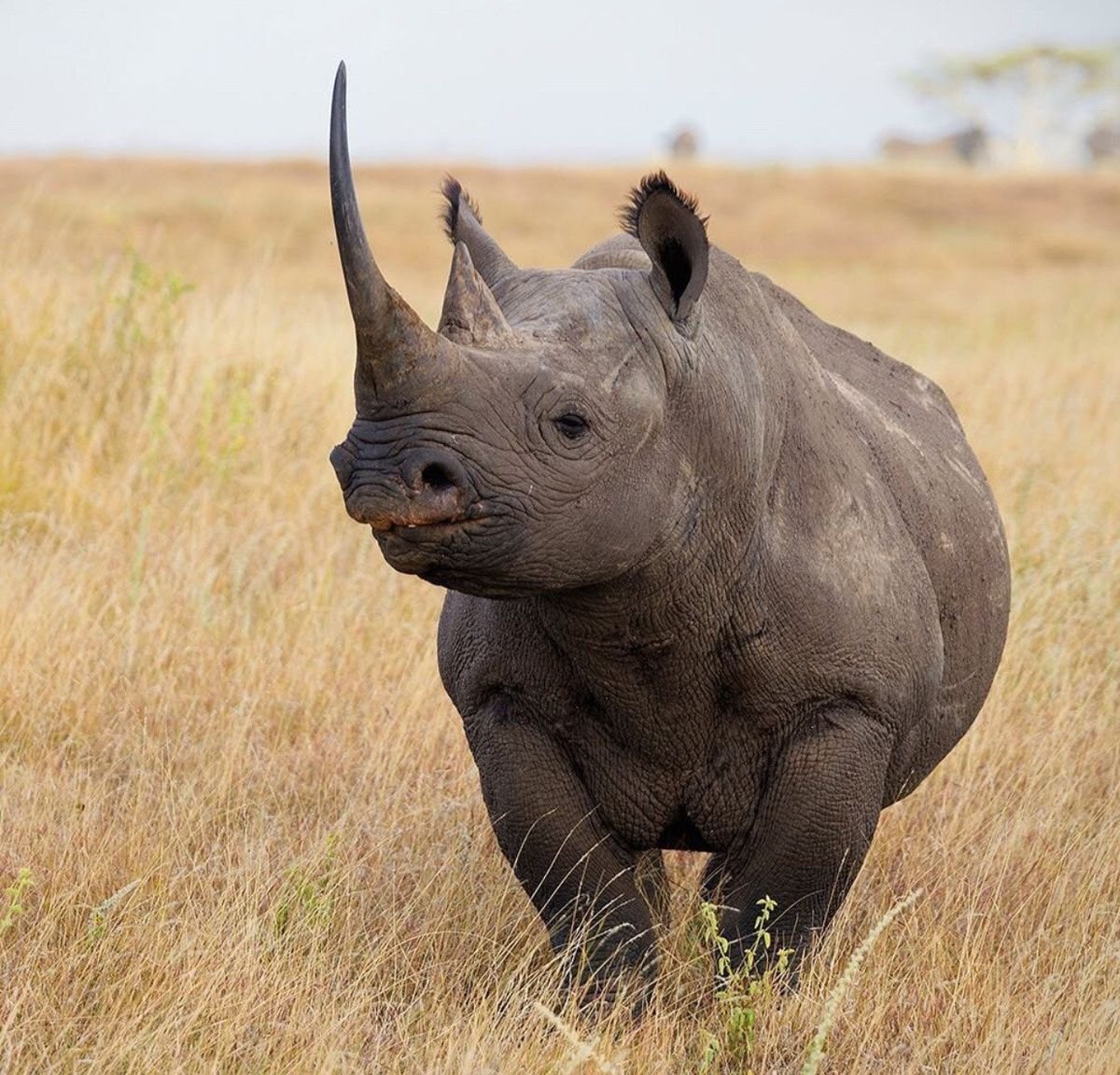
Black Rhinoceros
Diceros bicornisThe Endangered Browser of Africa's Wild Landscapes — prehistoric survivor with a hooked lip.
Sightings are never guaranteed and depend on local conditions. Follow your guide and respect park rules.
Powerful, elusive and critically endangered, the black rhino remains one of Africa's most unforgettable safari encounters.
Black Rhinoceros Quick Facts
What Is a Black Rhinoceros?
The Black Rhinoceros (Diceros bicornis) is one of Africa's most iconic and endangered large herbivores. It belongs to the odd-toed ungulates (Perissodactyla), alongside horses, zebras and other rhinoceroses, in the family Rhinocerotidae. Its name comes from the historical distinction from the white rhino — not because its skin is black (it's actually grey), but to contrast with the "white" rhino whose name derives from the Afrikaans "wyd" (wide) for its broad mouth.
The black rhino's defining feature is its pointed, prehensile upper lip — a specialised adaptation for browsing that allows it to selectively grasp leaves, shoots and twigs from woody vegetation. This adaptation sets it apart from the white rhino's broad, square mouth adapted for grazing. Once widespread across sub-Saharan Africa, black rhino numbers plummeted from an estimated 65,000 in 1970 to fewer than 2,500 by the 1990s due to catastrophic poaching for the illegal horn trade. Intensive conservation efforts have since brought numbers back to roughly 6,000–6,500, but the species remains Endangered.
Why Is It Called a "Black" Rhinoceros?
The name does not mean its skin is naturally black — both black and white rhinos are actually grey. The name distinction is historical: early Dutch settlers in southern Africa called the white rhino "wijd" (wide) for its broad, square mouth adapted for grazing. The other species, with its narrower, hooked mouth for browsing, became the "black" rhino by contrast — a historical naming convention, not a literal colour description.
This hooked, prehensile upper lip is the black rhino's signature adaptation. It functions like a small hand: the rhino uses it to reach, grasp, pull, strip and chew leaves, shoots and twigs from woody vegetation. This browsing adaptation allows it to exploit a feeding niche separate from grazers like the white rhino, zebra and wildebeest, making it a key browser in savanna and woodland ecosystems.
What Does the Black Rhinoceros Eat?
The black rhinoceros is a browser, not a grazer. Its diet consists primarily of leaves, young shoots, twigs, bushes, shrubs and other woody vegetation. Its pointed, prehensile upper lip acts like a grasping hand, allowing it to selectively pull vegetation from shrubs and branches that broad-mouthed grazers cannot reach. It feeds on a wide variety of woody plants — over 200 species recorded — and plays a key ecological role by controlling bush encroachment and creating open areas for other species.
- Leaves from acacia, commiphora and other woody plants
- Young shoots and tender twigs
- Bushes and shrubs (up to 2–3 m high)
- Succulent plants and euphorbias in arid areas
- Fruit and seed pods when seasonally available
- Bark and roots during dry season scarcity
How Does the Black Rhinoceros Feed?
Black rhinos are browsers, not hunters. They feed by selectively browsing through their home range, often following established paths between feeding areas, water sources and resting sites. Their feeding movements shape the vegetation structure, preventing bush thickening and maintaining habitat heterogeneity for other herbivores.
Where Does the Black Rhinoceros Live?
The Black Rhinoceros is found across parts of Africa, with its main populations in eastern and, where applicable, southern regions. Its preferred habitat is Savanna, woodland, shrubland & semi-arid areas with browse.
Eastern Africa
- Tanzania (Ngorongoro, Serengeti, Mkomazi)
- Kenya (Masai Mara, Lewa, Ol Pejeta, Nairobi NP)
- Rwanda (Akagera)
Southern Africa
- Namibia (Etosha, Kunene, Damaraland)
- South Africa (Kruger, Hluhluwe-iMfolozi, Pilanesberg)
- Zimbabwe (Matopos, Gonarezhou)
- Botswana (Khama Rhino Sanctuary)
Preferred Habitat
It favours savanna, woodland, shrubland & semi-arid areas with browse, where cover, food and shelter are in balance. Protected national parks across East Africa safeguard the .
Black Rhinoceros in Tanzania
Tanzania is one of the most important countries for black rhino conservation. The Ngorongoro Conservation Area holds a significant, monitored population within the crater floor — a UNESCO World Heritage Site where black rhinos are among the globally threatened species for which the area has major conservation importance. The Mkomazi Rhino Sanctuary in northern Tanzania is a dedicated reintroduction and protection site. Serengeti also supports a small but growing population under intensive protection.
Where Sightings May Occur
- Ngorongoro Conservation Area — crater floor population; best-known site for reliable black rhino viewing in Tanzania.
- Mkomazi Rhino Sanctuary — dedicated fenced sanctuary with intensive protection and monitoring.
- Serengeti National Park — small but growing population under intensive anti-poaching protection.
Where Can You See a Black Rhinoceros on Safari?
The Black Rhinoceros can be seen in several parks and reserves in Tanzania. The table below gives a realistic guide to habitat suitability.
| Destination | Habitat suitability | Sightings |
|---|---|---|
| Ngorongoro Crater | Excellent — monitored population on crater floor | High (best in Tanzania) |
| Mkomazi Rhino Sanctuary | Good — fenced sanctuary, guided access | Likely with guide |
| Serengeti | Fair — small population, vast area | Possible with expert guide |
Want to explore Tanzania's lesser-known wildlife?
Black Rhinoceros Behavior
Solitary
Adults are typically solitary; home ranges may overlap but individuals forage alone.
Browsing
Feeds selectively on woody vegetation 2–3 m high, using hooked lip to grasp and pull.
Wallowing
Regular mud wallowing cools the body, protects skin from sun and insects, and marks territory.
Scent marking
Communal dung middens and urine spraying communicate identity, reproductive status and territory.
Activity
Most active in cooler hours (dawn, dusk, night); rests in shade during midday heat.
Black Rhinoceros Family Life
Females give birth to a single calf after a gestation of 15–16 months — one of the longest of any land mammal. Calves are hidden for 1–2 weeks, then follow the mother closely. The mother is fiercely protective; the calf remains dependent for 2–4 years, learning which plants to browse, where to find water, and how to navigate the habitat. Males reach sexual maturity at 7–10 years; females at 5–7 years. This slow reproductive rate is a major factor limiting population recovery.
Physical Adaptations
Every feature of the Black Rhinoceros is finely tuned for life in savanna, woodland, shrubland & semi-arid areas with browse.
- Two horns: front horn larger (typically 50–140 cm), rear horn smaller; made of keratin, not bone
- Pointed, prehensile upper lip — the key adaptation for browsing
- Grey skin (not black) — appears darker or lighter depending on mud and dust
- Thick skin (1.5–5 cm) with minimal hair; sensitive to sun and insects, hence wallowing
- Rotating ears and poor eyesight compensated by acute hearing and smell
- Compact, barrel-shaped body; three-toed feet with semi-circular tracks
Vital statistics: body length approximately Up to 3.8 m long, 1,400 kg, weight 1,400 kg, top speed up to , lifespan typically 35-50 yrs.
Black Rhinoceros vs White Rhinoceros & African Buffalo
How does the Black Rhinoceros compare with its fellow African herbivores?
| Feature | Black Rhinoceros | White Rhinoceros | African Buffalo |
|---|---|---|---|
| Scientific name | Diceros bicornis | Ceratotherium simum | Syncerus caffer |
| Weight | 1,400 kg | 1,600-2,400 kg | 900 kg |
| Size | Up to 3.8 m long, 1,400 kg | Up to 4 m long, 2,300 kg | Up to 3.4 m long, 900 kg |
| Speed | |||
| Lifespan | 35-50 yrs | 40-50 yrs | 20-25 yrs |
| Diet | Herbivore | Herbivore | Herbivore |
| Conservation | Endangered | Vulnerable | Least Concern |
Predators of the Black Rhinoceros
For such a black rhinoceros, the savanna holds many dangers. It is important to distinguish between predators of adults and the greater threats facing young animals.
Healthy adults have virtually no natural predators; size, thick skin and horns deter even lions.
Calves and sub-adults can be taken by lions, spotted hyenas and Nile crocodiles, but mothers are ferociously protective.
The only significant predator is humans — poaching for the illegal horn trade has been the primary driver of the species' catastrophic decline.
Conservation Status
Endangered does not mean the species has no conservation challenges. It means the species is not currently assessed in a higher IUCN threat category at the global level.
The black rhino is classified as Endangered (IUCN Red List). Three subspecies are recognised: Eastern (D. b. michaeli), Southern Central (D. b. minor) and South-western (D. b. bicornis); the Western (D. b. longipes) was declared Extinct in 2011. Intensive protection (armed patrols, dehorning, translocation, fenced sanctuaries) has increased numbers from ~2,400 (mid-1990s) to ~6,500 today. Tanzania's Ngorongoro and Mkomazi populations are critical strongholds. The species remains conservation-dependent.
Did You Know?
The black rhino is actually grey, not black — the name is a historical contrast to the "white" (wide-mouthed) rhino.
Its hooked upper lip works like a finger: it can reach, grasp, pull and strip leaves and twigs from branches up to 3 m high.
Despite weighing up to 1,400 kg, a black rhino can charge at 50– in short bursts.
Communal dung middens are "social media" for rhinos — they convey identity, reproductive status and territory boundaries.
Safari Guide's Perspective
To stand in the Ngorongoro grass at dawn and watch a black rhino emerge from the mist — that hooked lip, those two horns, the sheer prehistoric presence — is to witness a survivor. This animal has walked the Earth for millions of years. Whether it continues to do so depends entirely on us.
Black Rhinoceros in Pictures
A closer look at the Black Rhinoceros in its natural East African habitat — its striking appearance, habitat and behaviour are best appreciated up close.
Frequently Asked Questions
No — the Black Rhinoceros is currently listed as Endangered on the IUCN Red List, though local populations can still face habitat pressure.
The black rhinoceros is a browser, not a grazer. Its diet consists primarily of leaves, young shoots, twigs, bushes, shrubs and other woody vegetation. Its pointed, prehensile upper lip acts like a grasping hand, allowing it to selectively pull vegetation from shrubs and branches that broad-mouthed grazers cannot reach. It feeds on a wide variety of woody plants — over 200 species recorded — and plays a key ecological role by controlling bush encroachment and creating open areas for other species.
Across savanna, woodland, shrubland & semi-arid areas with browse in Eastern & Southern Africa, including parts of Tanzania.
Yes — in suitable habitat such as Ngorongoro Crater & Mkomazi, Tanzania, although sightings vary by species and season.
Up to 3.8 m (12.5 ft) in body length, weighing up to 1,400 kg (3,090 lb).
It can reach speeds of up to when needed.
Activity patterns vary by species — some are active by day, others almost entirely at night. Most active in cooler hours (dawn, dusk, night); rests in shade during midday heat.
Diceros bicornis — a member of the Rhinocerotidae family.
Key threats include habitat loss and local habitat changes, alongside natural predation.
Adults are typically solitary; home ranges may overlap but individuals forage alone.
References & Further Reading
- IUCN Red List: Diceros bicornis
- Animal Diversity Web (University of Michigan): Species accounts for African carnivores, including diet, size and behavior.
- Tanzania Wildlife Research Institute (TAWIRI): Monitoring wildlife populations in Tanzania.
- Estes, R. (1991). The Behavior Guide to African Mammals. University of California Press.
- Kingdon, J. (2015). The Kingdon Field Guide to African Mammals. Bloomsbury.
- About these facts: Weight, speed and lifespan are approximate adult ranges. They can vary with sex, age, season, location and the measurement method; conservation status should be checked against the current IUCN assessment.