

.png)
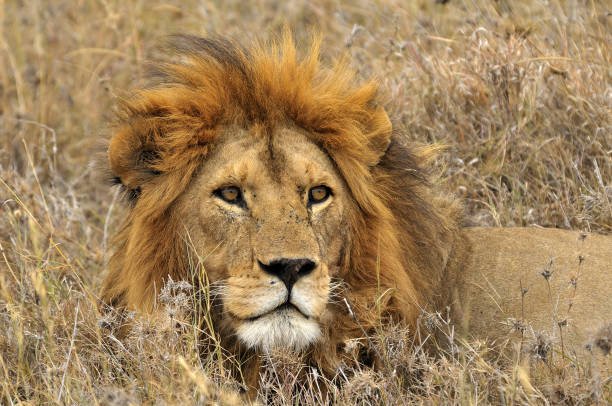
African Lion
Panthera leoAfrica’s iconic social predator and king of the savannah.
Sightings are never guaranteed and depend on local conditions. Follow your guide and respect park rules.
Powerful, social and unmistakable, the African lion is one of the continent’s most celebrated predators. From roaring territorial males and closely bonded prides to cooperative hunts across Tanzania’s great wildlife landscapes, lions reveal a complex society built around family, competition, survival and extraordinary adaptability.
African Lion Quick Facts
What Is an African Lion?
The African Lion (Panthera leo) is one of the world’s largest living cats and Africa’s most recognizable terrestrial predator. It is also exceptional among cats because of its highly developed social system, with many lions living in groups known as prides.
Lions historically occupied much more of Africa, the Middle East and parts of Asia. Today their range is greatly reduced and fragmented, with most wild lions occurring in sub-Saharan Africa and a separate surviving population in India. The lion is therefore not simply an iconic animal — it is also a dramatic example of historical range contraction.
Why Is the Lion Called the King of the Savannah?
“King of the Jungle” is a cultural nickname rather than a scientific description. African lions are much more strongly associated with savannas, grasslands, open woodlands, shrublands and bush country than dense tropical jungle. For African Majestic Adventure, the more geographically and ecologically appropriate phrasing is “The King of the African Savannah.”
What Does an African Lion Look Like?
African lions have enormously powerful bodies built for grappling with relatively large prey. Important characteristics include:
- Muscular body
- Large head
- Powerful jaws and canine teeth
- Strong forelimbs and retractable claws
- Tawny coat
- Long tail with a dark tuft at the end
- Excellent low-light vision and strong hearing
The tawny coloration provides camouflage among dry grass, soil, woodland and bush.
The Male Lion’s Mane
Adult males are famous for their mane. Mane characteristics vary considerably — from blond to golden, brown, dark brown and almost black — and in length, density, coverage, color and overall size. A male’s mane can make him appear physically larger and plays a role in sexual and social signaling.
A male’s mane does not automatically turn black with age. Mane color and density depend on several factors — including age, testosterone, genetics, climate and individual variation — and range from blond to almost black across populations.
Male vs Female Lion
| Characteristic | Male | Female |
|---|---|---|
| Body size | Generally larger | Generally smaller |
| Mane | Usually present in mature males | Normally absent |
| Pride role | Territory/coalition defense, mating | Hunting, cub care, social roles |
| Social structure | Coalition/pride or nomadic | Often remains with natal pride |
| Appearance | Heavy head and neck | More streamlined |
The old idea that “females hunt while males do nothing” is an oversimplification. Male lions also hunt, particularly when alone, nomadic or pursuing certain large prey.
Size
Size varies substantially according to sex, population, habitat, food availability, age and genetics. Adult males are considerably larger than females. Typical weights: males commonly around 150–225 kg and females around 110–150 kg, with exceptional individuals outside those ranges.
Speed
A lion’s top speed is approximately 60– over short distances (not ). More importantly, lions are not endurance pursuit predators. Their bodies are designed for stalking, getting close, explosive acceleration, ambush and powerful restraint — so speed alone doesn’t explain lion hunting.
What Does the African Lion Eat?
African lions are obligate carnivores. Their prey varies according to ecosystem and availability and can include wildebeest, zebra, buffalo, warthog, impala, gazelles, hartebeest, topi, other antelope, young giraffe and other mammals, plus smaller animals and carrion.
Can Lions Kill Buffalo?
Yes. African buffalo can be extremely dangerous prey, but lions — particularly coordinated groups — can successfully attack them. Hunting buffalo carries substantial risk: a buffalo can gore, trample, injure or kill a lion. Being an apex predator doesn’t mean hunting is easy or safe.
Do Lions Hunt Giraffes?
Yes, under certain circumstances, but adult giraffes are formidable. Lions are more likely to succeed when hunting cooperatively, targeting vulnerable individuals, or exploiting favorable terrain. Giraffes are not everyday easy prey.
Do Lions Hunt Elephants?
Occasionally, certain lion populations have been documented attacking elephants, particularly young or vulnerable animals. But elephants are not standard lion prey across Africa — a reminder that unusual behavior shouldn’t be turned into a general rule.
Do Lions Scavenge?
Absolutely. Lions are both hunters and opportunistic scavengers. They may take carcasses from hyenas, leopards, wild dogs and other predators, and feed on animals that died from other causes. Scavenging is a normal part of carnivore ecology.
How Do Lions Hunt?
A simplified cooperative hunt:
Lions generally rely on getting close before attacking because they cannot sustain maximum speed for long. They can hunt at night, around dusk, around dawn and during daytime under favorable conditions — so don’t say “lions only hunt at night.”
How Long Do Lions Sleep?
Lions spend enormous amounts of time resting — approximately 16–20 hours in a day. Hunting is energetically expensive and African daytime temperatures can be high, so resting conserves energy.
Where Does the African Lion Live?
African lions can occupy grassland, savanna, open woodland, bushland, scrub, semi-arid environments and some dry forest environments. They generally avoid extremely dense tropical rainforest and hyper-arid desert. IUCN material describes lions as having relatively broad habitat tolerance outside tropical moist forest and hyper-arid desert, with open woodland, thick bush, scrub and grass complexes being particularly suitable.
Historical Lion Range
Lions once occupied enormous areas across Africa, southeastern Europe, the Middle East, southwestern Asia and India. Today that distribution has contracted dramatically. Most remaining wild lions occur in sub-Saharan Africa, while the remaining Asian population survives in India.
Where Can You See an African Lion on Safari?
African Lions in Tanzania
Tanzania is globally important for lion conservation. Important lion landscapes include the Serengeti, Ngorongoro, the Tarangire–Manyara ecosystem, Ruaha, Nyerere and Katavi. Northern Tanzania conservation work specifically targets lions and other large carnivores across landscapes such as Tarangire-Manyara and Ngorongoro.
Best Places to See Lions in Tanzania
- Serengeti National Park — one of the world’s most famous lion landscapes; observe prides, cubs, hunting behavior, territorial males and lions around migration herds.
- Ngorongoro — excellent lion-viewing within a concentrated wildlife ecosystem.
- Ruaha — outstanding southern Tanzania predator country.
- Tarangire — important northern Tanzania lion habitat.
- Nyerere — huge southern Tanzania wilderness supporting lions and diverse prey.
- Katavi — remote and wild western Tanzania lion habitat.
Best Time to See Lions
June–October (dry season): Often excellent because vegetation can be thinner, wildlife concentrates around resources, roads are generally easier, and predator/prey interactions can be easier to observe. November–May (green season): Also excellent — lush photography, young prey animals, calving activity in parts of Serengeti, predator activity and fewer visitors during some periods. Important: Lions are resident year-round. Don’t make visitors believe Tanzania only has good lion viewing from June to October.
Do Lions Climb Trees?
Yes. Lions can climb trees, although climbing behavior varies considerably between individuals and populations. Tanzania is particularly famous for sightings of tree-climbing lions around Lake Manyara, parts of Serengeti and Tarangire and neighboring ecosystems. Don’t claim tree climbing is unique to one specific population.
A Note on the Masai Mara
The Masai Mara National Reserve is in Kenya, not Tanzania. It forms part of the broader Serengeti–Mara ecosystem, but it should not be described as a Tanzanian region.
Safari Experience
Game drives are the primary method for observing wild lions. Potential observations include sleeping prides, feeding, hunting, cubs playing, males roaring, territorial patrols, social grooming, pride reunions and — in some ecosystems — lions climbing trees.
African Lion Behavior
Roaring
The roar advertises presence, maintains contact, warns rivals, communicates territorial occupancy and helps separated pride members locate one another. A lion’s roar can travel several kilometers under favorable conditions.
Communication
Lions use roars, grunts, growls, moans, scent, urine, facial expressions, body posture, head rubbing, licking and physical contact. Their social system requires sophisticated communication.
Social Bonding
Head rubbing, grooming, resting together, licking, play and physical contact reinforce social relationships — a pride is a complex social unit, not just a group that hunts together.
Territory
Lions communicate territorial ownership through roaring, scent marking, urination, scraping and patrols. Territory size varies with prey density, water, habitat, neighbors, human disturbance and season.
When They Hunt
Lions can hunt at night, dusk, dawn and daytime under favorable conditions, often using cooler temperatures and darkness. They are not strictly nocturnal hunters.
A pride commonly consists of related adult females, their cubs, juveniles and one or more associated males. How a pride functions:
The Lion Pride
The pride is perhaps the defining difference between lions and other big cats. A pride commonly consists of related adult females, their cubs, juveniles and one or more associated males. Pride size varies enormously; the IUCN gives an average of roughly four to six adults, while group composition and total numbers vary considerably. Large prides occur, but don’t make “up to 30” sound typical.
Lionesses: The Pride’s Social Core
Related females often form the stable social core of a pride and may remain with or associated with their natal pride for long periods. They cooperate in hunting, territory defense, cub protection, nursing and social bonding.
Male Lion Coalitions
Male lions frequently form coalitions of brothers, half-brothers, related males or sometimes unrelated males. Coalition partners cooperate to compete for territories, challenge resident males, defend access to prides and defend territory from rivals. Lion society isn’t organized like a human monarchy — there is no simple single “pride leader.”
Lion Cubs
Lionesses normally give birth to litters rather than a single cub. The IUCN gives an average litter size of approximately 2.5 cubs; a broader practical range is 1–4, with larger litters possible. Cubs are born small, vulnerable and dependent, with eyes initially closed.
Lion Pregnancy & Raising Cubs
Gestation lasts approximately 110 days (roughly 3.5 months); a pregnant lioness typically seeks a secluded location such as dense vegetation, rocky cover or thick bush. As cubs grow they gradually walk, play, explore, meet the pride, eat meat, observe hunts and develop hunting skills.
Communal Cub Care — “The Lion Nursery”
Females in a pride may give birth around similar periods and can protect one another’s cubs, allow cubs to interact and sometimes nurse cubs communally. Cub life is dangerous, though: threats include starvation, disease, hyenas, leopards, other lions, male takeover, accidents and human disturbance, and a significant proportion of cubs do not survive to adulthood.
Male Takeovers & Infanticide
When new males take control of a pride, they may kill dependent cubs fathered by previous males, which can cause females to return to reproductive condition sooner. This sounds brutal from a human perspective, but it should be explained scientifically rather than morally.
African Lion vs Other Carnivores
Lion vs Leopard
| Feature | Lion | Leopard |
|---|---|---|
| Scientific name | Panthera leo | Panthera pardus |
| Social system | Highly social | Mostly solitary |
| Male appearance | Mane | No mane |
| Body | Larger/heavier | Smaller, compact |
| Hunting | Solo/cooperative | Primarily solitary ambush |
| Tree use | Can climb | Exceptional climber |
| Coat | Tawny | Rosettes |
Lion vs Cheetah
| Feature | Lion | Cheetah |
|---|---|---|
| Body | Powerful | Lightweight |
| Strategy | Ambush/power | Speed pursuit |
| Sociality | Pride-based | Variable |
| Top speed | ~60– | ~100+ km/h |
| Claws | Retractable | Less retractile |
| Build | Heavy | Aerodynamic |
Lion vs African Wild Dog
| Feature | Lion | African Wild Dog |
|---|---|---|
| Family | Felidae | Canidae |
| Social unit | Pride | Pack |
| Hunting | Ambush/cooperative | Endurance/cooperative |
| Size | Much larger | Smaller |
| Competition | Dominant competitor | Often avoids lions |
Lions vs Hyenas
Lions and spotted hyenas are competitors, predators and scavengers sharing many of the same prey resources. They may steal kills from one another, attack one another, compete around carcasses, avoid one another and follow each other’s activity. Importantly, lions steal from hyenas too — the simplistic story “hyenas steal lions’ food” doesn’t accurately describe the relationship. Both species exploit opportunities.
African Lion Competitors & Threats
As an apex predator, the adult lion has few natural predators. Its main challenges come from intense competition with other large carnivores — spotted hyenas, leopards and African wild dogs — and from human pressures. Cubs are vulnerable to hyenas, leopards, other lions and various other threats.
Are Lions Dangerous?
Yes. Lions are powerful wild predators and should only be observed according to professional safari safety procedures. Visitors should remain inside the safari vehicle where required, follow the guide’s instructions, and never approach, feed or provoke wildlife.
Conservation Status
The lion (Panthera leo) is classified as Vulnerable on the IUCN Red List. This should be explained rather than treated like a decorative badge: IUCN defines Vulnerable species as facing a high risk of extinction in the wild under its assessment criteria.
Major Threats to African Lions
- Habitat loss: Agriculture, settlement and infrastructure reduce available lion habitat.
- Habitat fragmentation: Remaining populations can become increasingly isolated.
- Human-lion conflict: Lions sometimes attack livestock, and retaliatory killing can follow.
- Prey depletion: Declining wild herbivore populations reduce available food.
- Illegal killing: Poisoning, snares and other forms of killing threaten populations.
- Poorly managed exploitation: Unsustainable management can negatively affect populations.
The IUCN material identifies human/livestock conflict, habitat loss and declining prey bases among major pressures.
Poisoning
This deserves special attention in Tanzania. When a lion kills livestock, a poisoned carcass may sometimes be used in retaliation. But poisoning can kill far more than the intended lion — also affecting hyenas, vultures, jackals and other scavengers. Northern Tanzania conservation programs specifically identify human-lion conflict and carcass poisoning as threats in the Tarangire-Manyara landscape.
Human-Lion Coexistence
Long-term lion conservation cannot depend entirely on fenced or isolated parks. Lions move across protected area, community land, grazing land, wildlife corridor and another protected area. Conservation increasingly involves predator-proof livestock enclosures, community conservation, livestock management, compensation/incentive systems, wildlife corridors, education, monitoring and local economic benefits. Projects in northern Tanzania have used community rangeland management and predator-resistant livestock enclosures to reduce carnivore conflict.
Ecological Role
The African lion is an apex predator. As a large carnivore it helps shape prey communities and predator interactions, influencing prey behavior, prey distribution, carcass availability, competition among carnivores and broader food-web relationships. When lions kill prey, other organisms benefit from remains — vultures, hyenas, jackals, insects and microorganisms — and carcasses return nutrients to the ecosystem. So lion predation participates in a much larger ecological network.
Why Tanzania Matters
Tanzania contains enormous interconnected landscapes including Serengeti–Ngorongoro, Tarangire–Manyara, the Ruaha ecosystem and the Nyerere/Selous ecosystem. Conservation isn’t simply about protecting individual lions — it’s about protecting lions, prey, habitat, corridors and communities.
Did You Know?
Mature males usually develop a mane; lionesses normally lack one.
Lions are unusually social — their groups are called prides.
Related females form the pride’s stable core; males often form coalitions.
A lion can run roughly 60– briefly, not .
Lions may rest or sleep around 16–20 hours per day.
A lion’s roar can travel several kilometers.
Lionesses normally have litters (1–4), not a single cub.
Lions can climb trees — famously around Lake Manyara and beyond.
Safari Guide’s Perspective
Hearing lions roar at night is one of the most extraordinary experiences in Africa — a sound that can travel several kilometers across the darkness. To then meet the pride at first light, cubs tumbling among the grass while a heavy-maned male patrols the boundary, is to witness one of the planet’s great social mammals at work.
African Lion in Pictures
A closer look at the African Lion in its natural African habitat — prides, manes, hunts and the unforgettable roar.
Frequently Asked Questions
Panthera leo.
The lion is currently classified as Vulnerable in the IUCN sources cited here.
Primarily across fragmented parts of sub-Saharan Africa, particularly in savannas, grasslands, bushland and open woodland.
Serengeti, Ngorongoro, Ruaha, Tarangire, Nyerere and Katavi are among Tanzania’s major lion landscapes.
Yes. Serengeti is one of Africa’s most famous lion ecosystems.
Yes. Lions are unusually social among cats and commonly live in prides.
A pride.
Cooperating males are commonly called a coalition.
There isn’t a simple human-style “king” or single permanent leader. Related females form the stable core, while associated males defend access and territory.
Yes.
Yes, and lionesses frequently cooperate during hunts.
Their prey includes wildebeest, zebra, buffalo, warthogs, antelope and other animals. They also scavenge.
Approximately 60– for short distances.
They can spend roughly 16–20 hours per day resting or sleeping depending on conditions.
Lionesses normally have litters rather than a single cub. Around 1–4 is common, with the IUCN material cited here giving an average of approximately 2.5.
Approximately 110 days.
The mane plays important roles in social and sexual signaling and makes the head and neck appear larger.
Several kilometers under favorable environmental conditions.
Yes, although frequency varies among populations and individuals.
Lions and hyenas are intense competitors and can kill one another. Killing a competitor doesn’t necessarily mean it is routinely eaten.
Yes. Lions are powerful wild predators and should only be observed according to professional safari safety procedures.
References & Further Reading
- IUCN Red List: Panthera leo
- IUCN Cat Specialist Group / Lion Conservation: Lion (Panthera leo) assessment, pride structure, reproduction and threat information.
- Serengeti research: Foundational long-term studies of lion ecology, pride structure, hunting, reproduction, territoriality and disease.
- Northern Tanzania conservation programs: Human-lion conflict, carcass poisoning and community rangeland management in Tarangire-Manyara and Ngorongoro.
- African Carnivores Initiative: Lion as a key African carnivore species.
- About these facts: Weight, speed and lifespan are approximate ranges that vary with sex, age, population and measurement method; conservation status should be checked against the current IUCN assessment.