

.png)
The Zanzibar Red Colobus
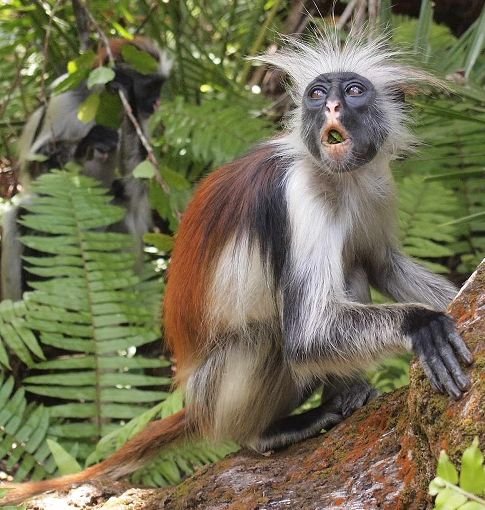
Piliocolobus kirkii — a specialised leaf-eating colobus monkey found only on Zanzibar: a reddish-brown coat, a dark face, a long tail and a life spent in big, sociable troops in the Jozani Forest.Introduction to the Zanzibar Red Colobus
The Zanzibar red colobus (Piliocolobus kirkii) is a leaf-eating colobus monkey endemic to the island of Unguja (Zanzibar), part of Tanzania. Its stronghold is the Jozani Forest, where troops move through the canopy and are a highlight of forest walks. It is a separate species from the Tana River red colobus of Kenya (P. rufomitratus) and must not be confused with it.
Scientific Classification
Physical Characteristics
- Coat: A reddish-brown to maroon coat with a black face and dark limbs.
- Face: Bare dark skin, sometimes with pale whisker patches.
- Tail: Long and slender for balance in the trees.
- Hands: Like all colobus, a reduced (vestigial) thumb.
- Build: Slender and agile, built for leaping between branches.
- Stomach: A sacculated, multi-chambered stomach ferments the leaves it eats.
Social Organization
The Zanzibar red colobus is highly social, living in cohesive mixed troops:
- Troops: Multi-male, multi-female groups, often 20–60 or more individuals.
- Sexes: Males and females look similar; males are typically a little larger.
- Cooperative care: Several females help care for infants (allomothering).
- Structure: Troops have a hierarchy and defend their forest range as a group.
Zanzibar Red Colobus Young & Reproduction
- Birth: Usually a single infant (twins uncommon).
- Care: The mother carries and nurses the infant; other troop females also groom and handle it (allomothering).
- Development: Infants are born darker and gradually gain the adult reddish coat; weaned over several months.
- Maturity: Young remain with the troop as they grow.
Habitat: Where They Thrive
This is a forest primate of Zanzibar:
- Jozani Forest: Groundwater/lowland forest - the species' main stronghold.
- Other woodland: It can use mangroves, plantation edges and other wooded patches on Unguja.
- Canopy life: Almost entirely arboreal, feeding and resting high in the trees.
Distribution Map
The Zanzibar red colobus is endemic to Unguja (Zanzibar), Tanzania. Outside Jozani it survives in scattered woodland on the island, but the Jozani Forest holds the healthiest population.
Found only on Zanzibar (Tanzania) - not in Kenya or the Tana River.
Where to See the Zanzibar Red Colobus in Zanzibar
Jozani is the place to look - but sightings are never guaranteed even though troops are regularly found there:
Jozani Chwaka Bay NP
Best: Year-round | Region: Zanzibar (Tanzania)
Visible (forest walk)
The Zanzibar red colobus' main stronghold; guided forest walks search the canopy for troops.
Unguja woodland
Best: Year-round | Region: Zanzibar (Tanzania)
Visible (forest walk)
Scattered troops survive in other wooded patches across the island.
This is a Zanzibar (Tanzania) endemic - it does not occur in Kenya or the Tana River.
Zanzibar Red Colobus in Pictures
A closer look at the Zanzibar red colobus (Piliocolobus kirkii) - the Endangered, Zanzibar-endemic leaf-eater of the Jozani Forest canopy.
Where to Spot the Zanzibar Red Colobus on Safari
This Zanzibar endemic is best sought on forest walks in Jozani. Explore the destinations below.
Diet: What They Eat
The Zanzibar red colobus is a folivore - a specialised leaf-eater:
- Leaves: Young, tender leaves form the bulk of the diet, fermented in a sacculated stomach.
- Flowers & fruits: Eaten in season, adding variety and nutrition.
- Seeds: Some seeds are taken; mature leaves less so.
- Adaptation: The complex stomach unlocks nutrition from a leafy, fibrous diet.
Daily Behaviour & Social Life
Day & Night
Day: Diurnal and arboreal - troops spend the day moving through the canopy, feeding on leaves, resting and grooming.
Night: The troop settles in the trees to sleep.
Troop life
Large troops mean shared knowledge of feeding trees and safety in numbers; infant care is spread across several females (allomothering).
Predators & Threats
Natural predators include crowned eagles. The main threat is habitat loss and pressure from domestic cats and development on Zanzibar.
Watching tip: Look for troops moving through the upper canopy on a guided forest walk in Jozani.
Reproduction & Lifespan
- Mating: Within the troop; multiple males and females breed.
- Birth: Usually a single infant.
- Care: Mother and allomothers raise the infant together.
- Lifespan: Colobus monkeys can live well over a decade; exact wild lifespan varies.
Conservation Status
IUCN Red List Status: The Zanzibar red colobus (Piliocolobus kirkii) is listed as Endangered. It is found only on Zanzibar.
Major Threats
- Habitat loss: Forest clearance and development on Unguja.
- Domestic cats: Predation and disease from free-ranging cats.
- Island endemic: A naturally small range makes it vulnerable to any habitat change.
Conservation Context
Jozani Chwaka Bay National Park protects the largest population. Managed, low-impact forest walks also help fund protection while letting visitors see this island endemic.
Interesting Facts
Zanzibar Red Colobus vs Other Colobus
Zanzibar vs Tana River Red Colobus
| Feature | Zanzibar (P. kirkii) | Tana River (P. rufomitratus) |
|---|---|---|
| Range | Zanzibar (Tanzania) | Kenya (Tana River) |
| Status | Endangered | Critically Endangered |
| Coat | Reddish-brown | Red-maroon mantle |
Zanzibar Red Colobus vs Black-and-white Colobus
| Feature | Red Colobus | Black-and-white Colobus |
|---|---|---|
| Coat | Reddish-brown | Black & white |
| Social | Troops | Troops |
| Habitat | Jozani forest | Forest canopy |
Zanzibar Red Colobus in Context
The Zanzibar red colobus is one of the island's best-loved wildlife symbols - an Endangered endemic that draws visitors to Jozani's shaded trails. It is a reminder that "red colobus" is not one species but several, each with its own island or river home.
Wildlife Photography Guide
- Best Camera Lens: A 100-400mm or 200-600mm lens for canopy shots.
- Best Time: Daytime forest walks in Jozani, year-round.
- Best Habitat: Jozani Forest, Zanzibar.
- Best Behaviour: Capture the reddish coat, long tail and troops moving through the canopy.
- Safety Distance: Stay quiet and keep distance; never disturb a troop.
Frequently Asked Questions
The Zanzibar red colobus (Piliocolobus kirkii) is a leaf-eating colobus monkey found only on Zanzibar - a different species from the Tana River red colobus of Kenya.
Adults typically weigh about 5-12 kg, with a head-body length of roughly 50-65 cm plus a long tail.
It is a folivore: leaves (especially young leaves) form the bulk of the diet, along with flowers, fruits and seeds, digested in a specialised sacculated stomach.
It is endemic to Zanzibar (Unguja), Tanzania, with the Jozani Forest as its main stronghold.
Yes - it lives in multi-male, multi-female troops often 20-60+ strong, with several females helping care for infants (allomothering).
A guided forest walk in Jozani Chwaka Bay National Park, Zanzibar. It is a Zanzibar endemic, not found in Kenya.
Jozani Forest and other woodland on Zanzibar; almost entirely arboreal.
Yes - it is Endangered on the IUCN Red List, found only on Zanzibar.
Usually a single infant, cared for by the mother and by other troop females.
They are separate species: P. kirkii is Zanzibar's (Endangered); P. rufomitratus is Kenya's Tana River (Critically Endangered). They should not be merged.
Related Safari Packages & Tours
The Zanzibar red colobus is a Zanzibar endemic - plan a Zanzibar holiday with a Jozani forest walk, or explore our wider Tanzania programmes.
References & Further Reading
- IUCN Red List: Piliocolobus kirkii - Endangered.
- Animal Diversity Web (ADW): University of Michigan, Piliocolobus kirkii account - taxonomy, folivory, social troops and Zanzibar range.
- About these facts: Weight, length and group size are approximate and vary by source. Conservation status should be checked against the current IUCN assessment. The Zanzibar red colobus (P. kirkii) is a separate species from the Tana River red colobus (P. rufomitratus) and must not be merged with it.