

.png)
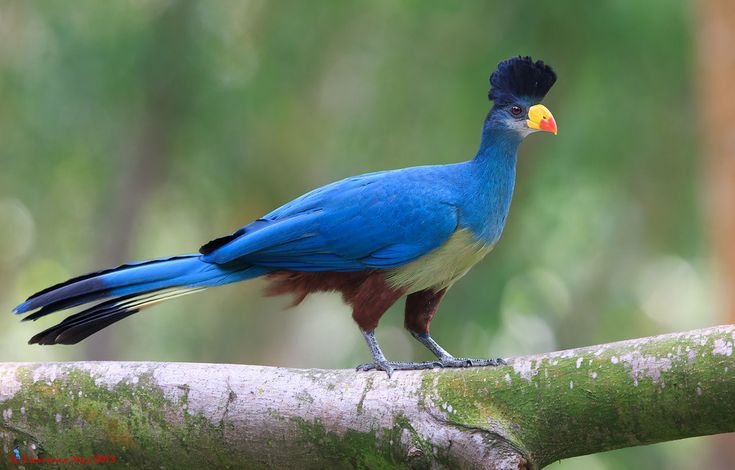
Great Blue Turaco
Corythaeola cristataA spectacular giant of the African canopy, the Great Blue Turaco moves through humid forests in flashes of deep blue and green.
The Great Blue Turaco (Corythaeola cristata) is the largest turaco, a striking fruit-eating forest bird associated with mature humid woodland. In Tanzania it is closely linked to the western forest belt, especially the Minziro Forest Reserve, where its size, powerful flight and bold coloration make it one of the most memorable canopy birds.
Great Blue Turaco Quick Facts
What Is the Great Blue Turaco?
The Great Blue Turaco (Corythaeola cristata) is a large fruit-eating forest bird in the family Musophagidae. It is the largest member of the turaco family, reaching roughly 75 cm in total length, and its combination of size, blue-green plumage and strong bill gives it a very distinctive presence in the forest canopy.
Unlike many open-country birds associated with safari plains, the Great Blue Turaco is a bird of humid woodland and forest. It often moves through the canopy in short flights between fruiting trees, using its strong feet and bill to negotiate branches and feed among dense foliage.
In Tanzania the species is especially associated with the country's western forest ecosystems, including the Minziro Forest Reserve near Lake Victoria. Its distribution across Central and East Africa makes it an important representative of the forest bird community that connects Tanzania with neighbouring Uganda, Rwanda, Burundi and the Democratic Republic of the Congo.
How to Identify a Great Blue Turaco
The Great Blue Turaco is unusually large for a turaco and can often be identified by its bulky silhouette, deep blue coloration and deliberate movements through the canopy.
- Size: The largest of the turacos, with adults reaching up to about 75 cm in length.
- Upperparts: Strong blue and green tones dominate the body, creating a rich appearance in filtered forest light.
- Head: A large head and robust bill give it a heavier profile than smaller turacos.
- Underparts: Darker blue-green and contrasting tones can be visible when the bird turns or glides between trees.
- Wings: Broad wings produce powerful, purposeful flight rather than the fluttering impression of a small canopy bird.
- Tail: Long and broad, contributing to its unmistakable large-turaco silhouette.
Distinguishing from Other Turacos
The Great Blue Turaco can be separated from smaller Tanzanian turacos by sheer size as well as by its strongly blue-green body. Fischer's Turaco, Hartlaub's Turaco and Livingstone's Turaco are much smaller and more compact, while the Great Blue Turaco has the unmistakable proportions of a giant forest turaco.
Behavior & Social Life
Great Blue Turacos are primarily arboreal. They spend much of their time in the canopy, where pairs or small groups move methodically among branches and fruiting trees. Their heavy bodies and strong feet are adapted to careful climbing and branch-to-branch movement.
Daily Activity
- Foraging: Searches fruiting trees and foliage for food, often remaining high above the forest floor.
- Movement: Flies between trees with steady wingbeats and a broad, powerful silhouette.
- Vocalization: Uses loud, far-carrying calls that can reveal its presence before the bird is visible.
Movement
The species is not a long-distance migrant. Local movements are linked mainly to food resources, forest structure and the availability of fruiting trees. In Tanzania, careful listening and patient scanning of mature forest can be more productive than searching open ground.
Habitat & Distribution
The Great Blue Turaco is closely associated with humid, tree-rich environments where a continuous canopy provides feeding and nesting opportunities:
- Lowland rainforest and evergreen forest with mature canopy trees.
- Forest edges and secondary growth where fruiting trees remain available.
- Riverine and gallery forest where moisture supports dense vegetation.
- Wooded landscapes adjoining intact forest, especially where canopy corridors persist.
Distribution: The species occurs across humid parts of tropical sub-Saharan Africa, with an extensive but fragmented forest distribution from West and Central Africa into parts of East Africa.
Tanzania Distribution
In Tanzania the Great Blue Turaco is strongly associated with the western forest belt. The Minziro Forest Reserve is one of the best-documented Tanzanian localities, and its occurrence there reflects the importance of mature forest habitat near the Lake Victoria basin.
Great Blue Turaco in Tanzania
This is a specialist forest bird rather than a regular open-savanna safari species. The best Tanzanian encounters are therefore associated with forest reserves and mature woodland where canopy cover remains strong:
Minziro Forest Reserve
One of the strongest documented Tanzanian localities for Great Blue Turaco, with repeated records from mature forest in the Kagera region.
Western Tanzania wildlifeKagera Forest Landscapes
Forest and woodland around the north-western Lake Victoria basin provide the type of humid habitat favoured by this giant turaco.
Kagera birdingLake Victoria Basin
Across the forested landscapes adjoining Lake Victoria, intact canopy and fruiting trees can support forest turacos and other specialized birds.
Lake Victoria regionForest Birding Tours
Dedicated birding in western Tanzania offers a better opportunity than conventional plains game drives for finding this canopy specialist.
Tanzania birdingSafari Methods
- Forest birding with slow walks and repeated listening stops.
- Canopy scanning – use calls and movement high in the trees to locate birds.
- Wildlife photography – longer lenses are useful because birds often remain high in the canopy.
Best Time to See Them
Dry-season forest roads and paths can make access easier in many areas, but Great Blue Turacos are fundamentally tied to suitable forest habitat rather than a single safari season. Early mornings are often productive for vocal activity, while fruiting trees can attract feeding birds at different times of day.
Diet & Feeding
The Great Blue Turaco is primarily frugivorous, but it is not limited to fruit. Its broad diet reflects the diversity of mature tropical forest vegetation.
Food Sources
- Fruit: The principal food source, especially ripe forest fruits available in the canopy.
- Leaves: Soft foliage can supplement the fruit-heavy diet.
- Seeds: Seeds and other plant material are taken while feeding in fruiting trees.
- Invertebrates: Small invertebrates may provide additional animal protein.
Feeding Behavior
It feeds mainly in trees, moving between branches and fruiting crowns. By consuming and carrying fruit through the forest, turacos can contribute to seed dispersal and the regeneration dynamics of tropical woodland.
Breeding & Life Cycle
Great Blue Turacos breed in forest habitat where dense canopy offers food, cover and suitable nesting sites. Pairs may defend territories around productive forest patches and nesting areas.
Nesting
- Nest: A relatively simple platform of sticks placed in a tree or within dense vegetation.
- Eggs: Usually 2 eggs are laid.
- Incubation: Both adults participate in incubation, which lasts roughly three to four weeks.
Chicks
Young develop under parental care within the forest canopy and remain dependent after leaving the nest. The adults continue to provide food while juveniles strengthen their flight and climbing abilities.
Conservation Status
The Great Blue Turaco is currently assessed as Least Concern globally. BirdLife International's current taxonomy and Red List framework are used widely for global bird conservation assessments.
Although its global category is not currently threatened, the species depends heavily on mature forest. Local populations can be affected where forests are cleared, fragmented or degraded and where large fruiting trees disappear.
Key conservation priorities include:
- Forest protection to retain mature canopy and feeding trees.
- Habitat connectivity so birds can move between forest patches and fruiting resources.
Comparisons
The Great Blue Turaco is easier to identify when compared with smaller forest turacos encountered in East Africa:
| Feature | Great Blue Turaco | Hartlaub's Turaco | Fischer's Turaco |
|---|---|---|---|
| Size | Up to about 75 cm | About 40–45 cm | About 40–43 cm |
| Build | Very large, heavy-bodied | Medium-sized, compact | Medium-sized, compact |
| Plumage | Deep blue-green overall | Green with contrasting crest and facial pattern | Green with vivid red/green details |
| Habitat | Humid forest and tall woodland | Montane and highland forest | Forest and woodland, including coastal/western habitats |
| Diet | Fruit-dominated | Fruit and plant material | Fruit and plant material |
| Field clue | Exceptional size and broad blue body | Smaller, greener silhouette | Smaller with strong red/green facial and wing accents |
Did You Know?
Largest Turaco
The Great Blue Turaco is the largest member of the turaco family and can reach about 75 cm in length.
Forest Giant
Its impressive size is easily underestimated because the bird usually stays high inside dense forest canopy.
Fruit Specialist
Ripe forest fruit forms the foundation of its diet, linking the bird closely to productive mature woodland.
Seed Disperser
By moving and swallowing fruit in the canopy, it can help transport seeds through the forest ecosystem.
Big Voice
Its loud calls can travel through dense vegetation and often reveal the species before the bird itself is seen.
Tanzania Forest Bird
In Tanzania it is especially associated with western forest habitat, including the Minziro Forest Reserve.
There is something extraordinary about finding a Great Blue Turaco in a Tanzanian forest. The bird is enormous for a turaco, yet the canopy can make it surprisingly elusive. A burst of deep blue through the leaves, a heavy wingbeat, and then a powerful call disappearing into the trees can be all that remains of the encounter. In forest birding, patience turns those fleeting moments into one of the most rewarding discoveries.
Gallery
Frequently Asked Questions
The Great Blue Turaco (Corythaeola cristata) is the largest turaco, a large fruit-eating forest bird of tropical Africa that can reach about 75 cm in length.
In Tanzania it is especially associated with western forest habitat, including the Minziro Forest Reserve and the wider Lake Victoria basin.
Its diet is dominated by fruit, with leaves, seeds and small invertebrates also contributing to feeding.
No. The species is currently assessed as Least Concern globally, although mature forest habitat remains important for its long-term conservation.
The name reflects its exceptional size among turacos and its striking blue-green plumage.
It nests in trees or dense vegetation, usually laying two eggs on a simple stick platform; the young are cared for by the adults.
Look for the exceptionally large body, broad tail, blue-green plumage and heavy forest-flight silhouette high in the canopy.
It is not a long-distance migrant; where suitable forest habitat persists in Tanzania, it can be encountered as a resident forest bird.
References & Further Reading
- BirdLife International / BirdLife DataZone – Current taxonomy and global conservation framework for Great Blue Turaco.
- Tanzanian Birds & Butterflies – Great Blue Turaco records, including Minziro Forest Reserve observations in Tanzania.
- Birds of the World – Detailed species account covering distribution, ecology, behavior and breeding.
- HBW/BirdLife Taxonomic Checklist – Scientific name and accepted taxonomic placement.
- eBird – Identification and distribution records for Great Blue Turaco.
- Oiseaux.net – Species identification, habitat and natural-history information.
- IUCN Red List / BirdLife International – Global conservation status and assessment framework.