

.png)
Schalow's Turaco
Tauraco schalowiA spectacular highland turaco with a long, white-tipped crest and brilliant green, blue and red plumage.
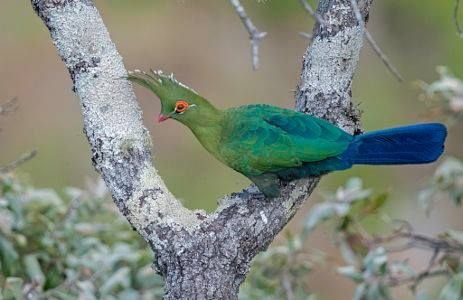
The Schalow's Turaco (*Tauraco schalowi*) is a large forest-dwelling turaco of the East African highlands. It is recognized by its long blue-green crest tipped white, broad rounded wings, green body plumage, crimson wing patches and red bill and orbital skin. It feeds mainly on fruit in montane forest, forest edges and mature woodland, often moving through the canopy in pairs or small groups.
Schalow's Turaco Quick Facts
What Is the Schalow's Turaco?
The Schalow's Turaco (*Tauraco schalowi*) is a large turaco of East Africa's montane forests, notable for its elongated blue-green crest tipped in white, glossy green plumage, deep blue tones on the wings and a vivid crimson patch in flight. It belongs to the family Musophagidae, a group of African fruit-eating birds that are strongly associated with forest and woodland habitats.
The species is especially associated with the Albertine Rift and adjacent East African highlands. In Tanzania it is a genuine montane forest bird, and records on the Ngorongoro Crater rim and northern parts of the country show that it can occur in the country's cooler upland forests. Its loud, carrying calls can reveal its presence before the bird emerges from dense foliage.
This eagle is a common and widespread resident of wooded habitats across much of sub-Saharan Africa, from Senegal to Ethiopia and south to South Africa .
How to Identify a Schalow's Turaco
The Schalow's Turaco is a large, powerful turaco with a long crest that makes its silhouette distinctive. Adult birds show a mostly green body, a long blue-green crest with conspicuous white tips, red bill and red bare skin around the eye, while the wings reveal strong blue and crimson areas in flight.
- Crest: Long blue-green crest, each elongated feather tipped white.
- Plumage: Predominantly rich green, with blue tones on the wings.
- Wings: Show striking crimson and blue patches in flight.
- Face: Red bill and red bare orbital skin.
- Size: A large, robust turaco with a broad, rounded-winged profile.
- Voice: Loud, far-carrying calls are often the first clue in dense forest.
Distinguishing from Other Turacos
Its combination of a long white-tipped crest, red facial skin, green body and montane-forest range helps separate it from other Tanzanian turacos. Schalow's Turaco can be compared with Livingstone's, Hartlaub's and Black-billed Turacos, but the crest pattern, facial colour and distribution are useful field clues.
Schalow's Turaco Behavior & Social Life
Schalow's Turaco is usually encountered singly, in pairs or in small family groups moving through the canopy. It uses its strong legs and feet to move along branches as well as short, rapid flights between feeding trees. Its social contact is often obvious through repeated, ringing calls exchanged between birds.
Daily Activity
- Feeding: Searches fruiting trees for ripe berries and other plant foods.
- Calling: Gives loud, repeated calls that carry through forested valleys and slopes.
- Flight: Short, direct flights reveal vivid blue and crimson wing colours.
Movements & Seasonality
It spends much of the day feeding in fruiting trees and shrubs. Early morning is especially productive for observers because birds call actively, move between perches and can be easier to detect before the forest becomes visually dense. When disturbed, a bird may slip through foliage or fly to a nearby tree rather than remain exposed.
Habitat & Distribution
Schalow's Turaco favours moist upland habitats where mature trees provide fruit and cover. It is most strongly associated with montane and submontane evergreen forest, but can also use forest edges, woodland mosaics and regenerating habitat where canopy resources remain available.
- Montane forest – mature highland forest with abundant canopy fruit.
- Forest edge – productive transition zones between forest and open habitat.
- Highland woodland – wooded landscapes retaining fruiting trees and dense cover.
- Moist forest mosaics – secondary and mixed habitats where food resources remain available.
In Tanzania, documented records include the Ngorongoro Crater rim and the northern corridor of Serengeti, while the species also occurs farther west around the Ufipa/Tadanda region. Tanzania therefore forms an important part of its East African distribution, especially in highland and forested landscapes.
Tanzania Distribution
In Tanzania, the Schalow's Turaco is found in most national parks and game reserves, including Serengeti, Ngorongoro, Tarangire, and Ruaha .
Schalow's Turaco in Tanzania
Schalow's Turaco is a forest specialist rather than a typical open-safari bird. The best Tanzanian encounters come from highland forest and forest-edge birding, especially around the Ngorongoro highlands and northern forested corridors. Tanzania Birds documents photographs from the Ngorongoro Crater rim and northern corridor of Serengeti, as well as Tadanda-Ufipa and Nou Forest.
Ngorongoro Crater Rim
Tanzania Birds documents Schalow's Turaco photographed on the Ngorongoro Crater rim, making the highland forest edge a strong destination for a targeted birding search.
Ngorongoro birdingSerengeti National Park
The northern Serengeti corridor has documented records, showing that this forest-associated turaco can occur in wooded landscapes within the wider Serengeti ecosystem.
Northern Serengeti birdingTadanda-Ufipa
Documented photographs from Tadanda-Ufipa demonstrate its occurrence in the southwestern Tanzanian highlands, another important landscape for forest and montane birding.
Tanzania highland birdingNou Forest
Nou Forest is another Tanzanian locality represented in the species record, reinforcing its association with mature forest and wooded uplands.
Forest birding in TanzaniaSafari Methods
- Game drives through woodland and savanna habitats.
- Birdwatching – watch for perched birds and soaring during the day .
- Wildlife photography – the long crest makes it a striking subject.
Best Time to See Them
Schalow's Turacos are present year-round in suitable habitat. They are most active during the cooler morning and evening hours .
Diet & Feeding
The Schalow's Turaco is primarily frugivorous. Its diet is dominated by fruits and berries taken from trees and shrubs, with flowers and smaller animal foods contributing opportunistically depending on season and availability.
Food Sources
- Rodents: Rats, mice, and shrews .
- Small birds: Occasionally .
- Reptiles: Lizards and snakes .
- Insects: Locusts and grasshoppers .
Feeding Behavior
<strong>Fruit:</strong> Ripe forest fruits and berries form the core of the diet. <strong>Flowers:</strong> Nectar-rich or fleshy floral material may supplement fruit. <strong>Invertebrates:</strong> Small insects and other invertebrates can be taken occasionally, especially when available.
Breeding & Life Cycle
Little is known about every detail of Schalow's Turaco breeding across its full range, but like other turacos it is a territorial forest breeder that typically nests above ground in dense vegetation. Pairs maintain contact through calls and select concealed sites where adults can approach and leave with some cover.
Nesting
- Nest: A loose platform of sticks placed in dense vegetation above ground.
- Clutch: Typically 2 eggs.
- Incubation: Roughly three to four weeks in turacos of this type.
Chicks
The nest is a platform of sticks placed in vegetation, often in a tree or dense climbing growth. Turacos commonly lay two eggs, and the nest is positioned where surrounding foliage offers concealment from predators and disturbance.
Conservation Status
Schalow's Turaco is assessed as <strong>Least Concern</strong> globally. Its broad East African range includes protected and forested landscapes, but localized habitat loss and degradation can still affect populations where highland forest is fragmented.
The most important long-term safeguard is the protection of mature forest, forest corridors and productive edges. Because the species relies on trees for both food and cover, maintaining native canopy is especially important.
Local pressures can include agricultural expansion, selective logging, forest fragmentation and the loss of mature fruiting trees. Tanzania's protected areas and forest reserves therefore provide important refuge for the species.
- Habitat loss due to deforestation and agricultural expansion .
- Persecution in some areas, though it is generally tolerated due to its rodent-control benefits .
Comparisons
The Schalow's Turaco is sometimes confused with other eagles. Here are the key differences:
| Feature | Schalow's Turaco | Livingstone's Turaco | Hartlaub's Turaco |
|---|---|---|---|
| Size | Large, about 45 cm | Large, about 40–45 cm | About 40–45 cm |
| Crest | Very long blue-green crest with white tips | Long green crest with white tips | Long green crest with white tips |
| Face | Red bill and red orbital skin | Red bill and red orbital skin | Red bill and red orbital skin |
| Habitat | Highland and montane forest | Eastern Arc and coastal montane forest | Highland forest of northeast Tanzania and Kenya |
| Range | Rift highlands from Zambia/DRC into East Africa | Eastern and southeastern Tanzania, Kenya and adjacent ranges | Northeast Tanzania and southern Kenya |
| Diet | Rodent specialist | Reptiles, small mammals | Large gamebirds, mammals |
Did You Know?
White-tipped Crest
The long blue-green crest ends in conspicuous white tips, one of the easiest field marks for Schalow's Turaco.
Forest Fruit Specialist
Turacos are strongly associated with fruiting trees, making seasonal food availability an important part of their ecology.
Powerful Canopy Bird
Its robust legs and feet help it move confidently along branches instead of relying only on flight.
Bright Hidden Colours
The wings can reveal intense blue and crimson tones that are much harder to notice when the bird is perched deep in green foliage.
Loud Voice
A calling bird may be detected from far away because its repeated notes carry strongly through forested valleys.
Tanzanian Highland Bird
Documented records from the Ngorongoro Crater rim and other Tanzanian forests place this species firmly within the country's highland birding story.
There is something unforgettable about hearing a Schalow's Turaco before seeing it. In Tanzania's cool upland forests, the call travels through the trees, and then the bird appears with a long white-tipped crest, green body and flashes of blue and crimson in the wings. It is a reminder that some of Africa's most spectacular wildlife experiences happen not on open plains, but high in the forest canopy.
Gallery
Frequently Asked Questions
The Schalow's Turaco (*Tauraco schalowi*) is a large East African turaco of highland forests, recognized by its long blue-green crest tipped white, green plumage and red facial skin.
Documented Tanzanian records include the Ngorongoro Crater rim, northern Serengeti corridor, Tadanda-Ufipa and Nou Forest.
It is primarily frugivorous, feeding mainly on fruits and berries, with flowers and small invertebrates taken opportunistically.
The species is assessed globally as Least Concern, although habitat loss and forest fragmentation remain local concerns.
Look for its long blue-green crest with white tips, green body, red bill and red orbital skin, plus flashes of blue and crimson in flight.
It inhabits montane and submontane forest, forest edge and wooded highland landscapes in parts of East and south-central Africa.
It builds a simple stick platform above the ground and typically lays two eggs; both adults contribute to raising the young.
In suitable Tanzanian forest habitat it can be present year-round; local movements are more important than long-distance migration.
References & Further Reading
- Tanzania Birds – Schalow's Turaco species page, with documented Tanzanian records and photographs from the Ngorongoro Crater rim, northern Serengeti, Tadanda-Ufipa and Nou Forest.
- Tanzania national bird checklist – lists Schalow's Turaco as Tauraco schalowi among Tanzania's Musophagidae.
- American Museum Novitates – molecular and geographic work on African turacos, including the range and taxonomic history of Schalow's Turaco.
- BirdLife International – conservation framework and current bird taxonomy resources.
- eBird – field identification, distribution and occurrence records for Schalow's Turaco.
- Birds of the World – species account for ecology, behaviour, feeding and breeding.
- Oiseaux.net – turaco identification and natural history reference material.