

.png)
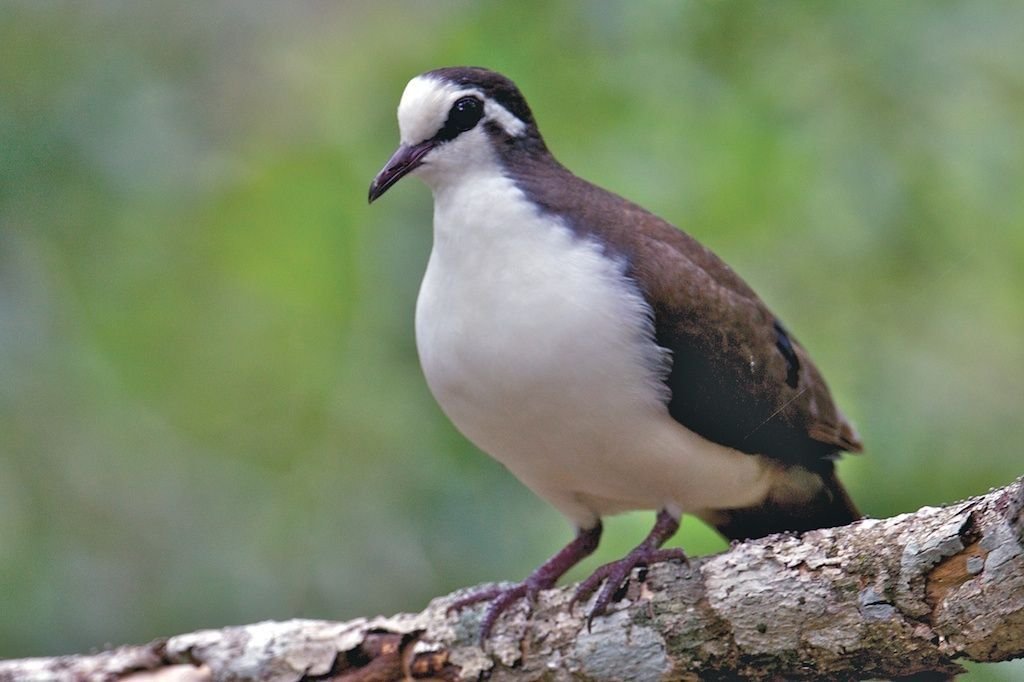
Tambourine Dove
Turtur tympanistriaA secretive woodland dove with a soft, rhythmic call and striking white underparts.
The Tambourine Dove (Turtur tympanistria) is a small, ground-feeding dove of dense woodland, forest edges, gardens and other thick vegetation across much of sub-Saharan Africa. In Tanzania it is widespread and common in suitable habitat, but its shy habits often make it easier to hear or flush than to watch for long.
Tambourine Dove Quick Facts
What Is the Tambourine Dove?
The Tambourine Dove (Turtur tympanistria) is a small pigeon and dove in the family Columbidae. It has a compact body, short tail, rounded wings and a subtly patterned plumage built for moving through dense vegetation and feeding on the ground.
The species was described by Coenraad Jacob Temminck in 1809. Its common name refers to its distinctive rolling, rhythmic call, which can sound like the muted beat of a tiny drum.
The Tambourine Dove is a widespread resident breeder in sub-Saharan Africa. It favours thick vegetation rather than open savanna and is especially associated with woodland, forest margins, gardens, plantations and other habitats where cover and ground food are available.
How to Identify a Tambourine Dove
The Tambourine Dove is a small, compact dove that can look understated in shadowed woodland. Close views reveal a grey-brown head and back, clean white face and underparts, darker markings across the wings and rich chestnut in the flight feathers.
- Size & shape: A compact dove about 22-23 cm long with a relatively short tail.
- Upperparts: Grey-brown to olive-brown, blending naturally with woodland shade.
- Underparts: White or grey-white, especially clean and conspicuous in males.
- Wings: Dark with greenish or blue-green iridescent spotting that can flash when the bird moves.
- Face: Pale face and forehead contrasted with darker markings around the eyes and lores.
- Legs & bill: Dark reddish legs and a dark bill.
Distinguishing from Similar Doves
In the field, its combination of size, white belly, dark facial markings and iridescent wing spots is particularly useful when separating it from other small African wood-doves.
Behavior & Social Life
The Tambourine Dove is shy, terrestrial and usually solitary or encountered in pairs. It spends much of its time quietly moving through leaf litter and low vegetation, where its subdued plumage provides excellent camouflage.
Daily Activity
- Foraging: Walks and runs quietly on the ground while picking up seeds, fallen fruit and small invertebrates.
- Movement: A strong, rapid flier that often flies low when disturbed before disappearing into cover.
- Vocalization: Its soft, repetitive call gives the species its memorable “tambourine” name and is often the first clue that a bird is nearby.
Migration
It is mainly active by day, although its secretive behaviour can make observations brief. Its flight is fast and agile when flushed, often staying low before dropping back into cover.
Habitat & Distribution
The Tambourine Dove is a species of thick vegetation, where it can feed on the ground while remaining close to protective cover.
- Thick woodland and forest: Dense undergrowth provides food, nesting cover and shelter.
- Forest edges and riparian vegetation: Especially valuable where shade meets open ground for foraging.
- Gardens and plantations: The species can use mature gardens, cocoa, rubber and other cultivated vegetation when adequate cover remains.
- Shrubby river margins: Tangled vegetation close to watercourses can provide secure feeding and nesting habitat.
Distribution: It ranges widely across sub-Saharan Africa, avoiding the driest areas of the southwest. It can occur from lowlands into higher elevations where dense habitat persists.
Tanzania Distribution
Tanzania Distribution: Tanzania Birds describes the species as widespread and common, with records from locations including Olasiti, Ngaresero, Arusha National Park, Usa River and Monduli.
Tambourine Dove in Tanzania
The Tambourine Dove is one of Tanzania’s characteristic small woodland doves. Because it is shy and often stays under cover, patient birding along quiet forest edges and leafy trails is more productive than scanning open plains.
Olasiti
Olasiti has documented Tambourine Dove records and is a good example of the leafy, settled environment the species can use.
Olasiti birdingArusha National Park
Recorded in Arusha National Park, where forest, woodland and moist vegetation provide suitable feeding and cover.
Arusha birdingUsa River
Documented near Usa River, demonstrating the species’ association with cultivated and semi-natural vegetation around the northern Tanzania highlands.
Usa River birdingMonduli & Ngaresero
Tambourine Dove records from Monduli and Ngaresero add to the species’ wide Tanzanian distribution.
Northern Tanzania birdingSafari Methods
- Quiet woodland walks and birding trails are especially useful because the species often stays close to cover.
- Listen first: its distinctive rolling call can reveal a hidden bird before it moves into view.
- Wildlife photography: early morning light and patient observation at forest edges can produce excellent views.
Best Time to See Them
Tambourine Doves are resident in Tanzania. Early morning is often productive, when birds are feeding before the day becomes hotter; calm periods after rain can also improve activity and detectability.
Diet & Feeding
The Tambourine Dove is primarily a seed- and fruit-eating ground forager, but it also takes animal foods when available.
Food Sources
- Seeds: Grass and other small seeds form an important part of the diet.
- Fruit: Small fallen fruits from woodland and garden plants are taken when available.
- Termites & larvae: Small invertebrates add protein, especially during periods of high availability.
- Molluscs: Tiny snails and other small molluscs have also been recorded in the diet.
Hunting Behavior
Food Sources include fallen seeds, small fruits and a variety of invertebrates.
Breeding & Life Cycle
The Tambourine Dove is monogamous and territorial, and breeding can occur in different seasons depending on geography and rainfall.
Nesting
- Nest: A light, saucer-shaped structure made from small twigs and vegetation.
- Eggs: Usually 1-2 cream-coloured eggs.
- Incubation: About 14-20 days, mainly by the female.
Chicks
Nesting is usually low, with a fragile platform of small twigs, leaves and petioles placed in tangled vegetation, a bush or low tree.
Conservation Status
The Tambourine Dove is assessed globally as Least Concern. Its very broad African distribution and ability to use a range of wooded habitats contribute to its comparatively secure global status.
The species can nevertheless be affected locally when dense woodland and forest-edge vegetation are cleared or simplified. The gradual loss of mature habitat can remove nesting cover and reduce the diversity of natural food sources.
Priority conservation actions are straightforward: retain native woodland, protect vegetated river corridors, maintain connected habitat and avoid unnecessary clearance of mature gardens and thickets.
- Habitat loss from agricultural expansion and settlement can reduce suitable cover.
- Degradation of woodland edges can lower the availability of ground food and nesting sites.
Comparisons
The Tambourine Dove is often compared with other small African doves. The most useful field clues are size, underpart colour, wing pattern and habitat preference.
| Feature | Tambourine Dove | Laughing Dove | Emerald-spotted Wood-Dove |
|---|---|---|---|
| Size | 22-23 cm | About 25-26 cm | About 22 cm |
| Wings & pattern | White underparts; greenish wing spotting | Rosy-pink throat/chest with barred body | White-spotted green wings; plainer underparts |
| Habitat | Dense woodland & forest edge | Open country, towns & dry habitats | Dry woodland, scrub & savanna |
| Diet | Seeds, fruit, invertebrates | Seeds and grain | Seeds, fruit & invertebrates |
| Habitat | Woodland, forest edge | Woodland, savanna | Open savanna |
| Diet | Rodent specialist | Reptiles, small mammals | Large gamebirds, mammals |
Did You Know?
Shy Forest Bird
It is famously secretive and is often detected by its call or a sudden low flight through vegetation.
Tambourine Call
Its distinctive rolling call is the reason for the English name Tambourine Dove.
Ground Forager
Much of its feeding takes place on the ground, where it gathers seeds, fallen fruit and small invertebrates.
White Belly
Males tend to show especially bright white underparts, while females can be darker and greyer below.
Resident African Dove
Unlike many spectacular migrant birds, it is a resident of suitable habitat across much of its range.
Woodland Specialist
It favours dense woodland, forest margins, gardens and other habitats with thick cover.
The Tambourine Dove is the kind of bird that rewards patience. A quiet path through leafy woodland may seem empty until a soft rolling call rises from the undergrowth, followed by a quick flash of chestnut wings. Finding the bird becomes a small lesson in listening, habitat and the hidden life of Tanzania’s forest edges.
Gallery
Frequently Asked Questions
The Tambourine Dove (Turtur tympanistria) is a small pigeon and dove in the family Columbidae, associated with dense woodland, forest edge, gardens and other thick vegetation across sub-Saharan Africa.
It is widespread in Tanzania. Documented records include Olasiti, Ngaresero, Arusha National Park, Usa River and Monduli, with many additional suitable wooded localities.
It mainly eats seeds and small fallen fruits, but also takes invertebrates such as termites and small molluscs.
No. The species is currently assessed as Least Concern globally, although local habitat loss can reduce suitable woodland cover.
The name refers to its distinctive rhythmic call, which has been compared with the rolling sound of a small tambourine.
It is monogamous and usually lays 1-2 cream-coloured eggs in a fragile low nest. Incubation is roughly two weeks and both parents help feed the chicks.
Look for a small compact dove with white underparts, grey-brown upperparts, dark markings around the face and iridescent spotting on the wings.
Yes. It is a resident species in Tanzania, and Tanzanian Birds describes it as widespread and common in suitable habitat.
References & Further Reading
- BirdLife / IUCN-aligned sources – global conservation status and current taxonomy.
- Tanzanian Birds & Butterflies – Tanzania distribution, records and photographs of Tambourine Dove.
- Oiseaux.net – habitat, diet, breeding and behavioural details for Turtur tympanistria.
- BirdGuides / IOC taxonomy – Turtur tympanistria, family Columbidae, order Columbiformes.
- Biodiversity Explorer – food, breeding ecology and habitat use.
- GBIF / Catalogue of Life – current scientific name and nomenclatural synonyms.
- Wikimedia Commons – species imagery and taxonomic identification resources.