

.png)
Emerald-spotted Wood-Dove
Turtur chalcospilosA small, beautiful dove with striking emerald spots on its wings – a gentle presence in Africa's woodlands.
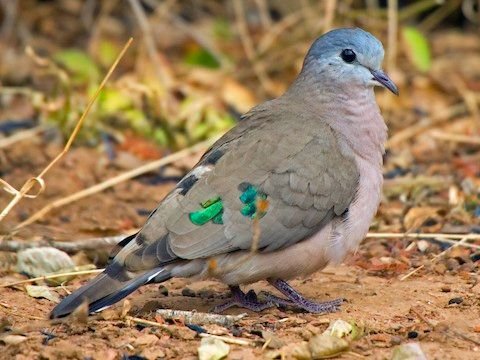
The Emerald-spotted Wood-Dove (Turtur chalcospilos) is a small, beautiful dove found in sub-Saharan Africa. Named for the striking green spots with emerald iridescence on its wings, this gentle and attractive bird is a common resident of dry woodland, savanna, and scrubland across the continent.
Emerald-spotted Wood-Dove Quick Facts
What Is the Emerald-spotted Wood-Dove?
The Emerald-spotted Wood-Dove (Turtur chalcospilos) is a small, beautiful dove belonging to the family Columbidae, which includes pigeons and doves. It was first described by the German naturalist Johann Georg Wagler in 1827. The species name chalcospilos is derived from the Greek chalkos meaning "bronze" or "copper" and spilos meaning "spot", referring to the distinctive metallic spots on the wings.
This species is also known as the Green-spotted Dove. It is a common resident across much of sub-Saharan Africa, found in dry woodland, savanna, and scrubland habitats. It is often seen foraging on the ground in pairs or small groups, searching for seeds and berries.
It is closely related to other members of the genus Turtur, including the Blue-spotted Wood-Dove and the Tambourine Dove. Despite its name, it is not a true wood dove in the sense of the genus Columba but belongs to the African wood-dove group.
How to Identify an Emerald-spotted Wood-Dove
The Emerald-spotted Wood-Dove is a distinctive and beautiful bird, easily recognised by its small size, colouration, and the striking green spots on its wings. Here are its key identifying features:
- Size: A small dove, measuring 20-23 cm (8-9 in) in length and weighing 65-85 g (2.3-3.0 oz).
- Plumage: Brownish-grey upperparts and pinkish-brown underparts, with a distinctive pinkish breast and belly.
- Wing spots: Two rows of striking green or emerald spots with metallic iridescence on the wing coverts – the most distinctive feature.
- Neck: A distinctive black and white striped patch on the side of the neck.
- Tail: Dark with white tips on the outer tail feathers, visible in flight.
- Bill: Dark with a reddish base.
- Legs: Reddish.
- Eyes: Dark.
- Female: Similar to male but slightly paler and with less distinct markings.
- Juvenile: Duller overall, lacking the glossy wing spots and neck patches.
Distinguishing from Similar Species
The Emerald-spotted Wood-Dove can be distinguished from the Blue-spotted Wood-Dove by its green (not blue) wing spots. The Tambourine Dove is smaller and has a different pattern on the wings. The Namaqua Dove is smaller and has a distinctive black band across the chest.
Behavior & Social Life
The Emerald-spotted Wood-Dove is a shy and unobtrusive bird, often seen in pairs or small groups. It is most active during the early morning and late afternoon.
Foraging Behavior
- Ground feeding: The Emerald-spotted Wood-Dove spends much of its time on the ground, foraging for seeds, berries, and small fruits.
- Dietary habits: In addition to plant material, it also takes some insects, particularly termites, which are an important protein source.
- Water dependence: Like all doves, it requires regular access to water and drinks by immersing its bill and sucking.
Vocalization
- Call: The call is a soft, melancholic, repeated "coo-coo-coo," often described as a slow, mournful sound that carries through the woodland.
- Song: The song is a series of low, penetrating, far-carrying notes, often repeated for long periods.
Habitat & Distribution
The Emerald-spotted Wood-Dove is found in a variety of dry and wooded habitats across sub-Saharan Africa.
Key habitat types include:
- Dry woodland – particularly miombo and mopane woodland.
- Savanna – with scattered trees and bushes.
- Scrubland – and thickets.
- Riverine forest – along watercourses.
Distribution: The Emerald-spotted Wood-Dove has an extremely large range, with an Extent of Occurrence of approximately 15,300,000 km². It is found across much of sub-Saharan Africa, from Senegambia in the west to Ethiopia and Kenya in the east, and southwards to South Africa.
Tanzania Distribution
In Tanzania, the Emerald-spotted Wood-Dove is found in dry woodland, savanna, and scrubland across the country. It has been recorded in Serengeti National Park, Ngorongoro Conservation Area, Tarangire National Park, and Ruaha National Park.
Emerald-spotted Wood-Dove in Tanzania
The Emerald-spotted Wood-Dove is a beautiful and gentle bird of Tanzania's woodlands and savannas. Here are the best locations to see it:
Serengeti National Park
Found in the Serengeti's woodland and savanna areas, particularly in the drier regions with scattered trees. Often seen foraging on the ground in pairs.
Serengeti safariNgorongoro Crater
Recorded in the Ngorongoro Conservation Area, especially in the woodland areas around the crater rim and in the Lerai Forest.
Ngorongoro safariTarangire National Park
Found in the acacia woodlands and scrubland areas of Tarangire. Often seen in pairs foraging on the ground under trees.
Tarangire safariRuaha National Park
A resident species in Ruaha's miombo woodland and dry savanna habitats. Often found in the riverine vegetation and woodland areas.
Ruaha safariSafari Methods
- Game drives in dry woodland, savanna, and scrubland areas.
- Birdwatching – look for the small brownish dove with distinctive green wing spots, often seen on the ground or perched in trees.
- Wildlife photography – the Emerald-spotted Wood-Dove's beautiful wing spots and gentle nature make it a charming photographic subject.
- Listen for calls – the soft, melancholic "coo-coo-coo" call is often the first indication of its presence.
Best Time to See Them
Emerald-spotted Wood-Doves are resident year-round in suitable habitat. They are most active during the cooler morning and evening hours. The dry season (June to October) is generally best for wildlife viewing.
Diet & Feeding
The Emerald-spotted Wood-Dove is primarily a granivore, with a diet consisting mainly of seeds and berries.
Food Sources
- Seeds: A variety of seeds from grasses and other plants.
- Berries and fruits: Small fruits and berries from shrubs and trees.
- Insects: Particularly termites, which are an important protein source, especially during the breeding season.
Feeding Behavior
The Emerald-spotted Wood-Dove forages on the ground, often in pairs or small groups. It uses its bill to pick seeds and berries from the surface of the soil or from low vegetation.
Breeding & Life Cycle
The Emerald-spotted Wood-Dove is monogamous, forming long-term pair bonds.
Nesting
- Breeding season: Typically during the rainy season, from November to May in East Africa.
- Nest site: A flimsy nest of twigs and rootlets built in a tree or bush, usually 1-5 metres above the ground.
- Nest construction: Both sexes build the nest, which is a loose platform of twigs.
- Clutch: 1 to 2 creamy white eggs.
- Incubation: 13 to 15 days, shared by both parents.
Chicks
Chicks are altricial (born helpless with down feathers). Both parents feed the chicks by regurgitating crop milk and seeds. Young fledge at 14 to 16 days old.
Conservation Status
The Emerald-spotted Wood-Dove is assessed as Least Concern on the IUCN Red List.
Population: The global population has not been quantified, but it is not believed to approach the thresholds for Vulnerable. The population trend is stable.
Justification: This species has an extremely large range (15,300,000 km²) and hence does not approach the thresholds for Vulnerable under the range size criterion. The population trend appears to be stable, and hence the species does not approach the thresholds for Vulnerable under the population trend criterion.
Threats: While the species is not currently threatened globally, local threats may include habitat loss through deforestation and agricultural expansion.
Comparisons
The Emerald-spotted Wood-Dove is sometimes confused with other doves. Here are the key differences:
| Feature | Emerald-spotted Wood-Dove | Blue-spotted Wood-Dove | Tambourine Dove |
|---|---|---|---|
| Size | 20-23 cm | 20-22 cm | 18-20 cm |
| Wing Spots | Green/emerald | Blue | Coppery |
| Neck Pattern | Black & white striped patch | Black & white striped patch | Black & white striped patch |
| Underparts | Pinkish-brown | Pinkish-grey | Pinkish |
| Tail | Dark with white tips | Dark with white tips | Dark with white tips |
| Range | Sub-Saharan Africa | West & Central Africa | Sub-Saharan Africa |
Did You Know?
Emerald Gem
The Emerald-spotted Wood-Dove is named for the striking green spots with emerald iridescence on its wings, which shimmer in the sunlight.
Melancholic Call
Its soft, melancholic "coo-coo-coo" call is one of the characteristic sounds of African woodlands.
Termite Eater
Although primarily a seed-eater, it also feeds on termites, which provide essential protein, especially during the breeding season.
Ground Forager
This dove spends much of its time on the ground, foraging for seeds and berries under trees and bushes.
Widespread Resident
With a range of over 15 million square kilometres, the Emerald-spotted Wood-Dove is found across much of sub-Saharan Africa.
Crop Milk
Like all pigeons and doves, parents feed their chicks "crop milk," a nutritious secretion produced in the crop.
There is a gentle beauty in the Emerald-spotted Wood-Dove that is easy to overlook. It moves through the woodland with a quiet grace, its soft cooing call a constant companion to the African bush. And then, when it stretches its wings, the emerald spots catch the light – a flash of brilliance against the muted browns and greys of its plumage. It is a reminder that even the most unassuming creatures carry a spark of magic, a hidden beauty that reveals itself only to those who take the time to look.
Gallery
Frequently Asked Questions
The Emerald-spotted Wood-Dove (Turtur chalcospilos) is a small, beautiful dove found in sub-Saharan Africa. It is named for the striking green spots with emerald iridescence on its wings, which are particularly visible in flight or when the wings are stretched.
Emerald-spotted Wood-Doves are found in dry woodland, savanna, and scrubland across Tanzania. Key locations include Serengeti National Park, Ngorongoro Conservation Area, Tarangire National Park, and Ruaha National Park.
The Emerald-spotted Wood-Dove feeds mainly on seeds, berries, and small fruits, with some insects, particularly termites, making up a portion of its diet.
No. The Emerald-spotted Wood-Dove is listed as Least Concern on the IUCN Red List. It has an extremely large range and a stable population.
It is a small, brownish-grey dove with a pinkish breast, a distinctive black and white striped patch on the side of the neck, and striking green emerald spots on the wings. The tail is dark with white tips on the outer feathers.
The Emerald-spotted Wood-Dove is a small dove, measuring 20-23 cm (8-9 in) in length and weighing 65-85 grams (2.3-3.0 oz).
The Emerald-spotted Wood-Dove is monogamous. It builds a flimsy nest of twigs and rootlets in a tree or bush, usually 1-5 metres above the ground. The female lays 1-2 creamy white eggs, which are incubated by both parents for about 13-15 days. Chicks fledge after 14-16 days.
In Swahili, the Emerald-spotted Wood-Dove is known as Njiwa-mlazi or Njiwa-ya-mwitu.
References & Further Reading
- BirdLife International – Emerald-spotted Wood-Dove: IUCN Red List assessment, Least Concern status, range 15,300,000 km².
- Wikipedia – Emerald-spotted wood-dove: Description, distribution, habitat, diet, breeding, conservation.
- eBird – Emerald-spotted Wood-Dove: Identification, distribution, sightings.
- Avibase – Emerald-spotted Wood-Dove: Taxonomy, subspecies, distribution.
- Birds of the World – Emerald-spotted Wood-Dove: Introduction, identification, habitat, behavior, breeding.
- Oiseaux.net – Emerald-spotted Wood-Dove: Photo records from Tanzania.
- South African National Biodiversity Institute – Emerald-spotted Wood-Dove: Conservation status, threats, research.