

.png)
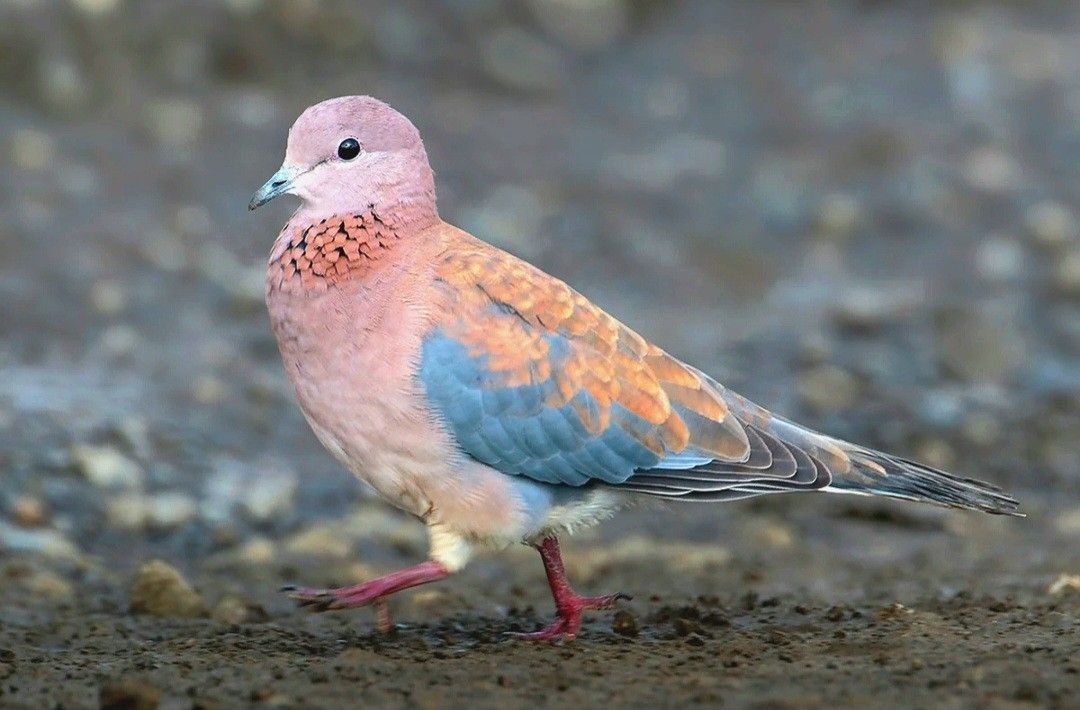
Laughing Dove
Spilopelia senegalensisA familiar dove of African drylands, gardens and villages, known for its soft plumage and rhythmic, laughing call.
The Laughing Dove (Spilopelia senegalensis) is a small to medium-sized dove in the family Columbidae. Its sandy-brown body, finely barred chest and neck, dark wing markings, and characteristic collar patch give it a distinctive appearance. It is a largely terrestrial forager and a familiar resident across much of sub-Saharan Africa.
Laughing Dove Quick Facts
What Is the Laughing Dove?
The Laughing Dove (Spilopelia senegalensis) is a widely distributed dove of the family Columbidae, recognized by its soft buff-brown body, patterned breast and wings, and characteristic rhythmic call. It is especially familiar around settlements, cultivated land and open country where food is available on the ground.
The English name reflects its distinctive vocalization: a repeated, gently rolling series of cooing notes that can sound almost like subdued laughter. Unlike woodland pigeons that spend much of their time in trees, this species frequently walks and feeds on open ground.
Laughing Doves occur across much of Africa and extend into parts of the Middle East and South Asia. In Tanzania it is a common and adaptable bird, able to live alongside people while also using natural savanna and semi-arid landscapes.
How to Identify a Laughing Dove
The Laughing Dove is best identified by its compact dove shape, warm sandy-brown plumage and strongly patterned upper breast and wing coverts. In good light, the combination of a pale head, pinkish-brown body and dark wing panel makes the species distinctive at close range.
- Size: About 25–27 cm long, with a compact dove-like build.
- Plumage: Warm sandy-brown to pinkish-brown overall, with darker patterned wings.
- Head and breast: Pale head with fine dark barring across the lower neck and upper breast.
- Wing pattern: Black-and-rufous patterning is especially noticeable on the folded wing.
- Eye: Dark eye set in a pale, softly coloured face.
- Bill: Short, slender dove bill, suited to picking small seeds.
Distinguishing from Other Doves
Look for these field marks:
Behavior & Social Life
Laughing Doves are commonly encountered singly or in pairs, though several birds may gather where food or water is concentrated. Much of their feeding takes place on the ground, where they walk steadily while picking up seeds and other small food items.
Daily Activity
- Hunting: It is a rodent specialist, often hunting from a perch and swooping down to catch prey on the ground .
- Soaring: Frequently seen soaring on flat wings, especially during the heat of the day .
- Vocalization: The call is a high-pitched "wee-oh" or a series of "kek-kek-kek" notes .
Migration
They are generally approachable compared with more wary woodland species, especially in towns, gardens, farms and lodge grounds where they have become accustomed to people.
Habitat & Distribution
The Laughing Dove occupies a broad range of open and lightly wooded environments:
- Woodland and savanna .
- Forest edges and riparian forest .
- Cultivated areas and grassland .
- Scrubland and semi-arid regions .
Distribution: Its very large African and Asian range includes dry savanna, scrub, agricultural land and human-modified landscapes. It often benefits from open ground, grain-rich fields and reliable water sources.
Tanzania Distribution
Tanzania Distribution: The species is widespread in Tanzania and is recorded from northern safari areas as well as many towns, farms and semi-arid landscapes.
Laughing Dove in Tanzania
The Laughing Dove is one of Tanzania’s familiar resident doves. It can be encountered in safari landscapes as well as villages, farms and urban gardens.
Serengeti National Park
Open plains, kopjes, camps and lightly wooded areas provide feeding ground and scattered perches.
Serengeti safariNgorongoro Crater
Recorded around the crater’s grassland, woodland edges, settlements and cultivated highland areas.
Ngorongoro safariTarangire National Park
Found in dry woodland, open savanna and around areas where seed-rich ground and water attract birds.
Tarangire safariArusha National Park
Occurs in open habitats, park edges and human-influenced areas around northern Tanzania.
Arusha safariSafari Methods
- Game drives in open woodland, grassland and village-edge habitats.
- Birdwatching around water points, camps, gardens and cultivated areas.
- Wildlife photography during early morning and late afternoon when light is soft and doves are active.
Best Time to See Them
They are present year-round in Tanzania. Early morning and late afternoon are often productive for viewing, when birds are active and temperatures are cooler.
Diet & Feeding
The Laughing Dove is primarily a seed-eating ground forager. It spends long periods walking over bare soil, short grass, tracks and cultivated ground while searching for small food particles.
Food Sources
- Seeds and grains: The main food source, gathered from bare ground, tracks and fields.
- Green plant material: Buds, small leaves and other plant matter may supplement the diet.
- Spilled grain: Around farms, villages and livestock areas, discarded grain can be an important food source.
- Small supplementary items: Tiny invertebrates or other particles may occasionally be taken.
Hunting Behavior
Its diet is dominated by plant material, but it can take small supplementary items when encountered. Feeding opportunities increase around harvested fields, livestock areas, roadsides, camps and village gardens where grains and seeds accumulate.
Breeding & Life Cycle
Laughing Doves may breed whenever local conditions provide sufficient food and shelter. In many regions breeding is flexible rather than restricted to one short season, and pairs can produce more than one brood when conditions are favourable.
Nesting
- Nest: A small, flimsy platform of twigs in shrubs, low trees or climbing vegetation.
- Eggs: Usually 2 white eggs.
- Incubation: Roughly two weeks, shared by the adults.
Chicks
Nesting is usually simple, with a small platform of twigs placed in shrubs, low trees, creepers or other protected vegetation.
Conservation Status
The Laughing Dove is currently assessed as Least Concern globally. Its extensive range, adaptability and ability to use human-modified landscapes have helped keep it widespread.
Even common species can face local pressures. Loss of natural vegetation, intensive agricultural practices, disturbance around breeding sites and changes in food and water availability may affect local populations.
Conservation of mixed farmland, dry-country vegetation, urban green space and small water sources benefits this species and many other birds that share the same landscapes.
- Habitat conversion: Loss of natural scrub and mixed agricultural margins can reduce suitable feeding and nesting sites.
- Intensive land management: Heavy pesticide use and reduced seed-producing vegetation may decrease food availability.
Comparisons
The Laughing Dove can be separated from other familiar doves by its combination of warm brown plumage, patterned wing, barred chest and characteristic call.
| Feature | Laughing Dove | Ring-necked Dove | Red-eyed Dove |
|---|---|---|---|
| Size | 25-27 cm | ~28-31 cm | ~26-28 cm |
| Wingspan | ~40-45 cm | ~50 cm | ~48-52 cm |
| Plumage | Warm brown with patterned wing and breast | Grey-brown with bold neck collar | Grey-brown with red facial/eye area |
| Habitat | Open country, towns, farms and dry savanna | Open woodland, farmland and villages | Woodland, gardens and forest edges |
| Feeding | Mostly seeds and grains on ground | Mostly seeds and grains | Seeds, fruits and other plant foods |
| Diet | Rodent specialist | Reptiles, small mammals | Large gamebirds, mammals |
Did You Know?
Ground Forager
Much of its food is collected by walking and pecking on bare or lightly vegetated ground.
Familiar Call
Its repeated cooing song is one of the easiest ways to recognize the species before seeing it.
Wide Range
The species occupies a huge range stretching across much of Africa and into parts of the Middle East and Asia.
Urban Adapter
Laughing Doves readily use gardens, parks, villages and town edges where food is available.
Flexible Breeder
Breeding can occur whenever food and nesting conditions are favourable, rather than only in one short season.
Small Clutches
Two white eggs are typical, with both adults sharing the work of incubation and chick care.
The Laughing Dove is easy to overlook because it lives so comfortably beside people. Yet its soft brown plumage, patterned wings and steady ground-foraging rhythm reveal a bird perfectly adapted to the open landscapes of East Africa. Its gentle, repeated call often announces its presence long before the bird is found on a roadside, garden path or patch of dry grass.
Gallery
Frequently Asked Questions
The Laughing Dove (Spilopelia senegalensis) is a small to medium-sized dove of the family Columbidae, widely distributed across Africa and parts of Asia. It is known for its warm brown plumage and rhythmic cooing call.
It is widespread in Tanzania and can be found in Serengeti, Ngorongoro, Tarangire, Arusha and many towns, farms and gardens.
Its diet is dominated by seeds and grains collected from the ground, with other plant material providing additional food.
No. The Laughing Dove is currently assessed as Least Concern globally.
The common name comes from its characteristic repeated cooing call, which can sound like subdued laughter.
It usually builds a small twig nest in shrubs or low trees and commonly lays two white eggs; both adults share incubation and care of the young.
Look for the warm sandy-brown body, barred breast, distinctive black-and-rufous wing pattern, dark eye and pinkish legs, together with its repeated call.
Yes. It is a widespread resident in Tanzania, although local movements may occur in response to food, water and rainfall.
References & Further Reading
- Birds of the World — Laughing Dove: identification, behaviour, habitat, diet and breeding ecology for Spilopelia senegalensis.
- eBird — Laughing Dove: identification, distribution and observations.
- Tanzanian Birds & Butterflies — national bird records and Tanzania distribution references for Laughing Dove.
- BirdLife / IUCN framework — current global conservation category: Least Concern.
- Ngorongoro Crater Bird Checklist — documented occurrence of Laughing Dove in the crater.
- iNaturalist — documented Laughing Dove observations from Moshi and other Tanzanian localities.
- Macaulay Library — photographic and observational records of Laughing Dove from Tanzania and across its range.