

.png)
African Civet
Civettictis civetta — a solitary, nocturnal forest-and-savanna dweller whose perineal gland once scented the world's perfumes.Introduction to the African Civet
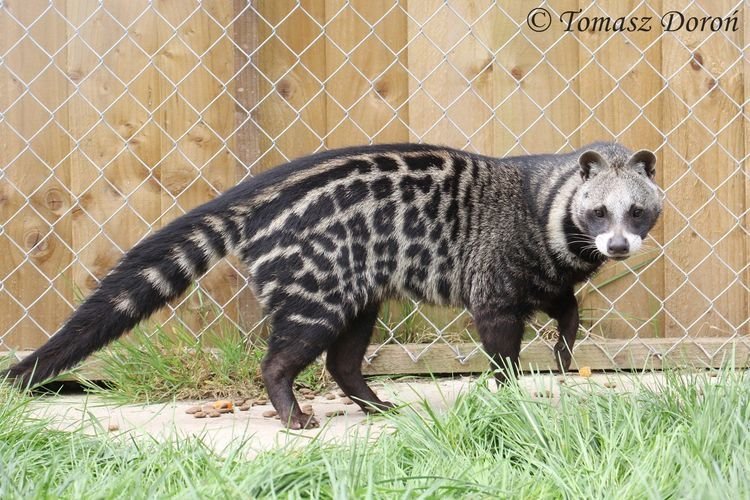
The African civet (Civettictis civetta) is one of Africa's most distinctive nocturnal mammals - a cat-sized viverrid with a stout body, a raccoon-like face mask, and a coat of bold black spots and stripes over grey. Despite the looks, it is neither a cat nor a mongoose but a member of the civet family.
It is a solitary and largely nocturnal animal of forest edges, thickets and savanna, usually close to water. By day it hides in dense grass or bush; after sunset it emerges to forage. Its famous perineal-gland secretion - civetone - was once harvested for the perfume industry and is still used to mark its own territory.
Why the African Civet Matters
As an omnivore it links plants and animals: it disperses fruit seeds and helps control rodents and invertebrates, and its scent-marking behaviour is a classic example of chemical communication in African mammals.
A Species Worth Understanding
Understanding the real African civet - its solitary, nocturnal life and varied diet - replaces vague template copy with one of Africa's most interesting small carnivores.
Scientific Classification
A member of the civet family (Viverridae), the African civet is the only species in its genus. The IUCN lists it as Civettictis civetta, assessed as Least Concern.
Physical Characteristics
The African civet is built for a solitary, nocturnal, ground-dwelling life:
- Size & weight: Adults weigh about 7–20 kg, with males heavier than females. Most adults fall in a typical range of roughly 12–15 kg (per ADW), though large males approach 20 kg - so the broad 7–20 kg figure should be read as a range, not a universal standard.
- Body & tail: Body length about 67–84 cm, with a thick tail of 40–50 cm (roughly half the body length).
- Coat: Grey to fawn fur marked with bold black spots, blotches and stripes, a black-and-white crested neck mane, and a raccoon-like dark face mask.
- Head: A pointed snout, small rounded ears, and large eyes adapted for night vision.
- Legs & feet: Short, plantigrade legs and broad paws with semi-retractable claws - built for walking and digging, not speed (it is a slow, waddling mover, not a runner).
- Black-and-white tail: The tail is ringed black and white, used in displays and signalling.
Social System & Behaviour
The African civet is primarily solitary - not a group or bachelor animal:
- Solitary forager: Adults live and hunt alone, each holding its own home range; they meet mainly to breed.
- Not family or bachelor groups: Describing African civets as 'family groups' or 'bachelor groups' is not supported - their society is centred on the solitary adult, with the mother-young bond the only lasting association.
- Territorial: Both sexes mark their ranges with scent (see Scent Marking below) and with communal dung piles.
- Nocturnal: Active from shortly before sunset through the night; it rests hidden in dense grass or thickets by day.
African Civet Young & Reproduction
Young are raised by the female alone:
- Mating: Breeding can occur year-round, with peaks that vary across the range.
- Litter: Usually 1–4 young (occasionally more) after a gestation of about 60–70 days.
- Care: The female raises the young alone in a hidden nest of grass or thicket; males do not help. Newborns are blind and sparsely furred.
- Independence: Young are weaned at a few weeks and become independent after several months, then disperse to solitary lives.
Habitat: Where They Thrive
The African civet is a habitat generalist of sub-Saharan Africa, but it always needs cover and water. A richer picture than 'just savanna':
Key Habitat Types:
- Forest & rainforest: Forest edges, clearings and gallery forest are prime civet country.
- Open country & savanna/grassland: Used where there is tall grass or thicket for hiding.
- Scrub & thicket: Dense shrub and riparian thickets are favourite resting and hunting ground.
- Tall grass / dense cover: Essential - civets avoid open ground by day and travel along vegetated edges.
- Near permanent water: Often found along rivers, lakes and wetlands where prey and cover are reliable.
- Human edges: Sometimes near farmland, plantations and village outskirts, though it remains shy of people.
Climate & Cover:
It tolerates a wide range of climates from rainforest to dry savanna, but dense cover plus water is the constant requirement.
Distribution Map
The African civet occurs across sub-Saharan Africa wherever cover and water exist - widespread, but secretive and nocturnal so seldom seen:
In Tanzania it is widespread; the best chance is a night drive in Lake Manyara, Nyerere, the Serengeti or Katavi.
Because it is a shy, nocturnal forager of thickets and grass, a sighting means a quiet night drive with a spotlight - present in the right habitat but never guaranteed.
Where to See the African Civet in Tanzania
The African civet is seen on night drives in Tanzania's parks - look for eyeshine along thicketed tracks. These are the headline spots:
Lake Manyara NP
Best: Year-round | Region: Tanzania, rift-valley forest & savanna
Rare (nocturnal)
Tip: One of the few parks offering night drives - the classic civet spot.
Nyerere NP
Best: Year-round | Region: Tanzania, Rufiji riverine bush
Rare (nocturnal)
Tip: Night drives from riverside camps scan thickets for eyeshine.
Serengeti NP
Best: Year-round | Region: Tanzania, savanna & woodland
Rare (nocturnal)
Tip: Night drives in private concessions and some lodges reveal civets.
Katavi NP
Best: Year-round | Region: Tanzania, floodplain thicket
Rare (nocturnal)
Tip: Remote and wild; night drives along riverine thickets pay off.
African Civet in Pictures
A closer look at the African civet (Civettictis civetta) - the boldly marked, nocturnal viverrid of Africa's forests and thickets.
Where to Spot the African Civet on Safari
Plan a guided night drive into Tanzania's parks to look for the secretive African civet. Explore the destinations below.
Diet: What They Eat
The African civet is a true omnivore with a genuinely varied diet - far more than the label suggests:
- Plant foods: Fruit (including fallen fruit) and berries form a large part of the diet and help disperse seeds.
- Small mammals: Rodents and other small vertebrates are taken when available.
- Reptiles: Reptiles such as lizards, snakes and frogs are regular prey.
- Eggs: Birds' eggs are eagerly eaten when found.
- Invertebrates: Insects and other invertebrates (beetles, grasshoppers, millipedes, snails) are staples, especially in the dry season.
- Other small animal foods: Carrion, scraps and small aquatic prey round out the diet; civets are opportunistic and adapt to what is abundant.
Foraging method: Mostly on the ground at night, using smell and a slow, methodical walk to find food; it may climb low branches for fruit. There is no rigid timetable - it simply feeds through the night and rests by day.
Ecosystem role: By eating fruit and berries it spreads seeds, and by taking rodents and invertebrates it helps balance small-prey populations.
Daily Behaviour & Social Life
Activity Pattern (nocturnal)
Predominantly nocturnal: The African civet is active from shortly before sunset into the night, with peak activity after dark. There is no daytime timetable - by day it sleeps in dense grass or thickets and avoids open ground.
Day: Rests concealed in vegetation, only moving if disturbed.
Night: Forages alone along vegetated edges, using scent and hearing to find food.
Social Structure
- Solitary: Adults live alone and meet mainly to breed; the only lasting bond is mother and young.
- Communication: Scent is central (see below); vocalisations are limited to hisses, growls and spits when threatened.
Predators & Threats
Large cats, hyenas and pythons may take civets; the greater threats are habitat loss, hunting for bushmeat and traditional medicine, roadkill and persecution as a crop-raider. Its best defence is cover and night.
Watching tip: On a night drive, sweep a spotlight slowly along thickets and grass edges; look for the pale, cat-like eyeshine and the striped tail.
Scent Marking & Civetone
The African civet is famous for its chemical communication - a behaviour as important as its diet:
- Perineal gland: Both sexes have a perineal gland near the genitals that secretes a strong, waxy musk (civetone).
- Territory marking: Civets rub the gland on vegetation, stones and logs, and drag the tail through the secretion to lay a scent trail marking their home range.
- Dung piles (latrines): They use communal dung piles at territory boundaries and along trails - a recognised civet sign in the bush.
- Civetone in perfume: Historically the gland secretion was harvested for the perfume industry as a fixative and scent; today synthetic alternatives have largely replaced it.
- Individual identity: The scent carries information about sex, status and ownership of a range - the civet's 'signature' in the dark.
Reproduction & Lifespan
- Mating: Can occur year-round, with regional peaks.
- Gestation: About 60–70 days.
- Litter: Usually 1–4 young.
- Care: The female raises the young alone in a hidden nest.
- Lifespan: Around 15–20 years in captivity (often shorter in the wild).
Conservation Status
IUCN Red List Status: Least Concern - the African civet (Civettictis civetta) is assessed as Least Concern, though local populations decline with habitat loss.
Major Threats
- Habitat loss: Clearing of forest and thicket for farmland and settlements removes cover and water.
- Hunting: Taken for bushmeat and traditional medicine, and historically for civetone.
- Roadkill & persecution: Killed on roads and where blamed for raiding crops or poultry.
- Pet trade: Young are occasionally taken, though this is rare.
Conservation Programs
Protected areas are the main safeguard. In Tanzania the Tanzania National Parks (TANAPA) and Wildlife Division protect civet habitat in Lake Manyara, Nyerere, the Serengeti and Katavi; the IUCN SSC Small Carnivore Specialist Group and viverrid researchers support monitoring and coexistence across the range.
20 Interesting Facts
African Civet vs Other Civets
African Civet vs African Palm Civet
| Feature | African Civet | African Palm Civet |
|---|---|---|
| Size | Larger (7–20 kg) | Smaller (~1.5–4.5 kg) |
| Coat | Spotted, striped, face mask | Plain brown, no mask |
| Habitat | Forest edge, thicket, savanna | Forest canopy |
| Arboreal | Mostly ground | Mostly arboreal |
African Civet vs Genets
| Feature | African Civet | Genet |
|---|---|---|
| Size | Large, stocky | Small, slender |
| Tail | Thick, ringed | Long, ringed, thin |
| Habitat | Ground & thicket | Arboreal & ground |
| Diet | Omnivore (fruit heavy) | Mostly carnivorous |
African Civet in African Context
The African civet has long sat at the edge of human life in Africa - valued, feared and exploited. Its civetone musk was once a prized perfume ingredient, and captive civets were kept for the secretion. Today the species is a reminder that even common, widespread animals depend on intact thickets, forests and water; reducing roadkill and bushmeat hunting keeps it a quiet resident of the night across the continent.
Wildlife Photography Guide
- Best Camera Lens: A fast 70-200mm or 100-400mm; at night, a high-ISO body and a spotlight with a red filter.
- Best Time: Night drives - shortly after sunset and the first hours of darkness are the peak.
- Best Habitat: Thicket edges and grass along park tracks in Lake Manyara, Nyerere, Serengeti, Katavi.
- Best Behaviour: Capture the face mask and ringed tail in spotlight; shoot steady from the vehicle.
- Safety Distance: Stay in the vehicle; use a dim red light so the civet is not dazzled.
Frequently Asked Questions
The African civet (Civettictis civetta) is a large viverrid of sub-Saharan Africa - a nocturnal, solitary mammal with a spotted, striped coat and a raccoon-like face mask.
Adults weigh about 7–20 kg, with males heavier; typical adults are around 12–15 kg, and the broad range should not be read as a universal standard for every animal.
No - it is primarily solitary and meets others mainly to breed. 'Family groups' and 'bachelor groups' do not describe its social system.
Yes - predominantly nocturnal, active from shortly before sunset into the night, resting hidden in grass or thickets by day.
A true omnivore: fruit, berries, rodents, reptiles, birds' eggs, invertebrates and other small animal foods. Fruit and berries form a large part of the diet.
Civetone is the strong musk secreted by the civet's perineal gland. It is used to mark territory and was historically harvested for the perfume industry.
It rubs the perineal gland on plants and objects, drags its scent-covered tail, and deposits droppings at communal dung piles along territory boundaries.
On night drives in Lake Manyara, Nyerere (Selous), the Serengeti and Katavi - look for eyeshine along thicketed tracks. Sightings are rare and never guaranteed.
Least Concern (IUCN), though local populations decline with habitat loss, hunting and roadkill.
Forest, rainforest, open country, savanna/grassland, scrub and thicket - but always with tall grass or dense cover and near permanent water.
No - despite the looks it is a viverrid (civet family), more closely related to genets and mongooses than to true cats.
Yes - on a night drive with a spotlight and a high-ISO camera; a red filter helps avoid dazzling the animal.
Related Safari Packages & Tours
Plan a guided night drive into Tanzania's parks to look for the secretive African civet with our expert guides.
References & Further Reading
- Animal Diversity Web (ADW): Civettictis civetta account - weight, length, habitat, diet and perineal-gland marking.
- IUCN Red List: Civettictis civetta - Least Concern.
- About these facts: Weight, size and lifespan are approximate adult ranges that vary by sex, age, location and measurement method; conservation status should be checked against the current IUCN assessment.
Sightings are never guaranteed and depend on local conditions.