

.png)
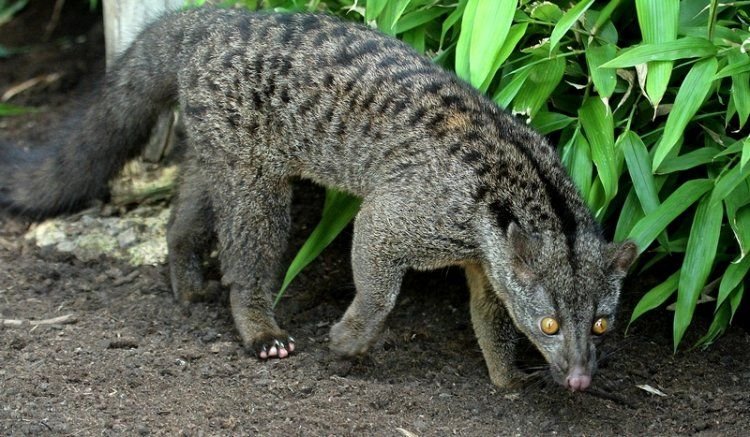
African Palm Civet
Nandinia binotata — a small, nocturnal, tree-living forest frugivore so distinct it sits in its own family, Nandiniidae.Introduction to the African Palm Civet
The African palm civet (Nandinia binotata), also called the two-spotted palm civet, is a small, cat-like forest mammal of sub-Saharan Africa. Despite its name and old grouping with civets, it is not a true civet (Viverridae) - it sits in its own family, Nandiniidae, the sole member of that family.
It is an arboreal and nocturnal animal that spends its life in the canopy of rainforests and other wooded habitats, feeding largely on fruit. By day it rests hidden among leaves and branches; after nightfall it moves through the trees, a shy climber rarely seen from a vehicle.
Why the African Palm Civet Matters
As a frugivore it is an important seed disperser for many forest trees (including figs and oil palms), helping tropical forests regenerate. Its placement in its own ancient family makes it a living piece of carnivoran evolutionary history.
A Species Worth Understanding
Understanding the real African palm civet - a forest canopy specialist in Nandiniidae, not a savanna civet - replaces vague template copy with one of Africa's most distinctive small carnivores.
Scientific Classification
Unlike the African civet (Civettictis civetta, a true viverrid), the African palm civet is not in Viverridae. Modern taxonomy places it in Nandiniidae - a distinct, monogeneric family - because molecular and morphological studies show it diverged early from other civets. This is the single most important correction to make about the species.
Physical Characteristics
The African palm civet is built for life in the trees, not for speed on the ground:
- Size & weight: Adults weigh about 1.2–3 kg (most 1.7–2.1 kg). Head-body length is roughly 37–62 cm, with a long tail of 34–76 cm (often as long as the body).
- Long tail: A long, ringed, bushy tail gives balance and stability when leaping and climbing between branches.
- Flexible body: A slender, lean build and short legs let it twist and reach through dense canopy and lianas.
- Arboreal locomotion: It is an agile climber; sharp, curved claws (sources differ on whether they are fully retractile - best described simply as strong climbing claws) grip bark and help it ascend and descend trunks.
- Forest camouflage: Grey to dark-brown fur with dark spots on the back provides camouflage in the forest canopy - not savanna. Large eyes support its nocturnal activity.
- No runner: It is a climber, not a sprinter - any 'top speed' figure is irrelevant to its tree-dwelling life.
Social System & Behaviour
The African palm civet is largely solitary - not a group or bachelor animal:
- Solitary forager: Adults live and forage alone in the canopy; they meet mainly to breed.
- Not family or bachelor groups: Describing African palm civets as 'family groups' or 'bachelor groups' is not supported - they are solitary, though a dominant male's home range may overlap the ranges of several females.
- Territorial: Both sexes hold territories and mark them with scent (see Scent Marking below).
- Nocturnal: Active from shortly after dusk (a 3–4 hour peak) and again before dawn; it rests hidden in the canopy by day.
African Palm Civet Young & Reproduction
Young are raised by the female alone:
- Mating: Breeding can occur up to twice a year, often in the rainy season when fruit is abundant.
- Litter: Usually 1–4 young after a gestation of about 60–64 days.
- Care: The female raises the young alone in a nest; she has scent glands that stain her abdomen (and the young) yellow. Young are weaned at about 3 months and accompany her until nearly adult size.
- Maturity: Both sexes reach sexual maturity at around 3 years.
Habitat: Where They Thrive
The African palm civet is an arboreal forest animal - its primary ecological identity is the tropical forest canopy, not savanna:
Key Habitat Types:
- Rainforest: The core habitat - lowland and montane rainforest (below about 2,000 m) with a closed, fruiting canopy.
- Other wooded habitats: Deciduous forest, riparian forest, secondary/logged forest and savanna woodland (tree-studded, not open plains) where fruit-bearing trees persist.
- Fruit-producing trees: It is tied to places with year-round fruit; it needs forests receiving at least ~1,000 mm of rain a year.
- Canopy life: It sleeps and travels among large branches and lianas, usually 10–30 m above the ground.
- Not open savanna: While it can use wooded savanna edges, calling it a 'savanna animal' is wrong - forest (and the fruit trees within it) is its world.
Climate & Cover:
It needs intact or recovering forest with continuous canopy and fruit; deforestation and canopy loss are the main pressures on its home.
Distribution Map
The African palm civet occurs across the equatorial region of Africa - West, Central and East Africa - wherever forest and fruiting trees exist:
In Tanzania it is found in forest reserves such as Udzungwa and Rubondo (and on Unguja/Zanzibar); in Uganda in Kibale, Bwindi and Budongo.
Because it is a shy, nocturnal canopy animal, a sighting means a patient night walk with a spotlight - present in the right forest but never guaranteed.
Where to See the African Palm Civet in Tanzania & Uganda
The African palm civet is seen on guided night walks in rainforest - never a daytime game-drive animal. These are the headline spots (correct countries and flags):
Udzungwa Mountains NP
Best: Year-round | Country: Tanzania, evergreen forest
Rare (nocturnal)
Tip: Night walks from the forest edge scan fruiting canopy for eyeshine.
Rubondo Island NP
Best: Year-round | Country: Tanzania, Lake Victoria forest
Rare (nocturnal)
Tip: Forested island; listen for the civet's hooting call after dark.
Kibale Forest NP
Best: Year-round | Country: Uganda, tropical rainforest
Rare (nocturnal)
Tip: Famous for primates; night walks also reveal palm civets in the canopy.
Bwindi Impenetrable NP
Best: Year-round | Country: Uganda, montane rainforest
Rare (nocturnal)
Tip: Dense forest night walks offer a chance of this canopy climber.
African Palm Civet in Pictures
A closer look at the African palm civet (Nandinia binotata) - the small, spotted, tree-living forest civet of Africa's rainforests.
Where to Spot the African Palm Civet on Safari
Plan a guided night walk into Tanzania and Uganda's rainforests to look for the secretive African palm civet. Explore the destinations below.
Diet: What They Eat
The African palm civet is mainly a frugivore (fruit-eater) - far more than the bare label 'omnivore' suggests:
- Fruit is central: It lives where fruit is available almost year-round and feeds heavily on forest fruit.
- Key fruit trees: Wild figs (Ficus), Musanga (umbrella/corkwood tree), Uapaca (sugar plums), Myrianthus (corkwood), oil-palm fruit (Elaeis guineensis), persimmon (Diospyros), papaya and banana.
- Animal prey: It supplements fruit with rodents, insects, lizards, bats, birds, eggs and hatchlings.
- Carrion & opportunism: It also eats carrion and is opportunistic - even raiding farms for small livestock on occasion.
- How it feeds: It holds food in hand-like front paws, bites repeatedly and swallows; fruit makes up the majority of the diet, so it is a major forest seed disperser.
Ecosystem role: By eating and dispersing the seeds of figs, oil palms and other trees, it helps tropical forests regenerate.
Daily Behaviour & Social Life
Activity Pattern (nocturnal, arboreal)
Predominantly nocturnal: The African palm civet is active from shortly after dusk (a 3–4 hour peak) and again for a few hours before dawn. There is no daytime game-drive timetable - by day it rests hidden in the canopy 10–30 m up.
Day: Sleeps among leaves and branches; almost never on the ground in open areas.
Night: Moves through the canopy, foraging on fruit and small prey, using scent and hearing.
Social Structure
- Solitary: Adults live alone; the only lasting association is mother and young. A dominant male's range may overlap several females' ranges.
- Communication: Mostly scent (see below) plus a distinctive hooting call, mewing, clucking, purring, growls and screams when threatened.
Predators & Threats
Large owls, leopards and pythons may take them; the greater threats are deforestation, habitat fragmentation, hunting for bushmeat and the pet trade. Its best defence is the canopy and night.
Watching tip: On a forest night walk, sweep a spotlight slowly across the canopy and listen for the hooting call; look for eyeshine among the branches.
Scent Marking & Communication
The African palm civet is a scent-marking specialist:
- Abdominal gland: The main scent gland sits on the lower abdomen and secretes a brown musk used to mark territory.
- Other glands: Glands on the chin and feet secrete a scent described as floral or fruity; a lactating female also has a belly gland that stains her young yellow.
- Vocal: Uniquely known for hooting calls, plus mewing, clucking, purring, growls and screams.
- Territory: Both sexes are territorial and use scent to define their ranges in the forest.
Reproduction & Lifespan
- Mating: Up to twice yearly, often in the rainy season.
- Gestation: About 60–64 days.
- Litter: Usually 1–4 young.
- Care: The female raises the young alone in a nest; young weaned at ~3 months.
- Lifespan: Around 15–20 years (often reported up to ~21 years in captivity).
Conservation Status
IUCN Red List Status: Least Concern - the African palm civet (Nandinia binotata) is assessed as Least Concern, though local populations decline with forest loss.
Major Threats
- Deforestation: Loss and fragmentation of rainforest removes the canopy and fruiting trees it depends on.
- Hunting: Taken for bushmeat and the pet trade.
- Habitat fragmentation: Below a critical rainfall/canopy threshold, populations cannot persist.
Conservation Programs
Protected forests are the main safeguard. In Tanzania the Tanzania National Parks (TANAPA) and Wildlife Division protect palm-civet habitat in Udzungwa and Rubondo; in Uganda the Uganda Wildlife Authority (UWA) protects Kibale and Bwindi. The IUCN SSC Small Carnivore Specialist Group and forest-research camera-trap networks support monitoring across the range.
20 Interesting Facts
African Palm Civet vs Other Civets
African Palm Civet vs African Civet
| Feature | African Palm Civet | African Civet |
|---|---|---|
| Family | Nandiniidae (own family) | Viverridae |
| Size | Small (1.2–3 kg) | Large (7–20 kg) |
| Habitat | Forest canopy | Forest edge, thicket, savanna |
| Diet | Mostly fruit | Omnivore (fruit + meat) |
African Palm Civet vs Genets
| Feature | African Palm Civet | Genet |
|---|---|---|
| Family | Nandiniidae | Viverridae |
| Build | Stocky, short-legged | Slender, long-bodied |
| Habitat | Rainforest canopy | Woodland, savanna, arboreal |
| Diet | Mostly fruit | Mostly carnivorous |
African Palm Civet in African Context
The African palm civet is a quiet architect of the rainforest - by scattering the seeds of figs, oil palms and other trees, it helps replenish the very forests that shelter it. Its placement in its own ancient family, Nandiniidae, also makes it a living record of carnivoran evolution. Protecting equatorial forest - from Udzungwa to Kibale - protects this spotted, hooting canopy climber.
Wildlife Photography Guide
- Best Camera Lens: A fast 70-200mm or 100-400mm; at night, a high-ISO body and a spotlight with a red filter.
- Best Time: Night walks - shortly after sunset and the first hours of darkness are the peak.
- Best Habitat: Rainforest canopy on forest trails in Udzungwa, Rubondo, Kibale, Bwindi.
- Best Behaviour: Capture the spotted coat and long tail among branches; listen for the hooting call.
- Safety Distance: Stay on the walk; use a dim red light so the civet is not dazzled.
Frequently Asked Questions
The African palm civet (Nandinia binotata), also the two-spotted palm civet, is a small, arboreal, nocturnal forest mammal of sub-Saharan Africa - and the only species in its own family, Nandiniidae.
No - although historically grouped with civets (Viverridae), modern taxonomy places it in its own family, Nandiniidae, based on genetic and anatomical evidence. It is not a member of Viverridae.
Adults weigh about 1.2–3 kg (most 1.7–2.1 kg). Body length is roughly 37–62 cm with a long tail of 34–76 cm.
Yes - it lives in the forest canopy and is active after dusk and before dawn, resting hidden in trees by day. It is not a daytime game-drive animal.
Mainly fruit - wild figs, Musanga, Uapaca, Myrianthus, oil-palm fruit, persimmon, papaya and banana - supplemented with rodents, insects, lizards, bats, birds, eggs and carrion.
Largely solitary; adults live alone and meet mainly to breed. 'Family groups' or 'bachelor groups' do not describe its social system.
An abdominal scent gland secretes a brown musk used to mark territory; chin and foot glands add a floral/fruity scent.
On night walks in Tanzanian forests (Udzungwa, Rubondo) and Ugandan forests (Kibale, Bwindi). Sightings are rare and never guaranteed - it is a canopy, nocturnal animal.
Least Concern (IUCN), though local populations decline with deforestation and hunting.
Rainforest and other wooded habitats with a continuous, fruiting canopy and at least ~1,000 mm of rain a year - not open savanna.
Sources differ; it has sharp, curved climbing claws suited to gripping bark. Whether they are fully retractile is debated, so it is safest to describe them simply as strong climbing claws.
Yes - on a forest night walk with a spotlight and a high-ISO camera; a red filter helps avoid dazzling the animal.
Related Safari Packages & Tours
Plan a guided night walk into Tanzania and Uganda's rainforests to look for the secretive African palm civet with our expert guides.
References & Further Reading
- Animal Diversity Web (ADW): Nandinia binotata account - Nandiniidae placement, habitat, diet and scent glands.
- IUCN Red List: Nandinia binotata - Least Concern.
- About these facts: Weight, size and lifespan are approximate adult ranges that vary by sex, age, location and measurement method; conservation status should be checked against the current IUCN assessment.
Sightings are never guaranteed and depend on local conditions.