

.png)
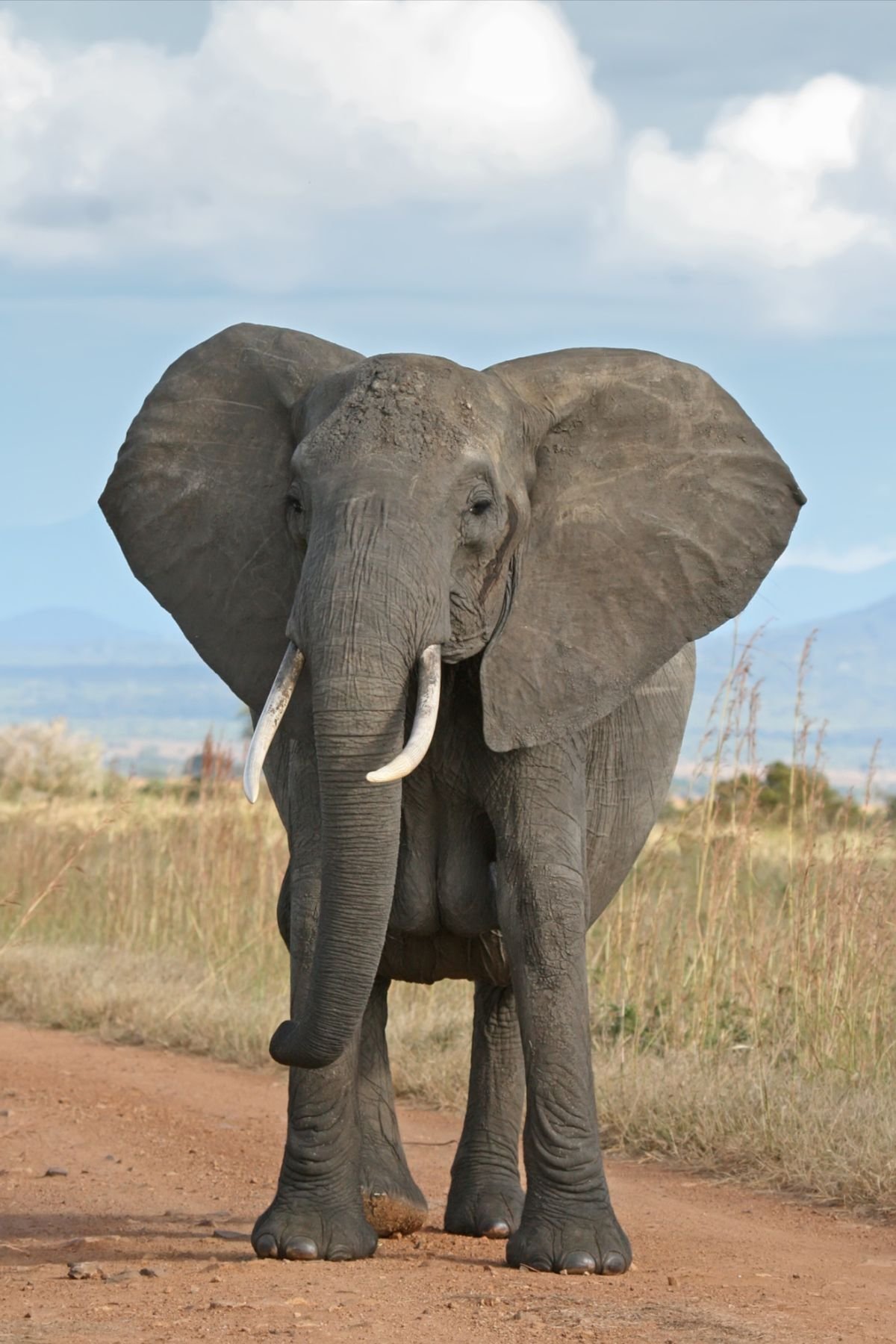
African Forest Elephant
Loxodonta cyclotisThe elusive giant and mega-gardener of Africa’s rainforests.
Sightings are never guaranteed and depend on local conditions. Follow your guide and respect park rules.
Smaller and more compact than its savanna cousin, the African forest elephant is perfectly adapted to the dense tropical forests of West and Central Africa. With rounded ears, powerful straight tusks and an extraordinary appetite for fruit and vegetation, this Critically Endangered elephant spreads seeds and helps maintain the health of the rainforest. Protect the elephant. Protect the forest.
African Forest Elephant Quick Facts
What Is the African Forest Elephant?
The African forest elephant is a distinct elephant species adapted to the dense tropical forests of Africa. It is smaller than the African savanna elephant and has several recognizable differences: forest elephants are smaller, darker, have more rounded/oval ears and straighter, downward-pointing tusks, while savanna elephants are larger with fan-shaped ears and outward-curving tusks. WWF specifically highlights these differences. Its ecological importance goes far beyond size — by consuming fruit and transporting seeds, it helps regenerate and maintain rainforest ecosystems. WWF describes it as the “mega-gardener of the forest.”
Signature Features
Straight tusks
Straighter, slender, downward-pointing tusks — denser and prized by poachers.
Rounded ears
More rounded/oval ears than the savanna elephant’s fans.
Compact body
Smaller and more maneuverable for dense forest.
Mega-gardener
Disperses seeds through dung, regenerating rainforest.
Keystone species
Its effects on the forest outweigh its abundance.
Family groups
Female-centered groups; males more solitary.
Physical Characteristics
Forest elephants weigh approximately 2–5 tonnes (WWF gives 2–5 tonnes), with shoulder height around 2.4–3 m in many adults and substantial variation. Don’t present 4,000 kg or a precise 5 m length as universal figures — use weight and shoulder height separately. Their tusks are straighter and more downward-pointing, often more slender and vertical; their ears are more rounded/oval and aid heat regulation, communication and visual signaling. The skull and skeleton also differ from savanna elephants, supporting the recognition of forest elephants as a distinct species. They are capable of rapid movement when needed, but speed is not their defining adaptation — strength, forest navigation, social behavior and seed dispersal are.
Why Smaller?
Moving through thick vegetation rewards a more compact body that favors maneuverability, strength and endurance rather than maximizing size. The species is built to slip along forest trails, through swamps, river corridors, and forest clearings.
Habitat & Range
The forest elephant’s principal remaining range is West and Central Africa, especially the Congo Basin. WWF identifies dense tropical forests as its core habitat: Congo Basin rainforest, lowland tropical forest, swamp forest, forest clearings, riverine forest, forest edges and some forest-savanna transition zones. Any claim that core populations are concentrated in East or Southern Africa is incorrect for this species. Major remaining countries include Gabon and the Republic of the Congo (the two biggest strongholds), plus Cameroon, Central African Republic, Equatorial Guinea, Côte d’Ivoire, Liberia and Ghana.
Why the Congo Basin Matters
The Congo Basin is one of Earth’s most important tropical forest regions, providing habitat for gorillas, forest buffalo, chimpanzees, thousands of plant species, carbon storage and freshwater systems. Protecting forest elephants helps protect an enormous ecosystem.
Diet & the Mega-Gardener
Forest elephants eat a wide variety of plant material — fruits, leaves, bark, seeds, grasses, roots, branches and other vegetation (WWF identifies fruits, leaves, grasses, seeds and tree bark as important). Fruit is especially important and leads directly to their key ecological role.
The Mega-Gardener of the Forest
When a forest elephant eats fruit: fruit consumed → seeds swallowed → elephant travels → seeds pass through the digestive system → seeds deposited in dung → new trees grow → forest regeneration. WWF explains that forest elephants are crucial seed dispersers and that some large-tree seeds depend on passage through an elephant’s gut for successful germination. By transporting seeds far from the parent tree, they maintain forest diversity, spread plant species and create food resources for other wildlife. Losing elephants can affect the forest itself.
Trails & Mineral Licks
Forest elephants create paths through dense vegetation that become routes for other mammals, birds and smaller wildlife. They also visit mineral-rich clearings and mineral licks to obtain minerals harder to get from ordinary vegetation (WWF notes their use of mineral-rich waterholes and licks).
Behavior & Social Life
Forest elephants are social, but their groups can be smaller and more fluid than the enormous savanna herds. Family groups are centered around related females and their offspring (adult females, calves, juveniles, related offspring); WWF notes family groups can contain up to about 20 individuals. Experienced adult females play important roles in movement and social decision-making — replace vague “group leadership” claims with this female-centered structure. Adult males generally become more independent: they may travel alone, associate temporarily with other males, and visit female groups during mating. Don’t describe adult males as permanent members of family herds.
Communication & Intelligence
Elephants use sounds, rumbles, trumpets, roars, low-frequency calls, body language, ear/trunk/head posture and chemical signals (urine, dung, scent). Low-frequency sounds travel long distances — especially useful where dense vegetation limits visibility. They are known for strong memory, complex social relationships, problem solving and environmental awareness, all vital for navigating the forest.
Reproduction & Life Cycle
Elephants normally give birth to usually one calf (twins possible but rare); the calf is cared for by its mother and other family-group members. Gestation is approximately 22 months — one of the longest among mammals (WWF). A newborn can stand relatively soon, depends heavily on its mother’s milk, and learns by following adults over years. The calf gradually learns walking, foraging, social communication, forest navigation and mineral-site knowledge — skills passed between generations.
Slow Reproduction = High Vulnerability
WWF notes forest elephants reproduce more slowly than savanna elephants, so populations cannot recover quickly after severe declines. One killed adult removes a reproductive individual, disrupts a family and loses future calves — population recovery can take decades. That makes poaching especially devastating.
Comparisons
vs Savanna (Bush) Elephant
| Feature | Forest Elephant | Savanna Elephant |
|---|---|---|
| Scientific name | Loxodonta cyclotis | Loxodonta africana |
| Habitat | Tropical forest | Savanna & open woodland |
| Size | Smaller | Larger |
| Ears | More rounded/oval | Larger, fan-shaped |
| Tusks | Straighter, downward-pointing | More outward-curving |
| Distribution | West/Central Africa | Broad sub-Saharan Africa |
| Conservation | Critically Endangered | Endangered |
| Ecology | Major forest seed disperser | Major landscape engineer |
vs Asian Elephant
African forest elephants belong to genus Loxodonta and live in African tropical forests; Asian elephants (genus Elephas) live in Asian forests/grasslands, are generally smaller, have smaller ears, and usually only males carry prominent tusks. WWF highlights these major differences.
Conservation Status
The African forest elephant is currently classified as Critically Endangered — correct this immediately if any page shows “Endangered.” It is not merely Endangered; it faces an extremely high risk of extinction in the wild.
Major Threats
Ivory poaching
The international ivory trade has driven severe declines; straight dense tusks make it a prime target.
Habitat loss
Agriculture, logging, roads, mining and settlement expansion destroy forest.
Fragmentation
Roads split forest into isolated populations with reduced genetic connectivity.
Human-elephant conflict
Crop damage leads to retaliation and elephant deaths near farms.
How Scientists Count Them
Because dense forest blocks visual surveys, populations are commonly estimated using dung counts (analyzing dung distribution and density), plus DNA, camera traps, acoustic monitoring, satellite tracking and field surveys. This is why conventional safari-style observation is insufficient.
A Keystone Species
Forest elephants disperse seeds, create trails, open vegetation, create forest gaps, transport nutrients and influence tree composition. Protecting the elephant helps protect the forest — a keystone effect disproportionate to its numbers.
The Long-Term Solution
Anti-poaching, forest protection, wildlife corridors, community conservation, law enforcement, ivory-trade controls, scientific monitoring, protected areas and sustainable land-use planning.
Where to See Forest Elephants
This species is primarily a West & Central African rainforest animal, not a Tanzanian safari species. Do not market “Uganda’s rainforests and mountains” or East Africa as its primary destination. For African Majestic Adventure, your stronger Tanzania elephant entity is the African Bush/Savanna Elephant (Loxodonta africana); this page stays geographically honest about where forest elephants actually live.
Genuine Range Countries
Gabon and the Republic of the Congo are the two major remaining strongholds (WWF). Other range countries include Cameroon, Central African Republic, Equatorial Guinea, Côte d’Ivoire, Liberia and Ghana. Forest-elephant tourism differs from a classic game drive: encounters can involve forest walks (where permitted), specialized vehicles, forest clearings, tracking, experienced guides, quiet observation and patience.
Sighting Likelihood & Timing
Replace any “High” claim with Specialized / Unpredictable — the species is deliberately difficult to observe. Don’t claim June–October is universally best; rainforest conditions vary dramatically by country and ecosystem. Use: best viewing periods vary by destination; consult local operators and park authorities for current seasonal conditions.
Did You Know?
Distinct species
Recognized separately from the savanna elephant.
Critically Endangered
One step from extinct-in-the-wild classification.
Mega-gardener
Disperses seeds that regenerate the rainforest.
Slow recovery
Reproduces slower than savanna elephants.
Counted by dung
Dung counts estimate forest populations.
Safari Guide’s Perspective
The African forest elephant is a West and Central African specialist — not a sighting you’ll tick off on a Tanzania safari. As a Tanzania-based operator, our elephant story is the savanna/bush elephant; if a traveller wants true forest elephants, we’re upfront that it means a dedicated Central or West African forest itinerary, not a Serengeti game drive. That honesty is exactly why this page exists.
Deep in the Congo Basin, a forest elephant tears open a fruit, swallows the seeds, and walks kilometres before leaving them in a pile of dung. Years later, a tree stands where none could have grown — the forest’s quietest gardener at work.
Gallery
Note: hero/gallery currently uses a savanna-elephant photo as a placeholder until a dedicated forest-elephant image is added to animals/images/.
Frequently Asked Questions
Loxodonta cyclotis.
Yes. It is recognized as a distinct African elephant species alongside the African savanna elephant; WWF describes two living African elephant species: forest and savanna elephants.
Primarily in the tropical forests of West and Central Africa, especially the Congo Basin.
They should not be marketed as a normal Tanzanian safari species. Their principal range is West and Central Africa; Tanzania’s elephant entity is the savanna/bush elephant.
Not as a normal range country. African forest elephants are a West and Central African species — the Congo Basin, Gabon and the Republic of the Congo are the major strongholds. Uganda’s elephants are overwhelmingly savanna elephants (Loxodonta africana), so true forest-elephant sightings are not part of a typical Uganda itinerary.
Approximately 2–5 tonnes according to WWF.
Forest elephants are smaller, have more rounded ears and generally straighter, downward-pointing tusks.
Fruit, leaves, grasses, seeds, bark and other vegetation.
They disperse seeds and help maintain the structure and diversity of tropical forests.
Because their feeding and movement patterns spread seeds and help regenerate forests.
Approximately 22 months.
Usually one calf at a time.
Yes. Females and offspring live in family groups, while adult males generally become more independent. Forest-elephant groups can be smaller than typical savanna-elephant herds.
More seriously: they are currently classified as Critically Endangered.
The major threats include ivory poaching, habitat loss, fragmentation and human pressure.
Gabon and the Republic of the Congo are among the most important remaining strongholds.
Because dense forests make visual surveys difficult, researchers commonly use methods including dung-count surveys to estimate populations.
References & Further Reading
- WWF (World Wildlife Fund): Forest elephant species account — distinct from savanna elephant; West/Central African tropical forest range; rounded ears, straighter downward tusks; 2–5 tonnes; ~22-month gestation; Critically Endangered status; seed-dispersal/“mega-gardener” role; poaching and habitat loss as major threats.
- IUCN Red List: Loxodonta cyclotis — current Critically Endangered classification and assessment.
- Research methods: Dung-count surveys, DNA, camera traps, acoustic monitoring and satellite tracking used to estimate forest populations.
- About these facts: Measurements are approximate ranges; conservation status should be checked against the current IUCN assessment.