

.png)
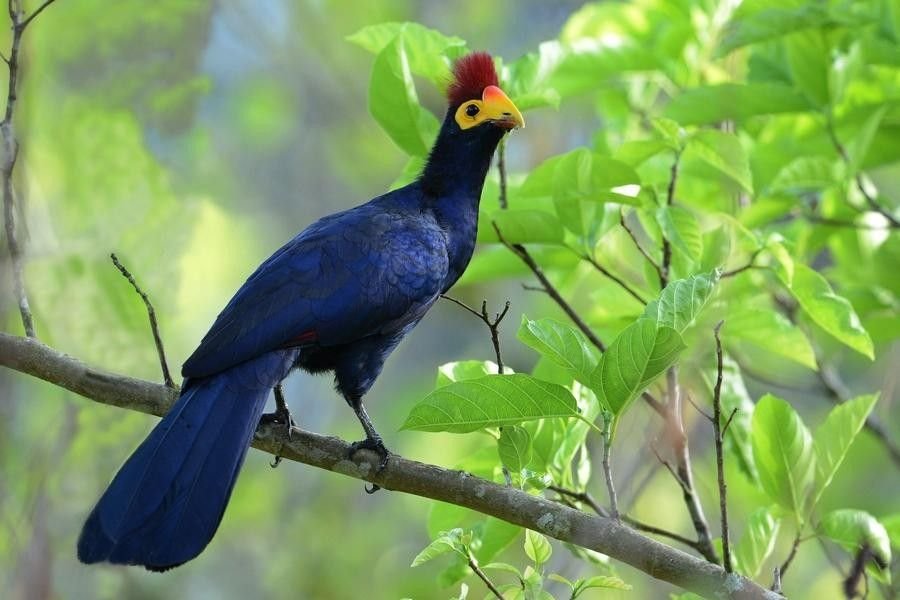
Ross's Turaco in Tanzania
Tauraco rossae — also Lady Ross's TuracoWhat Is Ross's Turaco?
Ross's Turaco (Tauraco rossae), also known as Lady Ross's Turaco, is a striking violet-blue African forest bird recognized by its bright red crest, yellow bill and red flight feathers.
A canopy specialist of gallery forest and riverine woodland, it lives largely among mature trees and dense foliage, feeding mainly on fruit and moving in small, noisy social flocks outside the breeding season. In Tanzania its documented range centres on northwestern Tanzania, including the Bukoba / Kagera landscape.
Scientific Classification
How to Identify Ross's Turaco
- Violet-blue to purplish body — the dominant colour of the plumage.
- Bright red crest on the crown, conspicuous at close range.
- Yellow bill with a broad yellow facial shield and yellow bare skin around the eye.
- Red flight feathers — particularly striking when the bird flies, flashing crimson against the violet-blue body.
- Long tail and strong, branch-gripping feet adapted for moving through the canopy.
- No strong sexual dimorphism — males and females look very similar.
Why Is Ross's Turaco So Colorful?
Turacos are famous for two unusual copper-based pigments rarely found elsewhere in birds:
- Turacin — a copper-containing red pigment responsible for the vivid red flight feathers and crest. It can even wash out with water — a unique property among bird pigments.
- Turacoverdin — a related green pigment found in many turacos, though Ross's Turaco itself is predominantly violet-blue/purple with bright red and yellow features, not entirely green.
These pigments help explain why turacos display such saturated reds and greens compared with most birds, whose colours rely more on structure and carotenoids.
Ross's Turaco Courtship and Pair Bonding
- Pair interactions and male feeding female.
- Joint nest building by the pair.
- Vocal displays and pair-bonding behaviour.
Generic dominance-ritual language is not used.
Male vs Female
Male and female Ross's Turacos are very similar externally and show little obvious sexual dimorphism. No claim is made that one sex is much larger, longer, or differently coloured, nor that roles are strongly sex-divided, without a direct source.
Habitat: Forest and Riverine Woodland
Ross's Turaco is a forest and woodland bird — not an open-water specialist:
- Gallery forest and riverine woodland along rivers and lush corridors.
- Primary and secondary forest and forest edge.
- Lush woodland with mature, fruiting trees and dense canopy.
River-associated forests matter because they provide mature trees, dense canopy cover and a reliable fruit supply — not because the bird depends on open water for feeding. Reliable water is not presented as an essential feeding requirement.
Global Distribution
Ross's Turaco has a Central African distribution extending through parts of the Democratic Republic of Congo, South Sudan, Zambia, Tanzania and Angola, with additional isolated populations elsewhere. It is not uniformly abundant across that entire range, and it is not correctly described as "found primarily in Uganda" with Tanzania as secondary, nor are Kibale and Budongo key Tanzania destinations.
For this Tanzania-focused page, global context is kept brief — detail is on the Tanzanian range below.
Ross's Turaco in Tanzania
In Tanzania, Ross's Turaco is documented in northwestern Tanzania, including the Bukoba / Kagera forest and woodland landscape. Tanzania Birds and regional checklists record the species in this corner of the country, where gallery forest and riverine woodland provide suitable habitat.
Ross's Turaco is not widespread throughout Tanzania and is not claimed here for the Serengeti, Tarangire, Ngorongoro or Mikumi without current species-specific evidence. Geographical precision matters more than a long park list.
Where to See Ross's Turaco in Tanzania
Bukoba / Kagera Landscape
Country: Tanzania | Region: Northwestern Tanzania
Gallery forest and riverine woodland with mature fruiting trees — the documented Tanzanian range for Ross's Turaco.
Specialist birding opportunity
Northwestern Tanzania Forest Belt
Country: Tanzania | Type: Forest & riverine woodland
Primary/secondary forest and lush woodland corridors that hold fruiting trees — specialist forest birding territory.
Specialist birding opportunity
Specialist sighting — best pursued in suitable forest and riverine woodland with an experienced birding guide. Sightings are never guaranteed and depend on fruiting trees, weather and local conditions.
Birding Methods
- Specialist birdwatching and forest birding with a local guide.
- Guided nature walks where permitted along forest edges and riverine corridors.
- Wildlife photography from forest-edge vantage points.
- Forest-edge observation — listening for calls and watching fruiting trees.
- Game drives only where appropriate to the actual site.
Best Time to See Them
Ross's Turaco can occur year-round in suitable forest and woodland habitat. Local visibility depends on fruiting trees, weather, vegetation, birding conditions and guide knowledge. No universal Tanzania-wide June–October calendar is imposed.
Ross's Turaco in Pictures
A closer look at the Ross's Turaco in its natural East African habitat — its striking appearance, habitat and behaviour are best appreciated up close.
Where to Spot the Ross's Turaco on Safari
Plan your trip around the destinations and safaris where the Ross's Turaco is easiest to see. Explore the parks, itineraries and tour packages by destination below.
What Does Ross's Turaco Eat?
Ross's Turaco is primarily frugivorous:
Primary Foods
- Fruits
- Figs
- Berries
- Flowers
- Seeds
Supplementary Foods
- Termites
- Snails
- Insects
- Other small prey taken opportunistically
Fruit consumption dominates; animal foods supplement rather than define the diet. Water is not described as essential for feeding.
Why Are Ross's Turacos Important to Forests?
By feeding on fruits and moving between trees, Ross's Turacos can transport seeds and contribute to forest regeneration and plant dispersal. No unsupported quantitative claim is made about how many seeds a single bird disperses — the role is described carefully as an ecological contribution.
How Does Ross's Turaco Feed in the Canopy?
- Moves through branches — hopping and climbing through vegetation rather than perch-and-pounce hunting.
- Selects fruit directly from trees, including figs and berries.
- May visit fruiting trees outside its normal local feeding area when food is abundant.
- May forage in small groups, especially outside the breeding season.
There is no plunge diving or fish-catching — this is canopy frugivory.
Breeding, Nesting, Eggs and Chicks
Ross's Turaco is a monogamous, egg-laying bird — no gestation, birth or parental feeding:
- Monogamous breeding pairs that build the nest together.
- Nest: a twig platform built in a tree canopy within leafy forest/woodland.
- Eggs: usually 2.
- Incubation: both parents incubate for approximately 21–24 days.
- Chicks remain in the nest and are dependent on parents; young can move and climb through branches before mastering full flight.
- Fledging at approximately 4–7 weeks after hatching.
Where Does Ross's Turaco Nest?
In the tree canopy — a twig platform built by the pair in leafy forest or woodland, located above ground. An exact nest height is not invented without a source.
What Are Ross's Turaco Chicks Like?
- Chicks remain dependent in the nest and are fed by both parents.
- Young can move and climb through branches before fully mastering flight.
- Fledging at approximately 4–7 weeks after hatching.
- Adult plumage develops gradually; full adult coloration can take about a year according to zoological sources.
No mammal language — no newborn walking, single baby or parental feeding.
Predators and Threats
Lions, leopards and hyenas are not relevant predators for this canopy bird and are not listed here.
Potential nest and young threats where source-supported:
- Snakes and arboreal predators.
- Larger predatory birds and other nest predators.
Human and ecological threats:
- Deforestation and forest fragmentation.
- Loss of mature nesting and fruiting trees.
- Agricultural conversion and habitat degradation.
- Trapping and capture where locally documented.
Because the global status is Least Concern, threats are described without exaggeration.
Conservation Status: Least Concern
IUCN Red List Status: Least Concern (LC). Ross's Turaco has a broad Central African range, and its current global assessment reflects that breadth.
Locally, forest populations can still be affected by habitat loss and fragmentation, including clearance of mature trees and conversion of woodland. The status is therefore not a reason to ignore habitat pressures.
Effective measures are habitat measures: forest protection, riverine woodland conservation, habitat connectivity, mature-tree retention, responsible bird tourism and anti-trapping measures where relevant. No claim is made here that African Parks, WWF and TAWIRI jointly monitor Ross's Turaco without direct, current, species-specific evidence.
Ross's Turaco Facts
Ross's Turaco vs Violet Turaco
| Feature | Ross's Turaco | Violet Turaco |
|---|---|---|
| Scientific name | Tauraco rossae | Tauraco violaceus |
| Plumage | Violet-blue/purple with red crest | Violet with yellow/red facial features |
| Crest | Bright red | Reddish |
| Habitat | Gallery forest, riverine woodland | Woodland, savanna edge |
| Range in Tanzania | Northwestern (Bukoba/Kagera) | More western/central Africa |
Ross's Turaco vs Great Blue Turaco
| Feature | Ross's Turaco | Great Blue Turaco |
|---|---|---|
| Scientific name | Tauraco rossae | Corythaeola cristata |
| Size | Up to ~54 cm | Largest turaco, up to ~75 cm |
| Plumage | Violet-blue/purple, red crest | Blue-grey with yellow/black bill |
| Social | Small noisy flocks ~30 | Larger bands, very vocal |
Ross's Turaco vs White-crested Turaco
| Feature | Ross's Turaco | White-crested Turaco |
|---|---|---|
| Scientific name | Tauraco rossae | Tauraco leucolophus |
| Crest | Red | White |
| Facial shield | Yellow | Yellow/black |
| Habitat | Riverine/gallery forest | Forest edge, woodland |
Why Ross's Turaco Matters to Forest Ecosystems
- Fruit consumption and seed movement support dispersal and regeneration of forest trees.
- Canopy biodiversity: as a frugivore it links fruiting trees to the broader food web.
- Forest connectivity indicator: where mature riverine forests remain intact, turacos persist.
- Birdwatching value: a colourful, sought-after specialist that rewards patient forest birding.
Photographing Ross's Turaco
- Red crest and yellow bill/facial shield against violet-blue body — the identification trio.
- Red flight feathers flashing in flight.
- Fruit feeding and pair interactions in the canopy.
- Social flock perched among foliage and flight between fruiting trees.
- Canopy habitat context — forest and riverine woodland.
Forest strategy: patience, listen for loud cackling calls, watch fruiting trees, use gaps in foliage, use a fast shutter speed for flight. Never chase or disturb birds; keep to trails and follow your guide.
Frequently Asked Questions
Ross's Turaco (Tauraco rossae), also called Lady Ross's Turaco, is a striking violet-blue African forest bird with a bright red crest, yellow bill and vivid red flight feathers. It lives in gallery forest and riverine woodland and is known for small, noisy social flocks.
The current scientific name is Tauraco rossae.
Musophaga rossae is a historical combination. Current classifications commonly use Tauraco rossae — the two names refer to the same species.
A Central African distribution extending through parts of DRC, South Sudan, Zambia, Tanzania and Angola, with additional isolated populations, centred on gallery forest, riverine woodland and primary/secondary forest.
Documented in northwestern Tanzania, including the Bukoba / Kagera landscape where gallery forest and riverine woodland provide suitable habitat. It is not widespread throughout Tanzania and is not reliably claimed for Serengeti, Tarangire or Ngorongoro.
Gallery forest, riverine woodland, primary and secondary forest, forest edge and lush woodland with mature fruiting trees and dense canopy. Riverine forests are important for trees and food, not for open water.
Primarily fruits, figs, berries, flowers and seeds, supplemented by termites, snails, insects and other small prey.
Yes. Figs are among the favoured fruits, along with other fruits, berries, flowers and seeds.
Yes. Outside breeding they may occur in small noisy flocks, sometimes around 30 individuals. During breeding they form monogamous pairs.
Loud cackling, rolling and trilling calls, often given as group choruses. Vocal interactions are important for territory and courtship — there is no scent communication.
No. Males and females are very similar externally and show little obvious sexual dimorphism.
In the tree canopy — a twig platform built by the pair in leafy forest or woodland, located above ground.
Usually 2 eggs per clutch.
Approximately 21–24 days, with both parents incubating.
Approximately 4–7 weeks before fledging. Young can move and climb through branches before mastering full flight.
Yes. Young can climb and move through branches before they are strong fliers, with adult plumage developing gradually — full coloration can take about a year.
By feeding on fruits and moving between trees it can transport seeds, contributing to forest regeneration, plant dispersal and canopy biodiversity.
No. It is assessed as Least Concern (LC) globally due to its broad range, though local forest populations can be affected by habitat loss.
Deforestation, forest fragmentation, loss of mature nesting/fruiting trees, agricultural conversion, habitat degradation and trapping/capture where locally documented.
Year-round in suitable forest and woodland habitat. Local visibility depends on fruiting trees, weather, vegetation, birding conditions and guide knowledge — no single national season is imposed. Specialist forest birding with an experienced guide is recommended, and sightings are never guaranteed.
Related Safari Packages & Tours
Book a safari to see the Ross's Turaco and the rest of Africa's incredible wildlife with our expert guides.
References & Further Reading
- Avibase / BirdLife: Tauraco rossae — Musophagidae, Musophagiformes; taxonomy and synonym Musophaga rossae.
- Tanzania Birds: Bukoba / Kagera and northwestern Tanzania records.
- IUCN Red List / BirdLife: Ross's Turaco — Least Concern.
- Ornithological literature: gallery forest / riverine woodland, frugivorous diet, 2 eggs, 21–24 d incubation, 4–7 week fledging and pigment turacin / turacoverdin.
- About these facts: measurements and timings are approximate ranges that vary with population, method and season.
Sightings are never guaranteed and depend on local conditions.

Ross's Turaco Social Life and Flock Behavior
Ross's Turacos are social outside breeding and monogamous during breeding:
No dominance interactions, experienced-adults-make-all-decisions, bachelor groups, generic group defense or mammal-style family hierarchy is described.
Calls and Communication