

.png)
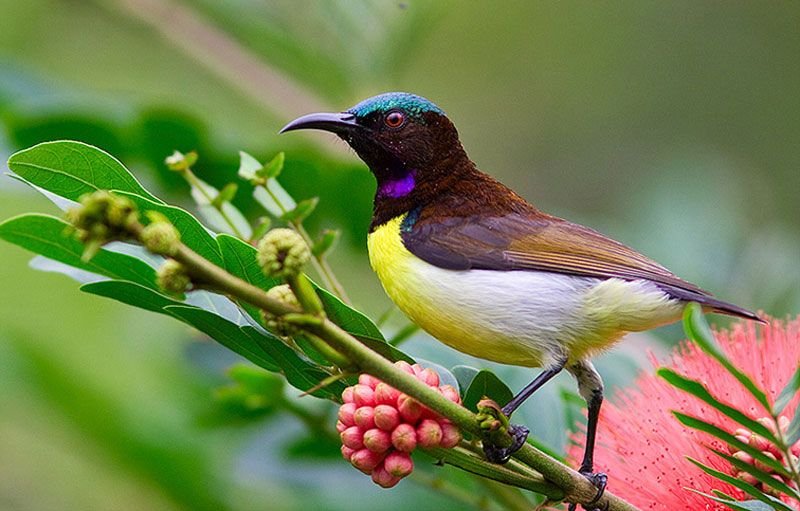
Sunbirds in Tanzania
Family Nectariniidae — 151 species in 16 genera (AviList v2025b)What Are Sunbirds?
Sunbirds are a diverse family of small Old World passerine birds in Nectariniidae — not a single species.
They feed on nectar and insects using a slender curved bill and brush-tipped tongue, with many males showing brilliant iridescent plumage. In Tanzania, sunbird diversity is exceptional — from widespread savanna species to highly localized Eastern Arc and island endemics such as Moreau's, Loveridge's and Pemba Sunbirds.
Sunbird Taxonomy: Nectariniidae and Passeriformes
Correct use: Nectariniidae is the family, not a genus or species. There is no single species called "Nectariniidae." Current AviList v2025b places Nectariniidae within Passeriformes — not Pelecaniformes, and Aves is the class, not the family.
How Many Sunbird Species Are There?
According to AviList v2025b, the family Nectariniidae comprises 151 species in 16 genera. Tanzania supports numerous species, but not all 151 occur in Tanzania — diversity varies by habitat, elevation and geography.
Are Sunbirds Important Pollinators?
Yes, in a targeted way. Some African flowering plants benefit from sunbird pollination — sunbirds can transfer pollen between flowers while feeding on nectar. They do not pollinate all African plants.
Are Sunbirds Hummingbirds?
No. They are not closely related; the resemblance reflects convergent adaptation for nectar feeding:
| Feature | Sunbird (Nectariniidae) | Hummingbird (Trochilidae) |
|---|---|---|
| Distribution | Africa, Asia | Americas |
| Order | Passeriformes | Apodiformes |
| Feeding | Mostly perching, brief hovering | Sustained hovering |
| Tongue | Brush-tipped | Grooved, piston-like |
How Do Sunbirds Fly?
Sunbirds are agile fliers that make rapid, direct short flights between feeding stations. Some species hover briefly at flowers, but many feed while perched. No single universal family speed is imposed — the earlier "" generic figure is removed.
Natural Threats
Large predators are not a primary threat to adults. Potential threats to eggs, chicks and adults may include snakes, raptors, nest predators and small mammalian predators — only named when supported for an individual species.
Male vs Female: Key Differences
Like many African species, the Sunbird shows some differences between the sexes. Here's a quick comparison:
| Characteristic | Male | Female |
|---|---|---|
| Weight | Typically larger and heavier | Generally smaller and lighter |
| Size | Often slightly longer | Usually slightly shorter |
| Appearance | More pronounced features | More streamlined build |
| Role | Competes for territory and mates | Core of family groups and care |
| Behaviour | May roam singly or in bachelor groups | Often found with young and relatives |
| Lifespan | 8-10 yrs | 8-10 yrs (often slightly longer) |
Fun Fact: Males of the species can reach weights of around 5-10 g — an impressive sight in the wild.
Daily Behaviour and Movement
Sunbirds are generally diurnal — feeding, defending feeding territories, visiting flowers, hunting insects, preening, displaying and interacting with mates. No diurnal label or rigid hourly timetable is used.
Social Behavior
Varies by species. Many are territorial or pair-based; some occur in loose groups around abundant food. No generic group-living, leadership or bachelor-group template.
Communication
- Song, calls, territorial displays, wing displays and courtship.
- No scent communication.
Movement
Varies by species. Some are resident; others make local or seasonal movements related to flowering, rainfall or elevation. No universal migration claim.
Sunbird Habitats in Tanzania
- Montane forest, forest edge, woodland, savanna, shrubland and gardens.
- Cultivated landscapes, riverine vegetation, coastal forest, island forest, high-elevation scrub and forest/grassland ecotones.
No single "woodland" label defines all sunbirds. Water availability can influence local conditions, but nectar, insects, vegetation structure and nesting habitat are more universal factors than reliable water.
Where Are Sunbirds Found in Tanzania?
Distribution is species-specific, varying by elevation, habitat, geography, flowering plants, forest type and island location. Not all sunbirds occur throughout Tanzania — each species has its own range.
Sunbirds of Northern Tanzania
Potential contexts include Kilimanjaro, Tarangire and Serengeti where individual species checklists support it, plus Ngorongoro, montane forests and gardens. No claim is made that every sunbird is a Serengeti bird.
Sunbirds of Tanzania's Eastern Arc Mountains
The Eastern Arc Mountains hold highly localized montane species across:
- Usambara, Udzungwa, Uluguru, Nguru, Ukaguru, Rubeho and Uvidunda.
Habitats include montane forest, forest edge, high-elevation scrub and forest/grassland ecotones with high endemism. A species is assigned to a specific range only when supported.
Moreau's Sunbird (Cinnyris moreaui)
Endemic — Tanzania Birds marks it as endemic. Research associates it with the southern Eastern Arc including Nguru, Ukaguru, Rubeho and Uvidunda. Not a widespread Tanzania bird.
Loveridge's Sunbird (Cinnyris loveridgei)
Endemic — Tanzania Birds marks it as endemic. Not given a broad national distribution.
Rufous-winged Sunbird (Cinnyris rufipennis)
Endemic — Tanzania Birds marks it as endemic. Only verified locations are used.
Sunbirds of Zanzibar and Pemba
Pemba Sunbird (Cinnyris pembae) is endemic — Tanzania Birds marks it as endemic — and is the focus of Pemba Island specialist birdwatching with island endemism. Other verified island species are included, but Zanzibar mainland distributions are not mixed.
Tanzania's Sunbird Species Directory
Anthreptes orientalis
Savanna/woodland — widespread
Hedydipna collaris
Forest, woodland, gardens
Cyanomitra olivacea
Forest
Chalcomitra amethystina
Woodland, savanna, gardens
Chalcomitra senegalensis
Savanna, woodland
Nectarinia kilimensis
Montane, Kilimanjaro
Cinnyris mediocris
Highlands, Eastern Arc
Cinnyris pulchellus
Savanna
Cinnyris mariquensis
Savanna, shrubland
Cinnyris nectarinioides
Riverine, arid savanna
Cinnyris tsavoensis
Arid savanna
Cinnyris venustus
Widespread — gardens, savanna
Cinnyris fuelleborni
Montane forest
Cinnyris moreaui — Endemic
Southern Eastern Arc (Nguru, Ukaguru, Rubeho, Uvidunda)
Cinnyris loveridgei — Endemic
Eastern Arc
Cinnyris pembae — Endemic
Pemba Island
Cinnyris rufipennis — Endemic
Montane forest
Cinnyris superbus
Forest, woodland
Cinnyris oustaleti
Miombo woodland
Cinnyris talatala
Miombo, savanna
Best Places to See Sunbirds in Tanzania
Eastern Arc Mountains
Type: Montane forest & forest edge
Usambara, Udzungwa, Uluguru, Nguru, Rubeho, Ukaguru — endemic and high-elevation specialists. Species-specific, habitat-dependent.
Mount Kilimanjaro
Type: Montane & gardens
Montane forest and cultivated foothill gardens — Often encountered in suitable habitat.
Usambara Mountains
Type: Montane forest
Forest edge and scrub — Eastern Arc diversity.
Udzungwa Mountains
Type: Montane forest
High-elevation scrub and forest/grassland ecotones.
Pemba Island
Type: Island forest
Pemba Sunbird endemic — Specialist sighting.
Serengeti / Tarangire
Type: Savanna & woodland
Only for species confirmed by local bird lists — e.g., Variable, Beautiful, Scarlet-chested where verified.
Sighting language: species-specific and habitat-dependent. No High Sightings guarantee. For widespread species: "Often encountered in suitable habitat." For restricted species: "Specialist sighting."
Best Months
Sunbird visibility varies with flowering cycles, rainfall, elevation, habitat and species. The earlier June–October family-wide season is removed. Species-specific seasonal information is given only when sourced.
Birdwatching Activities
- Specialist birdwatching, forest birding, garden birding, nature walks where permitted, montane birding and wildlife photography.
- Game drives only where appropriate — birdwatching is primary.
Sunbird in Pictures
A closer look at the Sunbird in its natural East African habitat — its striking appearance, habitat and behaviour are best appreciated up close.
Where to Spot the Sunbird on Safari
Plan your trip around the destinations and safaris where the Sunbird is easiest to see. Explore the parks, itineraries and tour packages by destination below.
What Do Sunbirds Eat?
Sunbirds are best known for nectar, but their diet is broader:
- Primary: nectar from tubular flowers.
- Essential supplement: insects, insect larvae, spiders and other small arthropods.
Animal prey becomes especially important during breeding and chick feeding, when protein demand rises. Not every sunbird is a strict nectarivore.
How Are Sunbirds Adapted to Feed on Nectar?
- Slender curved bill that probes tubular flowers.
- Brush-tipped tongue that efficiently extracts nectar.
- Most species perch while feeding; some species can hover briefly, though not constantly — they are not hummingbirds.
Sunbird Breeding and Nesting
Sunbirds are egg-laying birds and breeding biology varies considerably by species:
- Many build hanging, pouch-like woven or fibrous nests attached to branches or vegetation.
- Females commonly participate heavily in nest construction and incubation, but parental roles vary.
- Clutch size, incubation and fledging periods must be species-specific if stated — no universal number is imposed on the whole family.
No gestation, birth, parental feeding, single young or twin births.
What Do Sunbird Nests Look Like?
Nests show variation — hanging, pouch-like, woven/fibrous structures attached to branches or vegetation. Not every sunbird uses the same nest type.
How Do Sunbirds Feed Their Chicks?
Adults provide insects and other protein-rich animal prey. No parental feeding.
Sunbird Conservation in Tanzania
Conservation is species-specific — no single family-wide status is imposed. Priorities include forest protection, Eastern Arc conservation, habitat connectivity, montane and island habitat, flowering-plant diversity, forest-edge management, agricultural expansion and settlement pressure. Generic anti-poaching language is not the primary strategy.
Why the Eastern Arc Mountains Matter
Research shows restricted range, montane specialization, forest/grassland ecotone, high endemism and agricultural/settlement pressure. The Tanzania population of Cinnyris whytei is mentioned only where appropriate as restricted to Rubeho/Udzungwa highlands above approximately 1700 m in the cited study — not generalized to all sunbirds.
Sunbird Facts
How to Tell Common Tanzanian Sunbirds Apart
| Feature | Variable Sunbird | Eastern Double-collared |
|---|---|---|
| Male | Green head, maroon chest, yellow belly | Green, wide red band, grey belly |
| Female | Olive above, yellow below | Dull olive |
| Habitat | Widespread, gardens | Highlands/Eastern Arc |
Sunbird vs Weaver
| Feature | Sunbird | Weaver |
|---|---|---|
| Family | Nectariniidae | Ploceidae |
| Bill | Slender curved for nectar | Conical for seeds |
| Feeding | Nectar + insects | Seeds + insects |
Sunbird vs Flowerpecker
| Feature | Sunbird | Flowerpecker |
|---|---|---|
| Size | Small, slender | Tiny, stubby |
| Bill | Curved, brush-tipped tongue | Short, pointed |
Why Sunbirds Matter to Tanzania's Ecosystems
- Pollination of African flowering plants while feeding on nectar.
- Insect predation helping control small arthropods.
- Plant reproduction through pollen transfer.
- Montane biodiversity and island endemism — especially Eastern Arc and Pemba.
- Birdwatching value as colourful, active garden and forest birds.
Photographing Sunbirds
- Male iridescent plumage and flower feeding / hovering.
- Territorial displays, female plumage, forest-edge and mountain habitat.
- Nest and chick feeding — never disturb nests.
- Pemba endemic species on Pemba Island.
Use macro/telephoto depending on species and situation.
Frequently Asked Questions
Sunbirds are a diverse family of small Old World passerine birds in Nectariniidae, known for nectar feeding with curved bills and brush-tipped tongues and, in many species, bright iridescent male plumage.
Nectariniidae.
Passeriformes.
According to AviList v2025b, the family Nectariniidae comprises 151 species in 16 genera.
Nectar plus insects, insect larvae, spiders and other small arthropods; animal prey becomes especially important when feeding chicks.
Yes. Insects and spiders are an important part of the diet and crucial for chick growth.
Some African flowering plants benefit from sunbird pollination — sunbirds can transfer pollen between flowers while feeding on nectar, but they do not pollinate all plants.
Some species can hover briefly, but most feed while perched; they do not hover constantly like hummingbirds.
No. They are not closely related — similar nectar adaptations reflect convergent evolution. Sunbirds are passerines (Passeriformes), hummingbirds are Apodiformes in the Americas.
Across diverse habitats — montane forest, forest edge, woodland, savanna, shrubland, gardens and island forest — with species distribution varying by elevation, habitat and flowering.
Specialists include Moreau's Sunbird (southern Eastern Arc: Nguru, Ukaguru, Rubeho, Uvidunda), Loveridge's, Rufous-winged and Eastern Double-collared Sunbirds, plus other montane species — each verified to specific ranges.
Moreau's Sunbird (Cinnyris moreaui), an endemic sunbird associated with the southern Eastern Arc Mountains (Nguru, Ukaguru, Rubeho, Uvidunda) — not a widespread Tanzania bird.
Yes. Tanzania Birds marks Moreau's Sunbird as endemic.
Yes. Tanzania Birds marks Loveridge's Sunbird (Cinnyris loveridgei) as endemic.
Pemba Sunbird (Cinnyris pembae) — an endemic sunbird of Pemba Island, a specialist island birdwatching target.
Yes. Pemba Sunbird is endemic to Pemba Island, with other species on the island verified individually.
In many species, males are brighter and iridescent with territorial display roles, while females are duller and more involved in nesting; dimorphism varies by species.
Often hanging, pouch-like woven/fibrous nests attached to branches or vegetation, though nest type varies by species.
Movement varies by species — some are resident, others make local or seasonal movements related to flowering, rainfall or elevation; no universal migration claim.
No. Conservation status varies by species and is not assigned family-wide; some restricted-range Tanzanian species face significant habitat pressures while many widespread species are not globally threatened.
Specialist birdwatching, forest and garden birding, nature walks where permitted, montane birding and photography — with Eastern Arc and island birding for endemics and garden/forest edge for widespread species.
Visibility varies with flowering cycles, rainfall, elevation, habitat and species; no universal June–October family season is imposed. Local flowering and mountain conditions are key.
Related Safari Packages & Tours
Book a safari to see the Sunbird and the rest of Africa's incredible wildlife with our expert guides.
References & Further Reading
- AviList v2025b: Nectariniidae — 151 species in 16 genera, Passeriformes.
- Tanzania Birds: Checklist including Moreau's, Loveridge's, Pemba and Rufous-winged endemics and Eastern Arc records.
- Eastern Arc research: montane specialization, forest/grassland ecotone, endemism above ~1700 m (Cinnyris whytei study).
- BirdLife / IUCN: species-specific conservation — not family-wide.
- About these facts: Counts and ecology follow current sources; species assignments are source-verified.
Sightings are never guaranteed and depend on local conditions.