

.png)
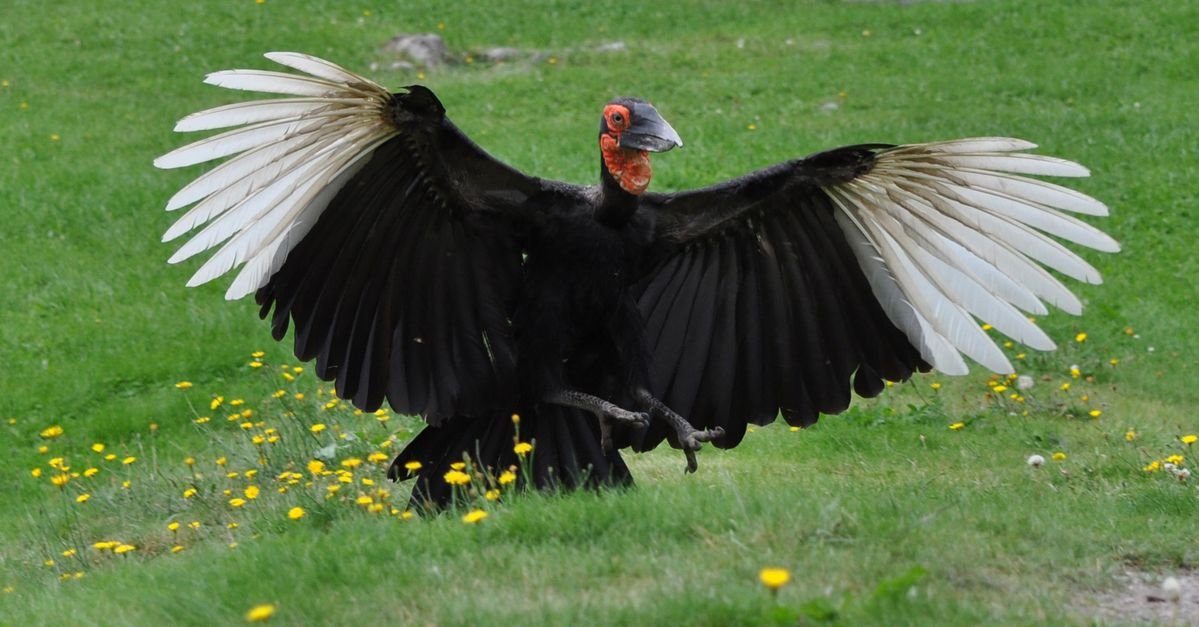
Abyssinian Ground Hornbill
Bucorvus abyssinicusA huge, ground-dwelling hornbill of Africa's dry savannas, known for its booming calls and powerful terrestrial hunting style.
The Abyssinian Ground Hornbill (Bucorvus abyssinicus), also called the Northern Ground Hornbill, is a large terrestrial hornbill found north of the equator. It forages mainly on foot through dry grassland and savanna, taking insects, reptiles and other small animals, while pairs and family groups can remain in territories for years.
Abyssinian Ground Hornbill Quick Facts
What Is the Abyssinian Ground Hornbill?
The Abyssinian Ground Hornbill (Bucorvus abyssinicus) is one of Africa's two ground-hornbills and one of the largest members of the hornbill radiation. It is strongly adapted to life on the ground, where it walks long distances while searching for animal prey in dry grassland, savanna and scrub.
It is also called the Northern Ground Hornbill because its range lies mainly north of the equator, extending from West Africa eastward through the Sahel and Horn of Africa into Uganda and northern Kenya. Modern references place it in the genus Bucorvus; the species is recognized as valid in current taxonomic databases.
Unlike the more forest-associated hornbills, this species spends much of the day on foot. Its size, black plumage, white primary feathers, huge casque and vividly colored bare throat skin make it one of the most distinctive large birds of open African country.
How to Identify a Abyssinian Ground Hornbill
The Abyssinian Ground Hornbill is unmistakable once its combination of size, posture and facial skin is learned.
- Size: A very large hornbill, about 90–100 cm long.
- Plumage: Predominantly black, with white primary feathers that stand out in flight.
- Bill and casque: A huge dark bill topped by a prominent open-fronted casque.
- Face: Bare blue skin surrounds the eye; the male has red on the inflatable throat pouch while females are predominantly blue.
- Eyes: Immatures begin with dull grey eyes that become yellow as they mature.
- Legs: Strong legs and broad feet suited to extensive walking and terrestrial foraging.
Distinguishing from the Southern Ground Hornbill
The Northern Ground Hornbill is separated from the Southern Ground Hornbill primarily by range and facial coloration. Bucorvus abyssinicus occurs north of the equator, while Bucorvus leadbeateri occupies much of eastern and southern Africa. Where their distributions approach one another in East Africa, careful attention to range and the colors of the bare throat and facial skin is important.
Behavior & Social Life
Abyssinian Ground Hornbills live in pairs or small family groups and can spend most of the day walking slowly through open country while searching for prey. They are vocal, territorial birds whose deep booming calls can carry across open savanna.
Daily Activity
- Foraging: Most feeding is terrestrial, with birds walking, pausing, probing and pouncing on prey in grass and bare ground.
- Movement: They prefer to run or walk when disturbed and fly mainly to travel across obstacles, escape danger or defend territory.
- Vocalization: Deep booming calls are used in territorial and pair communication and may continue for long periods.
Migration
The species is generally sedentary within its home range rather than a long-distance migrant. Juveniles may remain with their parents for several years, while females can occasionally shift between groups.
Habitat & Distribution
The Abyssinian Ground Hornbill is characteristic of open, relatively dry landscapes where visibility is high and ground prey are abundant.
- Dry savanna and open woodland with a grassy understory.
- Sub-desert grassland and scrub with scattered trees.
- Hilly or rocky country, including highland landscapes in Ethiopia.
- Burned or grazed areas where insects and other small animals become easier to detect.
Distribution: The species occurs in Africa north of the equator, from western and north-central Africa east to Ethiopia, north-western Somalia, Uganda and northern Kenya.
Tanzania Distribution
The Abyssinian Ground Hornbill is not a regular Tanzanian species. Its range is centered north of the equator, and Tanzania is instead associated with the Southern Ground Hornbill (Bucorvus leadbeateri). The page therefore does not assign Tanzanian safari localities to Bucorvus abyssinicus.
Abyssinian Ground Hornbill in East Africa
For travelers specifically seeking the Abyssinian Ground Hornbill, the most reliable opportunities are north of Tanzania in its established range. These locations are presented as regional birding options rather than Tanzanian sightings.
Murchison Falls National Park, Uganda
Documented recent records include pairs and a single male in the park's northern sector, providing a strong East African opportunity.
Regional birdingNorthern Kenya
The species reaches northern Kenya, where dry grasslands and open savanna form part of its East African range.
Species recordsEthiopian Highlands
In Ethiopia the species can occur in open habitats at substantial elevations, including dry highland landscapes.
Regional birdingUganda Savanna
Ugandan protected areas support habitat for the species where open grassland and scattered woodland persist.
Birding recordsSafari Methods
- Game drives through open savanna where terrestrial foraging birds can be watched from a distance.
- Birdwatching – scan grassy plains and roadside verges for large birds walking in family groups.
- Wildlife photography – early morning light is excellent for facial colors, bill structure and plumage contrast.
Best Time to See Them
Because the species is generally resident, visibility depends more on habitat conditions, local prey activity and access than on long-distance migration. Cooler morning hours can be especially productive for watching birds begin active foraging.
Diet & Feeding
The Abyssinian Ground Hornbill is an active terrestrial predator. It walks slowly through grassland and savanna, watching the ground closely before pouncing on prey.
Food Sources
- Insects: Beetles, larvae and other large arthropods.
- Spiders: Taken while searching through grass and leaf litter.
- Reptiles: Lizards and small snakes, with larger prey handled using the massive bill.
- Other vertebrates: Small mammals, amphibians, young birds and even small tortoises can be taken.
- Other foods: Carrion, fallen fruit and seeds may supplement the largely animal-based diet.
Hunting Behavior
Ground hornbills often exploit disturbed feeding opportunities, including places affected by grazing, fire or moving mammals. The long legs provide a high vantage point while the powerful bill helps seize and subdue difficult prey.
Breeding & Life Cycle
The Abyssinian Ground Hornbill has an unusually slow reproductive strategy for a bird that invests heavily in each young. Pairs defend breeding territories and use cavities, tree stumps, rock clefts or other suitable sites, lining the nest with dry vegetation.
Nesting
- Nest: A cavity or sheltered opening is lined with leaves and debris; unlike many hornbills, the female is not completely sealed in.
- Eggs: Usually 1–2 white eggs laid a few days apart.
- Incubation: About 37–41 days, beginning with the first egg.
Chicks
The first chick normally gains a major developmental advantage over the second. The male provides food during incubation and early chick-rearing, and the surviving young generally remains in the nest for about 80–90 days before fledging.
Conservation Status
The Abyssinian Ground Hornbill is currently treated as Vulnerable in the IUCN Hornbill Specialist Group's assessment, reflecting pressures associated with habitat degradation and hunting across parts of its range.
Its slow breeding rate makes the species particularly sensitive to the loss of established breeding territories. Pairs can occupy large home ranges, so fragmentation of dry grassland and savanna can remove the space needed to maintain viable family groups.
Key local threats include habitat conversion, pressure from hunting in parts of the range, and the broader loss of suitable open country. Conserving connected savanna, protecting large nesting structures and reducing direct persecution are important measures.
Comparisons
The Abyssinian Ground Hornbill is best compared with the other ground hornbill, especially where East African ranges meet.
| Feature | Abyssinian Ground Hornbill | Southern Ground Hornbill | Trumpeter Hornbill |
|---|---|---|---|
| Size | 90–100 cm | 90–130 cm | 50–65 cm |
| Range | Africa north of the equator | Eastern & southern Africa | Central & eastern African forests |
| Facial skin | Blue around eye; male red throat | Red facial/throat skin; female blue throat patch | Red facial skin around a mostly black-and-white head |
| Habitat | Dry savanna and grassland | Open savanna and grassland | Forest and woodland |
| Diet | Mostly animal prey | Mostly animal prey | Fruit, insects and small animals |
| Breeding | Slow, low-output breeding | Cooperative breeding system | Cavity nesting hornbill |
Did You Know?
Ground Specialist
Unlike most hornbills, it spends most of its active day walking and hunting on the ground.
Powerful Casque
The huge open-fronted casque and massive bill are defining features of this giant hornbill.
Blue & Red
Adult males combine blue facial skin with a red inflatable throat pouch, while females are mainly blue.
Booming Voice
Deep, far-carrying calls help pairs communicate across open landscapes.
Slow Breeder
A pair may raise only one surviving chick from a clutch of up to two eggs, making each young bird valuable.
Long Family Life
Young birds can remain with their parents for several years before fully leaving the family range.
There is something extraordinary about watching a ground hornbill stride across open savanna. The Abyssinian Ground Hornbill combines the presence of a large terrestrial predator with the unmistakable architecture of a hornbill—an enormous bill, towering legs, bright facial skin and a voice that seems to roll across the landscape. It is a reminder that Africa's great bird diversity is not confined to the treetops.
Gallery
Frequently Asked Questions
The Abyssinian Ground Hornbill (Bucorvus abyssinicus) is a very large terrestrial hornbill of dry savanna and grassland, also known as the Northern Ground Hornbill.
The species is distributed north of the equator, with strong opportunities in parts of Uganda, northern Kenya and Ethiopia. It is not a regular Tanzanian safari species.
It mainly eats animal prey, including beetles, larvae, spiders, lizards, small vertebrates and other ground-dwelling prey, with occasional fruit, seeds or carrion.
It is currently assessed as Vulnerable in the IUCN Hornbill Specialist Group reference used for this page.
Look for a huge black ground hornbill with white primaries, a large dark casque, blue facial skin and a brightly colored inflatable throat pouch.
No regular Tanzanian distribution is assigned to this species. Tanzania is associated with the Southern Ground Hornbill, Bucorvus leadbeateri, while the Abyssinian Ground Hornbill is centered north of the equator.
Pairs nest in cavities or sheltered sites and usually lay one or two eggs. Incubation lasts about 37–41 days, and the young may remain in the nest for roughly 80–90 days.
Because it spends most of its active time walking and hunting on the ground rather than living primarily in the canopy like many other hornbills.
References & Further Reading
- IUCN Hornbill Specialist Group – Northern Ground Hornbill: distribution, identification, ecology and Vulnerable status.
- ITIS / IOC taxonomy – Bucorvus abyssinicus and the common names Abyssinian Ground Hornbill and Northern Ground Hornbill.
- Smithsonian's National Zoo – Abyssinian Ground Hornbill behavior, conservation and life history.
- Birds of the World – detailed account of feeding, breeding, longevity and distribution.
- Recent eBird / Macaulay records – documented East African observations including Murchison Falls National Park, Uganda.
- African hornbill conservation literature – habitat change, hunting pressure and slow reproductive output.
- Avibase / AviList 2025 – current cross-checking of the scientific name and common-name treatments.