

.png)
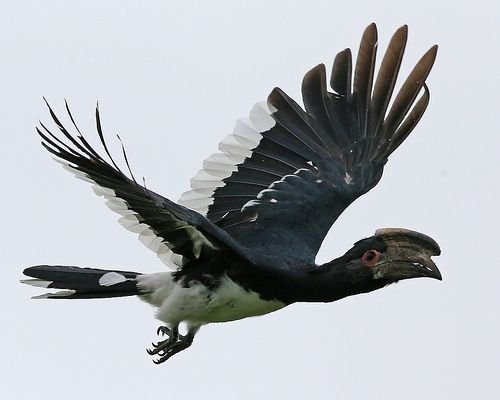
Trumpeter Hornbill
Bycanistes bucinatorA bold black-and-white forest hornbill with a huge casque, loud calls and a fruit-rich diet.
The Trumpeter Hornbill (Bycanistes bucinator) is a medium-sized African hornbill with glossy black plumage, a white belly and wing markings, red facial skin and a prominent dark casque. It is found in wooded habitats and is documented from several Tanzanian forests and woodlands.
Trumpeter Hornbill Quick Facts
What Is the Trumpeter Hornbill?
The Trumpeter Hornbill (Bycanistes bucinator) is a striking member of the hornbill family Bucerotidae, recognized by its glossy black plumage, white belly and wing markings, red facial skin and prominent dark casque.
The species was described by Coenraad Jacob Temminck in 1824. Modern taxonomies use Bycanistes bucinator, although older literature may place it in Ceratogymna.
Across eastern and south-central Africa it occupies wooded habitats. In Tanzania it is documented from Rubondo Island, Lake Duluti, Mahale National Park and Suledo Forest Reserve.
How to Identify a Trumpeter Hornbill
The Trumpeter Hornbill is a boldly patterned, medium-sized hornbill. The combination of glossy black plumage, bright white lower body and wing markings, red facial skin and a large dark casque is highly distinctive.
- Large dark casque, especially developed in males.
- Glossy black head, back and breast with a white belly, rump and wing markings.
- Red to pinkish-red bare skin around the eyes.
- Heavy dark bill integrated with the large casque; females have smaller casques.
- Broad wings with conspicuous white areas in flight.
- Dark, relatively long tail that completes the black-and-white silhouette.
Distinguishing from Other Hornbills
Among Tanzania’s large hornbills it can resemble the Silvery-cheeked Hornbill, but the Trumpeter Hornbill is distinguished by its darker overall plumage, cleaner white belly and conspicuous dark casque.
Behavior & Social Life
Trumpeter Hornbills are social birds, often seen in pairs or small groups and sometimes gathering in larger feeding flocks where fruit is abundant. Their loud calls can carry through dense forest.
Daily Activity
- Moves through the canopy searching for figs and other fruits, while also taking large insects.
- Pairs and family groups keep contact through calls and short flights between feeding trees.
- Loud nasal calls can reveal a group before the birds are visible.
Migration
The species is essentially resident where suitable habitat persists, although local movements can follow fruiting trees and changing food availability.
Habitat & Distribution
The Trumpeter Hornbill is associated with mature wooded habitats where tall trees provide fruit and suitable nesting cavities.
- Evergreen and riverine forest.
- Woodland and wooded savanna near fruiting trees.
- Forest edges and secondary woodland with mature trees.
- Island, lowland and montane forest habitats in suitable areas.
In Tanzania, documented records show it in forest and woodland landscapes from the Lake Victoria region to eastern and western forest blocks.
Tanzania Distribution
In Tanzania, the Trumpeter Hornbill is found in most national parks and game reserves, including Serengeti, Ngorongoro, Tarangire, and Ruaha .
Trumpeter Hornbill in Tanzania
Documented Tanzanian localities include:
Rubondo Island National Park
Recorded on Rubondo Island, where forest and fruiting trees provide suitable habitat.
Rubondo birdingLake Duluti
Pairs have been photographed feeding in fig trees around Lake Duluti near Arusha.
Lake birdingMahale National Park
Documented in the forested landscapes of Mahale on Lake Tanganyika.
Mahale birdingSafari Methods
- Guided forest birding walks.
- Quiet observation around mature fruiting trees.
- Photography from stable viewpoints near feeding trees.
Best Time to See Them
Trumpeter Hornbills are resident in suitable habitat and may be encountered year-round. Early morning is especially useful for listening for their loud calls and locating feeding groups.
Diet & Feeding
The Trumpeter Hornbill is primarily a fruit-eating hornbill, with figs and other fruits forming a major part of its diet. Large insects provide additional protein.
Food Sources
- Fruits and figs are major foods.
- Large insects such as beetles and caterpillars are taken opportunistically.
- Other small animal prey may occasionally supplement the diet.
- Feeding activity can concentrate around productive fruiting trees.
Feeding Behaviour
Most feeding occurs in trees. Birds work through branches and foliage, plucking fruit and moving between feeding trees as local resources change.
Breeding & Life Cycle
The Trumpeter Hornbill uses the classic hornbill cavity-nesting system: the female seals herself inside a tree cavity while the male supplies food through the narrowed entrance.
Nesting
- Nest: Natural tree cavity partly sealed with mud and other material.
- Eggs: Usually 4–5 white eggs.
- Incubation: About 24 days, with the female remaining in the cavity while the male feeds her.
Chicks
After hatching, the female and young remain in the cavity for an extended period. Chicks may stay for roughly seven to eight weeks before fledging while the male continues to supply food.
Conservation Status
The Trumpeter Hornbill is currently assessed globally as Least Concern. Its broad range means it is not presently close to the thresholds for a threatened category.
Local populations can still be affected by loss of mature woodland, removal of large nesting trees and fragmentation of fruiting habitat.
Conservation benefits include retaining old cavity-bearing trees, protecting connected forest and woodland and maintaining diverse native fruiting trees.
- Habitat loss from forest clearance and agricultural expansion.
- Loss of large old trees that provide nesting cavities.
Comparisons
The Trumpeter Hornbill is best compared with other large African hornbills using casque size, facial skin, belly pattern and overall plumage.
| Feature | Trumpeter Hornbill | Silvery-cheeked Hornbill | Crowned Hornbill |
|---|---|---|---|
| Size | 50–65 cm | 58–65 cm | 45–50 cm |
| Casque | Large, dark | Large, pale/grey | Smaller |
| Plumage | Black with white belly | Dark with silvery cheeks | Black-and-white |
| Face | Red facial skin | Blue/pinkish facial skin | Pale facial skin |
| Habitat | Forest and woodland | Forest and montane woodland | Woodland and forest edge |
| Diet | Fruit, figs, insects | Fruit and insects | Fruit and small animals |
Did You Know?
Big Casque
The male has a particularly large dark casque; females have smaller casques.
Fruit Specialist
Figs and other fruits are important foods, and groups gather where fruit is abundant.
Loud Voice
Its nasal calls can carry through dense forest and help birders locate feeding groups.
Cavity Nesting
The female seals herself into a tree cavity while the male supplies food through the entrance.
Tanzania Records
Rubondo, Lake Duluti, Mahale and Suledo are among documented Tanzanian localities.
Black-and-White
White belly and wing markings stand out sharply against the glossy black body.
The Trumpeter Hornbill is a forest bird that often reveals itself by sound before sight. A loud nasal call, white wing flashes between trees and the sudden appearance of a heavy dark casque can transform a quiet woodland walk into a memorable birding moment. Its dependence on large fruiting trees and natural cavities also links its story closely to the health of mature forest.
Gallery
Frequently Asked Questions
The Trumpeter Hornbill (Bycanistes bucinator) is a medium-sized African hornbill recognized by its black-and-white plumage, red facial skin and prominent dark casque.
Documented Tanzanian localities include Rubondo Island, Lake Duluti, Mahale National Park and Suledo Forest Reserve.
It feeds mainly on fruit, especially figs, and also takes large insects and occasional animal prey.
No. The species is currently assessed as Least Concern globally.
Look for glossy black plumage, a white belly and wing markings, red facial skin and a large dark casque.
The female seals herself inside a tree cavity during incubation while the male brings food through the entrance.
Young can remain in the nest for roughly seven to eight weeks before fledging.
It is resident in suitable habitat, although local movements can follow fruiting trees and food availability.
References & Further Reading
- Tanzanian Birds & Butterflies – Trumpeter Hornbill species page: Tanzania records, identification and photographs.
- Tanzania Bird Checklist – National checklist entry for Trumpeter Hornbill, Bycanistes bucinator.
- IUCN Hornbill Specialist Group – Trumpeter Hornbill profile: range, identification, measurements and global Least Concern status.
- BirdGuides / IOC – Trumpeter Hornbill taxonomy and species details.
- African Bird Club – Documented Trumpeter Hornbill record from the East Usambaras, Tanzania.
- Natural History Museum of Denmark – Current taxonomic record for Bycanistes bucinator and Red List information.
- Zootierliste – Reference data for body length, body mass and Least Concern status.