

.png)
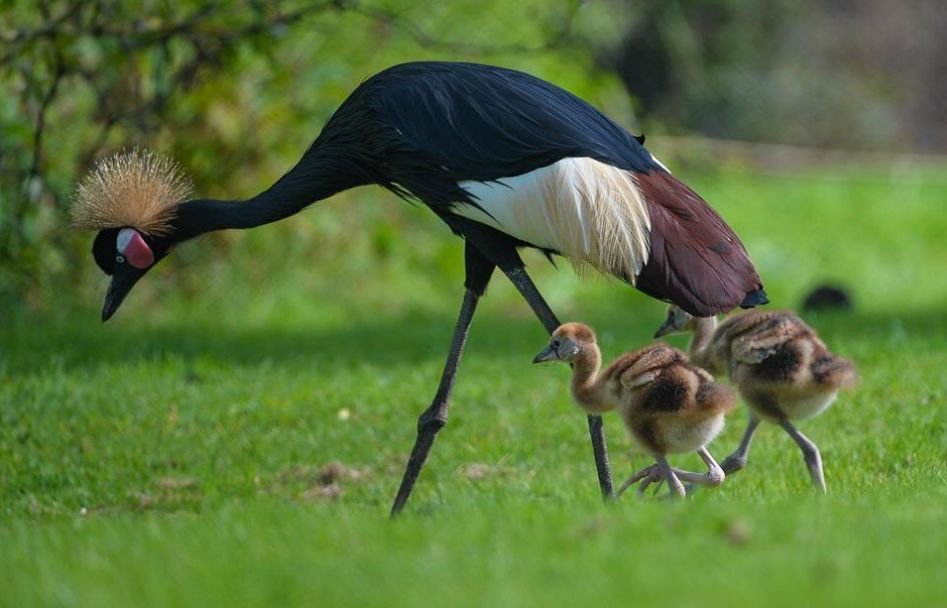
Black Crowned Crane
Balearica pavoninaA striking crowned crane of African wetlands, recognized by its golden crown and rhythmic courtship displays.
The Black Crowned Crane (Balearica pavonina) is a large crane in the family Gruidae. It occupies shallow wetlands, floodplains, grasslands and wet savannas across West and parts of East Africa. Its stiff golden crown, black-and-white facial pattern and red throat pouch make it unmistakable. Unlike Tanzania's familiar Grey Crowned Crane, the Black Crowned Crane is not a regular resident of Tanzania and should not be presented as a normal Tanzanian safari species.
Black Crowned Crane Quick Facts
What Is the Black Crowned Crane?
The Black Crowned Crane (<em>Balearica pavonina</em>) is one of Africa's two crowned crane species and belongs to the crane family Gruidae. It is a tall, elegant bird with long legs, a dark grey-to-black body, white wing panels and a remarkable fan of stiff golden crown feathers.
The species occurs mainly in the Sahel and Sudanian savanna belts of Africa, using shallow wetlands as feeding, roosting and breeding habitat while also moving into adjacent grasslands and cultivated landscapes.
One of its most important geographic facts for a Tanzania-focused wildlife guide is what it is not: it is not a regular Tanzanian crane. Tanzania's well-known crowned crane is the Grey Crowned Crane (<em>Balearica regulorum</em>). Keeping these species separate prevents a common safari identification error.
How to Identify a Black Crowned Crane
The golden crown immediately attracts attention, but the safest identification uses the whole head-and-body pattern. Black Crowned Cranes have a darker overall appearance than Grey Crowned Cranes and a comparatively smaller white cheek area.
- Crown: dense, stiff golden bristles forming the characteristic crown.
- Head: black cap with white cheek panels and red facial skin.
- Throat: a conspicuous red gular pouch hangs below the chin.
- Body: dark slate-grey to black with white wing panels and chestnut-toned feathers toward the rear.
- Legs: long and dark, adapted for walking through grassland and shallow wetlands.
- Hind toe: the long hind toe enables crowned cranes to perch in trees, unusual among cranes.
Distinguishing from the Grey Crowned Crane
The two crowned cranes are close relatives and can be confused. Black Crowned Crane generally has a much darker neck and body, a larger dark facial area and a smaller white cheek patch. Grey Crowned Crane is the familiar crowned crane of Kenya, Uganda and Tanzania and has a much more extensively pale-grey neck and a more prominent white cheek patch.
Behavior & Social Life
Black Crowned Cranes are social birds and may occur in pairs, family groups or larger flocks. Their social behavior is especially conspicuous during courtship, when partners perform coordinated displays.
Daily Activity
- Foraging: walks through grassland and shallow wetlands while picking food from the ground.
- Roosting: may use shallow water and wetland edges for security, while crowned cranes can also perch in trees.
- Social display: pairs and groups use calls, wing movements, bows, jumps and dancing behavior.
Movement & Seasonal Behavior
The species can make seasonal or short-distance movements, and IUCN movement classifications recognize crowned cranes as capable of migratory movements over parts of their range. Rainfall and water availability strongly influence where feeding and breeding conditions become favorable.
Habitat & Distribution
Black Crowned Cranes occupy open landscapes associated with water: shallow wetlands, marshes, floodplains, wet grasslands, lake margins and seasonal pans. They may also feed in drier grasslands and agricultural mosaics when food is available.
- Seasonal wetlands that fill during the rainy season and provide invertebrates and aquatic food.
- Floodplains and marshes with tall grasses and sedges for feeding and nesting.
- Sahelian and Sudanian savanna where wetland patches are embedded within open grassland.
- Cropland edges that can provide seeds and disturbed feeding areas near wetlands.
The species' range stretches from the Senegal and Gambia region across the Sahel to the Chad Basin and eastward toward South Sudan, Ethiopia and parts of northern Kenya. Avibase places the species' eastern range far to the north of Tanzania, with the Black Crowned Crane reaching only the far northern East African fringe.
Tanzania Distribution: An Important Correction
Black Crowned Crane is <strong>not a regular resident of Tanzania</strong>. CITES documentation specifically notes that Black Crowned Cranes are not resident in Tanzania and that supposed Tanzanian trade records may have resulted from imports or misidentification of the Grey Crowned Crane. For Tanzania safari content, the correct species to feature is Grey Crowned Crane (<em>Balearica regulorum</em>).
Black Crowned Crane: Where to See It
Because the Black Crowned Crane is not a regular Tanzanian species, this section deliberately does not invent Tanzanian parks where it can be reliably viewed. For authentic Black Crowned Crane encounters, birders should plan in its established West and northeastern African range.
Birding Methods
The western part of the species' range contains important wetland and floodplain habitats, including areas associated with the Senegal and Gambia systems.
Plan West Africa birdingBest Time to See Them
Timing depends strongly on local rainfall and wetland productivity. In seasonal Sahelian landscapes, birds can shift their distribution as wetlands fill and dry. A local guide who knows current water conditions is more valuable than relying on one fixed calendar.
Explore specialist birdingSudan & Ethiopia
The eastern form reaches Sudan, Ethiopia and neighboring areas, with seasonal wetland and savanna habitats supporting the species.
Plan East African birdingNorthern Kenya Fringe
Avibase places the species' eastern range as far south as far northern Kenya. This is substantially north of Tanzania's normal Grey Crowned Crane range.
Talk to a birding specialistSafari Methods
- Scan shallow wetlands: look for pairs and family groups feeding along wetland edges.
- Use the crown as a first clue: the golden crown is highly visible at distance, but confirm the darker body and face pattern.
- Watch behavior: courtship dancing, wing displays and loud calls can reveal groups even before the birds are close.
Best Time to See Them
Black Crowned Cranes are present year-round in suitable habitat. They are most active during the cooler morning and evening hours .
Diet & Feeding
Black Crowned Cranes are omnivores. Their diet combines plant material and animal prey, allowing them to exploit both wetlands and surrounding grasslands.
Food Sources
- Seeds and grains: important plant foods in grasslands and cultivated landscapes.
- Young shoots and grasses: taken while foraging on open ground and wetland edges.
- Insects and other invertebrates: including grasshoppers, molluscs and other small animals.
- Amphibians and reptiles: frogs and small reptiles are opportunistically eaten.
Foraging Behavior
The species walks slowly through grass and wetland margins, pecking at edible items and probing vegetation. It often forages in open country near wetlands, switching between seeds and small animal prey according to seasonal availability.
Breeding & Life Cycle
Breeding is closely associated with wetland conditions and rainfall. Pairs establish breeding territories within or beside dense wetland vegetation, where the nest can be concealed from predators.
Nesting
- Nest: a large platform or mound of reeds, grasses and other vegetation built directly on the ground, often within dense wetland growth.
- Eggs: usually 2-3 greenish-blue eggs.
- Incubation: about 29-30 days in published summaries, with both parents involved.
Chicks
Young are precocial compared with nestling songbirds: they can leave the nest area soon after hatching and follow their parents while feeding. Published summaries place fledging at around 63 days, although development depends on food, weather and habitat.
Conservation Status
Black Crowned Crane is currently classified as <strong>Vulnerable (VU)</strong> on the IUCN Red List. The species has experienced substantial decline and remains exposed to continuing habitat and exploitation pressures.
The conservation picture is especially important in seasonal wetlands, where breeding and feeding sites can disappear when water regimes are altered or wetlands are converted. International conservation assessments identify multiple pressures across the range.
Major conservation pressures include:
- Wetland drainage and conversion: destruction of seasonal wetlands for agriculture removes breeding and feeding habitat.
- Overgrazing and altered fire regimes: can degrade wet grassland and reduce suitable vegetation.
Comparisons
The most important comparison for an Africa-focused wildlife page is the difference between Black Crowned Crane and Grey Crowned Crane. They are sister species with similar crowns, but their ranges and appearance are different.
| Feature | Black Crowned Crane | Grey Crowned Crane | Best Tanzania clue |
|---|---|---|---|
| Scientific name | Balearica pavonina | Balearica regulorum | Tanzania's regular crowned crane is B. regulorum |
| Main range | West & northeastern Africa | East & southern Africa | Tanzania = Grey Crowned Crane |
| Neck/body | Darker slate-grey to black | More extensively grey | Black Crowned appears darker |
| Cheek pattern | Smaller white cheek area with red facial patch | Larger white cheek patch | White cheek pattern is useful |
| Habitat | Wetlands, floodplains, savanna | Wetlands, grassland & savanna | Both use seasonal wetlands |
| Status | Vulnerable | Endangered in current southern African assessment; regional status varies | Do not substitute one species for the other |
Did You Know?
The Crown Is Real
The golden crown consists of stiff, bristle-like feathers that give crowned cranes their extraordinary profile.
A Tree-Perching Crane
Crowned cranes are unusual among cranes because their long hind toe allows them to perch in trees.
Omnivorous
Black Crowned Cranes eat plant material as well as insects, molluscs, amphibians and small reptiles.
Wetland Breeder
Pairs build nests on the ground in dense wetland vegetation, usually laying two or three eggs.
Vulnerable
Black Crowned Crane is currently assessed as Vulnerable, reflecting substantial population pressure across its range.
Not Tanzania's Crane
The crowned crane normally associated with Tanzania is the Grey Crowned Crane, Balearica regulorum—not the Black Crowned Crane.
Two crowned cranes can look astonishingly similar in a photograph, yet their maps tell a completely different story. The Black Crowned Crane belongs primarily to the Sahelian and Sudanian belt, while Tanzania's iconic crowned crane is the Grey Crowned Crane. That distinction matters: accurate birding is not only about recognizing a bird's face—it is about understanding the landscape and range that belong to it.
Gallery
Frequently Asked Questions
The scientific name is Balearica pavonina, a crane in the family Gruidae.
It occurs mainly across the Sahel and Sudanian savanna belt, from West Africa eastward toward Sudan, Ethiopia and the northern East African fringe.
It is not a regular resident of Tanzania. CITES documentation specifically warns that supposed Tanzanian Black Crowned Crane records may represent imported birds or misidentified Grey Crowned Cranes.
The crowned crane normally associated with Tanzania is the Grey Crowned Crane, Balearica regulorum.
It is omnivorous, eating seeds, grasses, young shoots, insects, molluscs, amphibians, reptiles and other small prey.
It nests on the ground in dense wetland vegetation and commonly lays two or three greenish-blue eggs. Incubation is about a month.
Black Crowned Crane is generally darker, with a smaller white cheek area and a West/Central-to-northeastern African range; Grey Crowned Crane is the East and southern African species.
The species is currently assessed as Vulnerable.
References & Further Reading
- UNEP-AEWA species page – Balearica pavonina: current Vulnerable assessment, taxonomy and documented geographic range.
- Avibase – Balearica pavonina: current BirdLife/Clements taxonomy and mapped geographic range; distinguishes Black and Grey Crowned Cranes.
- CITES – Black Crowned Crane conservation/trade information: documentation noting that Black Crowned Cranes are not resident in Tanzania and discussing misidentification/trade concerns.
- Wetlands International East Africa: Black Crowned Crane status survey and conservation action planning for its wetland habitats.
- Oiseaux.net – Black Crowned Crane: diet, breeding, incubation, fledging and threats, with literature references.
- BirdLife / international crane conservation literature: regional population and habitat-conservation context.
- iNaturalist – Black Crowned Crane observation records from Tanzania .