

.png)
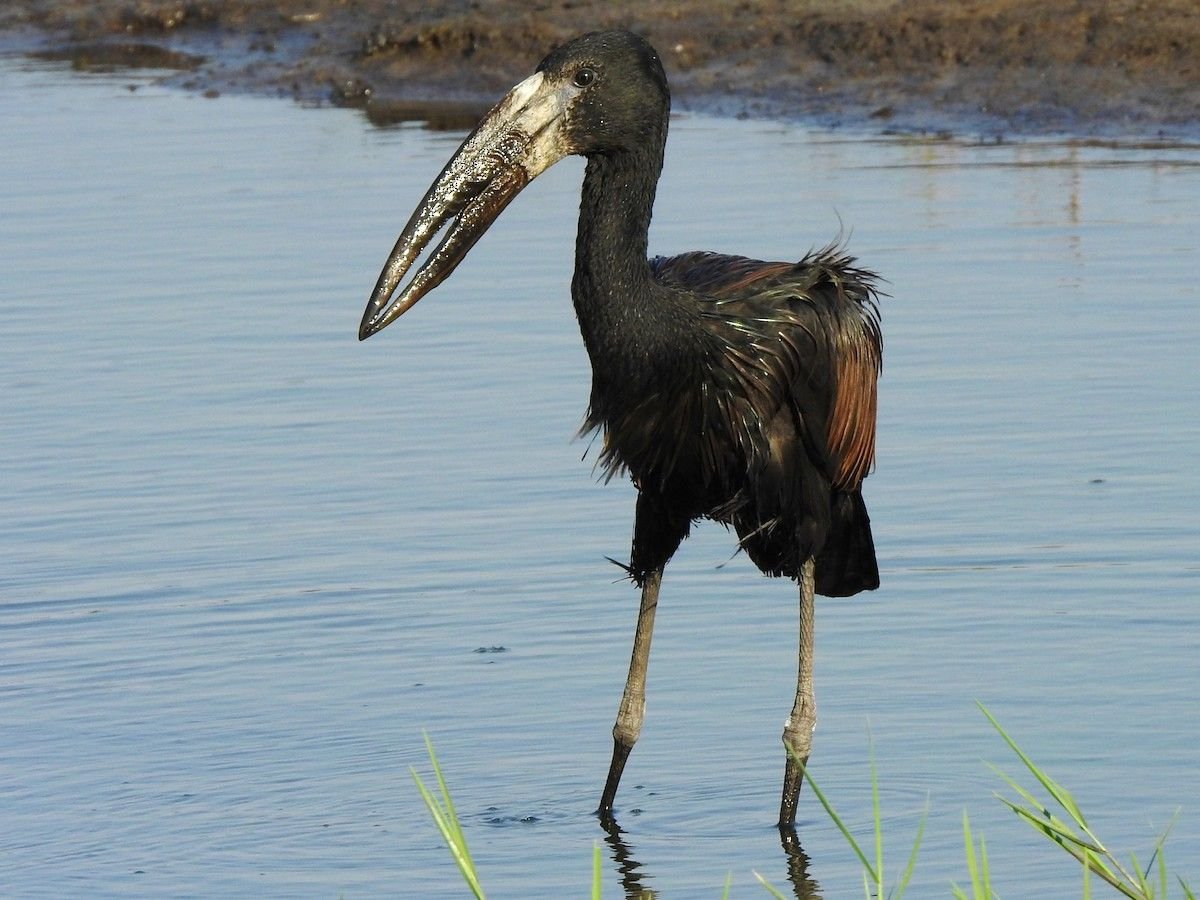
African Openbill
Anastomus lamelligerusA distinctive African stork with a remarkable bill built for opening freshwater snails.
The African Openbill (Anastomus lamelligerus) is a medium-sized stork of the family Ciconiidae. Its most extraordinary feature is the deep gap between the mandibles, a specialized structure that helps it handle and remove freshwater snails and mussels from their shells. Across Africa it occupies shallow lakes, swamps, floodplains and seasonal wetlands, and in Tanzania it can gather in impressive feeding flocks.
African Openbill Quick Facts
The African Openbill is a specialist rather than a generalist stork. Its bill shape is one of the clearest examples in African birdlife of form following function: the unusual opening between the mandibles is closely associated with its method of extracting molluscs from hard shells.
What Is the African Openbill?
The African Openbill is a medium-sized stork specialized for feeding in shallow freshwater environments. Its plumage is predominantly dark, often showing a greenish, bronze or purplish sheen in strong light, while the long legs and neck give it the elegant silhouette typical of storks.
What makes it exceptional is the bill. Unlike a conventional straight stork bill that closes along much of its length, the mandibles of the African Openbill leave a conspicuous gap. The tips curve toward one another, forming a tool remarkably well suited to handling the shells and opercula of freshwater molluscs.
In wetland ecosystems this specialization allows African Openbills to exploit prey that many other waterbirds cannot access as efficiently. When snails become abundant, dozens or hundreds of birds may gather and feed intensively across the same shallow-water landscape.
How to Identify an African Openbill
At a distance, the African Openbill can look like an all-dark stork or even a dark heron. The most reliable identification feature is the bill, followed by body shape, leg length and habitat.
- Bill: long, heavy and visibly open between the upper and lower mandibles for much of its length; the curved tips meet more closely than the middle portion.
- Plumage: predominantly dark brown-black, often with glossy green, bronze or purplish reflections.
- Head and neck: relatively plain and dark, with the long neck giving the bird a classic stork profile.
- Legs: long and adapted for wading through shallow water and soft wet ground.
- Flight: the neck is extended, unlike a heron, and the long legs trail behind the body.
- Juveniles: less glossy and browner overall, with a less strongly developed adult appearance.
When binoculars are available, the unusual bill silhouette should be your first confirmation. Once you notice the gap, the species becomes much easier to recognize.
Behavior & Social Life
African Openbills are highly social in many parts of their range. Small groups are common, while rich wetland feeding sites can attract much larger concentrations. They may stand quietly in shallow water, walk methodically across mudflats, or move through vegetation while searching for molluscs.
Feeding is often deliberate rather than frantic. A bird probes or manipulates a shell with its specialized bill, then uses the curved tip and bill mechanics to separate the prey from the shell. The process looks simple from a distance but reflects a highly specialized feeding system refined over evolutionary time.
The species can also move in response to rainfall. Where temporary wetlands fill and snail populations increase, birds may appear suddenly in places where they were scarce only weeks earlier. In this way, local abundance can change dramatically with hydrological conditions.
Habitat & Distribution
African Openbills are closely associated with shallow freshwater environments and seasonally inundated landscapes. Preferred habitats include marshes, swamps, flooded grasslands, floodplains, shallow lakes, pans, river margins and other wet areas with abundant aquatic molluscs.
The species is broadly distributed across sub-Saharan Africa and also occurs in western Madagascar. Its continental range is patchy rather than uniform because the birds depend strongly on suitable wetlands and on the availability of their principal prey.
Water depth matters. African Openbills are most useful to look for where water is shallow enough for wading and where soft mud, aquatic vegetation and exposed feeding surfaces make snails accessible.
Rainfall Shapes Local Abundance
Although the species can be resident in some areas, it is also described as nomadic or migratory where seasonal rainfall changes wetland conditions. In practical safari terms, this means a productive wetland one year or one season may support far more openbills when hydrological conditions are favorable.
African Openbill in Tanzania
Tanzania is an excellent country for encountering African Openbills because it contains an extensive network of lakes, swamps, floodplains and seasonal wetlands. Tanzanian bird records include the species from multiple regions, including northern, central and western parts of the country.
Tarangire National Park
Documented records from the Tarangire area make its seasonal waterholes, river system and surrounding wetlands worthwhile places to scan for feeding openbills.
Tarangire safariKatavi Landscape
Tanzanian bird records include the African Openbill in the Katavi region, where floodplains and seasonal wetlands create suitable snail-rich feeding habitat.
Explore KataviMkomazi National Park
The species has been photographed and recorded in Mkomazi, adding a northeastern Tanzania option for wetland-focused birding.
Explore MkomaziLake Victoria & Rubondo
Modern Tanzania photographic records from Rubondo Island and the Lake Victoria region demonstrate the species' strong association with productive inland waters.
Plan a birding safariHow to Find Them
- Check shallow water: especially the edges of lakes, marshes and seasonal pans.
- Scan exposed mud: recently receding water can reveal concentrated feeding opportunities.
- Look for flocks: large groups are easier to detect than single birds and may indicate a rich snail bed.
- Watch the bill: feeding behavior is often the best confirmation once the bird is identified by silhouette.
Diet & Feeding
The African Openbill is famous for its specialization on aquatic molluscs. Freshwater snails and mussels are major food items, and the species' bill is particularly suited to handling these hard-shelled prey.
- Freshwater snails: a principal food, including large aquatic snails that can be difficult for other predators to open.
- Mussels and other molluscs: taken where available.
- Frogs and tadpoles: opportunistically consumed in wet habitats.
- Fish and other aquatic animals: taken when encountered, especially in shallow water.
- Insects and other invertebrates: provide additional food, particularly when molluscs are less accessible.
The Openbill Feeding Tool
The gap between the mandibles is not a flaw—it is the defining adaptation. The bird uses the curved bill tips to grasp prey and manipulate a shell. Sources describing the species note that the bill's inner edges can help grip and crush prey, while the curved ends are especially useful for extracting molluscs from their shells.
This is an important ecological distinction: the African Openbill is not simply a stork that happens to eat snails. Its anatomy is tightly linked to that food source, allowing it to exploit a specialized niche in African wetlands.
Breeding & Life Cycle
African Openbills commonly breed in colonies, sometimes alongside other colonial waterbirds. Breeding activity is strongly associated with rainy periods because rainfall improves wetland productivity and can increase the availability of the snails and other prey needed by adults and chicks.
Nests are typically substantial stick structures placed in trees, often above or close to wetlands. Colonial nesting provides opportunities for many pairs to exploit the same productive landscape while also creating a conspicuous concentration of breeding birds.
- Breeding strategy: colonial and often linked to suitable wetland conditions.
- Nest: a platform or cup-like structure built largely from sticks and vegetation.
- Clutch: commonly several eggs, with published values varying among sites and populations.
- Incubation and chick-rearing: both parents contribute to the reproductive cycle and young remain dependent on adults until fledging.
- Timing: rainfall is a major ecological cue, so breeding dates vary geographically across Africa.
Because food availability changes with water levels and rainfall, breeding chronology is flexible across the species' enormous range. Local observations should therefore be interpreted in relation to local rainfall rather than a single rigid calendar.
Conservation Status
The African Openbill is currently assessed globally as Least Concern (LC). Its broad African distribution, widespread occurrence and ability to use a range of natural and seasonal wetlands support this global assessment.
That status should not be interpreted as meaning every wetland population is free from pressure. The species depends on aquatic habitats and on prey communities within them, so severe wetland alteration, pollution, drainage or hydrological disruption can reduce local suitability even when the species remains secure at continental scale.
Tanzania's extensive wetland systems are therefore valuable not only for iconic large mammals but also for specialist birds such as the African Openbill. Maintaining healthy seasonal water regimes helps preserve the food web on which these birds depend.
Comparisons with Similar Tanzanian Waterbirds
| Feature | African Openbill | African Openbill | Marabou Stork | Yellow-billed Stork |
|---|---|---|---|---|
| Overall look | Mostly dark, glossy stork | Dark above, white below | Very large, dark and heavy | Mostly white with black flight feathers |
| Bill | Distinctive open gap between mandibles | Long, straight, mostly closed profile | Very large, straight, powerful | Long yellow bill |
| Main food | Snails, mussels and aquatic prey | Mostly insects and other small prey | Carrion plus broad opportunistic prey | Fish, frogs and other wetland prey |
| Habitat clue | Shallow freshwater and marshes | Open grasslands and seasonal wet habitats | Open wetlands, savanna and human-associated areas | Shallow wetlands and lakeshores |
| Best field mark | Open bill with curved tips | Compact black-and-white pattern | Huge size and bare head/neck | Yellow bill and pale body |
The bill is the decisive feature. A distant African Openbill may look like another dark stork, but once the open mandibles are seen, identification becomes straightforward.
Did You Know?
A Bill With a Purpose
The conspicuous gap between the mandibles is a highly specialized feeding adaptation associated with extracting aquatic molluscs.
Snail Specialist
Freshwater snails and mussels form the core of the diet in many areas, making this stork unusually specialized among African waterbirds.
Flocks Can Explode in Size
When wetlands become productive, large concentrations can appear quickly, sometimes giving the impression that the species has suddenly arrived from nowhere.
Rain-Responsive
Movements are often linked to rainfall because rain controls water levels and the availability of aquatic prey.
Both Resident and Nomadic
Different populations show different movement patterns, with some areas supporting resident birds and others seeing strong seasonal movements.
Seen Across Tanzania
Modern records include Tarangire, Katavi, Mkomazi, Rubondo Island and other Tanzanian wetlands.
There is a quiet, watchful presence in the African Openbill. Its long crest is a signature of its species, and its habit of hunting at dusk makes it a special sight on the savanna. As a rodent specialist, it plays a crucial role in the ecosystem, keeping populations in check. Watching one of these eagles perched on a branch, scanning the ground below, is to see a master hunter at work.
Gallery
Frequently Asked Questions
The scientific name is Anastomus lamelligerus, a member of the stork family Ciconiidae.
The name refers to the conspicuous gap between the upper and lower mandibles. The curved bill tips form a specialized tool for handling molluscs.
Its diet is dominated by freshwater snails and other molluscs, with frogs, fish, insects and additional small aquatic prey taken opportunistically.
Tanzanian records include Tarangire, Katavi, Mkomazi, Rubondo Island and other wetland-rich landscapes. Local abundance varies with rainfall and water conditions.
Its movement pattern varies. It can be resident, nomadic or locally migratory, and rainfall-driven movements are an important part of its ecology.
It favors shallow lakes, swamps, seasonal pans, floodplains, marshes and other freshwater habitats where aquatic molluscs are available.
It walks through shallow water or wet ground, grasps snails and similar prey with its specialized bill, and manipulates them so the soft animal can be removed from the shell.
The species is currently assessed globally as Least Concern.
References & Further Reading
- BirdMap Africa / Coordinated Avifaunal Roadcounts: African Openbill species account, movement ecology, habitat and IUCN-linked assessment information.
- Tanzanian Birds & Butterflies: Tanzania occurrence records, habitat observations and photographs from places including Katavi, Mkomazi, Tarangire and the Lake Victoria region.
- eBird / Macaulay Library: species identification and modern occurrence and media records.
- BirdLife International taxonomy resources: global bird taxonomy and conservation framework.
- Oiseaux.net: documented Tanzania photographic records, including Rubondo Island and Tarangire National Park.
- Animal Diversity Web: field documentation illustrating the African Openbill's specialized mollusc-feeding behavior.
Accuracy note: Local abundance and movement can change with rainfall and wetland conditions. This page therefore separates species-wide biology from Tanzania-specific occurrence and avoids treating every Tanzanian population as permanently resident.