

.png)
Woolly-necked Stork
Ciconia episcopusAn elegant black-and-white stork with a distinctive woolly white neck – a graceful forager of Africa's wetlands.
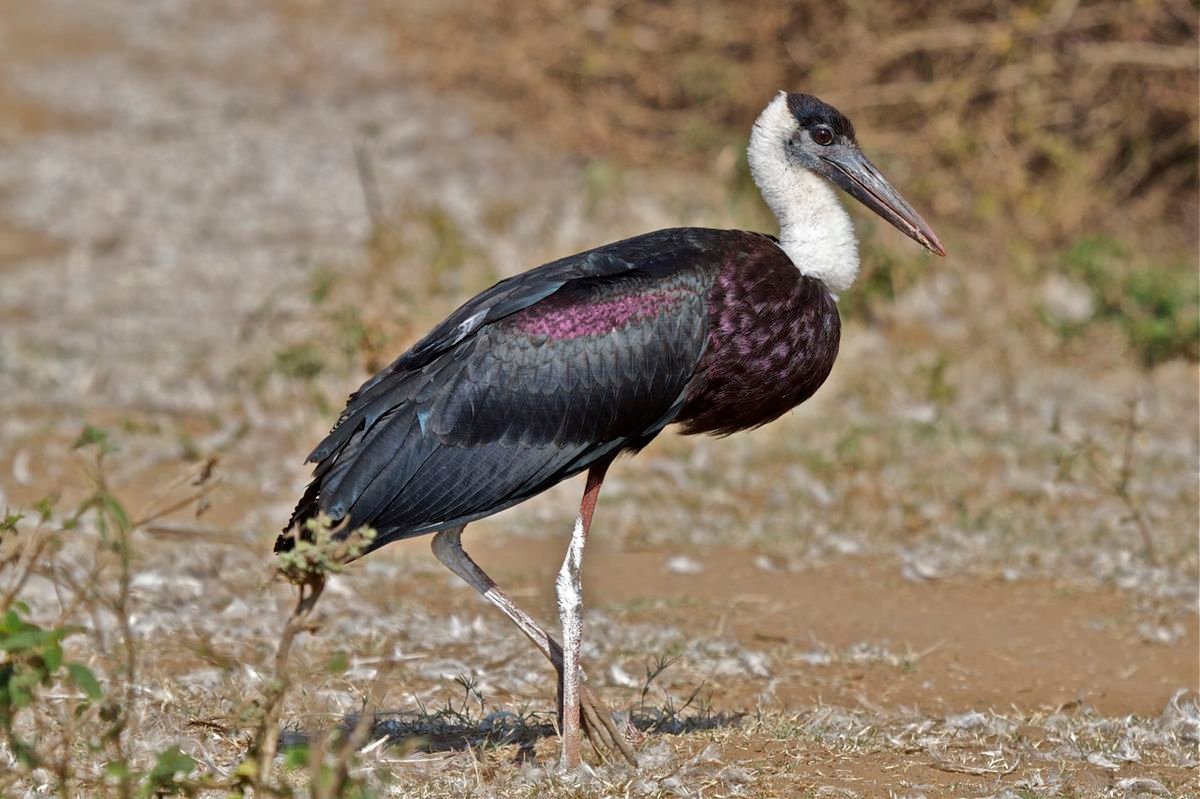
The Woolly-necked Stork (Ciconia episcopus), also known as the Bishop Stork or White-necked Stork, is a medium-sized stork found in sub-Saharan Africa, South Asia, and Southeast Asia. With its striking black body, pure white woolly neck, and a bare red patch on its crown, this elegant bird is a common sight in wetlands and grasslands across Tanzania.
Woolly-necked Stork Quick Facts
What Is the Woolly-necked Stork?
The Woolly-necked Stork (Ciconia episcopus) is a medium-sized stork belonging to the family Ciconiidae. It was first described by the German naturalist Johann Friedrich von Brandt in 1835. The species name episcopus is derived from the Latin word for "bishop", referring to the bird's black and white plumage which resembles the robes of a bishop.
This stork is also known by several common names, including the Bishop Stork (due to its resemblance to a bishop's vestments), the White-necked Stork, and the Episcopus Stork. It is a close relative of the White Stork and Black Stork, sharing many behavioural and ecological characteristics.
The Woolly-necked Stork is a widespread species, found in three distinct regions: sub-Saharan Africa, South Asia (India and Sri Lanka), and Southeast Asia. Three subspecies are generally recognised: C. e. episcopus (African), C. e. neglecta (South Asian), and C. e. microscelis (Southeast Asian). The African subspecies is the most widespread and commonly encountered.
How to Identify a Woolly-necked Stork
The Woolly-necked Stork is a distinctive and elegant bird, easily recognised by its striking black-and-white plumage. Here are its key identifying features:
- Size: A medium-sized stork, measuring 75-92 cm (30-36 in) in length with a wingspan of 150-170 cm (59-67 in).
- Plumage: The body is predominantly black with a greenish-purple iridescent sheen on the back and wings.
- Neck and Head: The head and neck are covered in fluffy, woolly white feathers, giving the bird its common name. The woolly texture of the neck feathers is a key identifying feature.
- Crown: A bare patch of red or orange skin on the crown of the head.
- Bill: A long, thick, dark bill, slightly curved downwards at the tip.
- Legs: Long, dark red or blackish-red legs.
- Tail: Black and relatively short.
Distinguishing from Similar Storks
The Woolly-necked Stork can be confused with the Abdim's Stork and the Black Stork. The Abdim's Stork is smaller and has a more slender bill and a white belly, while the Black Stork is larger, entirely black with a green sheen, and lacks the white neck. The Woolly Stork is also sometimes confused with the Saddle-billed Stork, but that species is much larger with a distinctive yellow and red saddle-shaped bill.
Behavior & Social Life
The Woolly-necked Stork is a solitary or gregarious bird, often seen alone, in pairs, or in small flocks. It is most active during the day, foraging in shallow water or walking through grasslands.
Foraging Behavior
- Foraging method: It forages by walking slowly through shallow water or damp grassland, probing with its bill and picking prey from the surface.
- Food searching: It uses a combination of sight and touch to locate prey, often stirring up the water with its feet to flush out hidden food.
- Social foraging: May forage in loose groups, especially when food is abundant.
Flight
- Flight style: Flies with slow, deep wing beats, neck outstretched, and legs trailing behind.
- Soaring: Often soars on thermals, using rising air currents to gain height.
Vocalization
Woolly-necked Storks are generally silent but may produce a variety of sounds, including hisses, bill-clattering, and guttural croaks, especially at nesting sites.
Habitat & Distribution
The Woolly-necked Stork is found in a variety of wetland and grassland habitats across sub-Saharan Africa and Asia.
Key habitat types include:
- Wetlands and marshes – including freshwater marshes, swamps, and floodplains.
- Rice paddies – agricultural areas that provide excellent foraging opportunities.
- Grasslands and savannas – especially damp grasslands and areas near water.
- Riverbanks and lakeshores – along the edges of rivers and lakes.
- Irrigation channels – man-made water channels.
Distribution: The Woolly-necked Stork has a wide distribution across Africa and Asia. In Africa, it is found throughout sub-Saharan Africa, from Senegambia in the west to Ethiopia and Kenya in the east, and southwards to South Africa. It is generally absent from the most arid regions. The species has an estimated Extent of Occurrence of 18,400,000 km².
Movements: While generally resident, some populations may make local movements in response to rainfall and water availability.
Tanzania Distribution
In Tanzania, the Woolly-necked Stork is found in wetland areas across the country. It has been recorded in Serengeti National Park (particularly in the wetland areas), Ngorongoro Conservation Area, Tarangire National Park, and Ruaha National Park. It is also commonly seen in agricultural areas and rice paddies.
Woolly-necked Stork in Tanzania
The Woolly-necked Stork is an elegant and widespread stork of Tanzania's wetlands and grasslands. Here are the best locations to see it:
Serengeti National Park
Found in the Serengeti's wetland areas, particularly around the Grumeti and Mara rivers and seasonal floodplains. Often seen foraging in shallow water or walking through damp grasslands.
Serengeti safariNgorongoro Crater
Recorded in the Ngorongoro Conservation Area, especially in the swampy areas of the crater floor. Often seen in small groups around the Lerai Forest and Lake Magadi.
Ngorongoro safariTarangire National Park
Found along the Tarangire River and in the seasonal swamps. Often seen wading in shallow water or perched in trees along the riverine forest.
Tarangire safariRuaha National Park
A resident species in Ruaha's wetland areas along the Great Ruaha River. Often found in the riverine vegetation and seasonal floodplains.
Ruaha safariSafari Methods
- Game drives near wetlands, rivers, and agricultural areas.
- Birdwatching – watch for the distinctive black-and-white plumage and woolly white neck.
- Wildlife photography – the Woolly-necked Stork's striking appearance makes it an excellent photographic subject.
- Look for water sources – the stork is most commonly found in shallow water or damp grasslands.
Best Time to See Them
Woolly-necked Storks are resident year-round in suitable habitat. They are most active during the cooler morning and evening hours when they forage in shallow water. The dry season (June to October) is generally best for wildlife viewing as birds congregate around remaining water sources.
Diet & Feeding
The Woolly-necked Stork is a carnivore with a varied diet that reflects its wetland habitat.
Food Sources
- Fish: Small to medium-sized fish.
- Amphibians: Frogs and tadpoles.
- Insects: Grasshoppers, crickets, aquatic insects, and larvae.
- Reptiles: Small snakes and lizards.
- Small mammals: Occasionally small rodents.
- Birds: Nestlings and small birds on rare occasions.
Foraging Behavior
The Woolly-necked Stork is a visual forager, walking slowly through shallow water or damp grassland while searching for prey. It uses its long bill to probe the water and mud, and may stir up the water with its feet to flush out hidden prey. It also takes prey from the surface, catching insects and small animals with its bill.
Breeding & Life Cycle
The Woolly-necked Stork is monogamous, forming long-term pair bonds.
Nesting
- Nest site: Builds a large stick nest in the crown of a tall tree, often near water. Sometimes nests on cliffs or man-made structures.
- Nesting colonies: Often nests in loose colonies, sometimes with other waterbirds such as herons and ibises.
- Nest construction: Both sexes build the nest, which is a platform of sticks lined with grass and leaves.
- Breeding season: In East Africa, breeds during the rainy season (typically February to June in Tanzania).
- Clutch: 3 to 5 eggs (usually 3-4), white with a rough texture.
- Incubation: 28 to 32 days, shared by both parents.
Chicks
The chicks are altricial (born naked and helpless) and are fed by both parents. They fledge at about 55-60 days old but remain dependent on the parents for some time after fledging. Chicks leave the nest at around 3 months of age.
Conservation Status
The Woolly-necked Stork is assessed as Near Threatened on the IUCN Red List.
Population: The global population is estimated at between 10,000 and 20,000 mature individuals. The population trend is decreasing.
Justification: The species has a large range (18,400,000 km²). However, it is suspected to be in moderately rapid decline (approaching 30% over three generations) due to habitat loss, wetland drainage, agricultural intensification, pesticide use, and hunting in some areas. This qualifies the species for Near Threatened status.
Specific threats:
- Habitat loss: Drainage and conversion of wetlands for agriculture and urban development.
- Pesticide use: Pesticides and other chemicals used in agriculture reduce food availability and may poison birds directly.
- Hunting: Hunted for food in some parts of its range.
- Nest disturbance: Nesting colonies are sometimes disturbed or destroyed.
Conservation: The species is listed on CITES Appendix II and is protected in many countries within its range. Continued conservation efforts are needed to monitor and protect its remaining wetland habitats.
Comparisons
The Woolly-necked Stork is sometimes confused with other storks. Here are the key differences:
| Feature | Woolly-necked Stork | Abdim's Stork | Black Stork |
|---|---|---|---|
| Size | 75-92 cm | 70-80 cm | 95-100 cm |
| Neck Colour | White, woolly | Black and white | Black with green sheen |
| Body Colour | Black | Black with white belly | Black |
| Crown | Bare red/orange patch | Black | Black |
| Bill | Dark, slightly curved | Slender, dark | Long, red |
| Legs | Dark red | Black | Red |
Did You Know?
Bishop's Robes
The species name episcopus means "bishop" in Latin, referring to the bird's black and white plumage which resembles the robes of a bishop.
Woolly Neck
The neck feathers are uniquely fluffy and woolly in texture, giving the bird its common name and making it instantly recognisable.
Three Continents
The Woolly-necked Stork is found in three distinct regions: Africa, South Asia, and Southeast Asia, with three recognised subspecies.
Silent Hunter
Like most storks, the Woolly-necked Stork is generally silent but may produce hisses, bill-clattering, and guttural croaks at nesting sites.
Agricultural Adaptation
This stork has adapted well to agricultural areas, particularly rice paddies, where it forages for insects and other small prey.
Near Threatened Status
Despite its wide range, the Woolly-necked Stork is classified as Near Threatened due to ongoing habitat loss and population decline.
There is a quiet elegance to the Woolly-necked Stork as it walks through the shallow water of an African wetland. Its black and white plumage is a study in contrast – the glossy black body catching the sunlight, the pure white neck a flash of brilliance against the green of the marsh. It moves with measured steps, pausing to probe the water, to catch a frog or a fish. In a world that often seems to move too fast, this stork reminds us of the value of patience, of the art of watching and waiting. It is a bird that has adapted to the changing landscape of Africa, but it is also a bird that needs our protection.
Gallery
Frequently Asked Questions
The Woolly-necked Stork (Ciconia episcopus) is a medium-sized stork with a distinctive black body and white woolly neck. It is also known as the Bishop Stork or White-necked Stork. It belongs to the family Ciconiidae and is found in Africa, South Asia, and Southeast Asia.
Woolly-necked Storks are found in wetlands, marshes, rice paddies, and grasslands across Tanzania. Key locations include Serengeti National Park, Ngorongoro Conservation Area, Tarangire National Park, and Ruaha National Park.
The Woolly-necked Stork is a carnivore that feeds on fish, frogs, insects, reptiles, small mammals, and birds. It forages in shallow water, walking slowly and probing with its bill to catch prey.
The Woolly-necked Stork is listed as Near Threatened on the IUCN Red List. Its population is decreasing due to habitat loss, drainage of wetlands, agricultural intensification, and pesticide use.
It is a medium-sized stork with a black body, white woolly neck and head, and a dark bill. The neck appears thick and fluffy due to the woolly feathers, and it has a bare patch of red or orange skin on the crown.
The Woolly-necked Stork measures 75-92 cm (30-36 in) in length with a wingspan of approximately 150-170 cm (59-67 in). It weighs between 1.8-2.5 kg (4.0-5.5 lb).
Woolly-necked Storks breed during the rainy season. They build large stick nests in tall trees, often in colonies with other waterbirds. The female lays 3-5 eggs which are incubated by both parents for about 30 days. Chicks fledge after approximately 55-60 days.
In Swahili, the Woolly-necked Stork is known locally as Korongo or Bwabwaja, though local names can vary across regions.
References & Further Reading
- BirdLife International – Woolly-necked Stork: IUCN Red List assessment, Near Threatened status, population estimate, range.
- Wikipedia – Woolly-necked stork: Scientific name, description, distribution, habitat, diet, breeding, conservation.
- eBird – Woolly-necked Stork: Identification, distribution, sightings.
- Avibase – Woolly-necked Stork: Taxonomy, subspecies, distribution.
- iNaturalist – Woolly-necked Stork: Observation records from Tanzania.
- Biodiversity Explorer – Woolly-necked Stork: Biology, ecology, distribution.
- Oiseaux.net – Woolly-necked Stork: Photo records from Tanzania.