

.png)
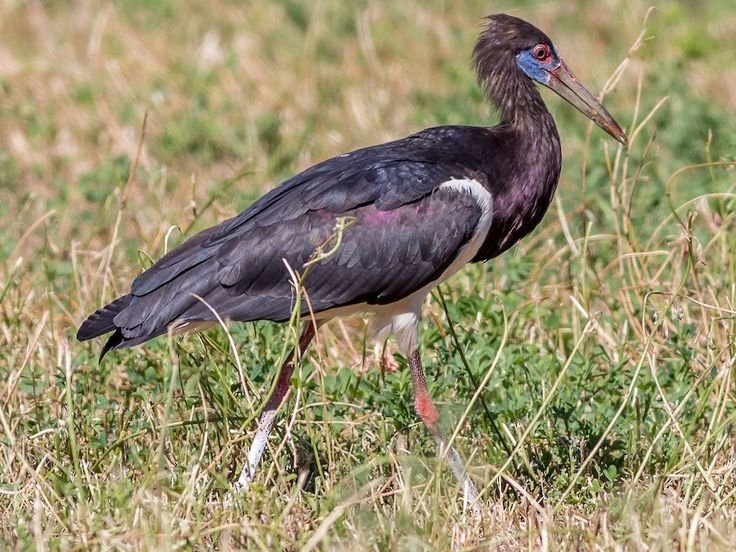
Abdim's Stork
Ciconia abdimiiA compact, elegant stork whose annual journey follows Africa's rains and the insect life they awaken.
Abdim's Stork (Ciconia abdimii) is the smallest stork species and a member of the family Ciconiidae. It is primarily an insect-eating, intra-African migrant of open country. Breeding is closely timed to rains in the northern tropics, while the non-breeding season brings large numbers into eastern and southern Africa, including Tanzania.
Abdim's Stork Quick Facts
Abdim's Stork Quick Facts
These quick facts describe the species conservatively. Published measurements vary slightly among sources and populations, while Tanzania seasonality is best treated as a typical pattern rather than an unchanging calendar.
What Is the Abdim's Stork?
Abdim's Stork is a small, long-legged stork of open African landscapes. Its scientific name is Ciconia abdimii, and it belongs to the family Ciconiidae. It is immediately striking because a dark, glossy head, neck, back and wings contrast with a pale white belly and lower underparts, while the bare skin around the face and the red knees and feet add vivid flashes of color.
The species is especially interesting because its life is tied closely to rainfall. Abdim's Storks breed during the rainy season in the northern tropics, when insects become abundant. After breeding, birds move south and east into their non-breeding range. Tanzania is therefore part of a continental seasonal cycle rather than the core breeding range.
It is also one of Africa's most social storks during feeding and migration periods. When locusts, grasshoppers or other prey become concentrated, flocks can number in the thousands, creating spectacular scenes across open grassland.
How to Identify an Abdim's Stork
The best way to identify Abdim's Stork is to combine its relatively small size with its crisp black-and-white body pattern and colorful bare parts. It can look very dark from a distance, but in good light the glossy upper plumage can show subtle purple, green or bronze reflections.
- Head and neck: dark, with a distinctive slightly shaggy appearance around the crown and nape; bare skin around the eye can look blue-grey with red around the eye.
- Bill: long, straight and greyish, suited to quickly grasping ground prey.
- Upperparts: dark brown-black to black with a glossy sheen.
- Underparts: strongly contrasting white belly and lower body.
- Legs: pale grey legs with noticeably red knees and feet.
- Flight: broad wings and a clean dark-and-white pattern make flying birds easier to recognize when the flock is circling.
Age & Plumage
Immature birds can appear duller and less sharply contrasting than adults, so a lone young bird may require closer observation. The bare facial colors are also more difficult to judge at distance. Size, body pattern and the overall shape remain useful even when fine plumage details are not visible.
Distinguishing Features in the Field
Among Tanzania's storks, the combination of a relatively compact body, dark head and upperparts, white belly, grey bill and vivid red knees and feet is particularly useful. If the bird is beside a Marabou Stork, the difference in size is dramatic.
Behavior & Social Life
Abdim's Storks are highly social outside the immediate breeding pair. Feeding groups can contain tens, hundreds or, during major insect events, thousands of birds. Flock size changes with food availability and seasonal movement rather than remaining constant throughout the year.
Daily Activity
The species is mainly a daytime ground forager. Birds walk steadily through short grass and open soil, pausing to seize prey. They may gather rapidly where an insect swarm has appeared and then disperse again when the food pulse fades.
Roosting & Group Behavior
Resting can be communal, especially during migration and the non-breeding season. A flock may feed across open country and then settle together at a suitable roost, giving safari observers repeated opportunities to see the species as both a ground-feeding bird and a soaring migrant.
Calls & Courtship Behavior
Like other storks, Abdim's Stork can use bill-clattering and body postures in social and breeding contexts. Courtship and territorial interactions include visual displays, head movements and aerial encounters around nesting colonies.
Seasonal Movement
This is not a sedentary Tanzanian stork. Its movements are strongly connected to rainfall and prey. East African birds move through broad regions as seasonal conditions change, while tracked West African birds have been documented moving to Tanzania.
Habitat & Distribution
Abdim's Stork favors open, productive landscapes where seasonal rainfall creates abundant prey. Typical habitats include grassland, savanna, pastures, seasonally wet plains and cultivated areas. The species can also exploit lightly wooded country and other open mosaics, especially where large insects are plentiful.
- Open grasslands: major feeding habitat during wet periods.
- Savanna: particularly productive when rainfall triggers insect abundance.
- Pastures: suitable where short vegetation exposes ground-dwelling prey.
- Cultivated landscapes: sometimes used, especially where insect prey is abundant.
- Seasonally wet ground: attracts insects, amphibians and other small prey.
A Continental Distribution
The species occurs widely across sub-Saharan Africa and is a true intra-African migrant. The exact seasonal distribution changes through the year, so a single static range description can be misleading. Breeding is concentrated in the northern tropics, while the non-breeding range extends into eastern and southern Africa.
Tanzania Distribution
Tanzania is a regular part of the non-breeding range. Tanzania Birds records the species in East Africa from October until April and documents it from sites including Ndutu, Ngorongoro Crater, Ruaha, Engikaret and Olasiti.
Abdim's Stork in Tanzania
Tanzania is one of the most rewarding countries in which to look for Abdim's Stork during its non-breeding season. The species is not equally numerous everywhere, however; rainfall, insects and local landscape conditions can make some plains much more productive than others in a given season.
Ngorongoro Conservation Area
Abdim's Storks are well documented in the Ngorongoro landscape, including the crater. Open grassland and seasonal food pulses make the area particularly suitable during the wetter months.
Ngorongoro safariNdutu & Southern Serengeti
Tanzania Birds specifically records Abdim's Stork at Ndutu. Seasonal short grass and abundant insects can attract feeding flocks.
Serengeti safariRuaha National Park
Documented observations from Ruaha show that the species is also encountered in southern Tanzania, extending the birding opportunity well beyond the northern circuit.
Ruaha safariArusha Area
Records from Engikaret and Olasiti show that seasonal Abdim's Storks can occur in open country around northern Tanzania as conditions permit.
Plan birdingSafari Methods
- Game drives: scan broad grasslands and recently rain-fed plains.
- Birding walks: useful where open ground and feeding flocks can be watched safely with a guide.
- Sky-watching: watch for circling groups before searching the ground where they descend.
- Weather-led birding: recent rain can be a strong clue to increased insect activity.
Best Time to See Them
A practical general window is October through April, when the species is regularly present in East Africa. Numbers can change quickly with rainfall and local prey conditions, so recent rain can matter as much as the month itself.
Why Abdim's Stork Appears in Tanzania
Tanzania is part of the bird's non-breeding landscape because seasonal rain can create exactly the conditions Abdim's Stork needs: open feeding grounds and an abundant supply of insects and other small prey. The species is therefore best understood through the ecology of rainfall rather than by a fixed resident-versus-visitor label alone.
Rain, Insects & Stork Numbers
When rain reaches dry grassland, plant growth and invertebrate activity can increase. Abdim's Storks respond to these food pulses, sometimes forming large feeding concentrations. In years or locations with poorer seasonal conditions, the number of birds encountered can be much lower.
From Plains to Crater Floor
Open landscapes around the Ngorongoro and Serengeti ecosystems can offer particularly visible feeding opportunities because birds can be watched across unobstructed grassland. The same principle applies in other parts of Tanzania where seasonal productivity creates suitable open habitat.
A Migrant's View of Tanzania
Seeing an Abdim's Stork in Tanzania means seeing one stage of a continental cycle. The bird may have bred far to the north and travelled south or southeast as seasonal conditions shifted. Tanzania is therefore not simply a destination on a safari checklist; it is an important part of the species' annual ecological story.
Diet & Feeding
Abdim's Stork is primarily insectivorous. Its feeding ecology is especially linked to large terrestrial insects such as locusts, grasshoppers, crickets and caterpillars. This specialization helps explain why major insect outbreaks can attract spectacular flocks.
Food Sources
- Locusts and grasshoppers: among the most important prey, particularly during outbreaks.
- Caterpillars and other insects: can make up a large part of the diet where abundant.
- Other invertebrates: various arthropods and small invertebrates are taken opportunistically.
- Frogs and other amphibians: especially where wet conditions make them accessible.
- Lizards and other reptiles: taken when encountered.
- Small mammals, fish and other prey: occasionally included, showing that the diet is flexible rather than exclusively insect-based.
Foraging Technique
The birds usually feed by walking across open ground, visually searching and then striking quickly with the bill. They can exploit disturbed soil, short grass and areas where insects have been flushed by rain, grazing, fire or other natural and human activity.
Why Large Flocks Form
Flock formation is closely tied to concentrated prey. BirdLife South Africa notes gatherings of several thousand at localised locust swarms, and flocks of up to around 10,000 have been reported. Such gatherings are not a sign that the species is always abundant everywhere; they are responses to unusually rich food opportunities.
Breeding & Life Cycle
Abdim's Stork is a colonial breeder. Breeding begins during the rainy season in the northern tropics, and the timing is closely associated with the arrival of rainfall and the resulting increase in insect prey. This synchronization gives adults access to abundant food while raising chicks.
Nesting
- Colonies: breeding sites may contain several nests to more than 50 nests.
- Nest trees: large trees are commonly used; studies have also documented nests in villages and on structures such as rooftops.
- Materials: sticks, vegetation and assorted nesting material form the nest platform.
- Clutch: commonly 2–4 eggs; field studies have recorded averages around 2.7–3 eggs.
- Incubation: approximately 28–30 days, with the parents sharing incubation duties.
Chicks & Fledging
Both adults contribute to caring for young. Chicks are fed regurgitated food, with insects forming an important component. Published field studies commonly place fledging at around 50–60 days, although timing can vary among populations and conditions.
Breeding Success & Rainfall
The close relationship with rainfall is one of the species' defining life-history features. In West African studies, nest initiation closely followed the onset of rains. This timing reduces the ecological mismatch between chick-rearing demands and the availability of insect prey.
Conservation Status
Abdim's Stork is currently assessed globally as Least Concern (LC). The IUCN 2025 assessment framework cited by BirdMap Africa and the current BirdLife South Africa regional assessment both retain the species in the Least Concern category.
The global population is difficult to quantify because the birds move across large areas and numbers vary seasonally. BirdLife South Africa cites a historical global estimate of roughly 300,000–600,000 mature individuals, while emphasizing the difficulty of counting birds during the non-breeding season because of regional movements.
Least Concern should not be interpreted as “no conservation concerns.” The species relies on connected breeding, migration and non-breeding landscapes, and local declines can occur even when the global assessment remains secure.
Conservation Context for Tanzania
For Tanzania, maintaining healthy open grasslands, seasonal wetlands and wider savanna mosaics is valuable not only for resident wildlife but also for migratory birds such as Abdim's Stork. Careful pesticide use and retention of suitable feeding habitat can help preserve the insect-rich conditions on which the birds depend.
Comparisons: Abdim's Stork & Similar Storks
Abdim's Stork is easiest to recognize when compared with other storks that occur in Tanzania. Size, bill shape, body pattern and the color of bare parts are especially useful.
| Feature | Abdim's Stork | Marabou Stork | Woolly-necked Stork | Yellow-billed Stork |
|---|---|---|---|---|
| Approx. build | Small, compact | Very large and heavy | Medium-large | Medium-large |
| Upperparts | Glossy dark | Dark | Dark | Black flight feathers with pale body |
| Underparts | Clean white belly | White belly | White neck and underparts | Mostly white |
| Bill | Long greyish bill | Huge, heavy bill | Dark heavy bill | Distinctive yellow bill |
| Legs / feet | Grey legs, red knees and feet | Dark/grey legs with dark lower parts | Dark legs | Pinkish/red legs |
| Main diet | Mostly insects | Highly opportunistic, including carrion | Mixed animal prey | Aquatic and wetland prey |
| Tanzania pattern | Non-breeding migrant | Widespread resident | Mostly resident | Widespread resident |
The Fastest Field Clue
When a dark-and-white stork appears on a Tanzania plain, check its size first. If it looks noticeably small beside other storks and shows vivid red knees and feet, Abdim's Stork becomes a strong identification candidate.
Did You Know?
Smallest Stork
Abdim's Stork is widely described as the world's smallest stork species, a striking distinction for a bird that can nevertheless gather in huge flocks.
Up to Thousands Together
Localised insect outbreaks can attract flocks numbering in the thousands, with reports of gatherings around 10,000 birds.
Rain Dictates the Rhythm
Breeding and seasonal movement are strongly associated with rainfall because rain drives the insect pulses that feed the birds.
Village Colonies
Breeding colonies may be close to people, and studies have recorded nests in villages and even on rooftops.
Red Knees & Feet
The red knees and feet are among the most useful field marks when identifying an Abdim's Stork at close range.
Migration to Tanzania
Tracking has documented birds travelling from northern breeding areas to Tanzania, illustrating the species' continental-scale movements.
There is something beautifully logical about an Abdim's Stork. The bird arrives when the landscape changes. Rain wakes the grassland; insects appear; and a stork that has crossed much of Africa suddenly has a reason to gather on the plain. In Tanzania, a flock of Abdim's Storks is not just a collection of birds—it is a visible expression of the continent's seasonal pulse.
Gallery
Frequently Asked Questions
The scientific name is Ciconia abdimii, a stork in the family Ciconiidae.
Yes. Tanzania is part of the species' regular non-breeding range. Tanzania Birds records it from October through April, including locations such as Ndutu, Ngorongoro Crater and Ruaha.
A practical general window is October through April, although local numbers depend strongly on rainfall and prey availability.
It is primarily insectivorous, taking locusts, grasshoppers, caterpillars and other insects. Frogs, lizards, fish, small mammals and other small prey can also be taken.
Yes. It is widely described as the smallest stork species, with published adult length figures around 75–81 cm.
Tanzania is primarily part of its non-breeding range. The species breeds colonially farther north during the rainy season and later moves south and east.
It is an intra-African trans-equatorial migrant whose movements are closely tied to rainfall. Tracked birds from breeding areas in Niger have migrated to Tanzania.
Look for the relatively small body, dark glossy upperparts, white belly, long greyish bill, grey legs and bright red knees and feet.
The species is currently assessed as Least Concern (LC) globally.
References & Further Reading
- BirdLife DataZone / IUCN: global species assessment framework, taxonomy and conservation status.
- BirdLife South Africa, 2025 regional assessment: migration, breeding, diet, population context and current regional status.
- Tanzania Birds: Tanzania seasonality and field records, including Ndutu, Ngorongoro Crater, Ruaha, Engikaret and Olasiti.
- Coordinated Avifaunal Roadcounts / BirdMap Africa: migration ecology and IUCN-linked assessment information for Ciconia abdimii.
- Adjakpa (2000), Ostrich: breeding biology, colony size, clutch size and incubation observations from northern Benin.
- Ivande et al. (2012), Malimbus: breeding distribution, nesting trees, clutch and brood data from Nigeria.
- Falk et al.: nestling diet research documenting the importance of grasshoppers and other insects.
Editorial note: Where measurements or breeding values differ among published sources, this page presents ranges or cautious wording rather than forcing a single number. Tanzania occurrence is described separately from the breeding range to avoid treating a seasonal migrant as a resident species.