

.png)
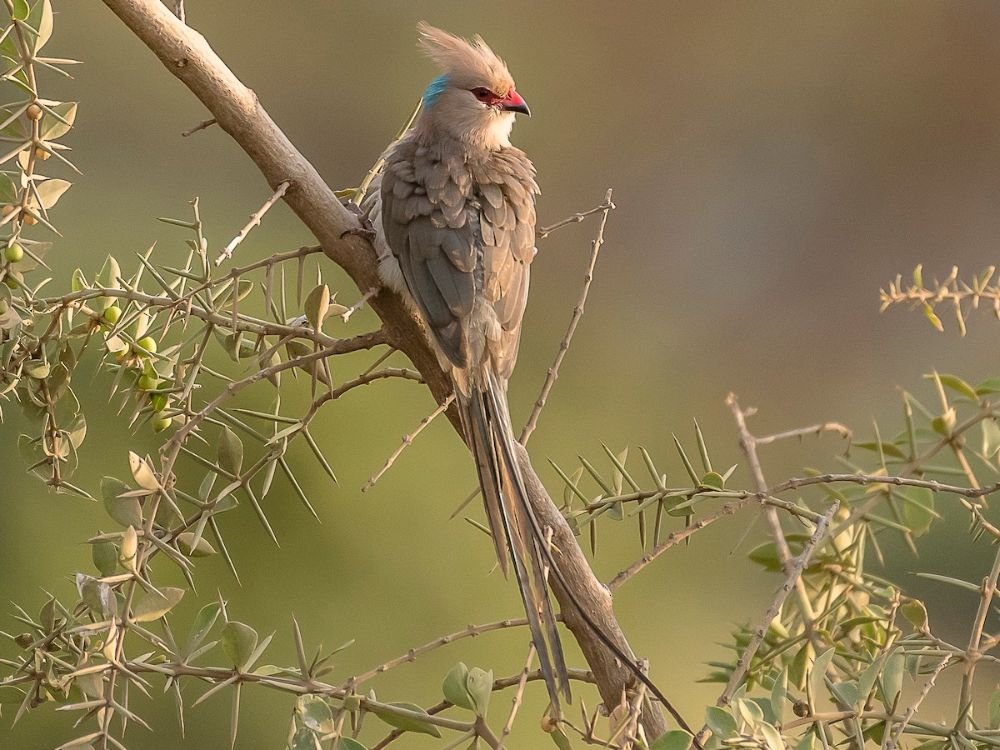
Blue-naped Mousebird
Urocolius macrourusA graceful, long-tailed mousebird with a brilliant blue nape and a life built around fruit-rich African bushland.
The Blue-naped Mousebird (Urocolius macrourus) is a slim, long-tailed member of the mousebird family Coliidae. It is easily recognized by its iridescent blue nape, red facial mask, black-tipped red bill and very long tail. Across eastern Africa it occupies dry woodland, bushland, scrub and other semi-open habitats where it feeds mainly on fruit and tender plant material.
Blue-naped Mousebird Quick Facts
What Is the Blue-naped Mousebird?
The Blue-naped Mousebird (Urocolius macrourus) is a slender, long-tailed mousebird in the family Coliidae. Its most striking field marks are the glossy blue patch on the nape, a red mask around the eye, a black-tipped red bill and a narrow, graduated tail that can make the bird look much larger than its body.
The species is a member of the mousebird order Coliiformes and is adapted to life in dry African woodland and bush. It is primarily a fruit-eater, moving through vegetation in small social groups and clinging easily to branches while feeding. Modern taxonomies place it in the genus Urocolius; older literature may use Colius macrourus.
This eagle is a common and widespread resident of wooded habitats across much of sub-Saharan Africa, from Senegal to Ethiopia and south to South Africa .
How to Identify a Blue-naped Mousebird
The Blue-naped Mousebird is especially distinctive when perched in good light. Look for the combination of a long narrow tail, grey-brown body, vivid blue nape, red eye mask and red bill with a dark tip.
- Nape: Iridescent blue feathers on the back of the neck are the signature field mark.
- Plumage: Mostly grey-brown with subdued tones that blend into woodland foliage.
- Body: The underparts are generally paler and softly patterned rather than boldly streaked.
- Face & eyes: A red facial mask surrounds the eye, contrasting sharply with the darker head.
- Tail: Very long, narrow and graduated, giving the bird a distinctive silhouette.
- Legs: Short, adapted for clinging and climbing among branches.
Distinguishing from Other Mousebirds
It can be separated from Speckled Mousebird and other long-tailed mousebirds by the intensely blue nape, red facial skin and black-tipped reddish bill. The overall pattern is compact, understated and strongly adapted to dry bushland.
Behavior & Social Life
Blue-naped Mousebirds are social, agile birds that often move through vegetation in pairs or small groups. They can hang sideways or even upside down while reaching fruit, and they frequently remain in cover rather than making long flights between feeding trees.
Daily Activity
- Feeding: Fruit and tender plant material are gathered directly from trees and shrubs.
- Social foraging: Small groups move through fruiting trees and communicate with soft calls.
- Vocalization: Calls include soft, ringing or chattering notes used to keep contact between birds.
Movement
The Blue-naped Mousebird is generally resident within suitable habitat, but local movements follow seasonal fruit supplies. It can range widely across woodland and scrub when food availability changes.
Habitat & Distribution
The Blue-naped Mousebird is associated with relatively dry but vegetated landscapes where fruiting trees and shrubs are available:
- Dry woodland Open woodland, especially where mature fruiting trees provide shade and food.
- Bushland & scrub Thornbush, scrub and semi-arid thickets across eastern Africa.
- Savanna edges Semi-open savanna with scattered trees and dense feeding cover.
- Cultivated landscapes Gardens, farms and other human-modified areas where fruiting plants persist.
Distribution: The species occurs across dry regions of East and northeastern Africa, extending from parts of the Horn and Sahel transition into Kenya, Tanzania and Uganda.
Tanzania Distribution
In Tanzania, documented records include Lake Manyara, Engikaret, Kia Lodge, Olasiti, Shambarai Swamp, Ngutukoiti, Lake Chala and the Mererani area.
Blue-naped Mousebird in Tanzania
Tanzania offers excellent opportunities to find the Blue-naped Mousebird in dry woodland, scrub and mixed bush. Reliable documented localities include:
Lake Manyara National Park
Best time: The species is present where suitable habitat persists year-round. Early morning and late afternoon are especially rewarding for active feeding and softer light for photography.
Birding in TanzaniaEngikaret & Kia
Documented northern Tanzania records from dry bushland around Engikaret and Kia Lodge.
Birding in TanzaniaLake Chala
Recorded near Lake Chala, where dry woodland and fruiting vegetation meet the East African highland landscape.
Birding in TanzaniaOlasiti & Shambarai Swamp
Records from Olasiti and Shambarai Swamp show the species can use both dry bush and greener wetland margins.
Birding in TanzaniaSafari Methods
- Birdwatching Scan fruiting trees and dense bush edges for long-tailed groups.
- Game drives Slow drives through woodland and bush can reveal perched or feeding birds.
- Photography Early light can bring out the iridescent blue nape and red facial mask.
Best Time to See Them
Blue-naped Mousebirds are present year-round in suitable habitat. They are most active during the cooler morning and evening hours .
Diet & Feeding
The Blue-naped Mousebird is primarily a frugivore, using its strong bill and agile feet to harvest soft fruits and other plant foods from shrubs and trees.
Food Sources
- Fruits Berries and other soft fruits are the core of the diet.
- Leaves & shoots Young leaves, buds and tender plant material supplement fruit when needed.
- Flowers Nectar-rich or soft floral material can be taken opportunistically.
- Seeds Small seeds may be eaten when available, although fruit remains dominant.
Feeding Behavior
The birds move deliberately through the canopy and outer branches, often hanging at unusual angles while reaching food. Their social feeding behaviour helps groups exploit patchy fruit supplies efficiently.
Breeding & Life Cycle
Blue-naped Mousebirds breed cooperatively within pairs and small family groups, with courtship, nest building and parental care centred on dense vegetation that provides shelter from heat and predators.
Nesting
- Nest A small cup or platform of plant fibres is placed among twigs, often within dense foliage.
- Eggs Usually 2–3 eggs are laid, although clutch size can vary.
- Incubation Roughly 12–14 days, with adults sharing parental duties.
Chicks
Young remain closely attended by the adults, leaving the nest after roughly two to three weeks and continuing to depend on their parents while they develop stronger flight, feeding and climbing skills.
Conservation Status
The Blue-naped Mousebird is currently assessed as Least Concern globally. Its population is not known to be approaching the thresholds for a threatened category.
Its broad East African distribution and tolerance of a range of dry woodland and bush habitats provide resilience, although local declines can occur where mature vegetation and fruiting trees are removed.
Key local pressures can include habitat clearing, loss of fruiting trees and degradation of woodland and scrub through intensive land conversion.
- Habitat conversion Replacement of mature woodland and bush with intensive agriculture or built areas.
- Loss of fruiting trees Removal of trees and shrubs that provide reliable seasonal food.
Comparisons
The Blue-naped Mousebird is most often distinguished from other long-tailed mousebirds by its blue nape and red facial pattern.
| Feature | Blue-naped Mousebird | Speckled Mousebird | White-headed Mousebird |
|---|---|---|---|
| Size | 33–36 cm | 31–38 cm | about 30–35 cm |
| Tail | Very long, narrow | Very long, graduated | Long, graduated |
| Nape | Iridescent blue | Grey-brown / patterned | White head and nape |
| Face | Red mask; red bill with black tip | Red bill; less vivid blue | Darker face, white crown |
| Habitat | Dry woodland, bush, scrub | Woodland, gardens, moist habitats | Arid scrub and savanna |
| Diet | Mainly fruits and plant matter | Fruit, leaves, flowers | Fruit, leaves, seeds |
Did You Know?
Blue Nape
Its shimmering blue nape is the field mark behind its common name.
Very Long Tail
The tail can make up a striking share of the bird’s overall silhouette.
Fruit Specialist
Soft fruits and berries make up the core of its diet.
Branch Acrobat
It can cling at unusual angles while reaching food among leaves and twigs.
Social Bird
Pairs and small groups often move together through feeding trees.
Dry-country Mousebird
It is especially associated with dry woodland, bush and scrub across eastern Africa.
There is something unmistakable about a Blue-naped Mousebird in good light: a long tail trailing behind a quiet, grey-brown body, then a sudden flash of electric blue at the nape. In Tanzania’s dry woodland and bush, these agile fruit-eaters turn thorn trees and fruiting shrubs into a moving network of feeding perches. Their social calls, acrobatic posture and subtle plumage make them a rewarding bird for patient observers.
Gallery
Frequently Asked Questions
The Blue-naped Mousebird (Urocolius macrourus) is a slender, long-tailed mousebird with an iridescent blue nape, red facial mask and red-black-tipped bill.
Documented Tanzanian localities include Lake Manyara, Engikaret, Kia, Lake Chala, Olasiti, Shambarai Swamp and the Mererani area.
It feeds mainly on fruits and berries, supplemented by leaves, buds, flowers and occasional seeds.
No. It is currently assessed as Least Concern globally, although local habitat loss can affect populations.
The name refers to the iridescent blue patch of feathers on the back of the neck, one of its clearest field marks.
Pairs and family groups build a small plant-fibre nest in dense vegetation, usually laying 2–3 eggs; incubation is about 12–14 days.
Look for the combination of a long narrow tail, blue nape, red facial mask and reddish bill with a black tip.
Yes. It is generally resident in Tanzania, although it makes local movements as fruit supplies and habitat conditions change.
References & Further Reading
- Tanzania Birds – Blue-naped Mousebird species page and photographic records from Lake Manyara, Engikaret, Kia, Lake Chala, Olasiti, Shambarai Swamp and related Tanzanian localities.
- ITIS – *Urocolius macrourus* current taxonomic record and accepted common name.
- African Bird Club – Blue-naped Mousebird records, including Lake Manyara National Park, Tanzania.
- Featherbase / AVONET – Morphological measurements and distribution data for *Urocolius macrourus*.
- Oiseaux.net – Species account covering taxonomy, ecology and conservation.
- BirdLife / IUCN framework – Current global conservation treatment and assessment context.
- eBird / Birds of the World – Identification, distribution, behaviour and vocalization references.