

.png)
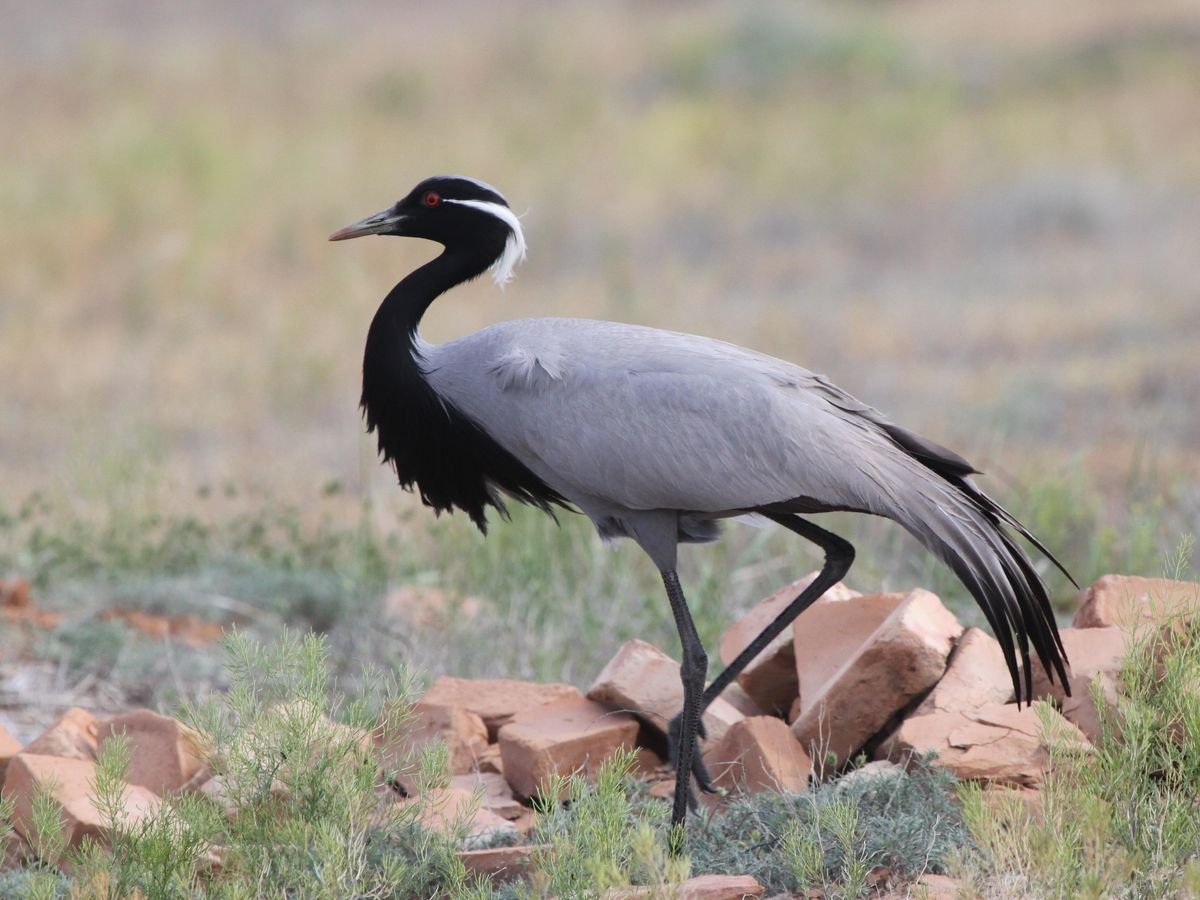
Demoiselle Crane
Grus virgoThe world's smallest crane — a graceful steppe breeder built for some of Africa and Asia's greatest migrations.
The Demoiselle Crane (Grus virgo) is the smallest crane species and a member of the family Gruidae. It breeds across open steppe and semi-desert landscapes of Eurasia and migrates seasonally to wintering grounds in Africa and South Asia. Its blue-grey body, black head and neck, white ear-coverts and trailing wing feathers make it one of the most elegant cranes in the world.
Demoiselle Crane Quick Facts
What Is the Demoiselle Crane?
The Demoiselle Crane (<em>Grus virgo</em>) is the smallest member of the world's crane family. It is a long-legged, long-necked bird designed for open-country life, with a compact elegant body and a remarkably graceful walking gait.
The species breeds across a broad belt of Central Eurasia, including Kazakhstan, southern Russia, Mongolia and parts of neighboring countries, with a smaller breeding population in Turkey. Most populations are migratory and move south after breeding.
Its annual journey is one of the defining facts of the species. Western populations winter in parts of Africa, including Sahelian regions, while many Central Asian populations migrate toward Pakistan and India. Modern tracking has documented long journeys of thousands of kilometres between breeding and wintering areas.
How to Identify a Demoiselle Crane
The Demoiselle Crane is much smaller and more delicate than Common Crane and most other large cranes. Its fine silhouette, pale grey-blue body and dramatic black-and-white head pattern are distinctive.
- Body: elegant blue-grey to pale grey body with long, narrow proportions.
- Head: black forehead and crown with white ear-coverts extending backward.
- Neck: mostly black at the front, with long white and dark ornamental feathers extending down the sides.
- Wing: long dark flight feathers create a trailing 'skirt' when the bird stands and a striking profile in flight.
- Legs: dark and relatively long for a small crane.
- Juveniles: browner and less sharply patterned than adults, lacking the full contrast of the adult head.
Distinguishing from Common Crane
Demoiselle Crane is smaller and more delicately built than Common Crane. Its distinctive white ear-coverts and long black-and-white chest feathers are especially useful. Common Crane has a bulkier grey body and a more extensive black-and-white facial pattern without the Demoiselle's slender proportions.
Behavior & Social Life
Demoiselle Cranes are highly social outside the nesting period. Families and flocks use open plains, agricultural fields and shallow wetlands, sometimes gathering in very large concentrations on migration and wintering grounds.
Daily Activity
- Foraging: walks steadily over open ground, picking seeds and plant material and taking insects and small animals.
- Roosting: often spends the night in shallow water or exposed wetland areas where predators are easier to detect.
- Social displays: pairs perform bowing, jumping, wing-flapping and running displays during courtship and pair bonding.
Migration Behavior
The species is a true long-distance migrant. Satellite tracking has documented journeys of several thousand kilometres, with spring and autumn routes using different combinations of stopover sites. Migration is strongly associated with seasonal food and water conditions and with safe staging areas along the route.
Habitat & Distribution
During breeding, Demoiselle Cranes favor open steppe, semi-desert and grassland with sparse vegetation and access to water. During migration and winter they can use wetlands, grasslands, agricultural fields and open floodplains.
- Open steppes where sparse vegetation provides nesting visibility and foraging space.
- Grasslands and semi-deserts with nearby water and seasonal food.
- Wetlands and floodplains used for roosting, staging and feeding.
- Agricultural landscapes that can supply seeds and grains during migration and winter.
The breeding range extends across Central Eurasia from the Black Sea region eastward through Kazakhstan and Mongolia to northeastern China, with additional western populations. Wintering ranges include the Sahel and northeastern Africa for western populations and the Indian subcontinent for many Asian populations.
African Wintering Range & Tanzania
Demoiselle Cranes that winter in Africa are mainly associated with the Sahelian belt, broadly from the Lake Chad region east toward Sudan and Ethiopia. Tanzania is south of the principal documented African wintering range, so this species should <strong>not</strong> be presented as a regular Tanzanian safari bird. Occasional vagrancy is possible in birds, but a confirmed local record requires verification rather than assumption.
Demoiselle Crane: Where to See It
For an authentic Demoiselle Crane encounter, plan around its established breeding, migration and wintering ranges. The strongest African opportunities are in the Sahel and northeastern African wintering zone rather than Tanzania.
Birding Methods
Western populations winter around seasonal wetlands and grasslands of the Sahel, where food and water concentrate large flocks.
Plan a Sahel birding tripBest Time to See Them
For Africa, the wintering period is broadly during the northern hemisphere winter, but exact dates vary by population and rainfall. In Central and South Asia, birds are typically present in winter after autumn migration and depart for breeding grounds in spring.
Explore specialist birdingSudan & Ethiopia
The eastern end of the African wintering range reaches Sudan and Ethiopia, with wetland and grassland habitats supporting wintering birds.
Plan Northeast Africa birdingCentral Asian Flyway
Asian populations breed across the steppes and migrate through Central and South Asia toward Pakistan and India.
Plan Central Asian birdingSafari Methods
- Watch migration corridors: large flocks become conspicuous during staging and passage periods.
- Scan open fields: Demoiselle Crane often feeds in open grassland and agricultural landscapes.
- Check shallow roosts: night roosts in open water can reveal large concentrations at dusk.
Best Time to See Them
Demoiselle Cranes are present year-round in suitable habitat. They are most active during the cooler morning and evening hours .
Diet & Feeding
Demoiselle Cranes are omnivorous foragers. Plant foods dominate much of the diet, but insects and other small animals add protein, especially during breeding.
Food Sources
- Seeds and grains: major foods on breeding, migration and wintering grounds.
- Young grasses and shoots: taken in open grasslands and steppe habitats.
- Insects: grasshoppers and other invertebrates provide important animal food.
- Small vertebrates and invertebrates: frogs, small reptiles and worms can be taken opportunistically.
Foraging Behavior
Birds walk across open ground and pick food from the surface or short vegetation. In agricultural landscapes they may exploit spilled grain and newly harvested fields, sometimes forming large feeding flocks.
Breeding & Life Cycle
Demoiselle Cranes form long-term pair bonds and breed in open landscapes where nests can be placed directly on the ground. Pairs are territorial around the nest even though the species becomes highly social after breeding.
Nesting
- Nest: a simple scrape or minimally lined depression on open ground, often in sparsely vegetated steppe.
- Eggs: normally 2 eggs, laid at roughly daily intervals.
- Incubation: about 27-30 days, with both parents contributing.
Chicks
The chicks are precocial and can leave the nest soon after hatching, following their parents while feeding. They grow rapidly but remain with the adults while learning to forage and fly; fledging is generally around two months after hatching.
Conservation Status
Demoiselle Crane is currently assessed globally as <strong>Least Concern (LC)</strong>. Its overall global category reflects its broad range, but this does not mean every regional population is stable.
Regional concerns are particularly important for migratory populations because the species depends on multiple landscapes across its annual cycle. European populations have experienced major declines, while wintering and migration areas can also face habitat pressure.
Important conservation pressures include:
- Wetland loss: drainage and degradation of important migration and wintering wetlands.
- Grassland conversion: agricultural intensification can remove open breeding and feeding habitat.
Comparisons
Demoiselle Crane is most often confused with Common Crane during migration. Size and head pattern are the strongest field clues.
| Feature | Demoiselle Crane | Common Crane | Grey Crowned Crane |
|---|---|---|---|
| Size | Smallest crane, slender | Much larger, heavier | Large, tall |
| Head | Black head with white ear-coverts | Grey/black head with red facial skin | Golden crown, white cheeks, black neck |
| Neck | Black front with long white side feathers | Grey with black lower neck | Black neck with long white feathers |
| Breeding range | Central Eurasia | Europe & northern Asia | Sub-Saharan East & southern Africa |
| Migration | Long-distance migrant | Many migratory populations | Mostly resident/locally mobile |
| Tanzania | Not a regular species | Rare/irregular depending on records | Regular Tanzania crowned crane |
Did You Know?
Smallest Crane
Demoiselle Crane is the smallest species in the crane family.
Himalayan Crossing
Asian populations are famous for spectacular long-distance migration routes that can cross major mountain systems.
Two Main Winter Worlds
Western Eurasian birds winter mainly in Africa, while many Central Asian populations winter in South Asia.
Ground Nester
The nest is usually a simple scrape on open ground rather than an elaborate nest structure.
Huge Flocks
Migration and wintering concentrations can become enormous where food and safe roosts are abundant.
Not a Tanzanian Resident
Tanzania is outside its principal established African wintering range; Tanzania's well-known cranes are other species, especially Grey Crowned Crane.
The Demoiselle Crane's elegance can be deceptive. Beneath the delicate silhouette is a bird capable of crossing continents, following ancient migration routes between Eurasian breeding grounds and distant wintering landscapes. A flock rising together is not just a beautiful sight—it is the visible result of a journey measured in thousands of kilometres.
Gallery
Frequently Asked Questions
The scientific name is Grus virgo, a crane in the family Gruidae.
Yes. Demoiselle Crane is widely recognized as the smallest crane species.
It breeds across open steppe and semi-desert habitats of Central Eurasia, from the Black Sea region eastward through Kazakhstan and Mongolia to northeastern China, with additional western populations.
Western populations winter mainly in Sahelian and northeastern Africa, while many Central Asian populations winter in Pakistan and India.
Tanzania is south of its principal established African wintering range, so it should not be described as a regular Tanzanian species. Any Tanzanian record requires verification.
It eats seeds, grains, grasses and shoots, supplemented with insects and other small animals.
It is a long-distance migrant. Different populations follow different routes, and some Asian birds cross the Himalaya during migration.
Pairs nest on the ground in open steppe, normally laying two eggs. Both parents incubate, and the chicks are precocial.
References & Further Reading
- BirdLife International taxonomy and conservation resources: current taxonomic framework and Red List assessment context.
- Natural History Museum, University of Oslo: taxonomy, distribution, family, order and Least Concern status for Grus virgo.
- Central Asian Flyway Network: breeding range, migration corridor, wintering areas, habitat and diet information.
- Satellite telemetry research: documented migration distances, routes and stopover behavior in Demoiselle Crane.
- BirdLife International – European Red List: regional population decline, wetland and hunting pressures in Europe.
- IUCN Red List supporting framework: species movement, habitat, ecology and threat terminology.
- iNaturalist – Demoiselle Crane observation records from Tanzania .