

.png)
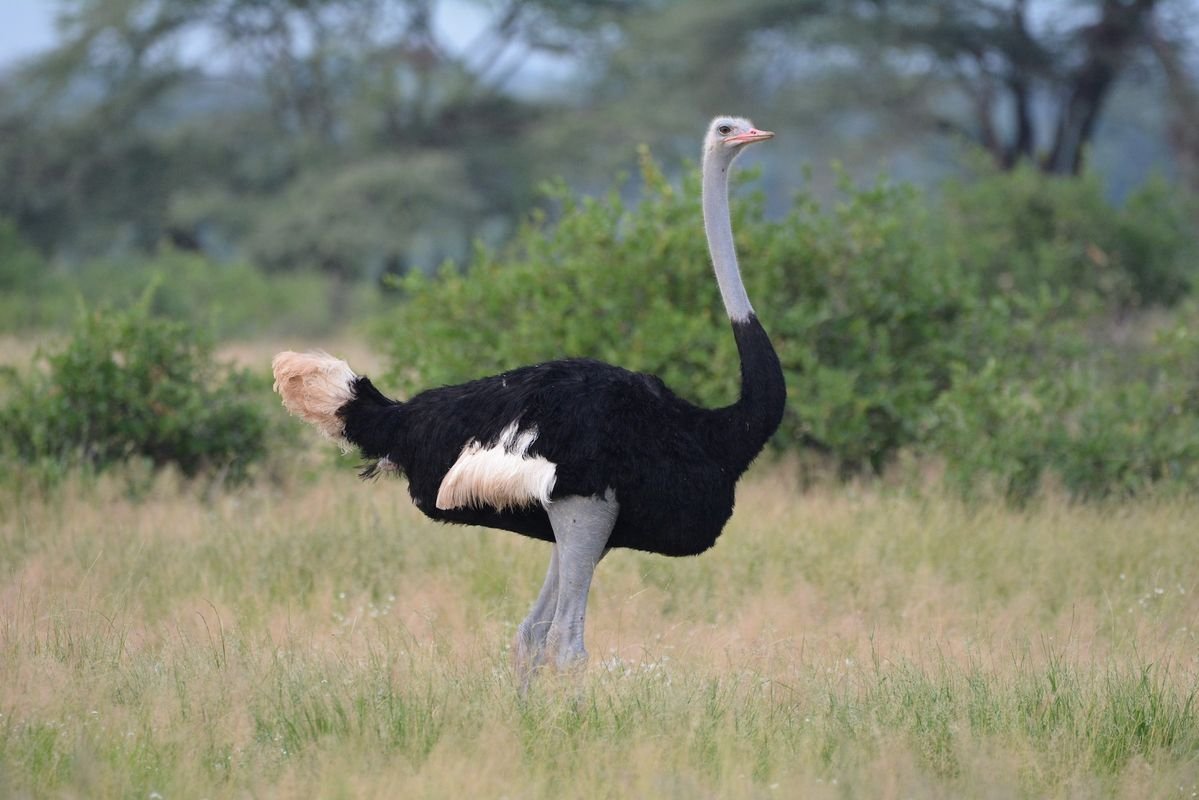
Somali Ostrich
Struthio molybdophanesA distinct species of the Horn of Africa – blue-necked, vulnerable, and found in Tanzania's dry north.
The Somali ostrich (Struthio molybdophanes) is a large flightless bird native to the Horn of Africa, distinguished by its blue-gray neck and legs. It was recognized as a separate species from the Common Ostrich in 2014. In Tanzania, it is found in the arid northern regions, particularly in Mkomazi National Park, where it shares the ecosystem with Kenya's Tsavo West [citation:4][citation:8].
Somali Ostrich Quick Facts
What Is the Somali Ostrich?
The Somali ostrich (Struthio molybdophanes), also known as the blue-necked ostrich, is a large flightless bird native to the Horn of Africa. It is one of the two living species of ostriches, the other being the common ostrich (Struthio camelus). It was previously considered a subspecies of the common ostrich, but was identified as a distinct species in 2014 based on mitochondrial DNA studies [citation:8][citation:5].
Molecular evidence indicates that the East African Rift has served as a geographic barrier isolating this species from the North African ostrich, while ecological and behavioral differences have kept it genetically distinct from the Masai ostrich [citation:8]. An examination of mitochondrial DNA suggests the Somali ostrich diverged from a common ancestor some 3.6 to 4.1 million years ago [citation:8].
How to Identify a Somali Ostrich
Though generally similar in size to other ostriches, the Somali ostrich is distinguished by its blue-gray skin on the neck and thighs, which becomes bright blue on the male during the mating season [citation:1][citation:8].
Key identification features:
- Male plumage: Black body and wings, white tail feathers, blue-gray neck and legs [citation:1].
- Female plumage: Grey-brown body, pale blue-gray eyes, and lighter pinkish-gray neck and legs [citation:1].
- Neck: Lacks the typical broad white ring found at the base of the common ostrich's neck [citation:8].
- Size: Similar to other ostriches; may be marginally smaller than some subspecies of common ostrich [citation:8].
Habitat & Range
The Somali ostrich is mostly found in the Horn of Africa, especially in north-eastern Ethiopia, southern Djibouti, most of Kenya, and across most of Somalia [citation:8]. Its range corresponds roughly to the area known as the Horn of Africa.
Ecologically, it is differentiated from the common ostrich, with which there is some range overlap, by preferring bushier, more thickly vegetated areas, where it feeds largely by browsing, whereas the common ostrich is mainly a grazer on open savanna [citation:8]. It inhabits arid and semi-arid grasslands, thorn scrub, and open woodland, and can go without water for extended periods [citation:1].
Somali Ostrich in Tanzania
In Tanzania, the Somali ostrich is a rare and special sighting, found in the dry northern regions near the Kenyan border. The most reliable location is Mkomazi National Park, which shares an ecosystem with Kenya's Tsavo West National Park and is home to dry-country species rarely seen in northern parks, including the Somali ostrich [citation:4][citation:14].
Mkomazi National Park
The best place in Tanzania to see Somali ostrich, in arid bushland and semi-desert habitat.
Mkomazi safariNorthern Kenya Border
Shared ecosystem with Tsavo West – Somali ostrich can be seen in the contiguous dry savanna.
Kenya safariSerengeti (Edge of Range)
Rarely seen in the extreme north-east of the Serengeti; Mkomazi remains the primary site.
Serengeti safariDry-country specialist
Thrives in thickly vegetated, water-scarce areas where common ostrich is less common.
Behavior & Social Life
Somali ostriches are diurnal and typically found in small groups. They may be resident or nomadic, depending on habitat conditions. During dry seasons or in arid regions, they travel long distances in search of food and water. In wetter seasons, they disperse more widely [citation:1].
They have a deep, booming call described as similar to a lion's roar [citation:1]. Their social structure and courtship behavior are similar to the common ostrich.
Diet & Feeding
The Somali ostrich is predominantly herbivorous, but its diet varies with habitat. In the more thickly vegetated areas it prefers, it feeds largely by browsing [citation:8]. It eats grasses, seeds, and leaves, and in arid regions consumes more succulent plants. It will also eat insects and small vertebrates opportunistically [citation:1].
This species is adapted to water-scarce environments and can obtain much of its moisture from its food, though it will drink when water is available.
Conservation Status
The Somali ostrich is assessed as Vulnerable on the IUCN Red List, contrasting with the Common Ostrich's Least Concern status [citation:3].
The primary threats include:
- Uncontrolled hunting for meat, medicinal products, and eggs, particularly in Somalia following political disintegration and the lack of effective wildlife conservation [citation:8].
- Habitat loss and fragmentation.
- Political instability across its Horn of Africa range [citation:8].
In Kenya, it is farmed for meat, feathers, and eggs. Effective conservation requires landscape-level measures: habitat protection, anti-poaching, nest protection, community coexistence, and responsible tourism.
Comparisons
The Somali Ostrich is often confused with the Common Ostrich but is a distinct species. Here are the key differences:
| Feature | Somali Ostrich | Common Ostrich |
|---|---|---|
| Conservation | Vulnerable | Least Concern [citation:3] |
| Male neck/legs | Blue-gray (bright blue in breeding season) | Pinkish |
| Neck ring | No white ring at base | Broad white ring at base |
| Tail feathers | White | White [citation:1] |
| Diet preference | Browser (bushier areas) | Grazer (open savanna) [citation:8] |
| Range | Horn of Africa + N Tanzania | Sub-Saharan Africa (wider) |
Did You Know?
Distinct since 2014
Recognized as a full species only in 2014, after genetic studies confirmed its divergence from the common ostrich [citation:8].
Ancient divergence
Mitochondrial DNA suggests it diverged from a common ancestor 3.6–4.1 million years ago [citation:8].
Blue-necked
The male's blue neck and legs turn a vivid bright blue during the breeding season [citation:1].
Lion-like call
Its deep booming call has been described as similar to the roar of a lion [citation:1].
Mkomazi gem
Mkomazi National Park in Tanzania is one of the few places to see this species in the wild [citation:4].
Vulnerable
Listed as Vulnerable, facing threats from hunting and habitat loss across its Horn of Africa range [citation:3].
There is rarity in the Somali ostrich – a blue-necked giant of the dry frontier, standing in the dusty bush of Mkomazi. It is a reminder that Africa's birdlife is not all pink flamingos and colourful rollers; there are subtle, ancient species that reward the patient traveller. An encounter with a blue-necked male in breeding display is a special, once-in-a-safari moment.
Gallery
Frequently Asked Questions
The Somali Ostrich (Struthio molybdophanes) is a large flightless bird native to the Horn of Africa, recognized as a distinct species from the common ostrich in 2014 [citation:8].
Male Somali Ostriches have blue-gray neck and legs (turning bright blue in mating season), lack a white ring at the neck base, and have white tail feathers [citation:1][citation:8]. Common Ostriches have pinkish necks and a white neck ring.
The Somali Ostrich is found in the dry north of Tanzania, primarily in Mkomazi National Park near the Kenyan border, which shares an ecosystem with Kenya's Tsavo West [citation:4][citation:14].
Primarily herbivorous, feeding on grasses, seeds, and leaves. In arid regions it consumes more succulent plants. It also eats insects and small vertebrates [citation:1].
The Somali Ostrich is listed as Vulnerable on the IUCN Red List, facing threats from uncontrolled hunting, habitat loss, and political instability in its Horn of Africa range [citation:3][citation:8].
No, they are two distinct species. The Somali Ostrich is differentiated by ecological preferences (browsing in bushier areas vs grazing in open savanna) and by genetic separation, with divergence estimated at 3.6–4.1 million years ago [citation:8].
References & Further Reading
- IUCN Red List of Threatened Species – Struthio molybdophanes (Somali Ostrich), Vulnerable.
- Wikipedia – Somali ostrich: distribution in Horn of Africa; blue-necked features; distinct species since 2014.
- Avibase – The World Bird Database: Struthio molybdophanes taxonomic status and synonyms.
- ITIS Integrated Taxonomic Information System: taxonomic serial no. 696082 for Struthio molybdophanes Reichenow, 1883.
- Chinese Bird Database (iselin.cn): details on the Grey-necked Ostrich (Somali Ostrich) – habitat, behavior, identification.
- Mkomazi National Park (Dream Peak Safaris): confirms Somali ostrich presence in Mkomazi National Park, Tanzania.
- Birds of the World – Somali Ostrich: species names and scientific definitions.