

.png)
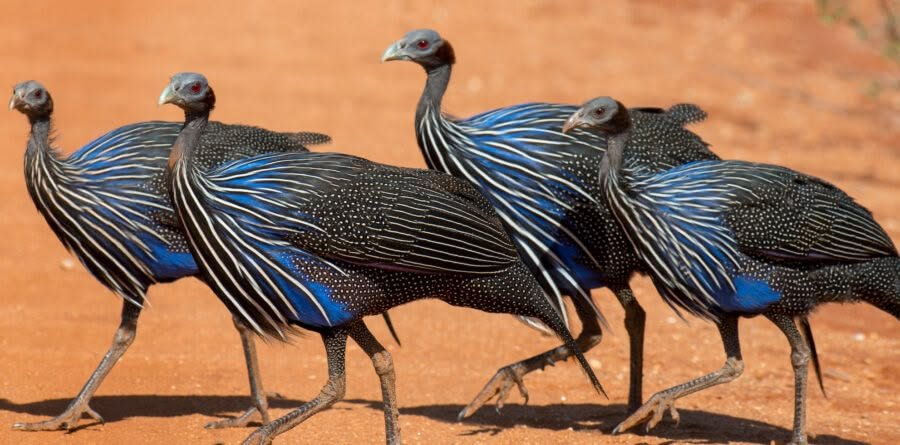
Vulturine Guineafowl
Acryllium vulturinumThe largest, most spectacular guineafowl – known as Kicheleko or Kororo tumbusi in Swahili.
The Vulturine Guineafowl (Acryllium vulturinum) is the largest extant species of guineafowl [citation:11]. It is easily distinguished from other guineafowl by its long, glossy, blue-and-white hackles that project from the neck, a cobalt-blue breast, and a bare blue face that gives it a vulture-like appearance [citation:1][citation:6][citation:11]. It is a resident breeder in northeast Africa, from southern Ethiopia through Kenya and just into northern Tanzania [citation:1][citation:11].
Vulturine Guineafowl Quick Facts
What Is the Vulturine Guineafowl?
The Vulturine Guineafowl (Acryllium vulturinum) is the largest extant species of guineafowl and the most spectacularly coloured of the family [citation:1][citation:11]. Systematically, it is only distantly related to other guineafowl genera; its closest living relative is the White-breasted Guineafowl (Agelastes meleagrides) of Central Africa [citation:11].
It is the only member of the genus Acryllium and a resident breeder in northeast Africa, from southern Ethiopia through Kenya and just into northern Tanzania [citation:1][citation:11]. The species gets its name from its small, bare head and long bare neck that resemble those of a vulture [citation:1][citation:11].
In Tanzania and Kenya it is known by its Swahili names Kicheleko or Kororo tumbusi [citation:3]. It is a bird of dry acacia scrubland and semi-arid savanna, often seen in flocks of 20-30 individuals [citation:3].
How to Identify a Vulturine Guineafowl
This species is unmistakable once seen. Its combination of brilliant colors and distinctive shape sets it apart from any other bird:
- Size: A large (61–71 cm) bird with a round body and small head [citation:1][citation:11].
- Neck and head: The adult has a bare blue face and black neck. It has a longer neck, legs, and tail than other guineafowl [citation:1][citation:11].
- Hackles: The slim neck projects from a cape of long, glossy, blue and white hackles (elongated neck feathers) [citation:1][citation:6][citation:11].
- Breast: A striking cobalt blue breast [citation:1][citation:11].
- Body plumage: Black, finely spangled with white [citation:1][citation:11].
- Wings: Short and rounded, with the tail being longer than others in the family Numididae [citation:11].
- Sexes: Similar in appearance, although the female is usually slightly smaller than the male and has smaller tarsal spurs [citation:1][citation:11].
Compared to Other Guineafowl
Unlike the Helmeted Guineafowl, which has a bony casque on its head, the Vulturine has a bare blue face with no helmet. The Vulturine is also slimmer and taller than other guineafowl species, with an unmistakable cobalt-blue breast [citation:1][citation:11].
Behavior & Social Life
The Vulturine Guineafowl is a gregarious species, forming flocks outside the breeding season typically of about 25 birds [citation:1][citation:3][citation:11].
Daily Activity
- Terrestrial: They spend the day scratching the ground in search of food [citation:3][citation:6].
- Flight: They prefer to run rather than fly when alarmed, but are strong fliers when they take to the air [citation:3][citation:6][citation:11].
- Roosting: At night they roost in trees, often flying up to their roosts [citation:1][citation:3][citation:6].
- Habitat preference: Despite the open habitat, they tend to keep to cover [citation:1][citation:11].
Communication
- Main call: A loud, high-pitched chink-chink-chink-chink-chink [citation:1][citation:11].
- Alternative call: A high-pitched, sing-song wi-yi-why-yi-why-yi-wii [citation:3].
- Disturbed: When excited or disturbed, their calls can be heard over long distances [citation:8].
They are capable of going for long periods without water, though they will drink when water is available [citation:3][citation:6].
Habitat & Distribution
The Vulturine Guineafowl inhabits dry and open habitats with scattered bushes and trees, such as savanna or grassland [citation:1][citation:11]. It is common in acacia scrubland and dry bush from southern Ethiopia and Somalia to Kenya and Tanzania [citation:3].
Distribution: It is a resident breeder in northeast Africa, from southern Ethiopia through Kenya and just into northern Tanzania [citation:1][citation:11].
Altitude: It lives in dry bush and savanna from sea level up to approximately 3,940 feet (1,200 m) [citation:3]. It is also recorded up to 1,900 m in some parts of its range [citation:5].
Tanzania Distribution
In Tanzania, the Vulturine Guineafowl is found in the dry north, primarily in Mkomazi National Park near the Kenyan border, which shares an ecosystem with Kenya's Tsavo West [citation:2]. A specimen has also been recorded from the North Pare Mountains in Tanzania [citation:7].
Vulturine Guineafowl in Tanzania
The Vulturine Guineafowl is a special sighting in Tanzania, restricted to the dry northern regions. Here are the best places to look for it:
Mkomazi National Park
The best place in Tanzania to see Vulturine Guineafowl, in arid bushland and acacia scrub near the Kenyan border [citation:2].
Mkomazi safariNorth Pare Mountains
A specimen has been recorded from this mountainous region in northern Tanzania [citation:7].
Explore DestinationsKenya Border Ecosystem
Shared ecosystem with Tsavo West – Vulturine Guineafowl are more common on the Kenyan side of the border.
Kenya safariDry-country Specialist
Thrives in arid thorn-scrub and semi-desert, often at the edges of lowland forest [citation:8].
Safari Methods
- Game drives through dry bushland and acacia scrub.
- Walking safaris where permitted, to watch them forage.
- Birdwatching – they are active and easy to observe in open habitats.
- Wildlife photography – their cobalt blue breast and long hackles make stunning subjects.
Best Time to See Them
Vulturine Guineafowl are present year-round in suitable habitat. They are most active during the cooler morning and evening hours, when they come out to forage in open areas.
Diet & Feeding
Vulturine Guineafowl are omnivorous, feeding on a wide variety of foods [citation:3][citation:8].
Food Sources
- Seeds and fallen fruit [citation:3].
- Insects – including grasshoppers and termites [citation:3].
- Tubers and roots [citation:3][citation:8].
- Small reptiles and rodents – they are quick enough to nab a small snake or rodent [citation:3][citation:8].
- Grubs [citation:8].
- Vegetation occasionally [citation:8].
Foraging Behavior
They spend the day scratching the ground in search of food [citation:3][citation:6]. They can go for long periods without water, though they will drink when water is available [citation:3][citation:6].
Breeding & Life Cycle
Breeding begins as the rainy season starts [citation:3].
Nesting
- Nest: A ground scrape made by the female, lined with grass or placed under low shrubs [citation:3][citation:8].
- Location: The nest is often situated under dense tussocks of grass or protected by rock or bush [citation:8].
- Eggs: Females lay 4-15 cream-colored or creamy-white eggs [citation:1][citation:8][citation:11].
Incubation & Chicks
- Incubation: Approximately 28 days [citation:3][citation:8].
- Chicks: Precocial – they leave the nest almost immediately and can feed themselves, but parents guide and protect them for some time [citation:8].
- Fledging: They can fly about 15-20 days after hatching, or by about 10 weeks [citation:3][citation:8].
Sexual Maturity
Birds attain their adult plumage at about six months and are sexually mature at two years [citation:15].
Conservation Status
The Vulturine Guineafowl is assessed as Least Concern on the IUCN Red List [citation:5][citation:10].
Its population is suspected to be stable, and it has an extremely large range of approximately 1,500,000 km² [citation:5][citation:10]. The total population may exceed 1 million individuals and is generally common and stable, though in some regions it may be locally reduced by overhunting [citation:14].
Despite its secure status, it faces some local pressures:
- Overhunting in some parts of its range [citation:14].
- Habitat loss and fragmentation.
- Trade – the species has been reported as used in trade at a high prevalence in some regions [citation:5].
No specific conservation actions are currently in place for this species, though it is recorded from 28 Important Bird and Biodiversity Areas (IBAs/KBAs) across its range [citation:5].
Comparisons
The Vulturine Guineafowl is sometimes confused with the Helmeted Guineafowl, which also occurs in Tanzania. Here are the key differences:
| Feature | Vulturine Guineafowl | Helmeted Guineafowl |
|---|---|---|
| Head | Bare blue face, no helmet, vulture-like appearance [citation:1][citation:11] | Bare head with bony casque (helmet) |
| Breast | Cobalt blue with long black-and-white hackles [citation:1][citation:11] | Slate-grey with rows of white spots |
| Size | Largest guineafowl (61-71 cm) [citation:1][citation:11] | 53-58 cm |
| Habitat | Dry acacia scrub and arid savanna [citation:3] | More widespread, including woodland and grassland |
| Call | High-pitched chink-chink-chink or sing-song wi-yi-why [citation:1][citation:3][citation:11] | Rasping kek-kek-kek |
Did You Know?
Vulture Lookalike
The species gets its name from its small, bare head and long bare neck, which resemble those of a vulture [citation:1][citation:11].
Only Member
It is the only member of its genus, Acryllium [citation:1][citation:11].
Largest Guineafowl
At 61-71 cm, it is the largest of all guineafowl species [citation:1][citation:11].
Tree Sleepers
They roost high in trees at night to avoid predators [citation:1][citation:3][citation:6].
Heat Avoiders
During the hottest hours of the day, they rest perched in thick vegetation [citation:8].
Small Snake Nabbers
They are quick enough to catch a small snake or rodent [citation:3].
There is nothing quite like seeing a Vulturine Guineafowl striding across the dry savanna – a splash of cobalt blue against the gold of the bush, its long, glossy hackles catching the light as it runs. In the acacia scrub of Mkomazi, this bird is a living jewel of the dry country, a sight that rewards the patient safari-goer with something truly spectacular.
Gallery
Frequently Asked Questions
The Vulturine Guineafowl (Acryllium vulturinum) is the largest and most spectacular of all guineafowl species. It is the only member of the genus Acryllium and is native to northeast Africa, from southern Ethiopia through Kenya and just into northern Tanzania [citation:1][citation:11].
In Tanzania, the Vulturine Guineafowl is found primarily in the dry north. The best location is Mkomazi National Park near the Kenyan border, which has confirmed records of the species. It is also recorded from the North Pare Mountains [citation:2][citation:7].
They are omnivorous, feeding on seeds, roots, tubers, grubs, rodents, small reptiles, and insects. They occasionally feed on vegetation and fruits [citation:3][citation:8].
No. The Vulturine Guineafowl is listed as Least Concern on the IUCN Red List, with a large range and a stable population trend [citation:5][citation:10].
The species gets its name from its small, bare head and long bare neck, which resemble those of a vulture. The blue face and long neck give it a distinctively vulture-like appearance [citation:1][citation:11].
It is the largest guineafowl, measuring 61-71 cm in length and weighing between 1.0-2.2 kg. It has a longer neck, legs, and tail than other guineafowl species [citation:1][citation:3][citation:11].
In Tanzania and Kenya, the Vulturine Guineafowl is known as Kicheleko or Kororo tumbusi in Swahili [citation:3].
The Vulturine has a bare blue face with no helmet, a cobalt blue breast, and long blue-and-white hackles. The Helmeted has a bony casque on its head, slate-grey plumage with white spots, and no blue breast [citation:1][citation:11].
References & Further Reading
- Wikipedia – Vulturine guineafowl: scientific name, largest extant guineafowl, resident breeder in northeast Africa, description, behavior .
- Mpala – Field Guide: Swahili name (Kicheleko), size, weight, flock size, call, diet, breeding, habitat .
- BirdLife International (2024): Species Factsheet – Least Concern status, population trend stable, range size .
- Birds of the World (Martínez & Kirwan, 2020): Scientific name definitions, taxonomy, protonym details .
- Oiseaux.net: Photo record from Mkomazi National Park, Tanzania, confirming presence in northern Tanzania .
- Natural History Museum Denmark: Specimen record from North Pare Mountains, Tanzania .
- Penang Bird Park: Description, range, behavior, diet, reproduction details .
- EcoPort: Observation of flocks gathering in Samburu, Kenya; roosting and flight behavior .