

.png)
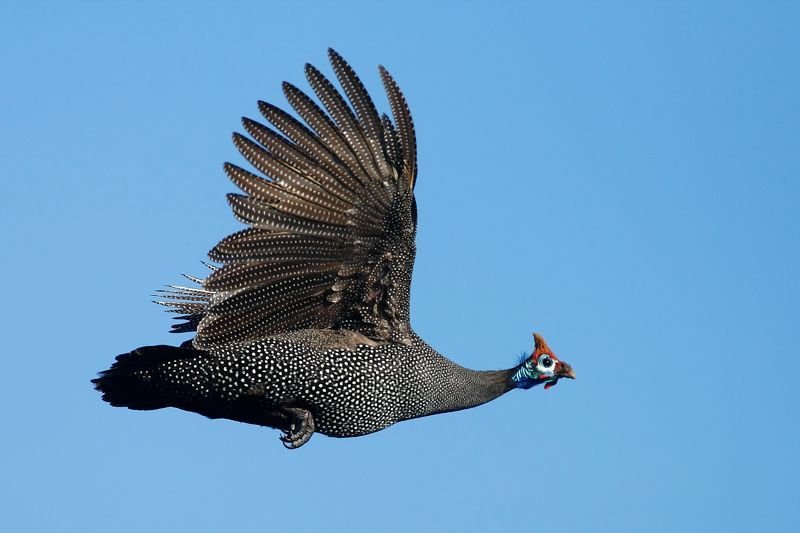
Helmeted Guineafowl
Numida meleagrisA speckled classic of the African savanna – known as Kanga or Chepeo in Swahili.
The Helmeted Guineafowl (Numida meleagris) is a large, chicken-sized gamebird native to much of mainland Africa. It is easily recognized by its slate-grey body speckled with rows of white spots, a small bare head with a bony casque (the 'helmet'), and naked warty facial skin colored blue, red, or white depending on the region [citation:1][citation:3][citation:12]. It forms stable flocks of 15–40 birds and is a familiar sight across Tanzania's savannas, woodlands, and even suburban gardens [citation:1].
Helmeted Guineafowl Quick Facts
What Is the Helmeted Guineafowl?
The Helmeted Guineafowl (Numida meleagris) is a large-bodied, chicken-sized gamebird native to much of mainland Africa. It is the best-known member of the guinea-fowl family (Numididae) and is Africa's most famous game bird, having been domesticated and introduced worldwide [citation:1][citation:3].
This bird is a familiar sight across Tanzania's savannas and woodlands. In Kenya and Tanzania it is known by its Swahili names Kanga or Chepeo. It is often seen in flocks of up to a few dozen birds, foraging on open ground. It is also a popular species for safari goers because its distinctive speckled plumage and constant foraging make it easy to observe [citation:3][citation:12].
How to Identify a Helmeted Guineafowl
The Helmeted Guineafowl is unmistakable once you know what to look for:
- Body: Large, plump, chicken-like bird with a humped-backed appearance [citation:6].
- Plumage: Slate-grey body densely speckled with white spots. The flight feathers are similarly patterned, with white stripes that create a barred appearance when the wing is closed [citation:6].
- Head: Small, bare head with a distinctive bone-like casque (helmet) on top [citation:1][citation:12].
- Facial skin: Naked, warty skin colored white, blue, or red depending on geographic location [citation:12].
- Wattles: Hanging wattles surround the nostrils, red-tipped and blue on the lower face [citation:6].
- Legs: Dark grey in wild-type birds; orange-brown in domestic stock [citation:6].
- Size: Approximately 53-58 cm in length [citation:1].
Differences Between Male and Female
Males and females are similar in appearance (monomorphic), but subtle differences exist:
- Casque: Males have a bigger helmet than females [citation:1].
- Wattles: Males have larger wattles [citation:6].
- Call: The most reliable difference. Males give a single, recurring 'chek' note. Females produce a distinctive, repetitive two-syllable call 'buck-wheat', where the first note is short and the second is longer and rising [citation:6].
Behavior & Social Life
The Helmeted Guineafowl is a highly social bird. It forms relatively stable flocks of 15 to 40 birds during the non-breeding season [citation:1]. Each flock develops its own complex society with a distinct pecking order among males [citation:3][citation:14].
Daily Activity
- Terrestrial: They are predominantly ground scavengers and will spend most of their time on the ground. They prefer to walk rather than fly and can cover up to 10 km per day in search of food [citation:1].
- Flight: They can fly, but use this option only when in danger or to reach their roosts for the night. These flights are usually very short, not more than about 100 m [citation:1].
- Roosting: Like chickens, they roost in trees at night to avoid predators [citation:1][citation:8].
Communication
Guineafowl are noisy birds with several distinct calls [citation:1][citation:6]:
- Breeding call: A harsh, loud sound during breeding season to attract a partner.
- Alarm call: A rasping, stuttering, grating "keerrrr" or a repeated harsh, rattling "kek-kek-kek-kek-krrrrrrr".
- Contact call: A quieter "pi-pi'oo".
Guineafowl are also known for their role in controlling ticks – they are known to glean ticks from warthogs [citation:3].
Habitat & Distribution
The Helmeted Guineafowl is widely distributed across much of mainland Africa, from Senegal in the west to Ethiopia and South Africa in the east and south [citation:4][citation:8].
Habitat: They are adaptable and can roam in almost any kind of habitat, but prefer:
- Grasslands
- Thornveld
- Open woodland and bush
- Agricultural land and farmland [citation:1]
They avoid arid areas and rain forests [citation:1]. They are not migratory, but they do move around more during breeding time [citation:1]. The Helmeted Guineafowl has also been introduced to many countries worldwide, including Portugal, Spain, the USA, and New Zealand, where it is often found around farmyards [citation:4][citation:6].
Tanzania Distribution
In Tanzania, the Helmeted Guineafowl is a local resident in the Serengeti and other national parks [citation:11]. It is widespread and common throughout the country's savanna and woodland habitats.
Helmeted Guineafowl in Tanzania
Helmeted Guineafowl are widespread across Tanzania's national parks and protected areas. They are an easy and rewarding species to spot on safari.
Serengeti National Park
A true birder's paradise – the helmeted guineafowl is a local resident of the Serengeti [citation:11].
Serengeti safariRubondo Island National Park
This park hosts about 150 bird species, including the Helmeted Guineafowl [citation:5].
Rubondo safariNgorongoro Crater
Animal Diversity Web records the helmeted guineafowl from the Ngorongoro Crater floor [citation:13].
Ngorongoro safariLake Manyara & Mkomazi
Also present in Lake Manyara National Park and Mkomazi National Park in the dry north.
Manyara safariSafari Methods
- Game drives across open grassland and woodland.
- Walking safaris where permitted, to watch them forage.
- Birdwatching – they are active and easy to observe.
- Wildlife photography – their speckled plumage and bright facial skin make great subjects.
Best Time to See Them
Helmeted Guineafowl are present year-round in suitable habitat. They are most active during the cooler morning and evening hours, foraging in open areas.
Diet & Feeding
Helmeted Guineafowl are omnivorous, feeding mainly on seeds and insects [citation:1][citation:3].
Food Sources
- Seeds and kernels of fallen corn [citation:3].
- Insects: Especially grasshoppers and termites [citation:3].
- Tubers and roots [citation:3][citation:8].
- Small reptiles and rodents [citation:8].
- Grubs [citation:8].
- Vegetation and fruits occasionally [citation:8].
Foraging Behavior
They use their short beaks and feet to scratch amongst soils and rubble in search of food [citation:1]. They have also been observed dissecting elephant dung in search of food [citation:1].
Their diet shifts seasonally: during summer they concentrate mainly on insects, and during winter they subsist on seeds and bulbs [citation:1].
Breeding & Life Cycle
Helmeted Guineafowl time their breeding to coincide with the arrival of the rainy season [citation:3].
Courtship
As pairs form, males fight over females. To win a mate, a male displays for a female and makes food offerings [citation:3]. During the breeding season, both partners will call to each other at the same time, almost as if singing a duet [citation:1].
Nesting
- Nest: A shallow ground scrape lined with grass and detached feathers, placed beneath a bush or in dense cover [citation:1][citation:6].
- Concealment: Nests are always concealed.
- Egg-dumping: Some females will lay their eggs in another nest to be incubated by the owner of the nest – a process called egg-dumping [citation:1].
Eggs & Incubation
- Clutch size: Females lay 6 to 20 eggs [citation:3][citation:8].
- Egg description: Cream-brown, pear-shaped eggs [citation:6].
- Incubation: 26 to 28 days [citation:8].
- Incubation period: Only starts when the last egg is laid [citation:1].
Chicks (Keets)
- Precocial: Baby guineafowl can leave the nest immediately and are called keets [citation:1].
- Fledging: By three months, the chicks are able to join the flock as fledged birds [citation:3].
- Sexual maturity: Approximately 2 years [citation:8].
Lifespan
Helmeted Guineafowl can live up to 12-15 years [citation:1][citation:8].
Conservation Status
The Helmeted Guineafowl is assessed as Least Concern on the IUCN Red List [citation:4][citation:8][citation:10].
Its population is suspected to be stable, and it has an extremely large range. The global population size is unknown, but the species is not considered threatened [citation:4][citation:8].
Despite its secure status, it faces some local pressures:
- Hunting as a gamebird in some regions [citation:1].
- Habitat loss and fragmentation in parts of its range.
- Pesticide use in agricultural areas, which can reduce insect food sources [citation:6].
The species is domesticated in many parts of the world and is farmed for meat, eggs, and as a natural tick-control agent.
Comparisons
Helmeted Guineafowl can be confused with the Crested Guineafowl, which also occurs in Tanzania. Here are the key differences:
| Feature | Helmeted Guineafowl | Crested Guineafowl |
|---|---|---|
| Head | Bare head with bony casque (helmet) [citation:12] | Plumed crest of black feathers on top of the head [citation:12] |
| Plumage | Slate-grey with rows of white spots [citation:12] | Darker overall, with fine white speckles |
| Facial skin | Colorful (blue, red, white) depending on region [citation:12] | Darker, less colorful |
| Call | Distinctive 'kek-kek-kek-kraaaaaaah' alarm [citation:12] | Different call pattern |
They also share habitat with other gamebirds like the Kori Bustard and the Ostrich.
Did You Know?
Ancient Delicacy
The ancient Greeks and Romans dined on helmeted guineafowl. Portuguese seamen brought them back to Europe in the 16th century [citation:3][citation:8].
Tick Gleaners
Helmeted guineafowl are known to glean ticks from warthogs – a natural pest control partnership [citation:3].
Walking Machines
They can walk up to 10 km a day in search of food [citation:1].
Egg Dumpers
Some females lay eggs in other females' nests, a practice called egg-dumping [citation:1].
Sex-Specific Calls
Males call 'chek', females call 'buck-wheat' – a simple way to tell them apart [citation:6].
Tree Sleepers
Like chickens, they roost in trees at night to avoid predators [citation:1].
There is a certain comedy in a flock of guineafowl – the frantic, dashing energy of a group of speckled birds on the savanna, their blue and red heads bobbing as they charge around. They are the wildlife watchers' friend, alerting the whole savanna to a predator's approach with their loud, grating alarm call. To stand near a flock is to glimpse the busy, social life of Africa's grassland.
Gallery
Frequently Asked Questions
The Helmeted Guineafowl (Numida meleagris) is a large-bodied, chicken-sized gamebird native to much of mainland Africa. It is easily recognized by its slate-grey body speckled with white spots, small bare head with a bony casque (helmet), and blue-red facial skin [citation:1][citation:3].
Helmeted Guineafowl are widespread across Tanzania. Key locations include Serengeti National Park, Rubondo Island National Park, Lake Manyara, Tarangire, and Mkomazi National Park [citation:5][citation:11].
They are omnivorous, feeding mainly on seeds, roots, tubers, insects (especially grasshoppers and termites), and small reptiles. They are known to dissect elephant dung in search of food [citation:1][citation:3].
No. The Helmeted Guineafowl is listed as Least Concern on the IUCN Red List, with a stable population across its extensive range [citation:4][citation:8].
Males have a larger helmet (casque) and larger wattles. The most reliable difference is their call: males give a single recurring 'chek' note, while females produce a distinctive two-syllable 'buck-wheat' call [citation:1][citation:6].
Female helmeted guineafowl lay 6 to 20 eggs each breeding season [citation:3][citation:8].
They can live up to 12-15 years in the wild [citation:1][citation:8].
In Tanzania and Kenya, the Helmeted Guineafowl is known as Kanga or Chepeo in Swahili [citation:3].
References & Further Reading
- SANBI (South African National Biodiversity Institute) – Helmeted Guinea-fowl: description, habitat, diet, behavior, breeding [citation:1].
- Mpala Live! Field Guide – Helmeted Guineafowl: scientific name, Swahili name, diet, breeding, behavior [citation:3].
- BirdLife DataZone – Species Factsheet: distribution, IUCN status, range description [citation:4].
- New Zealand Birds Online – Helmeted guineafowl: identification, voice, breeding, impacts [citation:6].
- SeaWorld Parks & Entertainment – Helmeted Guineafowl Facts: scientific classification, size, weight, incubation, lifespan, status [citation:8].
- eBird – Helmeted Guineafowl: identification features, calls, comparison with Crested Guineafowl [citation:12].
- Serengeti National Park Safaris – The Serengeti Is A True Birder's Paradise: confirms presence in Serengeti [citation:11].
- Safaris Rwanda Safari – Rubondo Island National Park Bird Checklist: confirms presence in Rubondo [citation:5].
- Animal Diversity Web – Numida meleagris (helmeted guineafowl): specimen from Ngorongoro Crater [citation:13].