

.png)
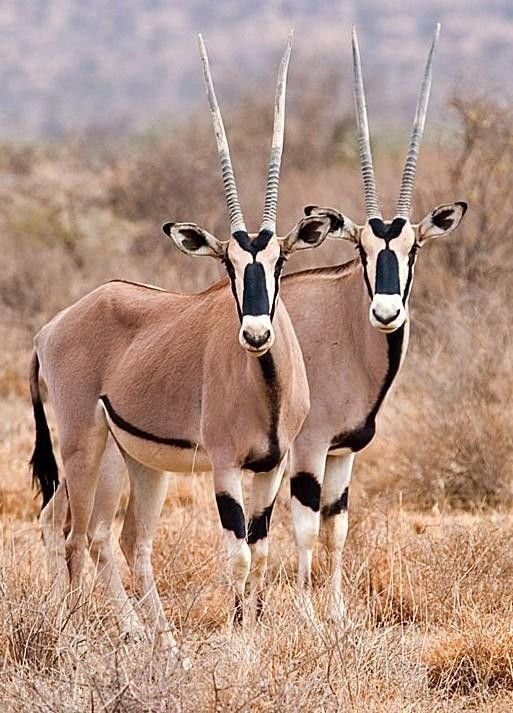
Beisa Oryx
Oryx beisaThe desert warrior of East Africa.
Sightings are never guaranteed and depend on local conditions. Follow your guide and respect park rules.
Built for some of Africa’s harshest landscapes, the Beisa Oryx moves across the drylands of East Africa with extraordinary resilience. Its pale coat, dramatic black markings and long, straight horns make it instantly recognizable, while its ability to obtain moisture from vegetation helps it endure environments where free water can be scarce. Endangered. Resilient. Wild.
Beisa Oryx Quick Facts
What Is the Beisa Oryx?
The Beisa Oryx (Oryx beisa) is one of East Africa’s most impressive desert-adapted antelopes. With a pale body, contrasting black markings and long, almost perfectly straight horns, it is built for life in some of the continent’s hottest and driest landscapes. Unlike animals that depend heavily on permanent water, the Beisa Oryx can obtain much of its moisture from vegetation and has physiological and behavioral adaptations that allow it to survive prolonged dry periods. It belongs to the antelope family Bovidae, subfamily Hippotraginae, which also includes the related Gemsbok and fringe-eared oryx.
Signature Features
Pale gray/fawn coat
Light body with white underparts for heat reflection.
Black markings
Dark facial, limb and flank markings create bold contrast.
Long straight horns
Both sexes carry near-perfectly straight “spears.”
Strong neck
Muscular neck powers horn use and dominance.
Compact muscle
Stocky, powerful body built for endurance.
Large ears
Big ears help detect sounds across open country.
Physical Characteristics
The Beisa Oryx has a compact but extremely muscular body with strong shoulders, a broad chest, powerful legs and a long neck useful for browsing and scanning the landscape. Body length is roughly 1.5–2 m (measured along the body), with the long straight horns adding further length — but avoid presenting one universal weight or length as if every individual is identical; size and mass vary by sex and individual. Both males and females possess the species’ famous long, straight horns. The oryx can reach approximately under favorable conditions, but that figure is an approximate maximum, not a constant cruising speed. Longevity should be described cautiously rather than with a fixed lifespan number.
Habitat & Range
The Beisa Oryx is primarily a Horn of Africa and East African species, not an “East and Southern Africa” species. Its principal range spans Ethiopia, Somalia, Kenya and northeastern Uganda, in arid and semi-arid environments: bushland, grassland, steppe, thorn scrub, dry savanna and open woodland. It is not a species of lush rainforest or dense wetland. Importantly, Southern Tanzania is associated more strongly with the fringe-eared oryx (historically Oryx beisa callotis) than with the nominate Beisa Oryx — so Tanzanian oryx sightings should not automatically be presented as Beisa Oryx records without form-level identification. This careful distinction makes the wildlife hub far more scientifically credible.
Where to See Beisa Oryx
Northern Kenya is the heart of Beisa Oryx tourism. The broader Samburu–Isiolo–Marsabit conservation landscape and the northern rangelands/community conservancies offer some of the best opportunities to see this dryland antelope in its natural environment. Don’t over-promise: wildlife distribution changes locally, so sightings are best described as a strong opportunity in northern Kenya rather than a guarantee. Ethiopia and Somalia are core parts of the species’ natural range and essential for accurate wildlife knowledge, even if African Majestic Adventure does not currently sell safari packages there. Northeastern Uganda is the western edge of the range — a “range country” is not the same as an easy safari destination. Regarding Tarangire, Tanzania: do not market it as a core Beisa Oryx hotspot; southern Tanzanian oryx populations are associated with the fringe-eared form and require careful identification. The dry season (broadly June–October) brings favorable general wildlife-viewing conditions, but local timing varies.
The Famous Oryx Horns
The horns are arguably the defining feature of the Beisa Oryx and deserve special attention. Both males and females possess long, straight horns that function as natural spears. They are used for defense, dominance contests, predator deterrence and male competition — which is why oryx are sometimes described as “spear-wielding antelopes.” Do not claim the horns are used primarily for territorial defense unless that specific context is given; their primary roles are protection and social competition.
Defense
Two long horns make an adult dangerous to approach.
Dominance
Males test strength and rank through horn use.
Predator deterrence
Horns discourage attacks on healthy adults.
Male competition
Contests establish social rank among males.
Predators & Defense
Lions are among the predators capable of killing oryx, and depending on location young or vulnerable animals may also face spotted hyenas, leopards and African wild dogs. The exact predator community varies geographically. However, a healthy adult Beisa Oryx is a formidable target: two long horns, a powerful neck and a strong body, combined with coordinated herd vigilance, can make it dangerous prey. A lion must manage the real risk of a horn through the body, which is why isolated, young or weakened animals are more vulnerable than healthy adults.
Behavior & Social Life
Oryx social systems are better described through herds, female-and-young associations, male dominance relationships, territorial males and temporary aggregations rather than a single dominant-leader structure. Group size varies; do not claim a fixed herd size. Dominant males may establish territories and use dung marking to communicate territorial information, while non-territorial males can live in mixed groups with females and young. Males establish dominance through size, strength, displays and horn interactions, with contests that involve standing side-by-side, pushing and clashing horns to determine social rank. Daily activity varies with temperature, food availability, predator pressure, season and disturbance; cooler parts of the day often see more feeding, rather than a rigid fixed timetable.
Diet & Feeding
The Beisa Oryx is not exclusively a grazer; it can switch between grazing and browsing depending on habitat, season and plant availability. The diet can include grasses, thorny shrubs, leaves, herbs, succulent vegetation, roots and tubers and other drought-resistant plants. African Wildlife Foundation notes that oryx commonly feed on coarse grasses and thorny shrubs, while desert populations may use thick-leaved plants, wild melons and roots/tubers. This flexibility is a major reason the species survives harsh, dry environments.
Drought & Heat Adaptations
The Beisa Oryx survives extreme heat and limited free water through a strategy of get water from food + conserve water + tolerate heat. It can obtain moisture from green vegetation, succulent plants and dew; free-standing water is useful when available, but the species can survive dry periods largely by extracting moisture from vegetation and conserving water. Behavior is strongly influenced by temperature — during hotter periods it can reduce activity and seek shade, so heat avoidance becomes energy conservation. Feeding often increases during cooler parts of the day (early morning and late afternoon), rather than following one fixed schedule.
Calves & Reproduction
One of the most fascinating aspects of Beisa Oryx ecology is the hidden-calf strategy. The mother generally leaves the herd to give birth and hides the newborn, rather than immediately bringing it into the group. African Wildlife Foundation reports that females hide newborn calves for approximately the first two or three weeks, visiting periodically to nurse them. Newborns have a less conspicuous brown coloration that helps them blend into the dry landscape; the adult black-and-white markings become more pronounced as they grow. Calves are suckled for roughly 6–9 months before becoming fully independent. The mother returns to nurse, check and eventually reunite the calf with the herd — a far more accurate picture than “the whole herd protects newborns.”
Taxonomy
| Kingdom | Animalia |
| Phylum | Chordata |
| Class | Mammalia |
| Order | Artiodactyla |
| Family | Bovidae |
| Subfamily | Hippotraginae |
| Genus | Oryx |
| Species | Oryx beisa |
NCBI and ITIS both currently recognize Oryx beisa as a valid species. Taxonomic treatment of the East African oryx group varies by authority, so the page avoids pretending all sources use an identical species/subspecies arrangement.
Comparisons
Beisa Oryx vs Gemsbok
| Feature | Beisa Oryx | Gemsbok |
|---|---|---|
| Scientific name | Oryx beisa | Oryx gazella |
| Main region | East / Horn of Africa | Southern Africa |
| Habitat | Dry East African landscapes | Southern African arid landscapes |
| Key range | Kenya, Ethiopia, Somalia | Namibia, Botswana, South Africa |
| Conservation | Endangered | Different status |
Beisa Oryx vs Fringe-eared Oryx
| Feature | Beisa Oryx | Fringe-eared Oryx |
|---|---|---|
| Scientific treatment | Oryx beisa | Often O. b. callotis |
| Core range | Horn + East Africa | Southern Kenya + Tanzania |
| Ears | Less distinctive | Characteristic ear fringes |
| Tanzania | Not the core nominate range | Important historical range |
| Habitat | Dry / semi-arid | Dry savanna & woodland |
Taxonomic treatment varies, so the southern form is labeled carefully rather than presented as universally settled.
Conservation Status
The Beisa Oryx is currently classified as Endangered. The IUCN’s 2018 assessment reported a decline from roughly 26,000 individuals in the mid-1990s to about 12,000 in its most recent estimate used for that assessment — an estimated decline of around 54%. The IUCN attributed the decline primarily to overexploitation and encroachment by settlement and livestock.
Why Is the Beisa Oryx Endangered?
1. Overhunting
Historically hunted for meat, hide and horns.
2. Habitat conversion
Agriculture, settlement, infrastructure and livestock expansion.
3. Livestock competition
Competition for grazing, browse, water and space, especially in drought.
4. Fragmentation
Roads, settlements and land conversion break habitat into pieces.
Community Conservation
The conservation solution cannot simply be “build more national parks.” Dryland wildlife often shares landscapes with pastoral communities, so conservation can involve community conservancies, sustainable grazing, anti-poaching, wildlife corridors, livelihood programs, tourism revenue and habitat restoration. Well-managed wildlife tourism can provide economic incentives for communities and landowners to conserve wildlife habitat when revenue-sharing and conservation partnerships are properly structured.
Ecological Role
Beisa Oryx influence dryland ecosystems through grazing, browsing, seed movement and nutrient cycling, and they provide prey for large predators — contributing to the wider food web. Climate change can increase drought frequency, heat stress, vegetation variability and competition with livestock; for a species already adapted to arid environments, the challenge is whether its ecosystem continues providing enough food and space.
Photographing Beisa Oryx
This species photographs beautifully because of its pale coat, black facial markings, long horns and strong silhouette. Effective compositions include a full-body side profile showing horn-to-tail shape, a front-facing portrait emphasizing the horns, and a wide landscape showing its relationship with dryland habitat. Early morning and late afternoon are often excellent because light is softer, shadows longer and temperatures cooler — but do not confuse best photography light with a fixed biological activity schedule.
Did You Know?
Horn of Africa
Core range includes Ethiopia & Somalia.
Spear antelope
Horns used as defense and in male contests.
Dung marking
Territorial males mark with dung.
Not just Tanzania
Tanzanian oryx needs form-level ID.
Northern Kenya
Samburu/Marsabit are key safari regions.
On a shimmering northern Kenyan plain, a Beisa Oryx stands like a living spear against the heat — proof that some of Africa’s most extraordinary wildlife has learned to thrive where water is a rumor and the sun never apologizes.
Gallery
Frequently Asked Questions
Oryx beisa.
Yes. The IUCN lists the species as Endangered.
Primarily across dry regions of Ethiopia, Somalia, Kenya and northeastern Uganda.
This requires taxonomic care. Southern East African oryx populations in Tanzania are associated with the fringe-eared form, historically treated as Oryx beisa callotis, rather than assuming every Tanzanian oryx is the nominate Beisa Oryx.
It eats grasses, thorny shrubs, leaves, herbs and other drought-adapted vegetation. In very dry environments it can exploit succulent plants and roots/tubers.
They are highly adapted to dry conditions and can obtain substantial moisture from vegetation, although free water can still be used when available.
It can reach roughly under favorable conditions.
Yes. Both sexes have long, straight horns.
They are used in defense and male competition and can be formidable weapons against predators.
Lions, hyenas and other large predators can threaten them, especially young or vulnerable animals.
Yes, they can form herds, but group size and composition vary with environmental conditions.
Dominant males may establish territories and use dung marking to communicate territorial boundaries.
Females can hide newborn calves for the first two or three weeks and return periodically to nurse them.
Approximately six to nine months, according to African Wildlife Foundation.
Major historical pressures include hunting/overexploitation, settlement expansion and livestock encroachment.
Northern Kenya is one of the strongest safari regions for the species. Samburu and surrounding northern drylands are particularly relevant.
Do not promise it as a core Beisa Oryx destination. Tanzania requires careful identification because southern East African oryx populations are associated with the fringe-eared form.
The Beisa Oryx is primarily an East/Horn African species, while the Gemsbok (Oryx gazella) is primarily associated with southern Africa.
They are closely related East African forms; the fringe-eared form is associated farther south, including parts of Tanzania. Taxonomic treatment varies by authority, so the page identifies the convention used.
References & Further Reading
- IUCN Red List (2018 assessment): Beisa Oryx (Oryx beisa) listed as Endangered; population estimated at ~26,000 in the mid-1990s declining to ~12,000, an approximate 54% decline attributed mainly to overexploitation and encroachment by settlement and livestock.
- African Wildlife Foundation (AWF): Range from Ethiopia through Somalia into northeastern Uganda and Kenya; fringe-eared oryx distinct and extending into Central Tanzania; oryx feed on coarse grasses and thorny shrubs, hide newborn calves ~2–3 weeks, nurse ~6–9 months; adults use dung marking.
- ITIS / NCBI: Both currently recognize Oryx beisa as a valid species, while noting taxonomic variation in treatment of the East African oryx group.
- About these facts: Measurements are approximate ranges; conservation status should be checked against the current IUCN assessment.