

.png)
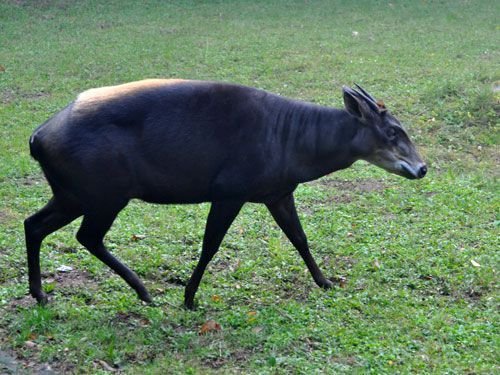
Blue Duiker
Philantomba monticolaAfrica’s tiny forest antelope that disappears in a heartbeat.
Sightings are never guaranteed and depend on local conditions. Follow your guide and respect park rules.
No larger than a small dog and perfectly adapted to dense forest undergrowth, the Blue Duiker is one of Africa’s most secretive antelopes. Its blue-gray coat, tiny horns and powerful instinct to dive into vegetation make it exceptionally difficult to spot. Feeding heavily on fallen fruit, flowers and other forest foods, this miniature antelope plays a quiet but fascinating role in Africa’s forest ecosystems. Small in size. Remarkable in survival.
Blue Duiker Quick Facts
What Is the Blue Duiker?
The Blue Duiker (Philantomba monticola) is a very small forest antelope belonging to the family Bovidae, and one of the smallest members of the duiker group. Its tiny body lets it move rapidly through thick undergrowth, and its secretive nature makes it one of Africa’s most difficult antelopes to observe. The name “duiker” comes from its characteristic behavior of diving into dense vegetation when alarmed — the Afrikaans word refers exactly to that habit of disappearing into cover.
Why “Duiker” & Why “Blue”?
When threatened, the animal reacts almost instantly: hear danger → turn → dive into vegetation → disappear. That behavior is the source of the name. The “blue” comes from the animal’s characteristic blue-gray or bluish appearance, especially noticeable in the cool shade of forest vegetation (SANBI notes the coloration can appear blue under forest shade). The coat is usually brown, chestnut-brown or grayish, with the bluish tone emerging under the right light.
Signature Features
Blue-gray coat
Appears bluish in forest shade.
Tiny compact body
Built to slip through cover.
Short horns
Both sexes may have them; male ~5 cm.
Explosive escape
Dives into vegetation in a heartbeat.
Large eyes
Strong forest-floor vision.
Vocal
Bird-like chirps and alarm calls.
How Tiny Is a Blue Duiker?
Animal Diversity Web gives an adult mass of about 4–6 kg, body length around 55–72 cm, and a tail approximately 7–12.5 cm long. An adult Blue Duiker can weigh about the same as a medium-sized domestic dog while still being a fully wild antelope — which is exactly why people frequently miss them on drives. Its advantage is maneuverability in cover, not the long legs of an open-country runner.
Horns, Tail & Senses
Both sexes can have horns, although they are generally more prominent in males and can be absent or less conspicuous in some females. The horns are short, straight and sharp — Animal Diversity Web gives about 5 cm for males — and are used mainly for territorial and social competition (presenting, pushing, ramming, clashing). The tail is short and dark with contrasting white hairs underneath; that white underside becomes a useful visual alarm signal when flicked during alarm. Because it is small and vulnerable, the species relies heavily on hearing (detect movement through vegetation), smell (predators and territorial information) and vision through forest cover.
Habitat & Range
Blue Duikers are strongly associated with rainforest, riverine forest, montane forest, dense thickets, forest edges, secondary forest and even some plantations/agricultural landscapes with sufficient cover — not open woodland or savanna. For a Blue Duiker, dense vegetation equals food + shelter + escape route. The species can also occur in montane forest (reflected in the species name monticola, “mountain-dwelling”), and can use relatively small or fragmented patches where adequate cover remains. Its broad distribution spans forested parts of West, Central, East and Southern Africa — including Angola, Cameroon, the Congo Basin countries, Kenya, South Sudan, Tanzania, Uganda, Malawi, Mozambique, Zambia, Zimbabwe, South Africa and others — so it should not be described as primarily Ugandan.
Blue Duiker in Tanzania
The Blue Duiker does occur in Tanzania, but it is not a Serengeti/Northern Circuit open-savanna animal, and should not be marketed as one. A Tanzanian field guide reports it as absent from northern and central Tanzania and most low-lying inland areas of south and central Tanzania. Where it does occur, it is a forest specialist:
Mahale National Park
Reported as abundant; camera-trap surveys recorded the species in more than one-third of photographs.
Zanzibar forests
Jozani-Chwaka Bay, Ukorongoni, Mtule, Muongoni and Mtende forest reserves — a natural link to Zanzibar/Jozani content.
Eastern Arc & Southern Highlands
Present but often uncommon; rare around Udzungwa. Abundance varies, so no single region should be called “the best place.”
Sightings are best described as uncommon / opportunistic. Even in good habitat, the animal can vanish into vegetation in seconds.
Behavior & Social Life
Blue Duikers are mainly diurnal, with occasional nocturnal activity documented under certain conditions — not a rigid fixed timetable. Socially, they are not herd animals. Adults can form monogamous territorial pairs, with the male and female occupying and defending a shared territory (reported at roughly 0.7–4 hectares, typically around 2.5–4 ha). The pair may forage separately and reunite, defending territory through scent marking using preorbital glands near the eyes rubbed on vegetation. Despite its size, the Blue Duiker can be surprisingly vocal — bird-like chirps, alarm calls, distress sounds and whistling when alarmed.
Diet & Feeding
The Blue Duiker is particularly associated with fruit and is best described as a forest frugivore/forager rather than a grass-specialized grazer. Animal Diversity Web describes it feeding heavily on fallen ripe and unripe fruit, plus seeds, flowers, fungi, leaves and occasional small animal matter such as insects. It can spend a remarkable ~67–76% of waking time foraging, much of it searching the forest floor for fallen fruit. A neat ecological link: monkeys feeding in the canopy drop fruit and seeds that reach the floor, where duikers retrieve them. Note the nuance — although they consume seeds, they appear not to be major seed dispersers because seeds are often thoroughly chewed, so they should not be automatically labeled seed-dispersal specialists.
Predators & Defense
Small enough to be prey for many animals, the Blue Duiker’s predator community varies by location and can include leopards, African golden cats, wild dogs, pythons, crocodiles, baboons, monitor lizards and the crowned eagle (a powerful forest raptor especially threatening to young/small individuals). Its defenses are its dense cover, vigilance and diving behavior rather than physical confrontation. This creates excellent internal links: Blue Duiker → Leopard, and Blue Duiker → African Golden Cat.
Young & Lifespan
Reproduction is best described cautiously: females give birth to young that are carefully concealed and raised within the mother’s territorial environment, rather than presented as a rigid universal litter size. Hiding young in dense vegetation and forest cover is a key survival strategy, and the most important relationship is mother + young, not a large cooperative family herd. Longevity: Animal Diversity Web records up to about 12 years in the wild and roughly 10–15 years (recorded maximum near 16) in captivity — so the oldest-known wild figure is about 12 years, with captivity permitting longer survival, rather than a guaranteed typical lifespan.
Conservation Status
The Blue Duiker is currently classified as Least Concern (Mammal Diversity Database / IUCN). But Least Concern does not mean no threat. The species is heavily exposed to bushmeat hunting across much of its range (SANBI describes extensive hunting for bushmeat), and can be caught in wire snares set for other animals. Habitat loss (deforestation, agriculture) and habitat degradation (loss of dense understory) further reduce quality. A species can remain globally Least Concern while local populations disappear — a key conservation concept. The Blue Duiker can occupy relatively small patches (a cited minimum critical patch size near 0.7 ha) and use plantations as corridors, but fragmented landscapes still expose it to hunting, dogs, roads and disturbance, so “adaptable” should not become “safe from habitat loss.”
Conservation in Tanzania
In Tanzania, Blue Duiker conservation depends on protecting forest habitat and controlling unsustainable hunting, particularly in the forests and protected landscapes where the species occurs (the Tanzania field guide identifies habitat loss and unregulated hunting as the main threats). Avoid generic claims of institutional monitoring unless tied to a specific current program/source.
Safari Experience
The Blue Duiker is not a classic safari species and should not be sold as “high sightings on game drives.” Instead, Blue Duiker encounters are specialist forest-wildlife experiences: their small size, secretive behavior and dense habitat make sightings unpredictable. Depending on destination, observation may be more realistic during forest walks where permitted, quiet forest-edge observation, or research/camera-trap encounters; game drives are possible in suitable areas but are not the primary selling point. Seasonal visibility varies by forest, rainfall and method — there is no universal “June–October is best” rule for this species. Photography is a patience game: a 100–400 mm lens, fast autofocus, high-ISO capability and a monopod (where permitted) help frame such a small, fast subject.
Comparisons
Blue Duiker vs Suni
| Feature | Blue Duiker | Suni |
|---|---|---|
| Scientific name | Philantomba monticola | Neotragus moschatus |
| Appearance | Blue-gray/brown | More slender, reddish |
| Habitat | Forest specialist | Thicket/coastal forest |
| Diet | Fruit-heavy | Leaves/browsing |
Blue Duiker vs Dik-dik
| Feature | Blue Duiker | Dik-dik |
|---|---|---|
| Habitat | Forest specialist | More open/bushland |
| Size | Larger than dik-dik | Very small |
| Nose | Small head | Characteristic elongated nose |
| Group | Different genus | Madoqua genus |
Blue Duiker vs Beisa Oryx
An easy visual lesson: Blue Duiker ~4–6 kg vs Beisa Oryx ~100+ kg. Both are antelopes (Bovidae) but occupy radically different niches — tiny forest forager versus arid-land desert warrior.
Blue Duiker vs Other Duikers
| Feature | Blue Duiker | Common Duiker | Red-flanked Duiker |
|---|---|---|---|
| Scientific name | Philantomba monticola | Sylvicapra grimmia | Cephalophus rufilatus |
| Coat | Blue-gray sheen, small | Tan/grey, no sheen | Reddish flank stripe |
| Habitat | Forest specialist | Open woodland & savanna | Woodland & forest edge |
| Tanzania | Mahale, Zanzibar, Eastern Arc, Southern Highlands | Widespread in open country | Not a Tanzanian species |
Did You Know?
Dives for cover
Name means “diver” into vegetation.
Blue in shade
Coat looks blue-gray under forest shade.
Fruit lover
Spends most waking time foraging for fruit.
Monogamous pairs
Adults defend a shared territory.
Tiny territory
Home range only ~2.5–4 hectares.
Scent marking
Preorbital glands mark territory.
Vocal
Bird-like chirps and alarm whistles.
Monkey link
Eats fruit dropped from the canopy.
In the dim green hush of a Tanzanian forest, a Blue Duiker freezes, then vanishes — a small gray ghost that reminds us Africa’s wildest stories are sometimes the ones we never quite see.
Gallery
Frequently Asked Questions
Philantomba monticola.
It is a very small forest antelope belonging to the Bovidae family.
Its coat often has a blue-gray or bluish appearance, particularly under forest shade.
The word refers to its tendency to “dive” into dense vegetation when alarmed.
Approximately 4–6 kg.
Approximately 55–72 cm in body length.
Yes. It is strongly associated with dense forest, thickets, riverine forest and other wooded habitats.
Yes. It occurs in forested parts of Tanzania, including areas around Mahale and Zanzibar.
You should not market Serengeti as a primary blue-duiker destination. The species is associated much more strongly with forest and dense vegetation than Serengeti’s open plains.
Documented Tanzanian locations include Mahale National Park and forested areas of Zanzibar, including Jozani-Chwaka Bay. The species also occurs in parts of the Southern Highlands and Eastern Arc, though abundance varies.
They are not herd animals. Adults can form monogamous territorial pairs, while mother-young relationships are important.
Mostly fallen fruit, seeds, flowers and fungi, with leaves and some animal matter also recorded.
Not primarily. They are more accurately described as forest frugivores/foragers than as grass-specialized grazers.
Potential predators include leopards, African golden cats, wild dogs, pythons, crowned eagles and other forest predators, depending on location.
Globally, the species is currently classified as Least Concern.
The biggest concerns include bushmeat hunting, snares and habitat loss/degradation. SANBI identifies widespread unsustainable exploitation as a significant threat.
Yes, they can sometimes use plantations and forest patches near human habitation when sufficient cover remains.
They are primarily diurnal, although nocturnal activity has been documented.
The oldest known wild individual in the cited material survived to about 12 years; captive individuals can live longer.
They are fascinating but not a predictable mainstream safari sighting. Their small size, secretive behavior and forest habitat make encounters opportunistic.
References & Further Reading
- Animal Diversity Web (ADW): Philantomba monticola — adult mass ~4–6 kg, body ~55–72 cm, tail ~7–12.5 cm; monogamous territorial pairs; territory ~0.7–4 ha (typical ~2.5–4 ha); frugivorous (~67–76% of waking time foraging); up to ~12 years in the wild, ~10–15 (max ~16) in captivity; preorbital scent marking; vocalizations; not major seed dispersers.
- SANBI: Blue-gray/bluish appearance under forest shade; “duiker” from diving into cover; monticola linked to mountains; extensive bushmeat hunting and snaring identified as major threats; very secretive.
- Mammal Diversity Database / IUCN: Philantomba monticola currently Least Concern.
- Tanzania field guide (cited in spec): Absent from northern/central Tanzania and most low-lying inland south/central Tanzania; abundant in Mahale (camera traps in >1/3 of photos); Zanzibar forests (Jozani-Chwaka Bay, Ukorongoni, Mtule, Muongoni, Mtende); uncommon in parts of Southern Highlands/Eastern Arc, rare around Udzungwa; main threats habitat loss and unregulated hunting.
- About these facts: Measurements are approximate ranges; conservation status should be checked against the current IUCN assessment.