

.png)
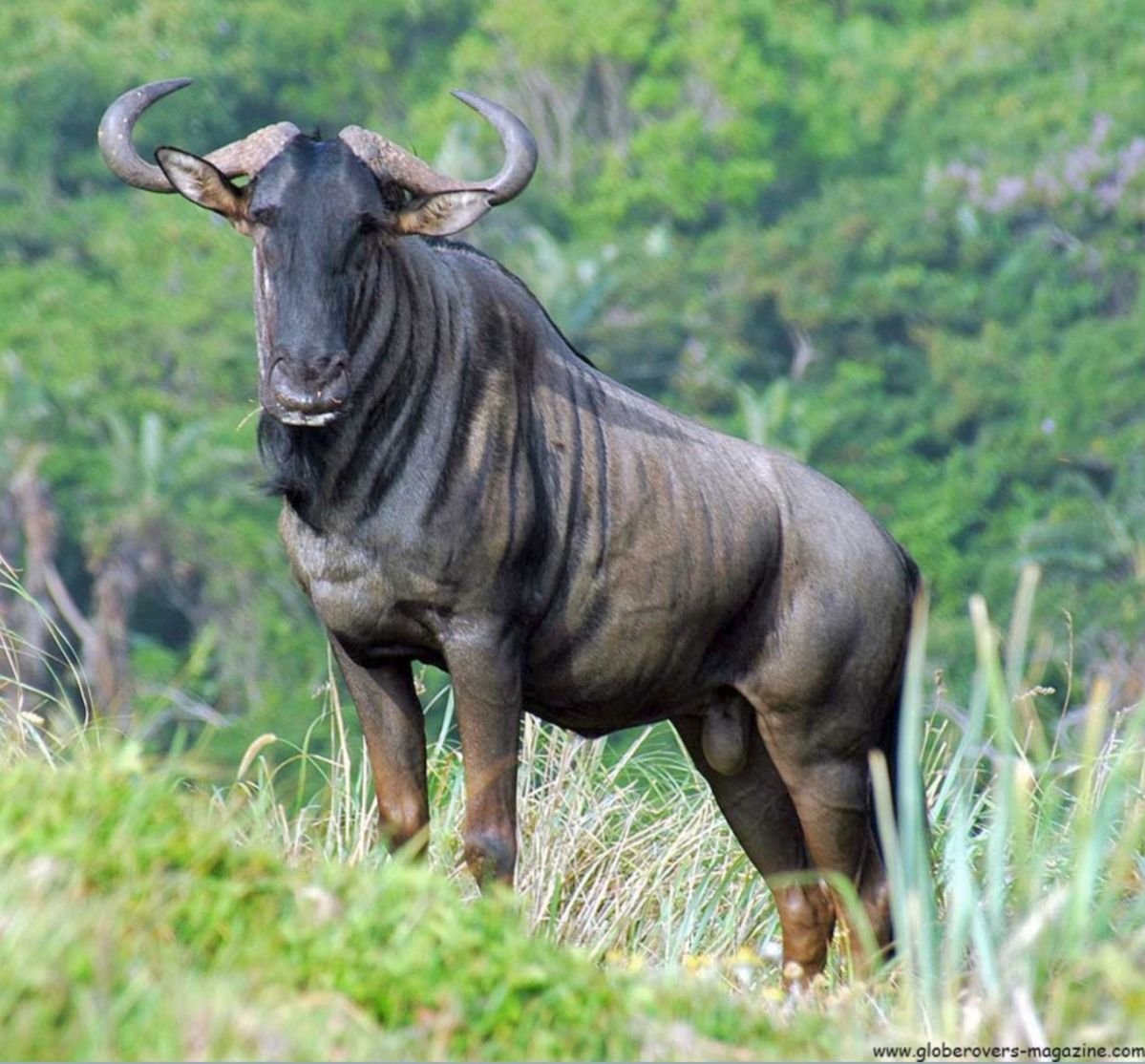
Blue Wildebeest
Connochaetes taurinusThe great migrator of the Serengeti–Mara.
Sightings are never guaranteed and depend on local conditions. Follow your guide and respect park rules.
Powerful, social and perfectly adapted to life on Africa’s open plains, the Blue Wildebeest is one of the defining animals of the Great Migration. Driven by rainfall, fresh grass and seasonal conditions, enormous herds move across Tanzania and Kenya in one of the most spectacular wildlife events on Earth. From the synchronized birth of hundreds of thousands of calves to dangerous river crossings and predator-packed plains, the wildebeest migration is a living demonstration of survival at extraordinary scale.
Blue Wildebeest Quick Facts
What Is the Blue Wildebeest?
The Blue Wildebeest (Connochaetes taurinus) is a large African antelope with an unusual, almost bovine appearance: a cow-like head, heavy shoulders, sloping back, long muzzle, curved horns, dark mane and dark beard. The name comes from Afrikaans/Dutch usage associated with its wild, cattle-like look. It is famous for its powerful build and the spectacular seasonal movement of enormous herds across Tanzania and Kenya. The species occurs broadly across eastern and southern Africa — from Kenya southward through parts of Namibia and South Africa — so it should not be described as limited to Tanzania and Kenya alone.
Coat & the “Blue” Name
Despite the name, the animal is not bright blue. Its coat is generally slate-gray, blue-gray or brownish-gray, with darker vertical stripes, a dark mane and a dark beard (Animal Diversity Web describes it as slate gray with tan forelegs and dark vertical shoulder/back stripes). The bluish tone is most noticeable under certain lighting. Adult males are generally darker than females. Males are also typically larger, heavier and more muscular, and more likely to hold a territory.
Size & Horns
Animal Diversity Web gives a broad adult mass of approximately 118–270 kg, with males generally larger and darker than females — so present the range rather than a single fixed weight. Body length is approximately 1.7–2.4 m, depending on individual and measurement method. Both sexes have horns: curved, thick at the base and strong, used in defense and competition. Males generally have heavier horns. Male competition can involve horn-locking, pushing, head movements, chasing, displaying and territorial challenges, while territorial males use physical displays and direct competition to maintain access to females during breeding periods.
Range & Habitat
Blue Wildebeest occur broadly across eastern and southern Africa, including Kenya, Tanzania, Zambia, Zimbabwe, Botswana, Namibia, South Africa and parts of Angola. The species is traditionally divided into geographic forms (notably western/eastern white-bearded, Cookson’s and Nyassa wildebeest), but this page focuses on Connochaetes taurinus rather than making subspecies taxonomy the main theme. Habitat is primarily savanna, grassland, open woodland and floodplains — not “savannah only” — with a strong preference for acacia savannas and plains carrying rapidly regrowing grasses and moderate soil moisture.
The Great Wildebeest Migration
The Great Migration is one of Earth’s great wildlife events and is best understood as an almost continuous rain + grass + water + reproduction + predator-driven movement across the broader Serengeti–Mara ecosystem rather than “wildebeest walking from Tanzania to Kenya.” The animals move through a roughly 1,000-km circular route (UNESCO) across Tanzania and Kenya, not a single straight line. The broader Serengeti–Mara ecosystem holds approximately 2 million wildebeest in total — alongside hundreds of thousands of zebra and gazelles (UNESCO) — while more recent TANAPA materials place the migratory segment at roughly 1.35–1.5 million. That gap is the point: population figures must always be tied to a specific scope (total ecosystem vs. migratory herd) and source/year, never flattened into a single “official number.”
Rain Drives the Migration
Rainfall changes soil moisture → grass growth → nutritional quality → herd movement. Wildebeest are specialized grazers that prefer short, fresh, rapidly growing grasses. The species can move considerable distances when forage and water conditions change, so its ecology is not simply “find water every day.” Water is very important and strongly influences movement, but the herd’s movement is also driven by rainfall, grass growth, nutrient availability and water distribution.
Calving & Calves
Peak calving generally occurs during the short-rains/green-season period around February–March on the southern Serengeti plains, depending on rainfall (TANAPA describes the main calving period as approximately mid-February, with more than 250,000 calves born in a concentrated window). Avoid writing “every calf is born on February 15” — timing varies with conditions. When huge numbers of calves are born close together, predators cannot target every calf and individual calves benefit from the protection of the crowd: this is predator swamping. A newborn calf can stand and begin following its mother within minutes of birth (ADW reports about six minutes; TANAPA gives roughly 3–7 minutes) — essential because the herd keeps moving and a slow calf is vulnerable to lions, hyenas, cheetahs and wild dogs. A mother identifies her own calf largely through scent, even after large herd movements separate them. Young gradually become more independent during their first year, with peer groups becoming increasingly important around eight months, while nursing and maternal association continue through early life. Gestation lasts approximately 7–9 months (averaging around eight).
The Rut, Sounds & Scent
Blue Wildebeest generally reproduce seasonally; the rut is strongly associated with favorable conditions after rainfall and abundant fresh grass, with a concentrated breeding period lasting roughly three weeks. During the rut, males become more aggressive, territorial, vocal and focused on females. A wildebeest is far from silent: it produces bellows, grunts, snorts, hums and calls, and a male’s bellow may travel up to about 2 km (ADW). They also use chemical cues — preorbital glands, pedal glands, urine and feces — and pedal-gland scent may help herds follow one another during migration, a more sophisticated communication story than “they communicate through sounds.”
Diet & Ecosystem Role
Blue Wildebeest are grazers: their principal food is grass, fresh shoots and other short-growing vegetation, with a marked preference for short, fresh, rapidly growing grass (more digestible and nutrient-rich than old, coarse vegetation). They are not browsers. Beyond consuming grass, they return nutrients through dung and urine and through movement. TANAPA estimates the migration deposits approximately 3,500 tons of dung per day, supporting vegetation and numerous dung-beetle species — a chain from wildebeest → dung → dung beetles → nutrient recycling → soil productivity. Within the Serengeti ecosystem, the migration has an outsized influence on grassland productivity, nutrient cycling and the distribution of other herbivores, so TANAPA describes the wildebeest as a keystone species of that migration system — phrased carefully, rather than claiming the species is universally a keystone in every part of its range.
Predators & River Crossings
Blue Wildebeest are one of Africa’s most important prey species. Major predators include lions, cheetahs, spotted hyenas and African wild dogs (ADW identifies these as major predators). During seasonal movements some herds encounter rivers — most famously the Mara River — where crossings can produce spectacular and dangerous scenes involving strong currents, steep banks, crowding, crocodiles, panic and separation. But do not write “every year thousands die at the Mara River”: the death toll varies widely and is difficult to measure precisely, and a traveler can be present during migration yet still not witness a crossing. Crossings depend on rainfall, river level, herd location, herd decision-making, temperature and timing. Large Nile crocodiles can prey on crossing animals, but animals can also die from drowning, crushing, injury, panic or separation from the herd.
Social Structure
Wildebeest social organization is more complicated than a single “leader.” Herds can form and dissolve; territorial bulls establish and defend areas during breeding periods; females and calves form major social units; bachelor males form separate groups; and migratory aggregations can contain enormous numbers. Animal Diversity Web describes the species as gregarious and territorial, with different herd structures depending on whether animals are mobile or sedentary. Mothers stay closely associated with calves, while the herd’s large numbers and collective vigilance can reduce individual predation risk — but this should not be written as a permanent family-defense system. Crucially, not every Blue Wildebeest migrates 1,000 km: the world-famous long-distance migration is especially associated with the Serengeti–Mara population, while other populations can be more sedentary or make shorter seasonal movements.
Serengeti–Mara Ecosystem
The broader ecosystem (TANAPA describes it as roughly 30,000 km²) includes Tanzania’s Serengeti National Park, Ngorongoro Conservation Area, Maswa, Grumeti and Ikorongo, and Kenya’s Maasai Mara. Note: Maasai Mara is in Kenya, forming the northern portion of the broader Serengeti–Mara ecosystem (UNESCO describes it as contiguous with Serengeti and part of the annual migration). The Serengeti is the principal safari destination for the species; UNESCO calls its migration one of the world’s most impressive natural events. The southern/eastern portions of the broader migration are closely linked to the Ngorongoro landscape, but the Ngorongoro Crater itself is not the core of the Great Migration in the way the Serengeti plains are — wildebeest occur within the broader Ngorongoro–Serengeti ecosystem, but the famous mass migration is centered on the wider Serengeti plains.
Best Time & Safari Experience
Unlike a forest specialist, the Blue Wildebeest is a classic game-drive species, and hot-air balloon safaris (where available) can reveal enormous herd patterns. “June–October” alone is too simplistic; the migration is rainfall-driven, not calendar-driven: January–March (southern Serengeti calving), April–May (movement toward greener areas), June–October (dry-season concentrations and, later, possible Mara-region river crossings), and November–December (herds move back south as rains return). Sightings of large herds are highly likely in suitable areas and seasons, but a particular migration event or river crossing is never guaranteed. Photography excels with wide landscapes (scale), telephoto compression (density), low-angle herd movement (power) and mother-calf frames.
Where to See Blue Wildebeest in Tanzania
The Serengeti–Mara ecosystem holds the world’s largest wildebeest population, and the migratory herd follows a predictable annual cycle through four core Tanzanian viewing areas:
Southern Serengeti & Ndutu
Calving season (roughly December–March). Hundreds of thousands of females drop calves on the short-grass plains, drawing intense predator activity — the most concentrated wildlife spectacle of the year.
Central Serengeti (Seronera)
Year-round wildlife. Resident herds and territorial bulls mean wildebeest are present even outside migration peaks, with reliable big-cat sightings along the Seronera Valley.
Western Corridor (Grumeti)
Seasonal movement (roughly May–July). Herds funnel west and cross the Grumeti River — a dramatic, smaller-scale precursor to the famous northern crossings.
Northern Serengeti (Mara River)
Later migration phases (roughly July–October). Herds reach the north for the iconic Mara River crossings; the river straddles the Tanzania–Kenya border, with Kenya’s Maasai Mara on the far side.
No single date is guaranteed: river crossings depend on rainfall and forage, so plan around the season rather than a fixed calendar.
Comparisons
Blue Wildebeest vs African Buffalo
| Feature | Blue Wildebeest | African Buffalo |
|---|---|---|
| Weight | ~118–270 kg | Much heavier |
| Feeding | Grazing | Grazing/browsing |
| Migration | Major (Serengeti population) | Not comparable |
| Horns | Curved | Heavy bossed horns |
| Body | Sloping, lighter | Massive, barrel-chested |
Blue Wildebeest vs Plains Zebra
| Feature | Blue Wildebeest | Plains Zebra |
|---|---|---|
| Feeding | Grazing | Grazing |
| Migration | Major role | Major role |
| Appearance | Gray/brown + dark mane | Black-and-white stripes |
| Social | Herds + territorial bulls | Herds/harems + stallions |
| Serengeti role | Core migration species | Core migration species |
The Great Migration is a multi-species movement — UNESCO explicitly describes wildebeest, zebra and gazelles as central to it. For lighter comparisons: vs Beisa Oryx (~118–270 kg vs a smaller dryland antelope; grazer vs grazer+browser) and vs Blue Duiker (~118–270 kg vs ~4–6 kg — both bovids, radically different niches).
Did You Know?
Great migrator
Part of a ~1,000-km circular migration.
Millions
UNESCO ~2M wildebeest in the Serengeti ecosystem.
Calving boom
>250,000 calves in a concentrated window.
Minutes to stand
Calf stands within minutes of birth.
Scent ID
Mothers recognize calves by scent.
Grazer
Prefers short, fresh, fast-growing grass.
Dung engine
~3,500 tons of dung per day on migration.
Bellow 2 km
A male’s call can carry about 2 km.
Territorial bulls
Males defend areas in the rut.
Bachelor groups
Non-territorial males form separate groups.
Not all migrate
Some populations are more sedentary.
Maasai Mara = Kenya
The northern end of the migration is in Kenya.
On the southern Serengeti plains, a quarter-million calves hit the ground in a matter of weeks — a thunder of hooves and new life that turns the savanna into the stage for one of the planet’s greatest survival stories.
Gallery
Frequently Asked Questions
Connochaetes taurinus.
Not bright blue. Its coat is generally slate-gray or blue-gray, with darker markings.
Approximately 118–270 kg, with males generally larger and heavier.
Primarily fresh grasses and other short-growing vegetation.
Primarily a grazer.
They occur across eastern and southern Africa, including Tanzania, Kenya and parts of southern Africa.
Yes. Tanzania contains the globally famous Serengeti population and forms the core of the Serengeti–Mara migration ecosystem.
It is the large-scale annual movement of wildebeest, zebra and gazelles through the Serengeti–Mara ecosystem in Tanzania and Kenya, driven primarily by changing rainfall, forage and water conditions.
The exact figure varies by source and year. UNESCO describes approximately 2 million wildebeest in the Serengeti ecosystem, while recent TANAPA material describes about 1.35 million western white-bearded wildebeest in the migration.
Peak calving generally occurs around February–March on the southern Serengeti plains, with timing influenced by rainfall.
A calf can stand and begin moving within minutes of birth.
Approximately 7–9 months, averaging around eight months.
Yes. They are highly social and can form large herds, with different social structures depending on season, breeding and mobility.
No. The spectacular long-distance migration is especially associated with the Serengeti–Mara population. Other populations can be more sedentary or make shorter seasonal movements.
Water is important, but movement is also heavily driven by rainfall and grass availability.
Lions, cheetahs, spotted hyenas and African wild dogs are major predators. Crocodiles can also prey on animals during river crossings.
No. The species is currently classified as Least Concern.
Animal Diversity Web reports an average wild lifespan of about 20 years, with some individuals surviving longer in captivity.
The strongest experience is the Serengeti ecosystem, particularly the migration route and the southern Serengeti during calving season.
Wildebeest occur within the broader Ngorongoro–Serengeti ecosystem, but the famous mass migration experience is centered on the wider Serengeti plains rather than the Ngorongoro Crater itself.
No. Maasai Mara is in Kenya and forms the northern part of the broader Serengeti–Mara ecosystem.
References & Further Reading
- UNESCO (Serengeti): Supports approximately 2 million wildebeest alongside hundreds of thousands of zebra and gazelles; describes a roughly 1,000-km circular annual migration across Tanzania and Kenya; Maasai Mara as the northern part of the broader Serengeti-Mara migration ecosystem; migration among the world’s most impressive natural events.
- TANAPA (current migration materials): ~1.35–1.5 million wildebeest leading the migration; calving around mid-February with >250,000 calves; calf mobility ~3–7 minutes; ecosystem ~30,000 km²; ~3,500 tons of dung deposited per day; keystone role within the Serengeti migration system.
- Animal Diversity Web (ADW): Connochaetes taurinus; mass ~118–270 kg; grazer preferring fresh regrowing grasses; gregarious and territorial; calf stands ~6 minutes; mother-calf recognition via scent; gestation 7–9 months; male bellow travels ~2 km; pedal-gland scent in migration; sedentary/mobile populations; average wild lifespan ~20 years.
- About these facts: Population and migration figures vary by source and year; conservation status should be checked against the current IUCN assessment.